


 by Tom Gurney
Tom Gurney BSc (Hons) is an art history expert with over 20 years experience
Published on June 19, 2020 / Updated on October 14, 2023
Email: tomgurney1@gmail.com / Phone: +44 7429 011000
Moll Hackabout Arrives at the Bell Inn: Introduction
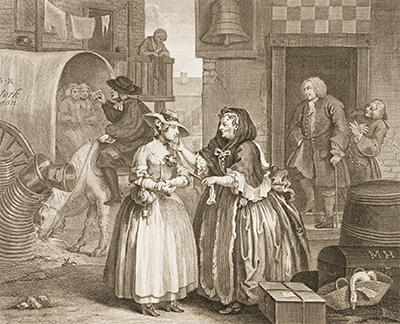
Moll Hackabout has scarcely arrived in London when a richly dressed woman reaches for her chin. Behind Moll is the covered York wagon, with passengers still inside. Behind the woman, a man watches from the inn doorway. William Hogarth gives the greeting the centre of the first plate of A Harlot’s Progress, an etching and engraving from the series issued in 1732. Two impressions at the Metropolitan Museum of Art document changes to the print. The museum dates first-state 32.35(2) to before April 1732 and catalogues fourth-state 91.1.128 under April 1732. Both show how a public place for meeting travellers gives the woman an opportunity to approach one. [1] [2]
At a Glance
- Artist and mediumWilliam Hogarth, etching and engraving
- Series issue1732, Plate 1 of six
- First-state impressionBefore April 1732, The Metropolitan Museum of Art, 32.35(2)
- Second-state impressionWellcome Collection, 38224i, with a cross below the design
- Fourth-state impressionThe Metropolitan Museum of Art, 91.1.128, catalogued under April 1732
This work across William Hogarth’s career
Assembly at Wanstead House
1728–31The Heir
1734The Marriage Settlement
about 1743Gin Lane
1751Canvassing for Votes
1754–55Contents
- What Moll brings to London
- A carrier’s yard near Cheapside
- The figures at the door
- What changes between impressions
- From the yard to the apartment
What Moll brings to London
The two women stand close enough for their sleeves to meet. Moll wears a broad hat and a light apron, her hands gathered at her waist. The older woman’s dark hood frames a face marked with patches, while ribbons and patterned folds give her dress a conspicuous finish. She extends one hand beneath Moll’s face and holds the other out lower down. From across the yard, the gesture might pass for the familiarity of a welcome. At the distance from which Hogarth lets us see it, the woman appears to be inspecting what she finds. Her advance takes place piecemeal, through the angle of her head, the reach of her arm and the space she occupies in front of Moll. [1] [2]
A small pair of scissors and what Southwark Heritage identifies as a pincushion hang at Moll’s side. They are easy to miss against the pleats of her apron. Southwark reads the implements as a clue that Moll hoped to earn a living as a seamstress. They make that prospect plausible, though a pair of scissors can suggest a skill without telling us how she meant to use it. What Moll might do with her hands is a quiet part of the picture. The procurer’s hand, raised where it catches the eye, makes it clear how much more quickly someone else can act on her arrival. [1] [3]
At the lower right, the initials M.H. are large enough to pick out on a curved trunk. Beside it, a goose’s neck hangs over a basket, with a slip of paper tied to the bird. The Colonial Williamsburg Foundation reads the tag on its impression as an address to a cousin in London. The basket suggests that Moll has someone in mind to visit, and that she has brought something to give them. An expected meeting at the inn is possible. The picture leaves the arrangement open. Hogarth supplies an address on a gift and puts a stranger within reach of the giver. The viewer can follow the connection written on the label while seeing the very different connection taking shape above it. [1] [2] [4]
A carrier’s yard near Cheapside
The bell sign gives the setting its familiar name. Below it are the practical features of a place where people and goods come off the road. A tied box sits on the ground. The wagon’s cover protects the passengers within, while its wheel and two large stacks of nested vessels take up much of the space at the left. A man rests his arms on the gallery rail above the wagon. Laundry hangs farther back. Passengers, baggage and people already at home in the yard occupy different levels of the picture, and a glimpse between the buildings gives the yard a position in a much larger city. [1] [2]
The Wood Street Bell near Cheapside was a real carrier’s inn. Transport historian Dorian Gerhold found a weekly service run by John Whitmash from Taunton to the Bell by 1690, reaching London on Fridays and leaving on Saturdays. The same service is recorded in 1724, when Whitmash left his son three travelling wagons in his will. The capital’s inns were places for a carrier to deliver and take in goods as well as places where a traveller could get down. [5]
A later study in Notes and Queries, tabulating information from the Company of Parish Clerks’ London survey of 1732, points to a complication. The survey’s entries for York carriers led the author to the Bear in Basinghall Street and the Red Lyon in Aldersgate. The bell and the lettering on the wagon make a persuasive London setting. Together they tell us where Hogarth wanted the encounter to take place and where the wagon came from within his story. A period directory gives us a separate account of where passengers could have arranged to meet someone in the city. [1] [2] [6]
Watch Hogarth’s paintings and prints
Five films on Hogarth’s painted stories, prints, drawing methods and work for the Foundling Hospital.
In 60 seconds: Hogarth's 'Gin Lane' & 'Beer Street'
A short introduction to the contrasting streets, the shops and the people in Hogarth’s paired prints.
Watch on YouTubeThe yard is busy enough to give the older woman cover. People from the wagon can see towards the centre of the scene, but their position inside the canopy keeps them apart from the greeting. Closer to Moll, a mounted clergyman raises a piece of paper to his eyes. His horse lowers its head beside the tilting stack of vessels. Hogarth sets the rider’s concentration on a small object against his apparent obliviousness to the action around him. The later commentator Georg Christoph Lichtenberg made the clergyman Moll’s father and treated the journey as one they had made together. That reading makes his distraction especially painful. The picture itself gives him clerical dress, a letter and an opportunity to notice the encounter. [1] [2] [7]
The figures at the door
The Met identifies the woman as Mother Needham and the man at the threshold as Colonel Charteris. Colonial Williamsburg gives their full names as Elizabeth Needham and Francis Charteris. An eighteenth-century source for those readings is John Nichols’s catalogue of Hogarth’s prints. Nichols names Needham and calls the man a portrait of Charteris, drawing on André Rouquet’s earlier description of the figure as a wealthy officer of notorious reputation. Nichols also calls the second man John Gourlay, an identification repeated by Southwark Heritage. In the print the companion stands a little behind the man at the threshold, with his hands raised together near his chest. His position makes him part of the watching group. His name depends on the account passed down with the print. [2] [3] [4] [8]
Nichols reproduces reports from the Grub-Street Journal about Needham’s conviction for keeping a disorderly house in Park Place, St James’s, and her punishment in the pillory in 1731. The evidence for Charteris comes from a different source. A Dublin account of his trial held by Wellcome Collection names Anne Bond and records that he was found guilty of raping her at the Old Bailey in 1730. Those reports help explain the menace the two names could carry for someone reading the print when it was new. Anne Bond belongs to the history of the prosecution. Hogarth constructed the greeting at the inn for his fictional protagonist. The woman’s intrusion into her personal space and the man’s attention from the doorway make the imbalance of power legible even to a viewer encountering the names for the first time. [1] [2] [8] [9]
What changes between impressions
Princeton University Library lists the 1732 etchings and engravings as a set of six. The number on the opening print gives it a place within that story. A state number describes the condition of the printing plate from which a sheet was pulled. In both Met impressions, the series title and stage number sit at the lower left and Hogarth’s abbreviated credit at the lower right. The small cross between them appears on 91.1.128, the fourth-state sheet, while the same space on first-state 32.35(2) is blank. The cross is already documented on Wellcome Collection’s impression 38224i, classified as state II under entry 121 in the third edition of Ronald Paulson’s catalogue. It distinguishes the two Met sheets when put side by side. On its own it can occur in more than one state. [1] [2] [10] [11]
Look up from the margin of the fourth-state sheet and there is another change. A patterned wedge of shade cuts across the wall below the bell and the foreground has more emphatic bands of shadow. One of the older woman’s shoes is visible below her hem. Nichols’s early account of variations includes changes to the shadow, the foreground and the woman’s foot. These small alterations can be seen without losing sight of what the impressions share. Moll still stands exposed in the yard while the watchers stand within the frame of the doorway. [1] [2] [8]
The Met lists April 1732 for the fourth-state sheet, the month associated with the original issue. Michael Printy captions a fourth-state example with a separate approximate date of 1744 for the revised form, and the University of San Diego catalogues its own fourth-state impression under 1798, using entry 121 of Paulson’s 1989 edition. The revision and subsequent printing of a plate can therefore each have a date of their own. The month attached to the original issue leaves the printing date of the Met’s later-state sheet uncertain. [2] [10] [12] [13]
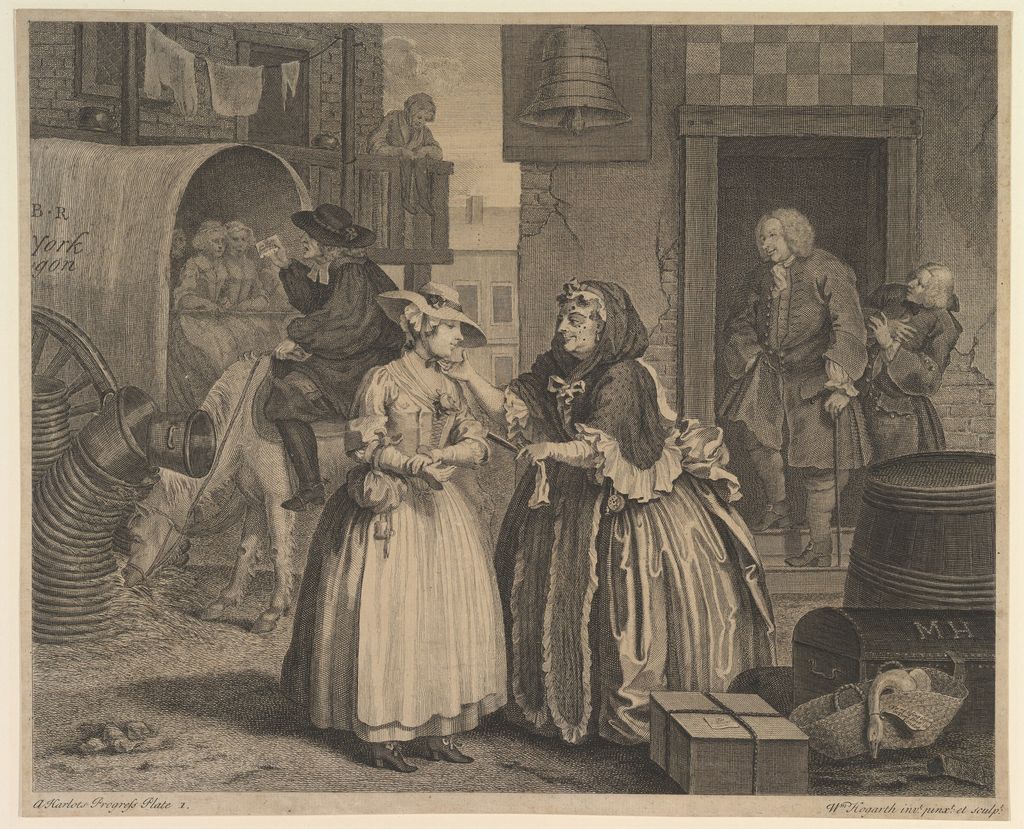
A Harlot's Progress, Plate 1, William Hogarth, before April 1732. Etching and engraving; first state of four. 32.35(2). Harris Brisbane Dick Fund, 1932. Image source. CC0 / Public domain.
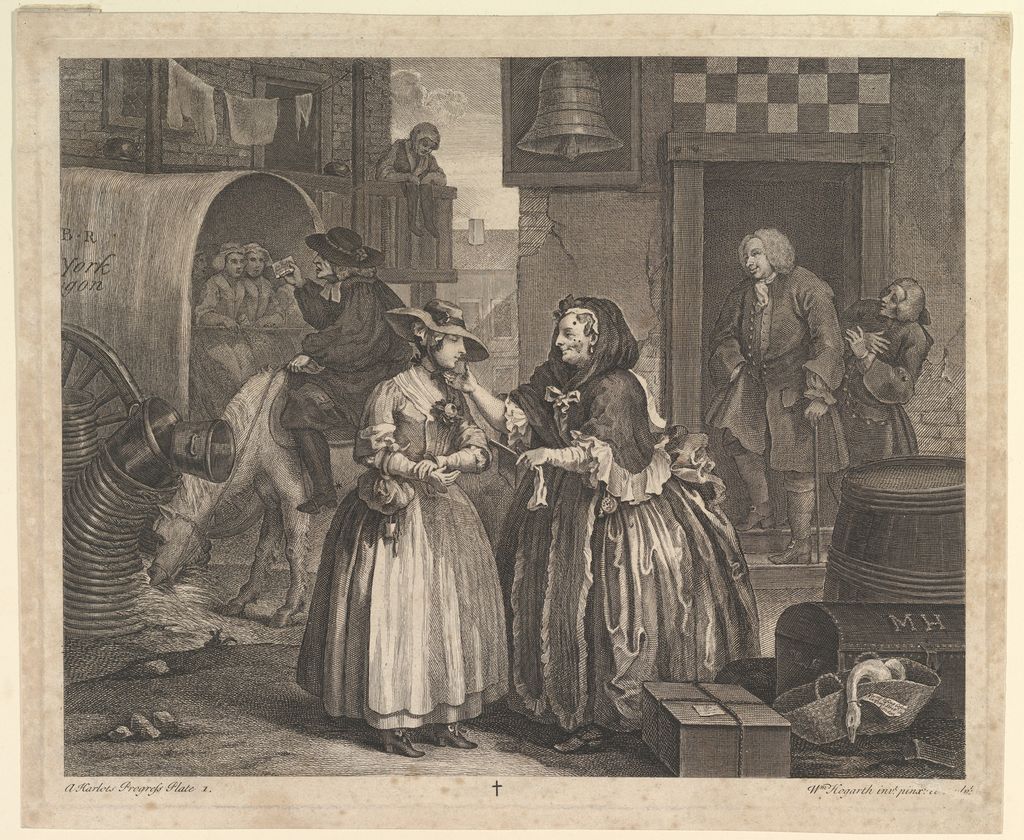
A Harlot's Progress, Plate 1, William Hogarth, April 1732. Etching and engraving; fourth state of four. 91.1.128. Gift of Sarah Lazarus, 1891. Image source. CC0 / Public domain.
From the yard to the apartment
In the next stage, A Harlot’s Progress, Plate 2, Moll is already a wealthy man’s mistress. Hogarth leaves the conversation at the inn and the arrangement that brought Moll into the apartment to the viewer’s imagination. Plate 2 supplies a new doorway, this time at the left. At the inn, the man watching from a threshold has an advantage over the newly arrived woman. In the apartment, Moll creates a commotion with a falling tea table as a man slips away through the door. Having used the first threshold to show what others could see of Moll, Hogarth uses the second to show what she can keep from someone else’s view. The gap between these encounters is the first of the changes the six prints ask the reader to reconstruct across A Harlot’s Progress. [2] [10] [14]
Browse Hogarth’s artworks
All 54 individual artworks and series stages in the approved English cluster
Frequently Asked Questions
It is plate 1 of 6 in A Harlot’s Progress. The plate number identifies the design across impressions. [1]
Discussion
Look again at the images and ideas explored in Moll Hackabout Arrives at the Bell Inn. These editorial prompts invite your observations.
Reader Insights
How does the letter held by the clergyman affect your reading of the encounter in front of him?
What does the goose’s address tag suggest about the welcome Moll might have expected in London?
Join the Conversation
Share a detail, comparison or question about Moll Hackabout Arrives at the Bell Inn below.
References
- The Metropolitan Museum of Art, William Hogarth, A Harlot’s Progress, Plate 1, first state, 32.35(2). View source.
- The Metropolitan Museum of Art, William Hogarth, A Harlot’s Progress, Plate 1, fourth state, 91.1.128. View source.
- Southwark Heritage, William Hogarth, The Harlot’s Progress 1, PT1090. View source.
- Colonial Williamsburg Foundation, William Hogarth, A Harlot’s Progress: Plate 1, James Heath edition, 1972-409,3. View source.
- Dorian Gerhold, The Whitmash Family, Carriers and Coachmasters of Taunton and Yeovil, 1685–1848, Somerset Archaeology and Natural History, 1999, pp. 117–118 and nn. 3–5. View source.
- Notes and Queries, London Coaching and Carriers’ Inns in 1732, series 12, vol. 8, 22 January 1921, p. 61, with entries drawn from the Company of Parish Clerks’ New Remarks of London (1732). View source.
- Georg Christoph Lichtenberg, Ausführliche Erklärung der Hogarthischen Kupferstiche, “The Harlot’s Progress. Der Weg der Buhlerin,” first plate (in German). View source.
- John Nichols, Biographical Anecdotes of William Hogarth, 3rd ed., London, 1785, catalogue entry for The Harlot’s Progress, Plate I. View source.
- Wellcome Collection, The Tryal of Colonel Francis Charteris, for a rape committed on the body of Anne Bond, Dublin reprint, Sylvanus Pepyat, 1730. View source.
- Princeton University Library, Sin & the City: Full Exhibition Checklist, A Harlot’s Progress, Paulson 121–126. View source.
- Wellcome Collection, William Hogarth, A Harlot’s Progress, Plate 1, 38224i, Paulson 121, state II, 3rd ed., 1989. View source.
- Michael Printy, “Social Physics: Observation and the Science of Man in Lichtenberg’s Hogarth Commentaries,” in Hogarth’s Legacy as a Printmaker, 2016, fig. 88. View source.
- University of San Diego University Galleries, William Hogarth, A Harlot’s Progress, Plate 1, PC2017.01.108, Paulson 121, state IV of IV, 1989 edition. View source.
- The Metropolitan Museum of Art, William Hogarth, A Harlot’s Progress, Plate 2, fourth state, 91.1.129. View source.







