


 by Tom Gurney
Tom Gurney BSc (Hons) is an art history expert with over 20 years experience
Published on June 19, 2020 / Updated on October 14, 2023
Email: tomgurney1@gmail.com / Phone: +44 7429 011000
The Inspection: Introduction
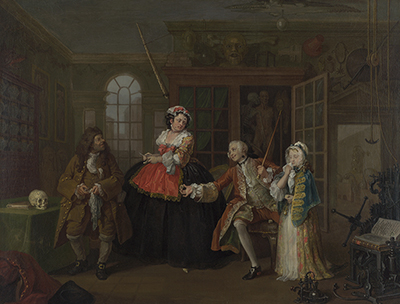
In William Hogarth’s The Inspection, Viscount Squanderfield holds out an open pillbox to a man who is occupied with his spectacles. The viscount raises his cane as if to press his complaint. Between his knees stands a young girl with a pillbox of her own and a cloth held to her mouth. Hogarth sets the action in a consulting room, where a customer appears to be disputing the effect of a remedy. Painted about 1743, the oil on canvas measures 69.9 × 90.8 centimetres and belongs to the National Gallery, London (NG115). It is the third of six scenes in Marriage A-la-Mode. [1] [2]
At a Glance
- Artist and dateWilliam Hogarth, about 1743
- Medium and dimensionsOil on canvas, 69.9 × 90.8 cm
- CollectionThe National Gallery, London, NG115
- Related printBernard Baron after William Hogarth, etching and engraving, second state of three, The Metropolitan Museum of Art, 91.1.109
- Plate date and issueInscribed 1 April 1745, available to subscribers in early June 1745
This work across William Hogarth’s career
Assembly at Wanstead House
1728–31The Heir
1734The Marriage Settlement
about 1743The Inspection (current article)
About 1743Gin Lane
1751Canvassing for Votes
1754–55Contents
- What the three pillboxes suggest
- What a patient could buy
- A consulting room full of claims
- From the painted room to Plate III
- The consultation in the sequence
What the three pillboxes suggest
The viscount sits sideways, with one leg extended and his body angled towards the practitioner. His outstretched hand brings the pills close to the man, whose hands are busy wiping his spectacles. Even in complaint the viscount depends on the other man’s attention, and the cane he raises can look as much like an appeal as a threat. The girl has been given little room of her own. Her position in front of the chair links her to the viscount, and the cloth she puts to her mouth gives her a small, inward gesture amid the adults’ larger movements. [1] [2]
The box he offers the practitioner is one of three. A second box rests near his groin, and the girl holds the third. Judy Egerton reads their placement as a chain of implication, from the seat of the viscount’s trouble to his demand for treatment and then to the girl’s possible infection. The dark mark on his neck has followed him from the earlier scenes. In the consulting room its colour echoes the dark pills, lending weight to the National Gallery’s reading of the mark as a sign of syphilis within the story. The arrangement invites suspicion about the viscount’s role, while the girl’s gesture and box leave her condition and the source of any infection uncertain. [1] [2]
The woman standing behind the viscount’s extended hand holds a blade that could be a surgeon’s bloodletting knife. Her turn towards him gives the little group the appearance of a confrontation. Egerton also draws attention to a quieter clue in the clothes. The woman’s sleeves and the girl’s skirt are made from what looks like the same gold brocade. The girl’s clothes are long for her, so the repeated material could suggest that an old gown has been cut down or shared. This gives the suggestion that the woman is her mother some visual basis. The further possibility that she arranged the encounter is an interpretation of her role. [1] [2]
Egerton reads the practitioner’s profile and bowed legs as possible signs of congenital syphilis and interprets the dark pits in the skull beside him as signs of disease. The skull sits beside the practitioner like a specimen brought out for a lesson. Here it gives the people waiting for his response a grim example of what may be at stake. Egerton’s reading makes his own health part of the question of whether he can help them. [1] [2]
What a patient could buy
Mercury was commonly used to treat venereal disease in Hogarth’s time, in pills and other preparations. A London dissertation by surgeon George Key, published in a second edition in 1747, compared mercurial treatments by salivation, rubbing in ointment and purging. Key’s title specifically promotes a way of using the ointment that promised to avoid the effects of salivation. The Royal Pharmaceutical Society Museum has a tin-glazed earthenware jar dated about 1700–30 that bears a label for elecampane and mercury ointment. The book and jar document a real trade in preparations and a debate about their administration. In the painting the colour of the pills makes a mercurial remedy plausible, though the preparation in the boxes is unknown. Szu Shen Wong and colleagues suggest that the girl could be wiping away saliva, an effect associated with mercury treatment, or dabbing a sore. The single gesture can sustain either reading. [2] [3] [4]
A consulting room full of claims
On the left, labelled jars and drawers give the room the look of an apothecary’s shop. A doorway on the right offers a glimpse of what Egerton identifies as a distilling room. The shaving bowl and urine flask among the objects above the cabinet suggest more occupations, from shaving and minor surgery to examining a patient’s urine. The room supplies grounds for the practitioner’s claims to a wide competence. It also makes them hard to take seriously once the eye reaches the machinery at the right. [1] [2]
Watch Hogarth’s paintings and prints
Five films on Hogarth’s painted stories, prints, drawing methods and work for the Foundling Hospital.
William Hogarth, Marriage A-la-Mode (including Tête à Tête)
A close look at Tête à Tête and how its figures and furnishings advance the story of the marriage.
Watch on YouTubeAn open book explains that one apparatus sets shoulders and the other draws corks. Its French title page credits their invention to Monsieur de la Pillule and claims the approval of the Royal Academy of Sciences in Paris. An engraved portrait faces the title page. The apparatus might first look painful, given its scale and the hardware overhead. Reading the book turns some of that menace into a joke about an inventor who gives cork pulling the same billing as setting a joint. The written name belongs to the fiction, where the well-placed book lets the practitioner advertise himself while a customer questions his remedy. [1] [2]
The cabinet brings together objects that could command serious interest in an eighteenth-century collection. Egerton compares the narwhal tusk and suspended crocodile with specimens owned by Richard Mead, physician to George II. Inside the cabinet Hogarth puts a skeleton beside an écorché, a model showing the muscles and tendons beneath the skin. Both could serve in anatomical teaching. Here the skeleton reaches between the model’s legs and the model seems to react. The group creates a second, silent encounter behind the viscount and the girl. Its near embrace makes mortality part of the joke. [1] [2]
A wig on a stand shares the cabinet with the anatomical figures. Tradition associates its shadowy face with John Misaubin, a London doctor who treated venereal disease and died in 1734. Arthur Pond’s 1739 etching after Watteau, held by Wellcome Collection, supplies a documented caricature of Misaubin with an inscription urging people to take pills. The print connects Misaubin with a joke about pills several years before Hogarth painted the scene. Egerton notes that the painted face differs from known depictions of Misaubin, leaving the suggested allusion uncertain. [2] [5]
From the painted room to Plate III
Hogarth revised the room to make some of its clues easier to read. David Bomford and Ashok Roy found that he had lowered the upright screw at the far right, clearing the last lines on the open book. He covered a retort beneath the left-hand table with the tablecloth, though the researchers could still make out part of it through the paint, and lengthened the woman’s skirt to cover more of her shoe. In the X-ray mosaic her earlier head is faintly visible closer to the viscount. Moving her away gives his arm and the box more space and leaves her watching the exchange from behind his hand. The mostly thin, relatively X-ray-transparent paint over a thick ground limited the contrast in the mosaic. Other alterations could escape that form of examination. [2] [6]
The engraver Bernard Baron made a red chalk copy of the scene on paper. Egerton records it in the Royal Collection and gives its dimensions as 35.7 × 45.8 centimetres. Baron squared the drawing for engraving, using a grid to carry the design across at a new scale. The Metropolitan Museum of Art holds an impression of Baron’s Marriage A-la-Mode, Plate III (91.1.109), an etching and engraving catalogued as the second state of three. The plate, at 39 × 47 centimetres, is just over half the width of the canvas. Reversal puts the book and machines to the left in the print, so an eye entering from that side can meet the practitioner’s claims before it reaches his customer’s complaint. Egerton also finds the letters FC on the woman’s chest clearer in the engraving. She notes that they have been associated with a punishment for prostitution, a reading that leaves the woman’s relation to the girl open. [2] [7]
The Met dates its print April 1745. The lower margin of a separate second-state impression at Colonial Williamsburg credits Baron as engraver and Hogarth as inventor, painter and publisher, and bears the date 1 April 1745. Egerton’s chronology places the prints in subscribers’ hands from early June. The inscribed date and availability of the set therefore describe separate events, and the date on the plate gives no day of printing for an individual sheet. [2] [7] [8]
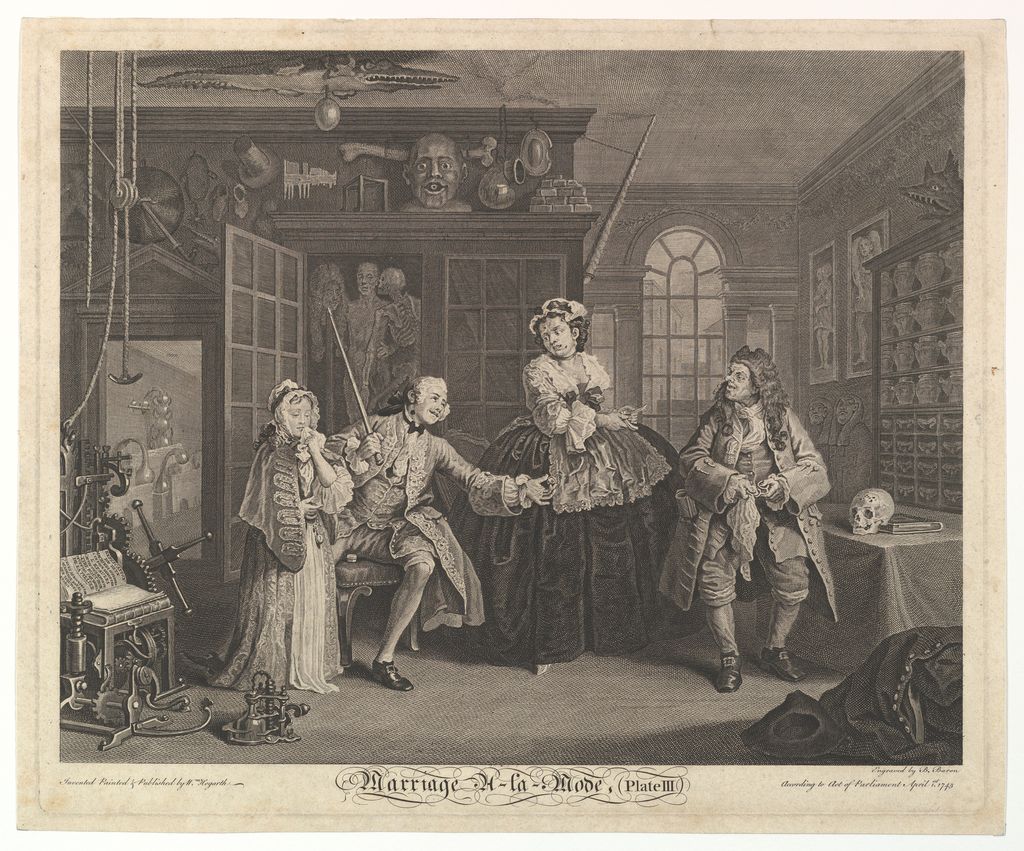
Marriage A-la-Mode, Plate III, Bernard Baron after William Hogarth, dated April 1745. Etching and engraving; second state of three. 91.1.109. Gift of Sarah Lazarus, 1891. Image source. CC0 / Public domain.
The consultation in the sequence
In The Tête à Tête, the viscount slumps in his chair while the steward departs with unpaid bills. At the consultation he leans forward and calls for an answer. The gesture makes his need visible to people outside his own household, while his place in the chair still marks his advantage over the girl. [1] [2]
In The Toilette, the newly titled countess receives visitors while her hair is dressed, and the series resumes its view of rooms where rank can be displayed. Hogarth has interrupted that view with a consultation whose most telling evidence fits in three little boxes. The viscount can insist on being heard, but the boxes on which his complaint rests also draw the eye to the child and to the question of his responsibility for her. [1] [2]
Browse Hogarth’s artworks
All 54 individual artworks and series stages in the approved English cluster
Frequently Asked Questions
It is painting 3 of 6 in Marriage A-la-Mode. The National Gallery catalogues the original canvas under that number in the sequence. [1]
Discussion
Look again at the images and ideas explored in The Inspection. These editorial prompts invite your observations.
Reader Insights
How does the placement of the three pillboxes shape your sense of the viscount’s responsibility for the girl?
How does the skeleton’s gesture towards the anatomical model change the way you read the consultation in front of it?
Join the Conversation
Share a detail, comparison or question about The Inspection below.
References
- National Gallery, London, William Hogarth, Marriage A-la-Mode: 3, The Inspection, about 1743, NG115. View source.
- Judy Egerton, The British Paintings, National Gallery, 2000, Marriage A-la-Mode, NG113–118, pp. 147–149, 151–152 and 163–166 (engraving, chronology, technical notes and scene 3). View source.
- George Key, A Dissertation on the Effects of Mercury on Human Bodies, in the Cure of the Venereal Disease, second edition, London, 1747, title page, Wellcome Collection, ESTC N1876. View source.
- Szu Shen Wong, Thibaut Deviese, Jane Draycott, John Betts and Matthew Johnston, “Syphilis and the use of mercury,” The Pharmaceutical Journal, 297 (7893), 2016, p. 159. View source.
- Wellcome Collection, Arthur Pond after Jean-Antoine Watteau, John Misaubin, coloured soft-ground etching, 1739, 6944i (French lettering). View source.
- David Bomford and Ashok Roy, “Hogarth’s ‘Marriage à la Mode’,” National Gallery Technical Bulletin, vol. 6, 1982, pp. 52 and 55, figs. 11–12. View source.
- Metropolitan Museum of Art, Bernard Baron after William Hogarth, Marriage A-la-Mode, Plate III, April 1745, etching and engraving, second state of three, 91.1.109. View source.
- Colonial Williamsburg Foundation, Bernard Baron after William Hogarth, Marriage a la Mode, Plate III (The Inspection), second state, 1967-567,3, lower-margin inscription. View source.







