


 by Tom Gurney
Tom Gurney BSc (Hons) is an art history expert with over 20 years experience
Published on June 19, 2020 / Updated on October 14, 2023
Email: tomgurney1@gmail.com / Phone: +44 7429 011000
The Marriage: Introduction
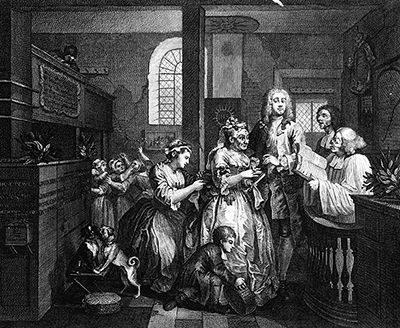
Tom Rakewell holds out a ring to a wealthy bride while Sarah Young, carrying their child, tries to reach him. William Hogarth puts both women in the same church and gives the wedding party a clear view of the altar, while a pew-keeper blocks the group at the back. In The Marriage, the fifth of eight scenes in A Rake’s Progress, the ceremony proceeds within sight of the people who have come to interrupt it. Sir John Soane’s Museum dates its oil on canvas, P44, to 1734. The painting measures 62.2 × 75.2 cm. [1]
At a Glance
- SeriesA Rake’s Progress, scene 5 of 8
- Painting1734, oil on canvas, Sir John Soane’s Museum, P44
- Early designThe Marriage Contract, about 1732, oil sketch, Ashmolean Museum
- First-state printPublished 25 June 1735, etching and engraving, Bibliothèque nationale de France, FRBNF40262628
- Third-state impressionEtching and engraving, The Metropolitan Museum of Art, 91.1.87
This work across William Hogarth’s career
Assembly at Wanstead House
1728–31The Heir
1734The Marriage Settlement
about 1743Gin Lane
1751Canvassing for Votes
1754–55Contents
- The ring and the doorway
- A church for a quiet wedding
- The wedding Hogarth kept
- What the print puts into words
The ring and the doorway
The ring brings two hands together without bringing the couple’s attention to the same point. The bride extends her hand. The clergyman follows the service in an open book, with his curate nearby. Tom’s head is angled away from the bride, and the Soane catalogue reads his look as directed towards her young attendant. The woman is close enough to help with the bride’s clothes. That gives Tom somewhere to look without turning his body away from the ceremony. Hogarth can suggest an immediate lapse of attention even as the groom performs the expected gesture. [1]
At the back, Sarah’s mother confronts the pew-keeper while Sarah holds the baby. The quarrel takes place at a distance from the ring, yet there is a direct connection between the two actions. In the opening scene Sarah’s mother had already pressed Tom to honour his promise of marriage. In The Arrest, immediately before the wedding, Sarah offered her purse when officers stopped him for debt. Now the child she carries makes the consequences of the earlier relationship visible in the very room where he undertakes a new one. Sarah’s mother can raise a protest from the back. The bride and groom have the minister, his book and the space around the altar for their exchange. [1] [2]
The bride’s role is easy to overlook in that confrontation. The sheen of her dress and the jewels on it make her wealth visible before the viewer knows anything about the terms of the marriage. Hogarth places a pair of pugs in the foreground, close to the viewer. The white markings and ribbon of the dog on the stool echo the trim at the bride’s neck, and the other dog rears up towards it. The resemblance makes the animals into a second courtship, at floor level, while the cracked tablet of the Ten Commandments above the wedding turns attention back to what a vow requires. The Soane catalogue connects the crack at the ninth commandment, against bearing false witness, with the sincerity of Tom’s words. [1]
Property helps explain why the bride’s wealth matters to an indebted groom. Under English common law, marriage gave a husband substantial rights over the personal property his wife brought to it. William Blackstone described the transfer of goods and chattels in his Commentaries later in the century. The historian Joanne Bailey shows how separate property arrangements and women’s own handling of household resources made the practice of marriage more varied than the broad rule suggests. Hogarth gives Tom a motive the audience could recognise, while leaving the nature of the bride’s assets and any settlement between them offstage. [1] [3] [4]
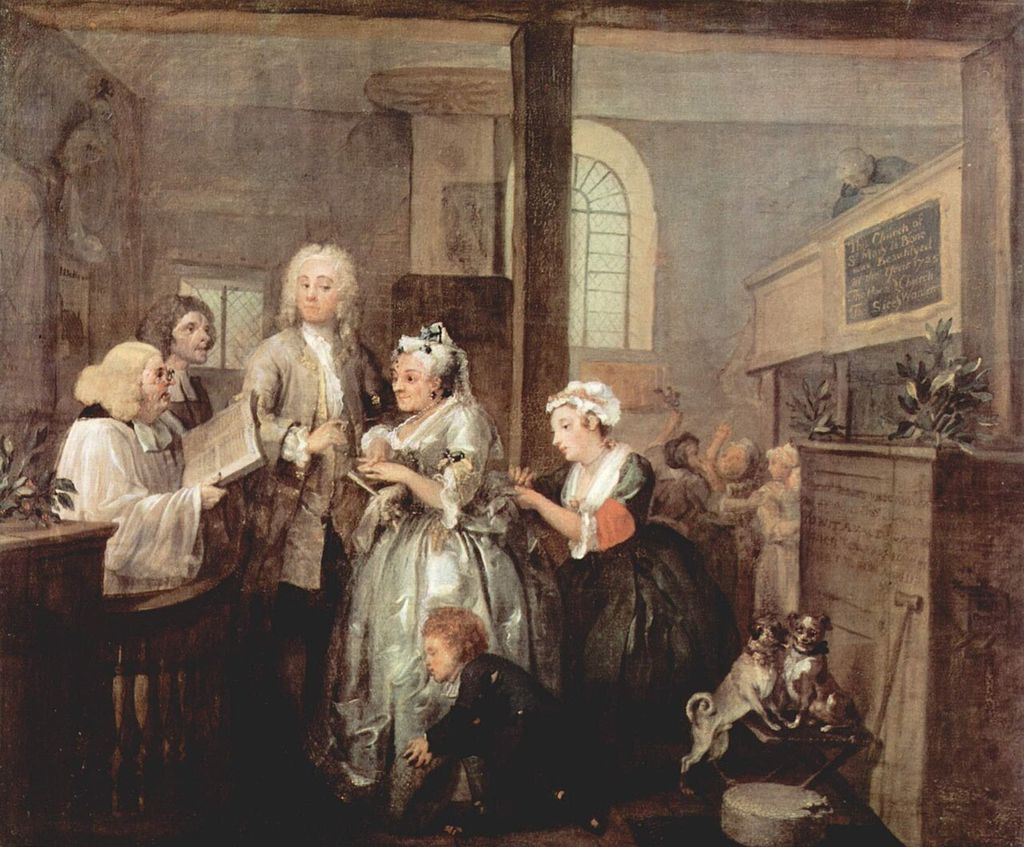
The Marriage, William Hogarth, 1734. Oil on canvas. SM P44. The Yorck Project via Wikimedia Commons. Image source. Public domain.
A church for a quiet wedding
The Soane identifies the setting as the old church of St Mary-le-Bone, then outside built-up London and known for hasty or secret weddings. The parish’s own history dates the replacement on the same site to 1740, after the painting and print. Hogarth makes the place recognisable with an inscription on the gallery claiming the church was beautified in 1725. The Soane identifies the men named in it as actual churchwardens. Over the rest of the room, flaking plaster exposes laths and the pulpit shows staining. The proud notice invites comparison with the surfaces below it. Even for a viewer who knew the church, that juxtaposition works as satire on how its keepers discharge their responsibilities. [1] [5]
A discreet marriage in the early 1730s carried possibilities that would later be narrowed by statute. The 1753 Marriage Act, effective from 25 March 1754, strengthened the requirements for public banns or a licence and specified where marriages could be solemnised under those rules. In a study of the series against earlier matrimonial practices, Anaclara Castro Santana argues that Sarah might be Tom’s first wife. That reading gives her attempted entry a possible legal dimension as well as a moral one. The Soane catalogue reads her as the lover to whom Tom promised marriage. The scene leaves her status open enough for the two readings to give different force to the same action at the door. [1] [6] [7]
Watch Hogarth’s paintings and prints
Five films on Hogarth’s painted stories, prints, drawing methods and work for the Foundling Hospital.
The Sequel: Hogarth’s "A Rake’s Progress" (1734–5)
The Paul Mellon Centre revisits the eight-scene story of Tom Rakewell and its place in Hogarth’s work.
Watch on YouTubeThe wedding Hogarth kept
The Ashmolean Museum holds The Marriage Contract, an oil sketch dated by Judy Egerton to about 1732. Egerton considers it a possible second scene for the series. Around a table, the terms of a marriage between an elderly heiress and the inattentive rake are being discussed. Antique busts on the floor still carry their auction lot numbers. That detail ties the proposed marriage to the way a newly wealthy man acquires things and displays his taste. The sketch gives the people around the table something to negotiate while allowing the intended groom’s attention to drift. [8]
The finished fifth scene places its decisive action at the moment of a vow. The proposed positions in the story give the bargain different stakes. In the sketch it would have followed the inheritance, when acquisitions could still attest to his new wealth. In the church it follows the arrest, when marrying into wealth offers a way to recover what he has spent. The picture also lets Sarah contest the event in person. The resulting drama is about who gets to speak before the service is completed, as much as it is about what a marriage will bring its groom. [1] [2] [8]
What the print puts into words
The Bibliothèque nationale de France catalogues its impression of plate V, FRBNF40262628, as the first state, published by Hogarth in London on 25 June 1735. It records etching and engraving, an impression area of 35.5 × 40.7 cm and a sheet of 39 × 43.8 cm. Princeton University Art Museum’s separate impression, x1988-34, is also catalogued as etching and engraving, dated 1735, with a plate measurement of 35.7 × 41.1 cm on a substantially larger sheet of 49.1 × 65.7 cm. Princeton gives the same Paulson plate number, 136, without specifying a state. The figures describe different parts of the two objects. In particular, the extra paper around a print tells us little about changes made to the image on the copperplate. [9] [10]
The printed composition reverses the main arrangement of the painting. In the Metropolitan Museum of Art’s third-state impression, 91.1.87, the pugs are at the lower left and the clergyman reads from the right. The reversal moves Sarah’s group to the left background, beneath the gallery, so the eye can travel from the quarrel through the attendant and the bride to the minister. In the canvas the same groups can be followed in the opposite direction. The print also gives readable space to writing at the left. Below the gallery inscription, lettering on the pew calls attention to a burial vault, and a small box nearby asks readers to remember the poor. Those appeals to memory and obligation sit close to the people Tom is leaving behind. [1] [11]
Under the image a verse begins with the loss of ease that brought the rake to this point. The BnF records its opening and its arrangement in five columns. The Colonial Williamsburg Foundation transcribes the full verse from its own later, third-state Boydell impression, 1967-566,5, which retains the 1735 publication line. Midway through, the verse credits gold with the power to confer the charms of youth. That claim makes sense of the conspicuous things on the bride’s body and of Tom’s eagerness to marry. The verse makes the money motive explicit. Its promise that wealth can make a couple out of two people with little in common sounds less convincing as Tom glances past the woman he is marrying. [9] [11] [12]
In the Soane’s Picture Room the work belongs to a set shown on hinged picture planes. The museum uses facsimiles to keep the sequence together when individual canvases are away for conservation. The placement of the wedding matters to the story even when the paintings are encountered one at a time. On leaving the church for The Gaming House, the viewer finds Tom again in a room full of witnesses and again in want of money. The purse at his feet is empty again. By placing the wedding immediately before that loss, Hogarth makes it possible to see who has paid for Tom’s brief recovery. [13] [14]
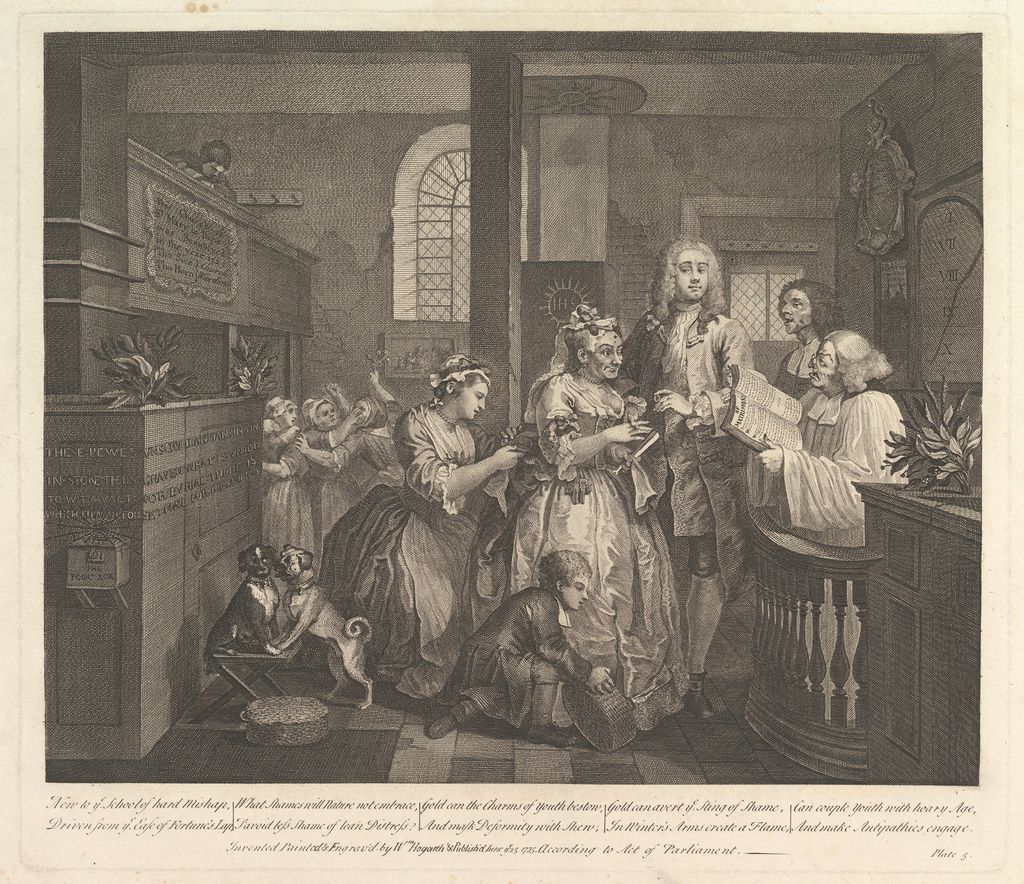
A Rake's Progress, Plate 5, William Hogarth, June 25, 1735. Etching and engraving; third state of three. 91.1.87. Gift of Sarah Lazarus, 1891. Image source. CC0 / Public domain.
Browse Hogarth’s artworks
All 54 individual artworks and series stages in the approved English cluster
Frequently Asked Questions
Sarah Young arrives carrying their child, but a pew-keeper blocks the group at the back of the church. [1]
It is scene 5 of 8 in A Rake’s Progress. Sir John Soane’s Museum uses the scene number for the original oil painting. [1]
Discussion
Look again at the images and ideas explored in The Marriage. These editorial prompts invite your observations.
Reader Insights
How does placing Sarah and her child at the back of the church change the way you read the exchange of the ring?
What does the cracked tablet above the wedding add to the scene?
Join the Conversation
Share a detail, comparison or question about The Marriage below.
References
- Joanna Tinworth, Sir John Soane’s Museum, William Hogarth, A Rake’s Progress V: The Marriage, P44, object record and curatorial note. View source.
- Sir John Soane’s Museum, William Hogarth, A Rake’s Progress IV: The Arrest, P43. View source.
- William Blackstone, Commentaries on the Laws of England, book II, chapter 29, “Of Title by Succession, Marriage, and Judgment,” Avalon Project, Yale Law School. View source.
- Joanne Bailey, “Favoured or Oppressed? Married Women, Property and ‘Coverture’ in England, 1660–1800,” Continuity and Change 17, no. 3, 2002, pp. 351–72. View source.
- St Marylebone Parish Church, A Brief Guide, history of the old parish church and its successor. View source.
- Parliament of Great Britain, An Act for the Better Preventing of Clandestine Marriage, 1753, 26 Geo. II c. 33, sections I, IV and VIII, in The Statutes at Large. View source.
- Anaclara Castro Santana, “The Rake’s (Un)Lawfully Wedded Wives in William Hogarth’s Rake’s Progress,” Eighteenth-Century Life 40, no. 2, 2016, pp. 66–87, author’s copy. View source.
- Judy Egerton, Marriage A-la-Mode, National Gallery catalogue, discussion of the Ashmolean oil sketch The Marriage Contract and note 116. View source.
- Bibliothèque nationale de France, William Hogarth, A Rake’s Progress: The Marriage, plate V, FRBNF40262628, Paulson 136.1 (in French). View source.
- Princeton University Art Museum, William Hogarth, A Rake’s Progress, Plate 5, x1988-34. View source.
- The Metropolitan Museum of Art, William Hogarth, A Rake’s Progress, Plate 5, 91.1.87, third state of three. View source.
- The Colonial Williamsburg Foundation, William Hogarth, A Rake’s Progress, Plate 5, 1967-566,5, third-state Boydell impression and inscription transcription. View source.
- Sir John Soane’s Museum, The Picture Room, hanging and conservation of A Rake’s Progress. View source.
- Sir John Soane’s Museum, William Hogarth, A Rake’s Progress VI: The Gaming House, P45. View source.







