


 by Tom Gurney
Tom Gurney BSc (Hons) is an art history expert with over 20 years experience
Published on June 19, 2020 / Updated on October 14, 2023
Email: tomgurney1@gmail.com / Phone: +44 7429 011000
The Industrious ’Prentice Lord Mayor of London: Introduction
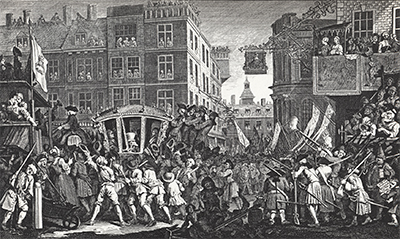
Francis Goodchild has reached the highest office in the City of London. Finding him in the crowd takes a moment. In William Hogarth’s The Industrious ’Prentice Lord Mayor of London, a small face and a pale hat show through the window of an ornate coach. Around it, hats fly up, spectators lean over railings, and the men charged with clearing the way seem as much in danger of colliding as the people they are trying to hold back. Goodchild has the honour of a procession. Most of the space in the print goes to the people who have come to see it. [1]
This is the twelfth and final plate of Industry and Idleness. The Metropolitan Museum of Art’s impression, 91.1.20, is an etching and engraving catalogued as the third of three states. A separately preserved impression in Melbourne records the publication line of 30 September 1747. The date belongs to the lettering of the design and leaves open when the individual sheet in New York was printed. [1] [2]
At a Glance
- ArtistWilliam Hogarth
- SeriesIndustry and Idleness, plate 12 of 12
- Inscribed publication date30 September 1747
- MediumEtching and engraving
- ImpressionThe Metropolitan Museum of Art, 91.1.20, third state of three
This work across William Hogarth’s career
Assembly at Wanstead House
1728–31The Heir
1734The Marriage Settlement
about 1743Gin Lane
1751Canvassing for Votes
1754–55Contents
- A view of the procession
- What the Show made public
- Two crowds and two street papers
- The same plate on different sheets
A view of the procession
Hogarth places the coach to the left of centre, at the point where hats and heads rise around its windows. The moulding over the roof and the carved uprights frame the little group inside. Trusler’s commentary identifies the conspicuously capped figure as the swordbearer, an officer who can be easier to pick out than the man the procession honours. Three footmen ride high at the back of the vehicle, where they too are in full view. The City of London’s account identifies the mounted figure ahead of the coach as the City marshal, whose raised sword is accompanied by a hat slipping over his eyes. The joke depends on the demands of his office. The man who should be able to see the way is losing his view of it. [1] [3] [4]
Hogarth gives the street depth with the receding walls and ranks of windows, then fills much of the space they open up. Banners and muskets cross the lines of the buildings. In the lower right, the militia’s long weapons point in several directions, and smoke marks a discharge. At ground level, people have fallen among boards in the foreground. John Trusler’s later commentary describes a board tipping over under a group of girls. A makeshift means of getting above the other spectators has become an obstacle underfoot. The front of the print lets the reader follow incidents that somebody watching the coach might miss. [1] [4]
Spectators also look out from sash windows, a roofline and temporary stands. At the upper right a cloth hangs over a balcony, setting it apart from the bare ledges people press against elsewhere. The organisers of the Lord Mayor’s Show identify two of its spectators as Frederick, Prince of Wales, and Princess Augusta. The identification is a reading of the pictured figures. Their position already conveys distinction on the page, since the balcony gives them room to sit apart from the bustle and a broad view of the route below. [1] [5]
What the Show made public
The City of London’s heritage account locates the scene in Cheapside and traces the City’s right to elect its mayor to King John’s charter of 1215. In Hogarth’s fictional story, Goodchild’s election has already happened by the time the coach comes into view. The incoming mayor’s journey to Westminster, where he pledged loyalty to the Crown, developed into the Lord Mayor’s Show. The point of the journey lay in presenting the new officeholder beyond the City as well as making him visible in its streets. By the time of Hogarth’s print, the land portion could use a hired coach of the kind represented here. The elaborate State Coach commissioned for the City in 1757 came a decade later. [3] [6]
Hogarth shows what an elected office looks like when it has to be recognised at a distance. The height and ornament of the coach, the attendants and the flags signal the arrival of somebody important well before a spectator can recognise the man inside. Canaletto’s Westminster Bridge, with the Lord Mayor’s Procession on the Thames, dated 1747 by the Yale Center for British Art, makes the river the setting for the ceremony. Open water gives the vessels room to spread across the picture. Hogarth takes the viewpoint of someone on the crowded street. The press of people makes the vehicle harder to see even as it shows how much attention the office commands. [1] [5] [7]
Watch Hogarth’s paintings and prints
Five films on Hogarth’s painted stories, prints, drawing methods and work for the Foundling Hospital.
In 60 seconds: Hogarth's 'Gin Lane' & 'Beer Street'
A short introduction to the contrasting streets, the shops and the people in Hogarth’s paired prints.
Watch on YouTubeTwo crowds and two street papers
In the previous plate, The Idle ’Prentice Executed at Tyburn, Thomas Idle rides in an open cart with his coffin. The gallows rise above the crowd in the distance. Each vehicle gives the onlookers a moving point of interest. At Tyburn the open cart exposes Idle to view, while the enclosure and ornament of Goodchild’s coach make recognising its occupant harder. At Tyburn the approach to the gallows runs across open ground. In Cheapside the houses hem in the procession, and the people who can find space above street level multiply at every storey. At Princeton University Art Museum both impressions survive on one sheet, with Tyburn above the mayoral ride. The identical width of the two printed areas gives the gatherings equal space there. [1] [8] [9]
Each gathering has a vendor with a paper about Idle. At Tyburn a woman hawks his purported last speech and confession. On the far right of the mayoral scene a boy holds up another sheet. Trusler reads it as an account of Idle’s ghost appearing to the Lord Mayor. The ghost enters the scene through a sales pitch. In plate ten the former apprentices had faced each other in a hearing. Now a street seller can put them together again in a story and use Goodchild’s new title to make the story worth buying. In the midst of a display of civic honour, someone is still making a living from the name of the man sent to Tyburn. [1] [4] [8] [10]
The verses below the scenes give the two gatherings a different relation to time. The Tyburn cartouche draws on Proverbs 1:27–28, where those in distress call out too late. The final plate takes Proverbs 3:16, which puts length of days in one hand and riches and honour in the other. The preceding verses identify the figure holding them as Wisdom and value her above silver and gold. Goodchild’s coach makes the honour easy to recognise, while his former colleague’s premature death makes the promise of length of days especially pointed. Both verses sit in ornamental cartouches against a regular pattern of bricks. Look above them at the sides of each print. The skeletal figures flanking Tyburn give way to ornaments spilling out fruit and leaves in the mayoral scene. Hogarth carries the promise of abundance to the very edge of the image, where it frames the struggle for a decent view. [1] [3] [9] [11]
The same plate on different sheets
The title and verse sit above and below the scene in the Met’s third-state impression, whose lower edge ends close to the cartouche. The Melbourne impression, also catalogued as the third state, preserves further lettering beneath the image. It gives Hogarth’s design and engraving credit, the plate number and the publication line. The Met also catalogues a first-state impression, 32.35(49), and a second-state impression, 32.35(50). The state describes a condition of the printing plate. The amount of margin visible on an individual sheet is a separate piece of evidence. The Lewis Walpole Library’s finding aid indexes the design under no. 179 in its arrangement based on the 1989 edition of Ronald Paulson’s Hogarth’s Graphic Works. [1] [2] [12] [13] [14]
Princeton University Library’s Graphic Arts Collection lists two examples of the final scene, one hand-coloured and undated in the finding aid. Its digital record groups two call numbers under the same design. Colour put on the paper by hand could change the balance between the coach, the banners and the spectators without changing the printed lines. The British Museum records a different form of reuse in a grey-wash drawing over graphite by Louis Philippe Boitard. It describes the sheet as an adaptation after Hogarth and places the coach at its centre. The pageant could thus be taken up as a subject in its own right, even though in Hogarth’s sequence every cheering spectator and every obscured view belongs to the last scene of Goodchild’s story. [15] [16] [17]
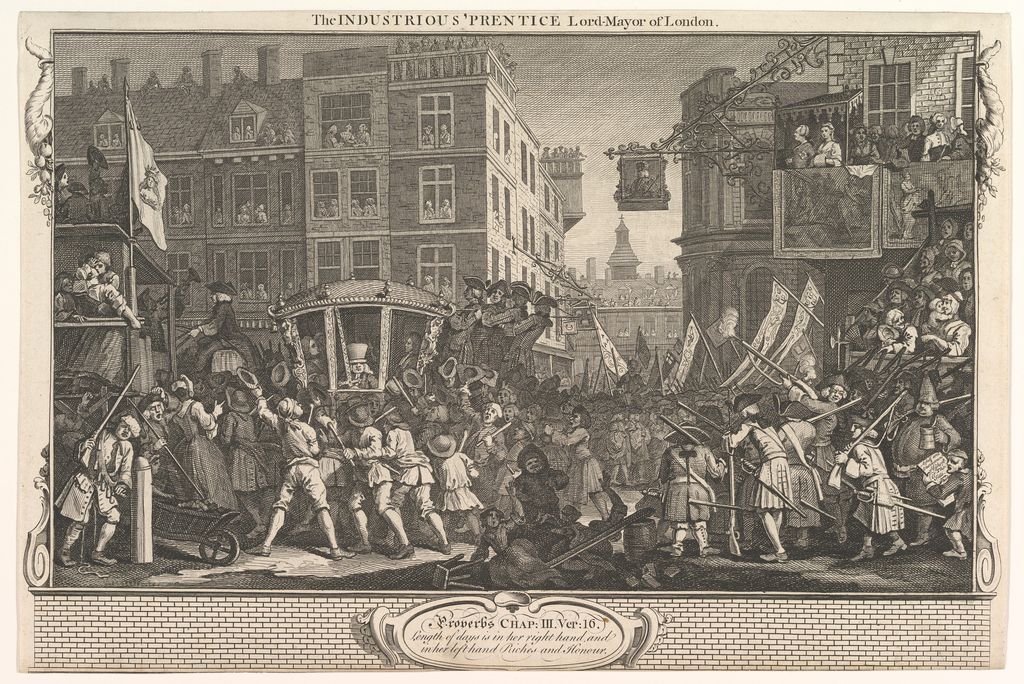
The Industrious 'Prentice Lord Mayor of London (Industry and Idleness, plate12), William Hogarth, September 30, 1747. Etching and engraving; third state of three. 91.1.20. Gift of Sarah Lazarus, 1891. Image source. CC0 / Public domain.
Browse Hogarth’s artworks
All 54 individual artworks and series stages in the approved English cluster
Frequently Asked Questions
Look for a pale hat and a small face through the window of the ornate coach. The crowd takes up much more of the print. [1]
It is plate 12 of 12 in Industry and Idleness. Following the plate numbers keeps Goodchild’s and Idle’s episodes in the intended order. [1]
Discussion
Look again at the images and ideas explored in The Industrious ’Prentice Lord Mayor of London. These editorial prompts invite your observations.
Reader Insights
How do the coach window and the crowded street affect what you can see of the new Lord Mayor?
What does the boy selling the story of Idle’s ghost add to Goodchild’s procession?
Join the Conversation
Share a detail, comparison or question about The Industrious ’Prentice Lord Mayor of London below.
References
- The Metropolitan Museum of Art, William Hogarth, The Industrious ’Prentice Lord Mayor of London (Industry and Idleness, plate 12), 91.1.20. View source.
- National Gallery of Victoria, William Hogarth, The Industrious ’Prentice Lord Mayor of London, 1278.463-3, state and inscriptions. View source.
- City of London Corporation, A History of the City in Ten Documents, “Industry and Idleness”. View source.
- John Trusler, The Works of William Hogarth, “Industry and Idleness”, plate 12, pp. 107–108. View source.
- The Lord Mayor’s Show, The Show in Art and Literature, balcony spectators and the hired coach. View source.
- The Lord Mayor’s Show, The State Coach, hired coaches and the 1757 commission. View source.
- Yale Center for British Art, Canaletto, Westminster Bridge, with the Lord Mayor’s Procession on the Thames, B1976.7.94, fourth-floor collection labels, p. 26. View source.
- The Metropolitan Museum of Art, William Hogarth, The Idle ’Prentice Executed at Tyburn (Industry and Idleness, plate 11), 91.1.19. View source.
- Princeton University Art Museum, William Hogarth, Plates 11 and 12, from the Series Industry and Idleness, x1988-61, dimensions and inscriptions. View source.
- The Metropolitan Museum of Art, William Hogarth, The Industrious ’Prentice Alderman of London, The Idle One Brought Before Him and Impeached by his Accomplices (Industry and Idleness, plate 10), 91.1.18. View source.
- The Bible, King James Version, Proverbs 3:13–16. View source.
- The Metropolitan Museum of Art, William Hogarth, The Industrious ’Prentice Lord Mayor of London, first-state impression, 32.35(49). View source.
- The Metropolitan Museum of Art, William Hogarth, The Industrious ’Prentice Lord Mayor of London, second-state impression, 32.35(50). View source.
- Lewis Walpole Library, Collection of Prints after William Hogarth, LWL MSS 42, pp. 5 and 33, catalogue arrangement and Paulson no. 179. View source.
- Princeton University Library, Vicki Principi, William Hogarth Collection, GC113, “Industry and Idleness”, plate 12 entries. View source.
- Princeton University Library, William Hogarth, Industry and Idleness. Plate 12. The Industrious ’Prentice Lord Mayor of London, Half Folio GA 2024.01807 and GA 2024.01806. View source.
- British Museum, Louis Philippe Boitard after William Hogarth, Adaptation of The Industrious ’Prentice Lord Mayor of London, 1978,0520.9, British drawings inventory. View source.







