


 by Tom Gurney
Tom Gurney BSc (Hons) is an art history expert with over 20 years experience
Published on June 19, 2020 / Updated on October 14, 2023
Email: tomgurney1@gmail.com / Phone: +44 7429 011000
The Lady’s Death: Introduction
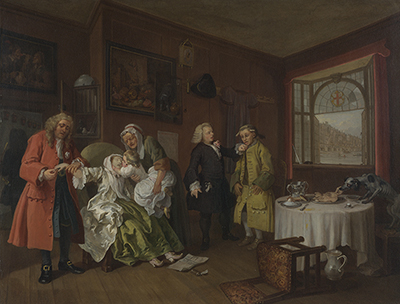
In William Hogarth’s The Lady’s Death, an alderman takes a ring from his dying daughter’s hand while a nurse lifts a child to kiss her. The child reaches towards her face as the alderman draws her hand away. The daughter, widowed in the previous scene, has come back to her father’s house in the City of London. Hogarth painted this final scene of Marriage A-la-Mode about 1743. It is an oil on canvas measuring 69.9 × 90.8 cm, now in the National Gallery, London, as NG118. [1]
At a Glance
- Painting dateAbout 1743
- Medium and dimensionsOil on canvas, 69.9 × 90.8 cm
- Painting collectionNational Gallery, London, NG118
- Plate VI impressionEtching and engraving by Gérard Jean-Baptiste Scotin after William Hogarth, second state of three, The Metropolitan Museum of Art, 32.35(13)
- Print datesPlate dated 1 April 1745, set available to subscribers in early June 1745
This work across William Hogarth’s career
Assembly at Wanstead House
1728–31The Heir
1734The Marriage Settlement
about 1743The Lady’s Death (current article)
About 1743Gin Lane
1751Canvassing for Votes
1754–55Contents
- The news on the floor
- Two claims on the countess
- The table and the City household
- What Hogarth changed in the paint
- The last scene on paper
The news on the floor
In the previous scene, The Bagnio, the countess’s lover Silvertongue is escaping through a window after fatally wounding her husband. The final picture depends on what happens between the two scenes. A sheet at the countess’s feet bears part of Silvertongue’s name and the words ‘last dying speech’. The little picture of the three-sided gallows identifies Tyburn, where he has been hanged in the story. The sheet takes up less space than the folds of the countess’s skirt, yet it carries the arrest, trial and execution that Hogarth leaves outside the frame. [1] [2]
The pictured sheet borrows a familiar way of turning punishment into news. The Ordinary of Newgate, the prison chaplain, could publish accounts that combined prisoners’ lives and offences with confessions and reports of their conduct at the scaffold. One account, printed and sold by John Applebee, covers executions at Tyburn on 22 November 1742 and even announces their place in the Lord Mayor’s term of office. That publication gives a historical context for the fictional sheet, whose fragmentary headline makes a similar promise of access to a condemned person’s final hours. Hogarth puts a piece of reading matter that could circulate around London within reach of the person for whom the news is most intimate. [2] [3] [4]
The National Gallery identifies the small bottle beside it as laudanum, which the countess has taken in the story. Look across the room from the objects on the floor to the man in black confronting the servant in yellow. Judy Egerton identifies the man in black as an apothecary and reads his gesture as an accusation that the servant supplied the drug. The object projecting from his pocket resembles a stomach pump in Egerton’s reading. She also allows that the apothecary himself may have supplied laudanum in the course of treatment. Hogarth gives the accusation a visible target and leaves the source of the bottle open. The figure understood to be the doctor is already turning away in the background. [1] [2]
Two claims on the countess
The nurse bends forward and supports the child with both arms. Look at the little face pressed towards the countess and then at the legs emerging beneath the clothing. The National Gallery reads the cheek mark, the sunken bridge of the nose and the supported legs as pictorial signs of congenital syphilis. The marks give the scene a history that reaches back beyond the immediate catastrophe. Egerton notes a possible echo of the earl’s dark patch, while leaving the child’s paternity open. The child’s sex is also ambiguous. The nurse’s action makes the consequences of the marriage visible in someone who had no part in arranging it. [1] [2]
At the left, the alderman holds his daughter’s arm almost horizontally as his hands work at her finger. The pose pulls her arm away from the child. The ring recalls the marriage her father helped arrange, and the attention he gives it has a possible legal context. Writing later in the century, William Blackstone explained that a finding of felo de se, a felony against oneself, could lead to the forfeiture of goods and chattels to the Crown. The legal rule depended on a finding of responsibility, and Blackstone acknowledged that coroners’ juries could take a broad view of incapacity. Egerton reads the alderman’s haste in light of the risk of forfeiture. Hogarth leaves the ring’s ownership and any legal outcome unstated. His grip steadies her hand while he takes the ring and keeps her from reaching towards the child. [1] [2] [5]
Watch Hogarth’s paintings and prints
Five films on Hogarth’s painted stories, prints, drawing methods and work for the Foundling Hospital.
William Hogarth, Marriage A-la-Mode (including Tête à Tête)
A close look at Tête à Tête and how its figures and furnishings advance the story of the marriage.
Watch on YouTubeThe table and the City household
The room tells us what sort of wealth supported the marriage. Beyond the table, houses on old London Bridge identify the City setting. Inside, the alderman’s civic gown and hat hang near a plain clock, and the open corner cupboard shows the edges of his ledgers. Their placement makes record keeping feel like an everyday habit. The bare boards and plain furnishings give the silver punch bowl an unusual prominence. Egerton suggests it may have been a gift associated with civic office. Its brightness draws attention to a man whose position is visible in his belongings even when little has been spent to make the room comfortable. [1] [2]
A boiled egg rises from a dish that Egerton identifies as rice. The white tablecloth makes the modest portions easy to pick out. At the edge of the table a thin dog reaches for the ear of a pig’s head. The snout tips up like the countess’s face across the room, an uncomfortable likeness that draws the eye back to her chair. Egerton proposes that the arrangement on the cloth may parody a still life such as Chardin’s The White Tablecloth of 1731–32, now in the Art Institute of Chicago. The comparison makes sense of the care Hogarth gives a meal that serves a comic purpose. It remains uncertain whether he saw that particular painting. [1] [2] [6]
What Hogarth changed in the paint
The overturned chair in front of the table once had a high, rounded back like the upright chair by the window. The National Gallery’s examination also showed that Hogarth finished a framed still life on the wall before adding the overlapping picture. David Bomford and Ashok Roy found evidence that the table may at first have been bare, although they were less certain about the cloth than they were about the chair. The X-radiograph records a repaired tear as well. The earlier contours record Hogarth’s choices about furnishings and their outlines. The repaired tear records damage to the canvas after it was painted. [2] [7]
The examination also explains something the eye can see in the servant’s coat. A sample showed an extremely thin green layer underneath paint made with almost pure Naples yellow. Bomford and Roy relate that build-up to the greenish cast of the finished coat. Egerton compares its colour with the livery of the old earl’s servants in the first scene, raising the possibility that the coat is a cast-off. The sample establishes how Hogarth produced the colour. The resemblance between costumes gives a reason to look for a family connection in the servant’s clothes, whose earlier wearer remains unknown. [2] [7]
The last scene on paper
Gérard Jean-Baptiste Scotin engraved plate VI after Hogarth. The Metropolitan Museum of Art’s impression, 32.35(13), is an etching and engraving catalogued as the second state of three. Colonial Williamsburg’s separately catalogued second-state impression preserves the credit to ‘G. Scotin’ and the date 1 April 1745 in the lower margin. Its catalogue uses the name Louis Gerard Scotin. Egerton records both forms of his name and distinguishes the publication line from the early June 1745 announcement that subscribers could collect the set. The exact date when the Met’s sheet was printed remains uncertain. [2] [8] [9]
Scotin’s print reverses the scene. The window and dinner table stand on the left, with the mother and child on the right. In the oil a viewer starting at the left may encounter the alderman’s action before working out what the meal says about his household. In the print the dog and the table can set up that reading before the viewer reaches the ring. A separate impression at the Wellcome Collection also shows how much work lettering does within the picture. Its catalogue records a label identifying the little bottle as laudanum and transcribes the headline giving Silvertongue’s last speech. A reader can move from the engraver’s credit in the margin to the execution notice inside the scene. The smaller sheet tells them what has already happened and sends their attention back to what the people in the room are doing now. [1] [2] [8] [10]
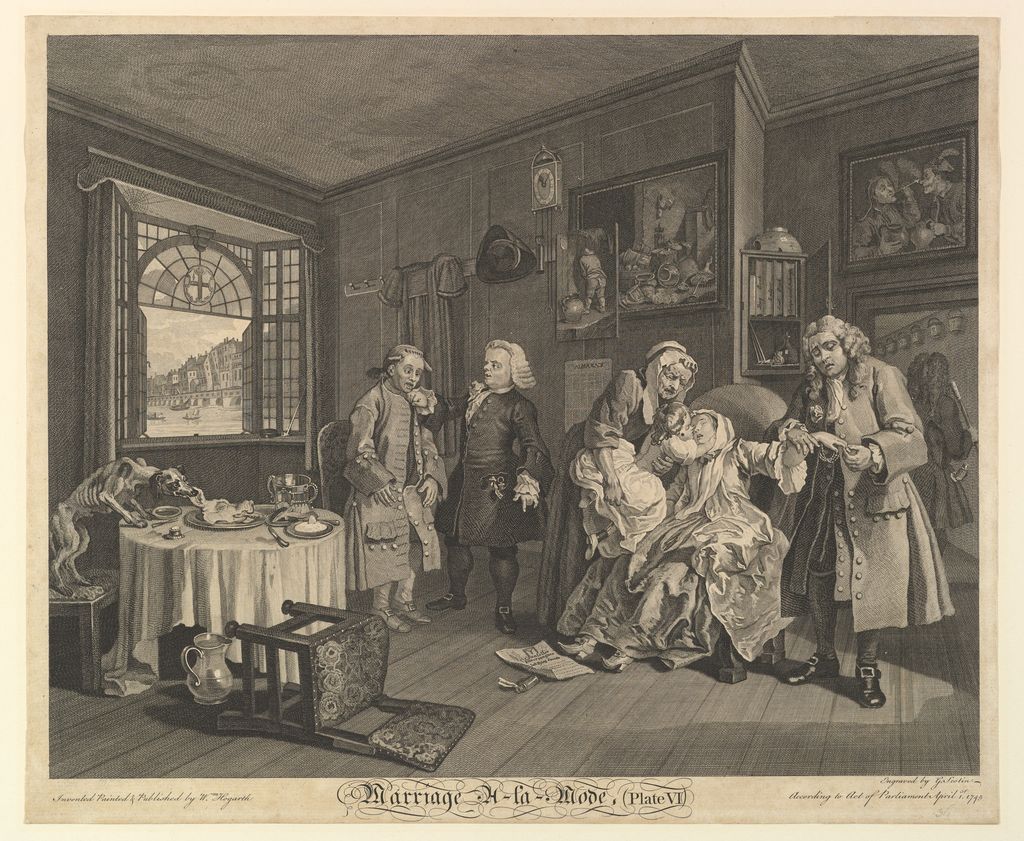
Marriage A-la-Mode, Plate VI, Gérard Jean-Baptiste Scotin after William Hogarth, dated April 1, 1745. Etching and engraving; second state of three. 32.35(13). Harris Brisbane Dick Fund, 1932. Image source. CC0 / Public domain.
Browse Hogarth’s artworks
All 54 individual artworks and series stages in the approved English cluster
Frequently Asked Questions
He removes a ring from her hand while a nurse lifts the child to kiss her. The gesture recalls the bargain the alderman made at the beginning of Marriage A-la-Mode. [1]
It is painting 6 of 6 in Marriage A-la-Mode. The National Gallery catalogues the original canvas under that number in the sequence. [1]
Discussion
Look again at the images and ideas explored in The Lady’s Death. These editorial prompts invite your observations.
Reader Insights
How does the tiny image of the Tyburn gallows on the sheet change the way you read the scene in the room?
What do the nurse’s hands and the alderman’s grip each draw your attention to in the countess’s final moments?
Join the Conversation
Share a detail, comparison or question about The Lady’s Death below.
References
- The National Gallery, London, Marriage A-la-Mode: 6, The Lady’s Death, William Hogarth, collection record NG118. View source.
- Judy Egerton, Marriage A-la-Mode, in The British Paintings, National Gallery Company and Yale University Press, 2000, NG117 and NG118, including pp. 173–175, Technical Notes for NG118, and the discussion of engraving and publication on pp. 151–153 and note 30. View source.
- London Lives, Ordinary’s Accounts: Biographies of Executed Convicts, source guide to the Newgate chaplain’s publications. View source.
- James Guthrie, The Ordinary of Newgate, His Account of the Behaviour, Confession, and Dying Words of the Malefactors Who Were Executed at Tyburn, on Monday the 22d of November, 1742, no. I, printed and sold by John Applebee, London, 1742, Wellcome Collection record n6cth748. View source.
- William Blackstone, Commentaries on the Laws of England, book IV, chapter 14, “Of Homicide”, pp. 189–190, Yale Law School’s Avalon Project. View source.
- Art Institute of Chicago, The White Tablecloth, Jean Baptiste Siméon Chardin, 1731/32, 1944.699, A Case for Wine exhibition archive. View source.
- David Bomford and Ashok Roy, “Hogarth’s ‘Marriage à la Mode’”, National Gallery Technical Bulletin 6, 1982, pp. 44–67, figs. 19–20 and “The layer structure”. View source.
- The Metropolitan Museum of Art, Marriage A-la-Mode, Plate VI, Gérard Jean-Baptiste Scotin after William Hogarth, 32.35(13), second state of three. View source.
- Colonial Williamsburg Foundation, Marriage a la Mode, Plate VI (The Death of the Countess), 1967-567,6, second state, with transcription of the lower margin. View source.
- Wellcome Collection, The Countess, Having Taken a Dose of Laudanum Nears Death, plate VI engraved by Louis Gérard Scotin after William Hogarth, 38358i, description and lettering. View source.







