



 by Tom Gurney
Tom Gurney BSc (Hons) is an art history expert with over 20 years experience
Published on June 19, 2020 / Updated on October 14, 2023
Email: tomgurney1@gmail.com / Phone: +44 7429 011000
The Four Stages of Cruelty by William Hogarth: Introduction
William Hogarth’s The Four Stages of Cruelty follows the fictional Tom Nero from a childhood marked by tormenting animals to his arrest for the murder of Ann Gill. The last print takes up the story after his execution, as surgeons dissect his body before an audience. When Hogarth issued the four etchings and engravings in February 1751, he gave readers a story they could follow from one sheet to the next. The surviving drawings and prints suggest that he arrived at this sequence by a less direct route. The churchyard and anatomy theatre, the last two settings in Nero’s life, are the only subjects known in an earlier project for two large woodcuts. [1]
The story also changes with each group of people who see what cruelty does. A child offers something of his own to save a dog. A man records the number of a cab as its driver beats a collapsed horse. Neighbours converge on the scene of a murder and begin to assemble evidence. Finally, men entitled to act on behalf of medicine and the law gather around the exposed body of the man who once made animals suffer. Watch what the figures around Nero do with their hands and whom they look at. Those gestures carry a second narrative across the four prints, about the difference that a witness can make. [1] [2] [3] [4] [5]
The First Stage of Cruelty (The Four Stages of Cruelty), William Hogarth, February 1, 1751. Etching and engraving; first state of two. 91.1.136. Gift of Sarah Lazarus, 1891. Image source. CC0 / Public domain.
At a Glance
- ArtistWilliam Hogarth
- SequenceFour prints
- Issue1751
- MediumEtching and engraving, with separate woodcut versions of the final two scenes
Contents
- The four stages in order
- How one witness gives way to the next
- What the drawings reveal about the order of invention
- Bell’s woodcuts and the four copperplate prints
- Surviving sheets and later circulation
- The February advertisements and their readers
- Execution and anatomy before and after 1752
The four prints
The four stages in order
1. The First Stage of Cruelty
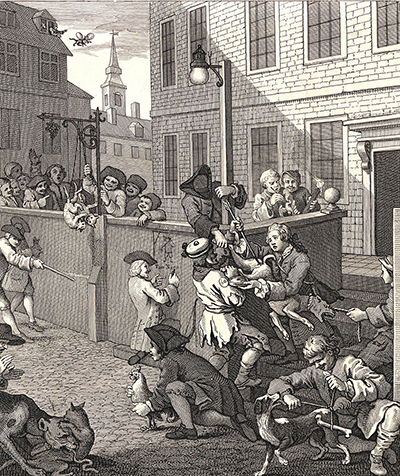
In The First Stage of Cruelty, cruelty is a shared pastime. Nero is the central figure in a group of boys hurting a dog. Others hold the animal in place, making the group’s cooperation visible. Around them, smaller groups pursue their own amusements. The open street lets Hogarth show these incidents side by side. They seem to take place in plain view without anyone empowered to stop them. The boy who offers Nero his tart is close enough to intervene and conscious enough to try. Hogarth sets the offered food against the act at the centre, giving the eye a second point of interest and the reader a model of behaviour. [1] [2] [6]
The verse calls him a youth of “gentler Heart” and says his tears and tart are in vain. The gesture still matters. The verse directs those who enjoy cruel sports to learn from his example, so his action can have an effect beyond the scene even though it fails within it. Farther back, a boy draws a hanging figure and associates it with Tom. That drawing makes a picture of violence visible inside Hogarth’s own picture. A child in the street imagines what will be done to Nero, while the four-print sequence obliges readers to reckon with how they respond when the imagined end comes closer. [1] [2] [6]
2. The Second Stage of Cruelty
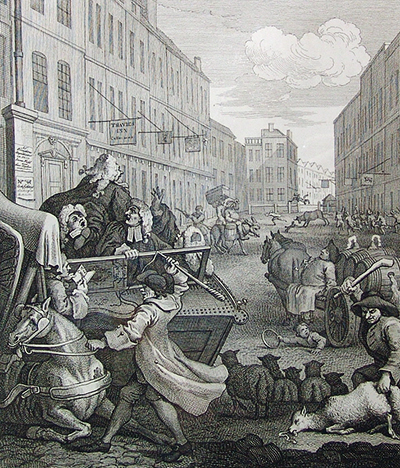
In The Second Stage of Cruelty, Nero drives a hackney cab. His horse has collapsed under the weight of its load. The cab lurches and the passengers try to extricate themselves as the driver strikes the animal. The composition makes the strain of the horse’s work visible through the tilt of the vehicle and the mass of the bodies it carries. There is enough activity in the rest of the street to show that the driver’s brutality belongs to a larger economy of transport, trade and entertainment. Another man attends to the cab number. With that detail, Hogarth gives the concerned bystander a way to hold the driver accountable after the moment of violence. [1] [3] [6]
The margin grants the horse a history of work and age, and it asks what interest or enjoyment can justify its suffering. A boxing advertisement and an announcement of cockfighting put other kinds of public entertainment on the wall behind the street action. Sports historian Doreen Skala traced the named boxing match, between James Field and George Taylor at Broughton’s Amphitheatre, to an actual bout in December 1743. Its appearance in a print published in 1751 places a recognisable event in Nero’s fictional world. Field’s name will surface again in the anatomy scene. A reader able to recognise it could connect the changing fortunes of a figure known from prizefighting and crime news to details planted at opposite ends of the series. [1] [3] [6] [7]
3. Cruelty in Perfection
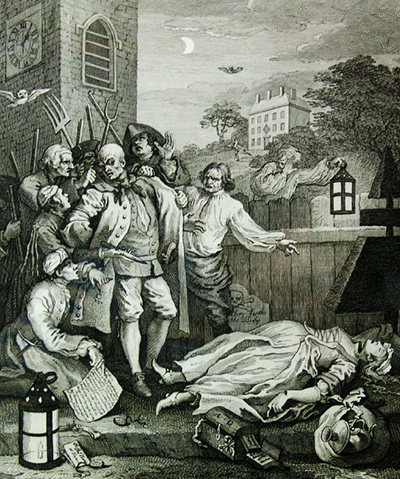
In Cruelty in Perfection, the violence has taken place before the crowd gets there. Ann Gill lies in the foreground. Figures seize Nero and examine the things around him, turning the churchyard into a place where what he hoped to conceal can be pieced together. A lantern throws light across the ground. The gathering extends into the background, so the circulation of news begins inside the picture. The title’s use of “perfection” is bitter. Across the first three sheets, cruelty has ripened into the act that brings Nero within reach of the criminal law. [1] [4] [6] [8]
Ann’s letter gives information that a picture of the discovery alone could scarcely communicate. The writer weighs her mistress’s kindness against her promise to bring goods to her lover. The paper recovered in the scene allows Ann to speak after death and lets the reader understand something of the relationship that preceded it. The margin, with its warning to the seducer, turns that private history into an address to a public audience. Someone who comes upon the print at this point in the sequence can recover much of the immediate story from the paper, the possessions on the ground and the response of the witnesses. That capacity to tell a story on a single sheet also helps explain how the two large woodcut subjects could have worked as a pair. [1] [4] [6]
4. The Reward of Cruelty
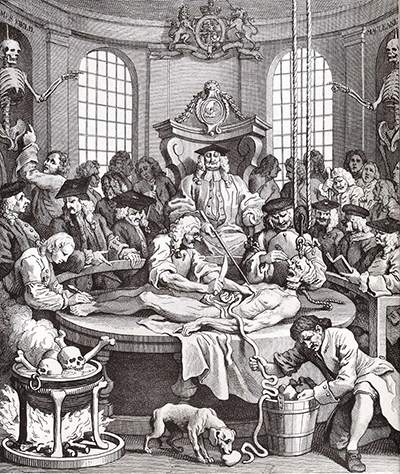
In The Reward of Cruelty, Nero himself lies at the centre of a ring of figures. The rope around his neck identifies what has already happened. The men at the table handle the body, the figure in the high chair presides, and others learn, watch or react. Skeletons in wall niches show the kind of display that could outlast the operation. A dog beneath the table gives the scene a pointed echo of the opening print. Whether a reader takes it as a return of the first dog or a reminder of that earlier victim, the animal now has access to the incapacitated body of a man. The shift in power is visible at the scale of the whole scene, before the smallest details of the operation come into focus. [1] [5] [6]
The final verse imagines a “Monument of shame” made from Nero’s bones. It asks the reader to behold what the first caption taught the reader to find repellent. The distinction it proposes rests on who is entitled to carry out the act, what purpose the exposure serves and whose body the reader is expected to pity. The picture still leaves room to notice expressions of curiosity around the table. The judges and hangman belong to the action between prints. By leaving them out, Hogarth concentrates the last scene on the people who receive the body and on what punishment looks like once a death sentence has been carried out. [1] [5] [6]
How one witness gives way to the next
The child with the tart and the man at the cab offer two forms of intervention. The child tries to stop the act with a request and a gift. The man uses information that can travel to someone with authority. The second intervention depends on a feature of commercial life, the number displayed on a vehicle, becoming evidence of responsibility. Ann’s letter undergoes a similar change in the churchyard. A private arrangement becomes discoverable through writing. The result is a series in which written matter moves from a child’s drawing on a wall to an identifying number, a letter and finally the names under the displayed skeletons. Each kind of mark has a different power over the story. [1] [2] [3] [4] [5]
It matters that the churchyard figures have arrived to discover the crime. People can become witnesses by hearing an alarm, helping someone in distress, finding an object or noticing a person trying to leave. In a study of Old Bailey cases from 1688 to 1751, Lily Bentley uses Hogarth’s crowded churchyard to open a discussion of how witnesses came to be present in cases of fatal violence against women. Many witnesses in the cases she examines were neighbours, household members or people connected through work. They had knowledge because of the places and relationships they shared. The print makes this kind of community knowledge legible by bringing discovery, restraint and the examination of evidence together in one view. The surviving court accounts show how much longer and more uneven such a process could be. [4] [8]
The difference between the first and fourth crowds is sharper if the scenes are seen together. The children’s attention breaks into little groups spread across a wall and street. In the theatre, furniture and the direction of the men’s bodies organise attention around a single exposed subject. One ring of onlookers has rules and a hierarchy, while the other makes its own. Yet both have the capacity to turn suffering into something to watch. The print outside the theatre extends that chain to its buyers, who can trace a gesture or lean in to see what others in the picture are looking at. This arrangement gives the final sheet an unease that its verse, with the unequivocal judgment of shame, only partly resolves. [1] [2] [5] [6]
Hogarth had pictured a different public punishment in 1747. In The Idle ’Prentice Executed at Tyburn, plate XI of Industry and Idleness, Tom Idle rides in a cart to the gallows in full view of a vast outdoor crowd. The Reward of Cruelty takes Nero’s story into a room after hanging and puts custody of the body at the centre. Both prints ask the viewer to look at people gathered around a punishment, but at different points and from different vantage points. The Tyburn crowd has room for diversions and trade. The wall niches and table of the anatomy picture suggest a ceremony with offices, established tasks and a place for the eye to settle. [5] [9]
What the drawings reveal about the order of invention
In their 2024 study of the surviving material, Jennifer Tonkovich and Laurel O. Peterson argue that Hogarth likely began with the murder and its aftermath. The two subjects work as a compressed exchange between discovery and consequence. Bell’s woodcuts give them a shared scale, and the earliest surviving drawing related to the project is a large study for its final scene in the Royal Collection at Windsor. The four much smaller Morgan drawings are evidence of a subsequent effort to make episodes from different phases of the project read as a coherent set. The order of the story is clear on the engraved sheets. Reconstructing the order in which Hogarth invented it depends on physical evidence, including lines one can barely see and changes in the size of a design. [1]
The large Windsor study for The Reward of Cruelty, RCIN 913494, is about 46.3 by 38.3 centimetres. Hogarth blocked out the scene in graphite, built up the foreground with strong parallel strokes in black ink and used wash to carry areas of shadow. The background was worked more lightly, with architectural guides and further touches of brown ink and grey wash. The contrast between those two parts of the sheet records decisions about both the placement of the people and the kind of line that would make sense in a woodcut. The broad foreground marks have a counterpart in the Bell impression reproduced alongside it by Tonkovich and Peterson. Its printed design on the Steevens example they compare is about 45.8 by 38.3 centimetres. [1]
The sheet also preserves signs of ideas that moved. A small graphite sketch at the right anticipates the man in the high chair who will supervise the operation nearer the centre. That change makes the authority in the room easier to read at a glance. The conservators found stylus indentations selectively following the design and traces of red chalk on the back, visible at tears because the sheet has been mounted. Rubbing chalk on the back of a drawing allows pressure from a pointed instrument to deposit a line onto a surface below. This is evidence of an intention to carry parts of a slowly worked composition forward. The successive surfaces involved, and who did all the transferring, remain open. [1]
The four Morgan compositions, III, 32b through III, 32e, stand close in size at about 35.5 to 36 centimetres high. Their format allows changes across the series to be seen together. Red chalk gives the pages a degree of finish, but they also bear incised lines and red chalk on the backs. The two later scenes have an additional graphite grid. Tonkovich and Peterson report that the grids were laid over already completed drawings. Their presence therefore shows a subsequent need to transfer or measure a design, while leaving the specific destination open. One can see why the distinction matters. The large version of the anatomy scene reached paper at practically the size of the Windsor sheet, whereas the four engraved compositions had to occupy closely comparable spaces considerably smaller than the woodcuts. [1] [10]
The Yale Center for British Art’s First Stage of Cruelty, B1975.4.1543, looks much less settled than the corresponding Morgan drawing. The earlier-looking work is itself a difficult witness. The two versions share many passages, but close comparison shows adjustments in the relative heights and positions of groups. One figure clapping in the lower right is more fully described in the rough drawing, reduced essentially to hands in the Morgan version and resolved again in the print. An area above the pleading boy also has signs of experimentation on the Yale sheet. The same rough-looking sheet could have been useful first as a place to establish a composition and later as a place to rethink it. The history of this small passage makes more sense if Hogarth could return to a sheet after preparing a more presentable version. [1] [10]
Paper adds another form of evidence. The Morgan drawing for the second stage has a Strasbourg lily watermark and an IV countermark that the researchers match to the paper used for the Morgan designs for Beer Street and Gin Lane. The Morgan first and third stages share a different watermark, a lion on a pedestal with a crowned GR countermark. The Yale working sketch and the Morgan fourth stage share another mark, a crowned coat of arms with a bell below it. One project could draw on several stocks of paper, and a stock could serve more than one project. The marks give physical substance to the idea that Hogarth worked on several February subjects in overlapping campaigns. They leave plenty of room for him to put down a drawing and pick it up again. [1]
Between drawing and engraving, the story continued to gain small connections. The parish badge on Nero’s sleeve in the first print identifies him with the care of St Giles-in-the-Fields, the parish associated with Gin Lane. The boxing and cockfighting signs appear during the development of the second engraving. In the third, the pronounced shape of a clipped yew supplies a landmark for the meeting described in Ann’s letter. In the fourth, the names below the skeletons introduce references to contemporary executions. These changes give separate scenes a shared world of places, entertainments, documents and public notices. They also put a limit on how fully the artist could solve the narrative in a finished-looking chalk drawing. [1] [2] [3] [4] [5] [11]
Bell’s woodcuts and the four copperplate prints
John Bell’s signature, “J. Bell sculp.”, gives a maker’s credit that the copperplate prints handle differently. The woodcut names Hogarth as inventor and publisher. A woodcut prints from the raised parts of its block. Its cut-away passages leave the paper clear, so the surviving ridges have to carry the strokes and dark masses. In the four etchings and engravings, ink held in recessed lines in the copper produces the printed design. Each technique offers a way to keep the main figures visible across a crowded scene, and the Windsor study shows Hogarth already thinking in substantial strokes compatible with relief printing. In the engraved Reward, the relatively open parallel lines on a Windsor working proof still show something of that approach. Crosshatching, with a second set of lines crossing the first, was added as the plate was finished. [1] [12]
Cruelty in Perfection gives a particularly good way to tell two impressions of Bell’s woodcut apart. In early examples studied at the Lewis Walpole Library, the words on Ann’s letter are arranged across the page it depicts, slanting upwards to the right. Tonkovich and Peterson identify the letters as set in type, probably fitted into a recess in the block. In the later National Gallery of Art example, a replacement piece of wood carries cut lettering and changes the letter’s orientation. The later version brings the layout closer to that of the copperplate print and makes the message more legible by enlarging and shortening it. This is a change to the printing surface. A sheet that preserves the earlier arrangement and one that shows the altered letter can carry the same title and publication inscription while recording different states of the block. [1] [12]
The early impressions also have something to say about the commercial experiment. Surviving examples on thin laid paper have areas of weak printing, creases and oily halos around the lines. Damage to the border of the block for Cruelty in Perfection can be detected by comparing impressions. Ordinarily, the possibility of pulling many copies from a relief block was an advantage when producing inexpensive prints. The uneven results give the investigators a reason to ask whether this unusually large, intricate work could be printed reliably at the proposed price of sixpence a sheet. The material evidence shows difficulties. The decision to set the project aside could have involved the expense of the blocks, the quality of the pulls or both. [1]
The lettered date on the Bell Cruelty in Perfection is “Jany. 1st 1750”. In England the civil year still began on 25 March, so the January date can be read as January 1751 when the year is reckoned from 1 January. The inscription records what appears on the image, even on impressions made from the block decades later. For example, the National Gallery of Art catalogues its thick laid paper impression, 2012.2.1, under 1750 and transcribes that date from the block. Tonkovich and Peterson identify the same sheet as a later impression from around 1790, based on its altered letter and paper in the context of the Boydell printing. In this case the 1750 inscription survived the change to the block and can be read alongside the evidence of a later date for the sheet. [1] [12]
Watch Hogarth’s paintings and prints
Five films on Hogarth’s painted stories, prints, drawing methods and work for the Foundling Hospital.
Crafting Cruelty: Hogarth’s Innovative Drawing Methods
The Morgan examines Hogarth’s drawings for The Four Stages of Cruelty and the methods he used to work out his designs.
Watch on YouTubeThe shift to copper brought the episodes closer in scale. Tonkovich and Peterson give about 35.3 by 29.8 centimetres for the engraved image, excluding the lettering. The Met’s engraved Cruelty in Perfection, 91.1.138, measures 38.8 by 32.2 centimetres at the plate and 40.2 by 33.5 at the outer dimensions of the paper. The larger Met Bell impression, 21.72(2), has a catalogued printing area of 45 by 37.5 centimetres. The physical distinction matters even when a book or screen displays all three at an equal height. Compare the same part of Ann’s letter across examples, and separate the size of the printed picture from the size of the plate mark or the surviving sheet. [1] [4] [13]
The four published engravings are lettered as designed by Hogarth. That credit identifies the person responsible for the compositions. It is less explicit about the cutting of every line. Tonkovich and Peterson raise the possibility that an engraver started work on the plates and Hogarth finished them, but link the suggestion to the wording, the function of the drawings and Hogarth’s known working relationships. In Hogarth’s engravings one can see projects for which he divided the labour and named the specialists involved. With The Four Stages of Cruelty the drawings establish his hand in the design at a level of detail that goes beyond the printed credit, while the division of copperplate work remains uncertain. [1]
The inscription itself could also be part of the story. The lettering near Ann’s scattered belongings in Bell’s Cruelty in Perfection invokes God’s revenge against murderers. John Reynolds’s The Triumphs of God’s Revenge against Murder, collected in six books in 1635, advertised accounts of grievous crimes, extraordinary discoveries and punishments. It even provided a table of letters and challenges from the stories. The woodcut calls on a familiar way of telling a crime story, in which written evidence and a discovery that appears almost providential lead towards punishment. In the engraved series, readers have two sheets of Nero’s earlier life to reckon with as well. The published verse finds an echo of the older language of discovery by insisting that the crime will make itself known despite the concealment of night. [1] [4] [6] [12] [14]
Surviving sheets and later circulation
An impression is a particular printed sheet. A state records a stage of work on the block or plate, which may have printed many sheets before it was altered. An issue concerns the time and circumstances in which impressions were published or offered. The Met’s four engravings offer a compact comparison. It records 91.1.136 and 91.1.137, the first two subjects, as the first state of two. It records the third, 91.1.138, as the only state, and the fourth, 91.1.139, as the third state of three. These are judgments about separate plates and separate sheets. A state number applies within the sequence of changes to a single printing surface. Among the four impressions at the Met, the first-state Second Stage remains the second scene in the story. [2] [3] [4] [5]
The Met also holds a separate pair of woodcuts, 21.72(2) for Cruelty in Perfection and 21.72(1) for The Reward of Cruelty. It names Boydell and Co. as publisher and dates both 1790. Its label for the third subject also specifies a first state of two. Tonkovich and Peterson’s study distinguishes the earliest letterpress trials from the cut replacement they associate with the later Boydell issue, using identified sheets for the comparison. The date and the state in the Met record describe its particular object in that catalogue. For the proposed chronology of the change, the physical clues on the identified Yale and Washington examples offer a firmer basis than transferring a date or state from one collection’s sheet to another. [1] [12] [13] [15]
John Nichols’s 1785 catalogue describes the expense of the woodcut project and says impressions from the blocks could be obtained at Jane Hogarth’s house in Leicester Fields. His catalogue presents the widow’s house as a place where interested readers could seek impressions. The small group of early experimental sheets tells a separate story about what happened around 1751. After Jane’s death, the blocks passed to John Boydell, whose later printing placed the subjects in a different market for Hogarth’s collected work. In the National Library of New Zealand, the associated Boydell folio of 1790 preserves an example of the engraved Reward. The same publisher’s name can therefore lead to different objects, either a folio with the copperplate subject or impressions from Bell’s relief blocks. The medium and the relevant publication both matter. [1] [16] [17]
The Biblioteca Nacional de España’s 2019 acquisition report records the purchase of Bell’s last two subjects in a John and Josiah Boydell edition it dates broadly to 1790–1810. The library already held the four copperplate subjects. Having both allows a comparison between the story as London readers could buy it in four engravings and the two larger designs that survived through a different publishing history. In Tokyo, the National Museum of Western Art holds an engraved Second Stage, G.1994-0013, which it dates 1750/51 and records as state 1 of 2. The entry cites number 202 in Ronald Paulson’s 1965 catalogue and number 188 in his 1989 revision. The museum lists its display in a 2009 print exhibition and a 2017 exhibition concerned with disturbing pictures. Those are occasions on which the scene was brought before modern viewers under different themes from those of the original London advertisement. [18] [19]
The series also circulated through books that reproduced and explained Hogarth’s designs. The 1840 Stuttgart edition of W. Hogarth’s Zeichnungen, which brought together Georg Christoph Lichtenberg’s commentaries and supplementary material by Franz Kottenkamp, presented the four subjects to German readers through a new series of reproductions on steel. The commentary for the first sheet questions its artistic merit on account of the horror of the scene, then invites a comparison with Tom Idle’s journey to the gallows. Its accompanying English title lets a reader recognise the named subject while reading a German account of it. By this stage a viewer could come to the story with a long history of commentary and a differently produced set of prints. [20]
The February advertisements and their readers
A London customer could buy the 1751 engravings at the sign of the Golden Head, Hogarth’s home and place of business in Leicester Fields. The advertisement in the London Evening Post of 14–16 February promoted Beer Street and Gin Lane and the Cruelty series in the same notice. John Nichols also transcribed a version in the General Advertiser dated 13 February 1750/51. The two drink subjects were due on Friday, with the four Cruelty subjects following on Thursday. The date of the four-engraving launch is normally given as 21 February 1751. The Met and Princeton catalogue their sets under 1 February 1751, the date lettered on the four prints. For the sequence in which Hogarth said the works would go on sale, the newspaper notice is the evidence. [1] [2] [3] [4] [5] [6] [16] [21]
A shilling each made the engraved Cruelty set four shillings at the ordinary advertised price. The notice offered a better printing of the drink subjects at a shilling and sixpence each, then gave the Cruelty prints the same price and size. The possibility of a second price tier is evidence of how Hogarth proposed to reach buyers with different expectations. The announcement gives prices, while the number of sheets sold at either price remains open. Tonkovich cites Ronald Paulson’s judgment that Hogarth seems to have dropped the scheme for the drink pair while using it for Cruelty. By 1754 a price list that Tonkovich and Peterson discuss had the two drink prints at three shillings together and the four Cruelty prints at six. The later list and advertisement bear witness to offers made at different moments. [1] [16] [21]
The 1751 notice says the works were intended to reform vices Hogarth attributed to the “lower class of people”. That tells us whose conduct the advertisement singled out. It also puts an obligation on the designs. A viewer should be able to grasp what is happening at once, with an individual such as the boy with the tart easy to pick out and a turn in the action apparent from a gesture. The same pictures reward the kind of close inspection a collector might give to a purchased sheet. The cab number, a half-seen letter or the scattered marks of a drawing on a wall have to be read at a different distance. Hogarth could pitch his images at people he wished to instruct and sell them to readers able to examine such details. Prices and wording give only a partial account of who saw the series. [1] [2] [3] [4] [16]
Another notice gives a glimpse of what a visit to the Golden Head could offer. In May 1751, Hogarth invited subscribers for prints after two history paintings, Moses Brought before Pharaoh’s Daughter and Paul before Felix, to see the drawings there. They could examine how the designs looked on paper before they paid for the completed prints. Tonkovich and Peterson suggest that the finished red-chalk drawings for Cruelty and the drink prints may have served a similar purpose. The surviving May notice establishes the practice for the two history subjects. For the February sets, the comparison suggests why a chalk sheet for transfer might also have had value as a finished object once its immediate workshop use was over. [1] [16]
Written explanations also formed part of the early market. Nichols records a pamphlet sold for a shilling in 1751 as a key to the designs. Its long title promised to address wanton cruelty and presented its dedication to the Lord Mayor and aldermen alongside praise for their efforts against excessive consumption of spirits. The link between the two projects could thus be made by a reader or publisher outside the Golden Head. Hogarth’s own designs use the connection selectively. Beer Street and Gin Lane set alternatives beside each other, whereas the four Cruelty sheets make actions accumulate across one life. At the same time, the parish badge in the first Cruelty print and the drinking and work incidents in the city locate Nero in the kind of urban world the pair invites its readers to judge. [1] [2] [3] [16] [21]
Early commentators took the visual disturbance seriously. Nichols quotes Horace Walpole on the presiding surgeon, praising Hogarth for showing how habitual exposure to shocking scenes could harden those who encountered them in a professional capacity. Walpole sees the chair and the business of the lecture as evidence of composure. In another passage Nichols offers a sharply different judgment of the opening print, questioning whether its most shocking incident belonged in a London street at all. The two responses show how soon readers debated the means Hogarth used to make cruelty recognisable. A scene could stir unease about the people who exercise authority over a body or make an observer dispute the plausibility of the very incident meant to command attention. [2] [5] [16]
The idea that bad habits could grow into a public danger also found a voice in Henry Fielding’s 1751 Enquiry into the Causes of the Late Increase of Robbers. The magistrate examined social customs and the laws concerning poverty and felony. He pictured luxury passing down through the ranks of society by imitation. In his argument, the attractions of apparently cheap diversions could encourage people to spend beyond their means. Hogarth’s notice proposed to use cheap pictures to counter conduct it condemned. The two works give price opposite roles, as an inducement to a dangerous habit in Fielding’s account and as a way of broadening access to the warning in Hogarth’s. The title of a contemporary reply published under Ben. Sedgly and Timothy Beck’s names promised to examine the vices of polite society alongside those imputed to the poor. The disagreement supplies some context for the language of Hogarth’s advertisement. The prints themselves distribute attention more widely than that language might suggest. They ask the reader to look at paying passengers, consumers of violent entertainment and people professionally entitled to command a room as well as a child left to a street game. [1] [3] [5] [16] [22] [23]
Execution and anatomy before and after 1752
The chronology of the last scene is easiest to understand if the end of Nero’s story is set beside dates from the Company of Surgeons. English surgeons had long had access to a limited supply of executed bodies for teaching. London’s surgeons separated from the barbers in 1745. According to the Royal College of Surgeons’ archive, their new hall close to Newgate and the Old Bailey was finished in 1751, with an anatomy theatre where they could teach and dissect. Hogarth’s print belongs to this existing culture of criminal anatomy. The gathering, the chair and the skeletons give him ways of representing an institution without requiring the depicted room to be identified with a surviving plan of a single building. [1] [5] [24]
The arrangement resembles older images of public anatomy in some ways. In her study of medical images, Isobel Fiona Haslam identifies features that recall several London theatres, including the old Barber-Surgeons’ theatre and the Cutlerian theatre of the Royal College of Physicians. She also compares the way observers gather around a body to the frontispiece to Andreas Vesalius’s De humani corporis fabrica. The comparison brings out what Hogarth makes especially prominent. The clothes and setting indicate different roles among the men who look on, while the central table gives the reader a view of the punishment itself. The visible similarity between the printed spectacle and a teaching image helps explain how readily the same room could be imagined as a place to learn and to judge. [5] [25]
The engraved series appeared a year before the Murder Act, 25 Geo. II c. 37. In April 1752, the London Gazette printed the Act for public information. Its preamble made adding terror and public infamy to the death penalty an explicit aim. For wilful murder it specified execution on the day next but one after sentence, with provision for a Sunday and judicial discretion to stay an execution. It gave sheriffs responsibility for delivering bodies in London and Middlesex to the Company of Surgeons or a place appointed by it, and provided for a surgeon designated by the judge elsewhere. A judge could instead direct that the body be hung in chains. Burial was forbidden unless the body had been dissected and anatomized. The statute prescribed what should happen to the body after execution. Hogarth, working in 1751, had already made that fate the substance of his closing scene. [1] [5] [26]
The distance between the image and the later law makes both clearer. The verse under the final print promises shame in bodily display. The Act likewise treats what happens after death as something a judge should name publicly in the sentence. The line in the Gazette about the people present concerns a court audience as well as the offender. Both the print and the statute imagine punishment being communicated to other people. The print supplies a figure and a room to look into. The statute defines obligations and powers for judges, sheriffs and surgeons. Their points of contact illuminate an established culture of exemplary punishment and the specific direction given to it in 1752. [5] [6] [26]
Archival accounts show that the later spectacle required people and equipment outside the view Hogarth gives us. Elizabeth T. Hurren’s investigation of the London Company’s records identifies the beadle as a key link between the gallows, the hall and the people who prepared it. In July 1752 the company paid for iron railings in the theatre, a material way of controlling where spectators could move. The diarist Silas Neville, recalling the dissection of Elizabeth Brownrigg in September 1767, described waiting in the lobby, pressing up a narrow staircase and regretting what he had gone to see. He also noticed the niches for skeletons and remarked on who else had turned out. This is evidence of a later visitor’s experience, with its mixture of curiosity, shock and a wish to know how others responded. The engraved theatre gives an unobstructed view. Neville’s account shows how much someone might have to do to secure one. [27]
The treatment of the body could draw resistance as well as an audience. The continuation of the Act on the next page of the Gazette makes forcible rescue or attempted rescue of a corpse from those entrusted with it a felony punishable by transportation for seven years. That provision puts legal weight on the passage between gallows and theatre, the passage that happens out of sight in Hogarth’s narrative. The men at the table have already obtained undisputed physical control in the picture. The later statute shows how much the law depended on securing the same outcome in practice. [5] [28]
Hurren also shows how anatomy’s stated purposes and its practice could diverge. In 1760, controversy over the handling of Earl Ferrers’s corpse brought into public view a distinction surgeons could draw between an initial anatomization and a more extensive dissection. The position of the prisoner, the decisions of the surgeons and the uses to which a particular body was put could all affect how the statutory sentence played out. Nero’s print supplies its own emphatic resolution in the exposed body and anticipated skeleton. The archive opens up the longer history behind that apparent finality, from the organisation of the audience to debates over what a particular anatomist was obliged to do. [5] [27]
Read in order, the four sheets take the power to act away from Nero. At first it belongs to him and to the boys who help him. In the street, the horse’s collapse and the cab number make his behaviour visible to an outsider. In the churchyard, the witnesses physically stop him and take possession of facts he can no longer control. The men in the anatomy room then decide what may be done with his body. A viewer can follow those changes without taking the verse’s certainty on trust. The child’s plea and the diarist’s later regret, voices from different kinds of evidence, both make it possible to ask what looking at suffering can achieve. Hogarth’s other print series offer different answers to what an audience sees, what it learns and where its attention goes when the story ends. [1] [2] [3] [4] [5] [6] [27]
Browse Hogarth’s artworks
All 54 individual artworks and series stages in the approved English cluster
Frequently Asked Questions
Discussion
Look again at the images and ideas explored in The Four Stages of Cruelty by William Hogarth. These editorial prompts invite your observations.
Reader Insights
What changes between the boys gathered around the dog and the men gathered around Nero?
How does the child who tries to intervene in the first scene affect your reading of the group?
Join the Conversation
Share a detail, comparison or question about The Four Stages of Cruelty by William Hogarth below.
References
- Jennifer Tonkovich and Laurel O. Peterson, “Hogarth and the Making of the Four Stages of Cruelty,” Master Drawings 62, no. 1 (2024), pp. 21–40, figs. 1–24 and notes 2, 6–7, 19–42 and 48. View source.
- The Metropolitan Museum of Art, William Hogarth, The First Stage of Cruelty, etching and engraving, 91.1.136. View source.
- The Metropolitan Museum of Art, William Hogarth, The Second Stage of Cruelty, etching and engraving, 91.1.137. View source.
- The Metropolitan Museum of Art, William Hogarth, Cruelty in Perfection, etching and engraving, 91.1.138. View source.
- The Metropolitan Museum of Art, William Hogarth, The Reward of Cruelty, etching and engraving, 91.1.139. View source.
- Julie L. Mellby, Princeton University Library, “The Four Stages of Cruelty,” Graphic Arts GA113, catalogue commentary and transcription of the printed verses. View source.
- Doreen Skala, “‘The Miseries of Others’: Boxing in Hogarth’s Second Stage of Cruelty,” Sport in History (2019), opening discussion and fig. 1, DOI 10.1080/17460263.2019.1655471. View source.
- Lily Bentley, Witnessing Violence against Women: Gender and Narrative in Old Bailey Murder Trials 1688–1751, Open University dissertation, chapter 1, pp. 9–15. View source.
- London Museum, William Hogarth, The Idle ’Prentice Executed at Tyburn, plate XI of Industry and Idleness, 64.51/36a. View source.
- The Morgan Library & Museum, Hogarth: Cruelty and Humor, exhibition of 1750–51 drawings and related prints, 2019. View source.
- The Morgan Library & Museum, “First Stage of Cruelty [print],” Hogarth: Cruelty and Humor, 2019, catalogue commentary. View source.
- National Gallery of Art, John Bell after William Hogarth, Cruelty in Perfection, woodcut on thick laid paper, 2012.2.1, inscription and object measurements. View source.
- The Metropolitan Museum of Art, John Bell after William Hogarth, Cruelty in Perfection, woodcut, 21.72(2). View source.
- John Reynolds, The Triumphs of God’s Revenge against the Crying and Execrable Sin of Murder, collected edition, London, 1635, title and contents description. View source.
- The Metropolitan Museum of Art, John Bell after William Hogarth, The Reward of Cruelty, woodcut, 21.72(1). View source.
- John Nichols, Biographical Anecdotes of William Hogarth, with a Catalogue of His Works, 3rd ed. (London, 1785), catalogue year 1751, items 1–2 and notes, with the prospectus for the history prints in the entry on Marriage à la Mode. View source.
- National Library of New Zealand, The Original Works of William Hogarth, John and Josiah Boydell, London, 1790, Alexander Turnbull Library, associated impression The Reward of Cruelty, D-020-077. View source.
- Biblioteca Nacional de España, Compra de fondo antiguo y especial 2019, “Estampas,” printed p. 9, acquisition entry for Bell after Hogarth, Estados de la crueldad (Spanish). View source.
- National Museum of Western Art, Tokyo, William Hogarth, Second Stage of Cruelty, etching and engraving, G.1994-0013, Paulson 188 (1/2), exhibition history (Japanese and English). View source.
- Georg Christoph Lichtenberg and Franz Kottenkamp, W. Hogarth’s Zeichnungen, nach den Originalen in Stahl gestochen, Stuttgart, 1840, “Die vier Stationen der Grausamkeit,” p. 789 (German). View source.
- Jennifer Tonkovich, “Hogarth and the Making of Beer Street and Gin Lane,” Master Drawings 60, no. 2 (2022), pp. 201–218, discussion of the February advertisement and proposed tiers. View source.
- Henry Fielding, An Enquiry into the Causes of the Late Increase of Robbers, 2nd ed., London, 1751, section I, on public diversions. View source.
- Ben. Sedgly and Timothy Beck, Observations on Mr. Fielding’s Enquiry into the Causes of the Late Increase of Robbers, London, 1751, title, Wellcome Collection. View source.
- Royal College of Surgeons of England, “Records of the Company of Surgeons,” SurgiCat fonds COS, administrative history. View source.
- Isobel Fiona Haslam, Medical Images in Eighteenth-Century British Art, with Special Reference to William Hogarth and Thomas Rowlandson, University of St Andrews, 1993, chapter 5, pp. 177–184. View source.
- The London Gazette, “An Act for better preventing the horrid Crime of Murder,” 25 Geo. II c. 37, issue 9160, 21–25 April 1752, p. 1. View source.
- Elizabeth T. Hurren, “Delivering Post-Mortem ‘Harm’: Cutting the Corpse,” Dissecting the Criminal Corpse (2016), chapter 4, pp. 125–169, especially “Under-Door at Surgeon’s Hall” and the discussion of Earl Ferrers. View source.
- The London Gazette, “An Act for better preventing the horrid Crime of Murder,” 25 Geo. II c. 37, issue 9160, 21–25 April 1752, p. 2. View source.







