


 by Tom Gurney
Tom Gurney BSc (Hons) is an art history expert with over 20 years experience
Published on June 19, 2020 / Updated on November 20, 2026
Email: tomgurney1@gmail.com / Phone: +44 7429 011000
Introduction
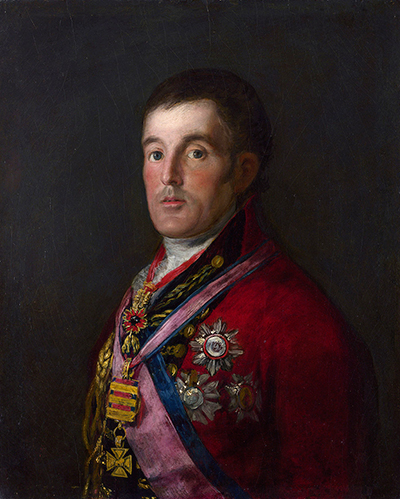
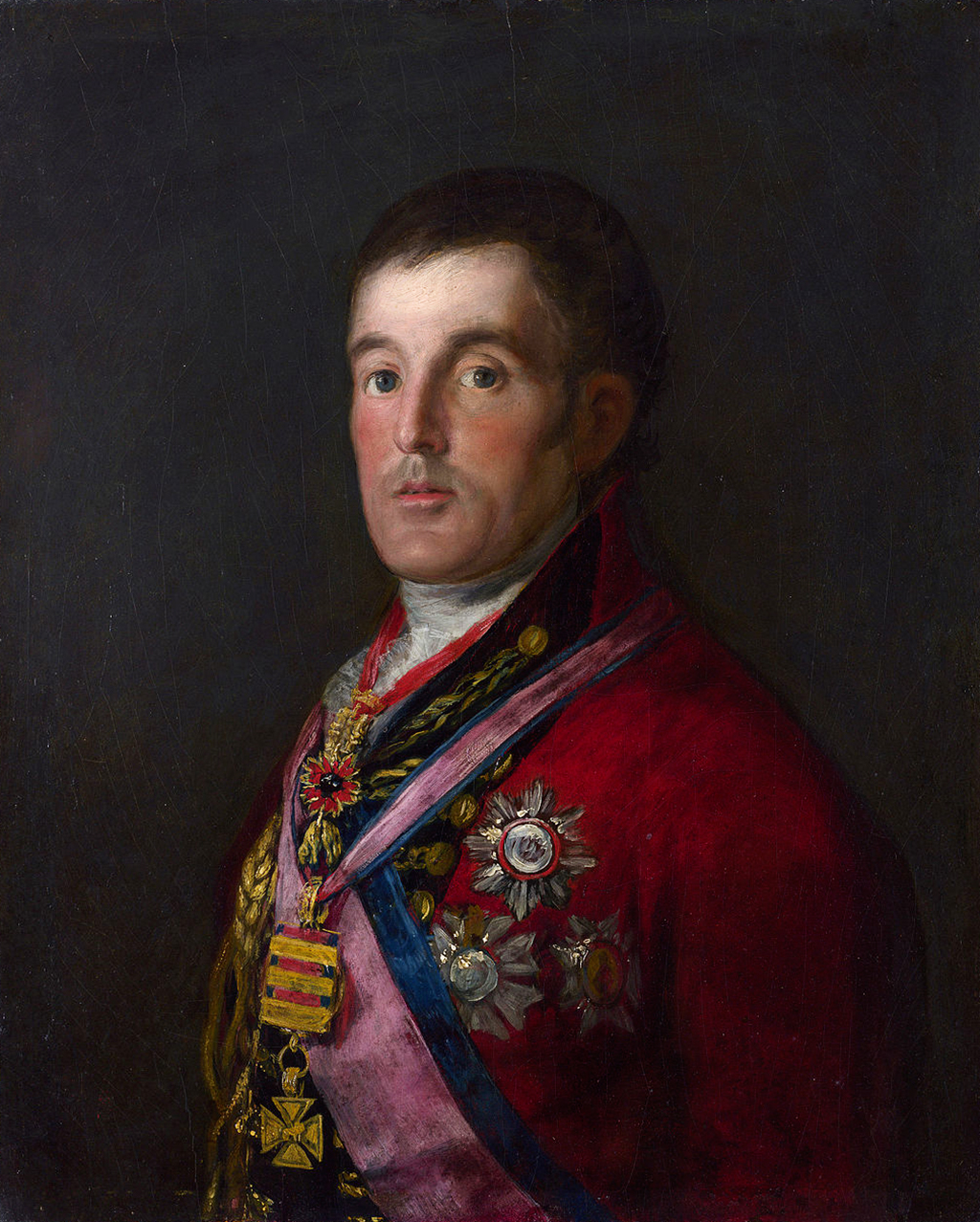
Arthur Wellesley turns his head towards us above a crimson coat heavy with decorations. The light catches his forehead, his eyes and the silver points of a star on his chest. Against a dark, plain background, the pink and blue sashes are easy to follow as they cross the coat. The face takes longer to read. Wellington holds himself upright and meets our gaze, but the shadows around his eyes and the slight parting of his lips give the likeness a wary, tired air. [1] [2]
Francisco de Goya began the portrait after Wellington entered Madrid in August 1812, following the allied victory at Salamanca. He returned to the small wooden panel as Wellington acquired new honours. The medals help date those changes, while technical examination has shown how extensively Goya reworked the body beneath them. [1] [3]
At a Glance
Works across Goya’s career
The Parasol
1777The Nude Maja
1795–1800The Duke of Wellington
1812–14Saturn Devouring His Son
c. 1820–23The Dog
c. 1820–23Wellington sits for Goya in Madrid
On 22 July 1812, the allied army under Wellington defeated Marshal Marmont’s French forces near Salamanca. Wellington was then an earl and a lieutenant-general. He entered Madrid in August, four years after Napoleon’s brother Joseph had been installed on the Spanish throne. For a court painter such as Goya, the arrival of the allied commander presented an opportunity to record a sudden shift in who held power in the capital. The war continued for nearly two more years, and Wellington’s rank and the decorations he could wear changed while the portrait was still being worked on. [1] [4]
The National Gallery suggests that Goya probably worked directly from life and that the panel was almost certainly made for Wellington himself. Its scale suits a painting meant to be seen at close quarters. Wellington’s coat and decorations occupy most of the lower half, and the lower edge cuts across the torso. The head has space around it, particularly above the hair and to the left of the face. With the figure so close and the setting left bare, small differences in where the paint catches the light carry much of the likeness. [1] [2]
Annotated Details from Portrait of the Duke of Wellington, 1812–14
Read the face first, then follow the marks of rank and service across the red coat.
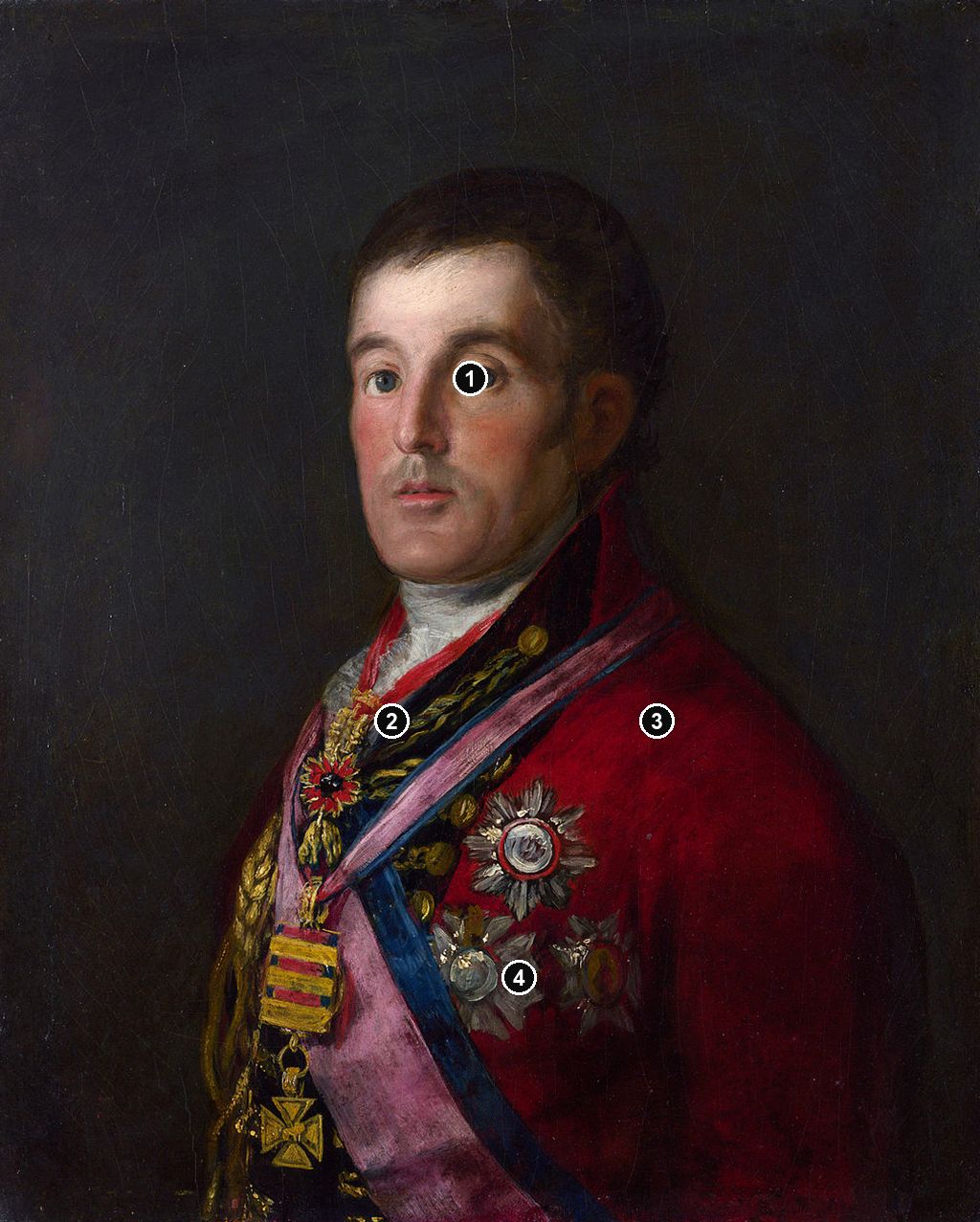
Details from PORTRAIT OF THE DUKE OF WELLINGTON, 1812–14
Details from the panel in the National Gallery, London (NG6322).
Wellington's face
The head turns just far enough for both eyes to meet the viewer.
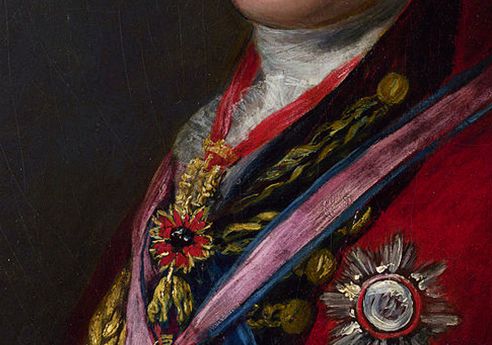
Decorations at the collar
Gold and dark marks cluster beneath the pale collar.
The diagonal sash
The sash runs from the shoulder towards the decorations at the waist.
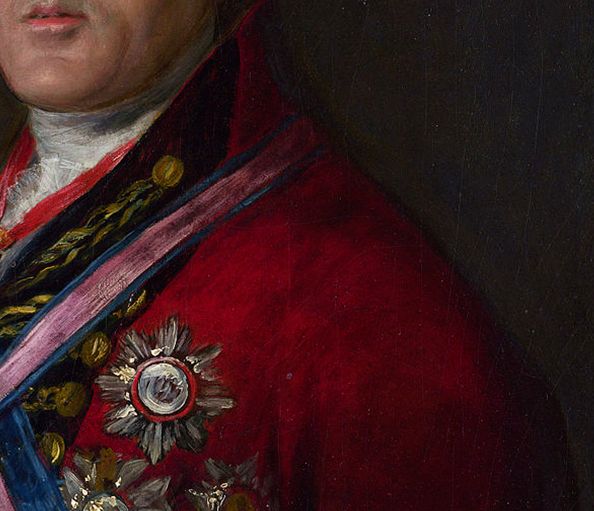
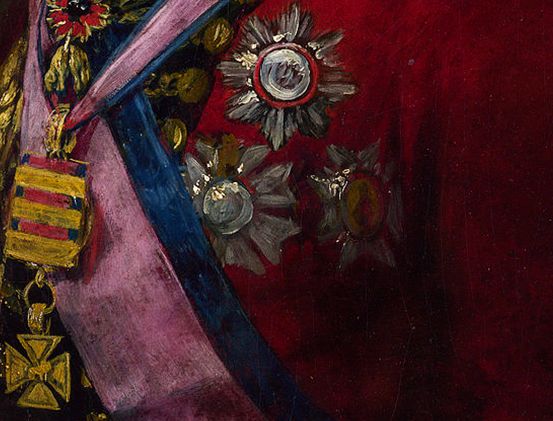
Stars and medals
Bright stars and medal bars punctuate the red coat and dark trim.
The face and the uniform
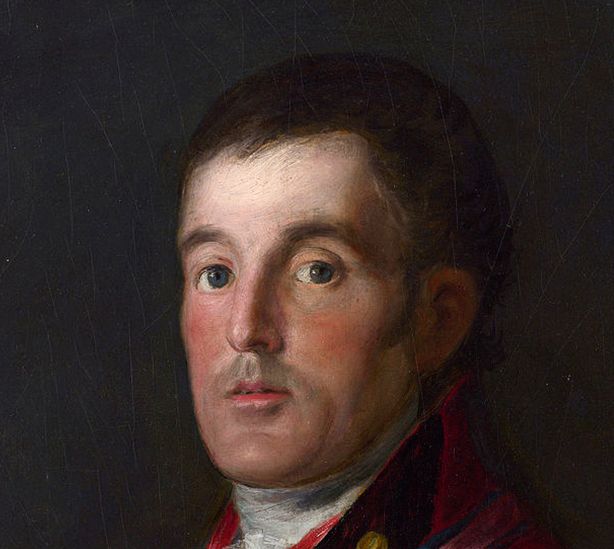
The chest is turned, with the shoulder on the right swelling towards the edge of the panel. Above it, the white neckcloth forms a short, pale curve under the chin. This change from the diagonal of the coat to the curve under the face gives the head a distinct place in the composition. Goya picks out the bridge of the nose and the ridge above the eye on our left, while the ear on the other side recedes into warm shadow. The short dark hair merges with the background near the crown. Look at the lower lip, where a pale touch meets a thin shadow. The mouth seems on the point of moving, despite the sitter’s held pose. [1]
The National Gallery points to the brown preparatory paint still visible around the eyes and mouth. These small areas of exposed ground give depth to features that Goya defines with remarkably little paint. The Fundación Goya en Aragón draws attention to the difference between the fine handling of the face and the fuller strokes used for the coat and insignia. Around the upper breast star, short strokes radiate from the disc. The sash has long strokes that follow the fall of the fabric. On the Military Gold Cross, a flick of yellow suggests the lion in the centre. Goya varies the marks with the material he is describing, from the sheen of ribbon to the sparkle of metal. [1] [2]
What the medals tell us
Three stars are grouped on Wellington’s left breast, to the viewer’s right. The top one belongs to the British Order of the Bath, which he joined in 1804 for his service in India. Below it, the star on the viewer’s left belongs to the Portuguese Order of the Tower and Sword, which he received in 1811. The other lower star belongs to the Spanish Order of San Fernando, bestowed in 1812. The pink sash is the Bath and the blue beneath it is the Tower and Sword. In the painting the blue shows as a narrow edge along the upper diagonal and broadens as the sashes descend. Adding the sashes required Goya to shift some of the decorations and buttons that were already in place. [1] [2] [5]
The Golden Fleece hangs higher, at the centre of the chest on a red neck ribbon. The Fundación Goya en Aragón dates the Spanish award to 7 August 1812 and records Wellington’s acceptance in early September. One of Goya’s drawings of the general, now in the Hamburger Kunsthalle, shows the Golden Fleece above a large round medal. The Fundación connects that arrangement with an earlier state of the panel. It gives a sense of how the narrow space below the collar had to accommodate honours with different ribbons and pendants. [1] [6]
Lower down, three gold clasps sit above the Military Gold Cross on its pink and blue ribbon. The clasps stood for engagements in the campaign. The cross was introduced in October 1813, providing a firm earliest date for that part of the painting. Wellington eventually earned nine clasps. The National Gallery associates the three shown here with the stage his campaign had reached by the time of the 1812 sitting and dates the later alterations to probably 1814. The date range thus brings together the first likeness and a sequence of additions whose timing can only partly be recovered. [1]
Goya on film
Five films explore Goya’s portraits, prints, Black Paintings and painting techniques.
The Duke of Wellington by Goya
The portrait, its military decorations and its later theft.
Watch on YouTubeHow the earlier pose came to light
The National Gallery examined the picture for its 2015 exhibition Goya: The Portraits. Researchers used three-dimensional surface mapping to record the ridges left by brushstrokes and differences in paint thickness where layers had accumulated. The study showed an earlier, more frontal body. Wellington’s right arm originally ran into the lower left corner of the panel, and his left arm was slightly bent. The study also traced repeated changes to the honours on his chest. In a separate scan, macro X-ray fluorescence mapped the distribution of chemical elements associated with pigments and showed changes to the vermilion coat. The evidence locates revisions across the body, including areas where the finished red uniform now looks continuous. [3]
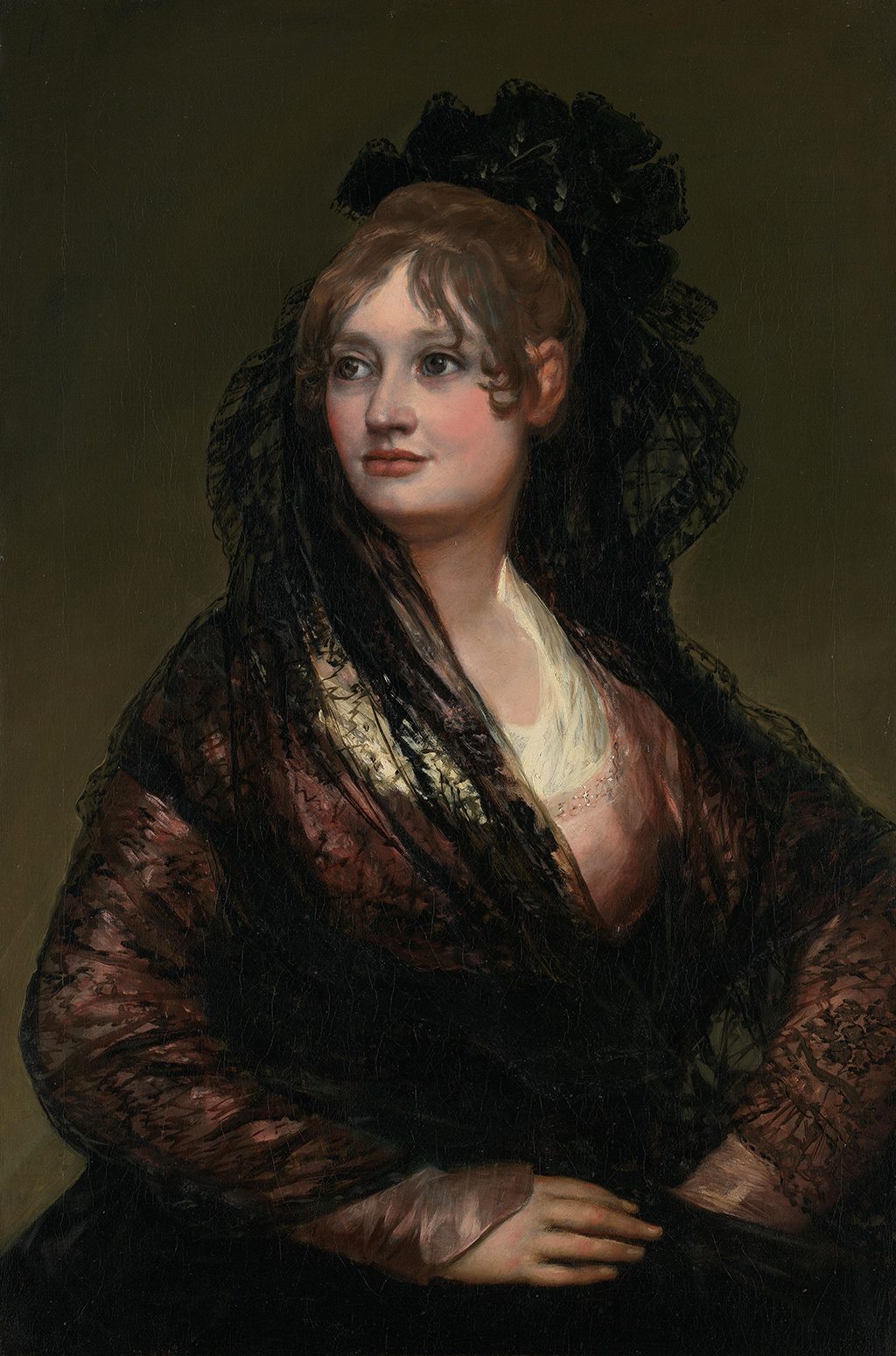
An earlier examination raised a separate question about the panel itself. The conservator Martin Wyld reported that two tiny samples from losses at the edge contained coloured layers that were hard to relate to the visible portrait. A thick layer containing red and white lead obscured the image on the conventional X-radiograph. Wyld proposed that a well-advanced painting may already have been on the board and that it was probably primed again before the Wellington portrait took its present form. The samples suggest reuse and leave the subject of any earlier picture open. Wyld discussed his findings alongside Doña Isabel de Porcel, whose canvas yielded a recognisable figure beneath the visible portrait. [7]
The chalk study and the mounted portrait
Goya’s 1812 chalk study in the British Museum shows a closely related turn of the head. In red chalk over graphite, he uses short lines and patches of shading to describe the face, while the uniform is more lightly indicated. The drawing has fewer decorations than the finished panel. The Fundación Goya en Aragón connects the study with an account by Sir James McGrigor, a military doctor who was present as Wellington sat for Goya, and regards the drawing as a likely model for the head in the mounted portrait. The National Gallery also allows that the panel and drawing could have been made as independent likenesses. The resemblance lets us compare the same face across both works while the order in which Goya used them remains open. [1] [8] [9]
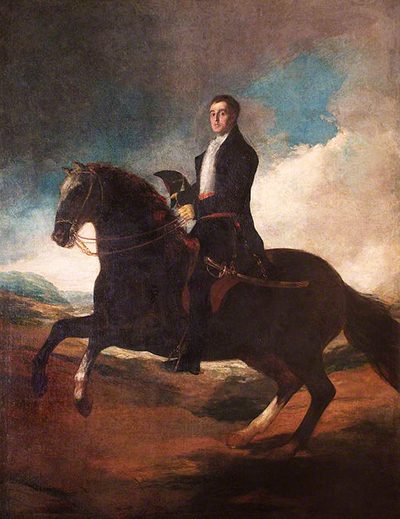
The Equestrian Portrait of the 1st Duke of Wellington is a large oil on canvas at Apsley House, London. It was shown at Madrid’s Royal Academy of Fine Arts in September 1812. Wellington wears dark civilian riding clothes, and his hand, reins and rearing horse have room to establish the pose across the canvas. English Heritage reports that X-radiography of the canvas revealed that Goya added Wellington’s head to a body that had already been painted. In the smaller work, where the body turns within a tight crop, the coat and the weight of its decorations play a much larger part in defining the sitter. [10] [11]
From the Duke of Leeds collection to the National Gallery
By 1878 the panel was recorded in the Duke of Leeds collection at Hornby Castle in Yorkshire. It probably reached the family through Louisa Catherine Caton, Duchess of Leeds, either from Wellington himself or through her sister, who had married his elder brother Richard. The National Gallery bought the work in 1961 with assistance from the Wolfson Foundation and a special Exchequer grant. The purchase kept the portrait in Britain and gave it a public home. [1]
The painting disappeared from the Gallery on 21 August 1961 and was recovered in May 1965. Kempton Bunton, a campaigner for free television licences for pensioners, came forward and told police that he had taken it. A jury convicted him of taking the frame, which was still missing, and he served three months in prison. The Gallery archive records that his son John confessed to the theft in 1969. The case later inspired the film The Duke, with Jim Broadbent as Kempton Bunton. [1] [12] [13]
Artworks directory
| Name | Date | Medium |
|---|---|---|
| And There’s No Help for It, Plate 15 | Printed 1863 | |
| Asmodea | c. 1820–23 | Wall painting transferred to canvas |
| Boys Inflating a Bladder | 1777–78 | Tapestry cartoon |
| Boys Picking Fruit | 1778 | Tapestry cartoon |
| Bullfight in a Divided Ring | 1825 | Lithograph |
| Card Players | 1777–78 | Tapestry cartoon |
| Card Players (sketch) | 1777–78 | Painted sketch |
| Dance on the Banks of the Manzanares | 1777 | Tapestry cartoon |
| Duel with Cudgels | c. 1820–23 | Wall painting transferred to canvas |
| Heads in a Landscape | c. 1820–23 | Easel painting |
| Judith and Holofernes | c. 1820–23 | Wall painting transferred to canvas |
| Leocadia | c. 1820–23 | Wall painting transferred to canvas |
| Maja and Cloaked Men | 1777 | Tapestry cartoon |
| Maja and Cloaked Men (sketch) | 1777 | Painted sketch |
| Majo Clapping in Time to the Music | 1777 | Drawing |
| Men Reading | c. 1820–23 | Wall painting transferred to canvas |
| Out Hunting for Teeth, Plate 12 | 1799 | Etching, burnished aquatint and burin |
| Picnic in the Countryside (sketch) | 1776–78 | Painted sketch |
| Picnic on the Banks of the Manzanares | 1776 | Tapestry cartoon |
| Pilgrimage to San Isidro | c. 1820–23 | Wall painting transferred to canvas |
| Preparatory study for The Sleep of Reason Produces Monsters | c. 1796–97 | Drawing |
| Procession of the Holy Office | c. 1820–23 | Wall painting transferred to canvas |
| Quarrel at the Cockerel Inn (sketch) | 1777 | Painted sketch |
| Quarrel in the New Tavern | 1777 | Tapestry cartoon |
| Saturn Devouring His Son | c. 1820–23 | Wall painting transferred to canvas |
| Seated Majo Smoking | c. 1776 | Drawing |
| The Dog | c. 1820–23 | Wall painting transferred to canvas |
| The Drinker | 1777 | Tapestry cartoon |
| The Fates | c. 1820–23 | Wall painting transferred to canvas |
| The Great He-Goat | c. 1820–23 | Wall painting transferred to canvas |
| The Kite | 1777–78 | Tapestry cartoon |
| The Parasol | 1777 | Oil on canvas, tapestry cartoon |
| The Second of May 1808 | 1814 | Oil on canvas |
| The Sleep of Reason Produces Monsters, Plate 43 | 1799 | Etching and aquatint |
| The Third of May 1808 | 1814 | Oil on canvas |
| Thou Who Canst Not, Plate 42 | 1799 | Etching and burnished aquatint |
| Three Figures | 1776 | Drawing (lost) |
| Two Old Men | c. 1820–23 | Wall painting transferred to canvas |
| Two Old Men Eating Soup | c. 1820–23 | Wall painting transferred to canvas |
| Two Women and a Man | c. 1820–23 | Wall painting transferred to canvas |
| Universal Language: The Author Dreaming | 1797 | Drawing |
| The Family of Charles IV | 1800 | Oil on canvas |
| Witches’ Sabbath (Osuna painting) | 1797–98 | Oil on canvas |
| The Nude Maja | 1795–1800 | Oil on canvas |
| The Clothed Maja | 1800–07 | Oil on canvas |
| Self-Portrait (Drawing) | c. 1796 | Brush and carbon black ink on laid paper |
| The Swing, Madrid Album B.21 | 1795–97 | Brush and carbon black washes |
| Majas Fighting, a Majo Observing, Madrid Album B.15 | 1796–97 | Brush, grey and black washes on laid paper |
| Majos and Majas Conversing, Madrid Album B.16 | c. 1794–97 | Ink wash on paper |
| Weeping Woman and Three Men, Madrid Album B.17 | 1795–97 | Brush, carbon black washes and black chalk |
| Maja Seated on a Chair and Two Companions Behind, Madrid Album B.18 | 1795–97 | Brush and carbon black washes |
| Girl and Bull, Madrid Album B.23 | 1796–97 | Brush and carbon black washes |
| Lovers Sitting on a Rock, Madrid Album B.24 | 1796–97 | Brush and carbon black washes |
| Mariano Ceballos Riding a Bull | 1825 | Crayon lithograph and scraper |
| Landscape (lifetime impression) | c. 1807–10 | Etching and aquatint |
| Self-Portrait (1815), Prado canvas | 1815 | Oil on canvas |
| Self-Portrait (1815), Academy panel | 1815 | Oil on panel |
| Self-Portrait with Dr Arrieta | 1820 | Oil on canvas |
| Christ Crucified | 1780 | Oil on canvas |
| The Last Communion of Saint Joseph of Calasanz | 1819 | Oil on canvas |
| Christ on the Mount of Olives | 1819 | Oil on panel |
| The Flower Girls, or Spring | 1786–87 | Oil on canvas |
| The Grape Harvest, or Autumn | 1786–87 | Oil on canvas |
| The Snowstorm, or Winter | 1786–87 | Oil on canvas |
| The Threshing Ground, or Summer | 1786–87 | Oil on canvas |
| Picnic on the Banks of the Manzanares | 1776 | Oil on canvas |
| The Kite | 1777–78 | Oil on canvas |
| Dance on the Banks of the Manzanares | 1777 | Oil on canvas |
| A Fight at the Venta Nueva | 1777 | Oil on canvas |
| Blind Man’s Bluff | 1788 | Oil on canvas |
| Dogs on a Lead | 1775 | Oil on canvas |
| Hunting with a Decoy | 1775 | Oil on canvas |
| Hunter Loading His Rifle | 1775 | Oil on canvas |
| The Angler | 1775 | Oil on canvas |
| The Hermitage of San Isidro on His Feast Day | 1788 | Oil on canvas |
| The Meadow of San Isidro | 1788 | Oil on canvas |
| The Straw Manikin | 1791–92 | Oil on canvas |
| Witches’ Flight | c. 1797–98 | Oil on canvas |
| A Scene from ‘The Forcibly Bewitched’ | 1798 | Oil on canvas |
| The Duchess of Alba in Black | 1797 | Oil on canvas |
| The Duchess of Alba in White | 1795 | Oil on canvas |
| Charles III in Hunting Dress | c. 1786 | Oil on canvas |
| The Duke and Duchess of Osuna and Their Children | 1787–88 | Oil on canvas |
| Manuel Osorio Manrique de Zúñiga | 1787–88 | Oil on canvas |
| The Marquesa de Pontejos | c. 1786 | Oil on canvas |
| Equestrian Portrait of the 1st Duke of Wellington | 1812 | Oil on canvas |
| The Duke of Wellington | 1812–14 | Oil on wood |
| Portrait of Ferdinand VII of Spain | 1814 | Oil on canvas |
| Gaspar Melchor de Jovellanos | 1798 | Oil on canvas |
| María Tomasa Palafox y Portocarrero | 1804 | Oil on canvas |
| Señora Sabasa García | c. 1806–11 | Oil on canvas |
| Don Juan Bautista de Muguiro | 1827 | Oil on canvas |
| Doña Isabel de Porcel | Before 1805 | Oil on canvas |
| The Colossus | After 1808 | Oil on canvas |
| The Burial of the Sardine | 1808–12 | Oil on panel |
| The Madhouse | 1808–12 | Oil on panel |
| A Procession of Flagellants | 1808–12 | Oil on panel |
| Portrait of Jacques Galos | 1826 | Oil on canvas |
| Portrait of Mariano Goya, the Artist’s Grandson | 1827 | Oil on canvas |
| Milkmaid of Bordeaux | c. 1827 | Oil on canvas |
| Portrait of Don Juan Antonio Cuervo | 1819 | Oil on canvas |
| María Luisa of Parma (Naples version) | c. 1800 | Oil on canvas |
| The Countess of Baena | 1819 | Oil on canvas |
| The Family of the Infante Don Luis | 1783–84 | Oil on canvas |
| The Holy Family | c. 1787 | Oil on canvas |
| Saint Barbara | c. 1773 | Oil on canvas |
| Saints Justa and Rufina | 1817 | Oil on canvas |
| El Tío Paquete | c. 1819–20 | Oil on canvas |
| The Forge | c. 1815–20 | Oil on canvas |
| Majas on a Balcony (Metropolitan Museum version) | c. 1800–10 | Oil on canvas |
| Maja and Celestina on a Balcony | c. 1808–12 | Oil on canvas |
| The Water Bearer | 1808–12 | Oil on canvas |
| Time and the Old Women | c. 1810 | Oil on canvas |
Frequently Asked Questions
Goya began it around the time Wellington sat for him in Madrid in August 1812. The Military Gold Cross, visible near the bottom of the painting, was introduced in October 1813. The National Gallery dates the later reworking to probably 1814. [1]
Discussion
Look again at the images and ideas explored in Portrait of the Duke of Wellington, 1812–14. These editorial prompts invite your observations.
Follow the sashes across the uniform, then return to the eyes and mouth. Where do the brushmarks make the fabric or metal catch your attention, and where does Goya use the brown ground to give the face its expression? Would the earlier, more frontal pose change the way you read that expression?
Reader Insights
How does the red coat shape what you notice about Wellington’s face?
Which marks pull your eye down towards the medals?
Join the Conversation
Share a detail, comparison or question about Portrait of the Duke of Wellington, 1812–14 below.
References
- The National Gallery, Francisco de Goya, The Duke of Wellington, NG6322, collection record. View source.
- Fundación Goya en Aragón, The Duke of Wellington (El duque de Wellington), catalogue entry 318. View source.
- The National Gallery, ‘New technical imaging techniques at the National Gallery’, Review of the Year 2015–2016, pp. 44–45. View source.
- National Army Museum, Wellington: The Iron Duke. View source.
- The Gazette, A history of the Order of the Bath: Part 2 (1726–1825). View source.
- Fundación Goya en Aragón, El duque de Wellington, catalogue entry 1412, Hamburger Kunsthalle 38547. View source.
- Martin Wyld, ‘Goya’s Re-use of a Canvas for “Doña Isabel”’, National Gallery Technical Bulletin, vol. 5 (1981), p. 38. View source.
- British Museum, Arthur Wellesley, 1st Duke of Wellington, drawing, 1862,0712.185, museum entry on Google Arts & Culture. View source.
- Fundación Goya en Aragón, El duque de Wellington, catalogue entry 319, British Museum drawing. View source.
- English Heritage, Apsley House Collection Highlights, entry for Goya’s Equestrian Portrait of the 1st Duke of Wellington. View source.
- Fundación Goya en Aragón, The Duke of Wellington on Horseback (El duque de Wellington a caballo), catalogue entry 317. View source.
- The National Gallery Archive, Hugh Courts’ papers relating to the trial of Kempton Bunton, NGA26. View source.
- The National Gallery, Jim Broadbent meets “The Duke of Wellington”. View source.







