


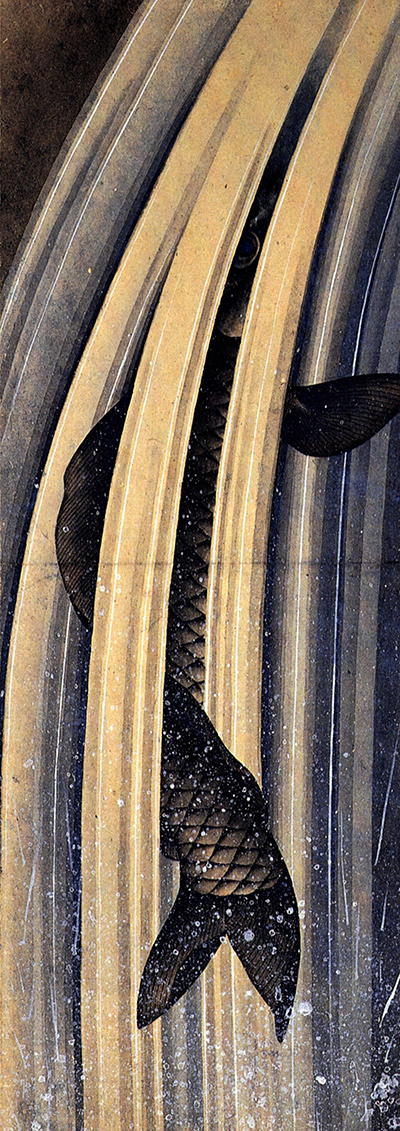
Carp Leaping up a Cascade, attributed to Katsushika Hokusai. Date, medium and holding unconfirmed.
Buy Art Prints Nowfrom Amazon
* As an Amazon Associate I earn from qualifying purchases.
 by Tom Gurney
Tom Gurney BSc (Hons) is an art history expert with over 20 years experience
Published on June 19, 2020 / Updated on November 20, 2026
Email: tomgurney1@gmail.com / Phone: +44 7429 011000
Carp Leaping up a Cascade
A dark carp rises from the bottom of a narrow picture, then almost disappears into the falling water. Its forked tail is easy to see. The eye, much farther up, is a faint ring between two pale bands. The longer you look, the more of the fish you can trace. The picture circulates under the title Carp Leaping up a Cascade and is attributed to Katsushika Hokusai. The published reproduction traces to an image archive without an object or collection number, so the attribution, date and medium of this particular image remain unconfirmed. Hokusai’s documented work gives us several ways to understand the composition. [1] [2] [3]
At a Glance
- ArtistKatsushika Hokusai and works attributed to him
- ScopeCarp and streaming water in Hokusai’s work
Contents
Finding the carp in the falling water
Start towards the bottom, where pale specks run across a tail with two pointed lobes. Alternating rows of scales become clear above the fork. Higher up, a pale stream passes in front of the scales and interrupts their pattern. A fin projects across a darker band of water on the right. The faint eye is tucked into a narrow dark interval above it. From any one of those details, the rest of the carp is difficult to read. Taken in sequence, they let the viewer reconstruct the body across openings in the cascade. [1]
The lightest ribbons enter near the top at a slant and straighten towards the bottom. Some are broad enough to conceal a large part of the fish. Thin lines mark other streams, including those running alongside the tail, where the viewing distance makes a difference. From a distance, the narrowest lines and small pale specks merge into the passage of silvery water. Close up, they divide the tall image into many different currents. The dark body of the carp interrupts that division in the lower part, where the tail cuts diagonally across the long pale ribbons. [1]
Little outside the water locates this scene. There are no clearly defined banks or trees to give the cascade a scale, and the image shows no pool below. The long lines continue beyond the top and bottom edges, and the carp looks small beside the full height of the picture. Its upward orientation is enough to put the dark body in tension with the falling streams. In the upper half, though, it nearly vanishes. That difference between what can be seen near the tail and what can be seen near the head is central to the impression of movement. [1]
A painted carp in Six Tama Rivers
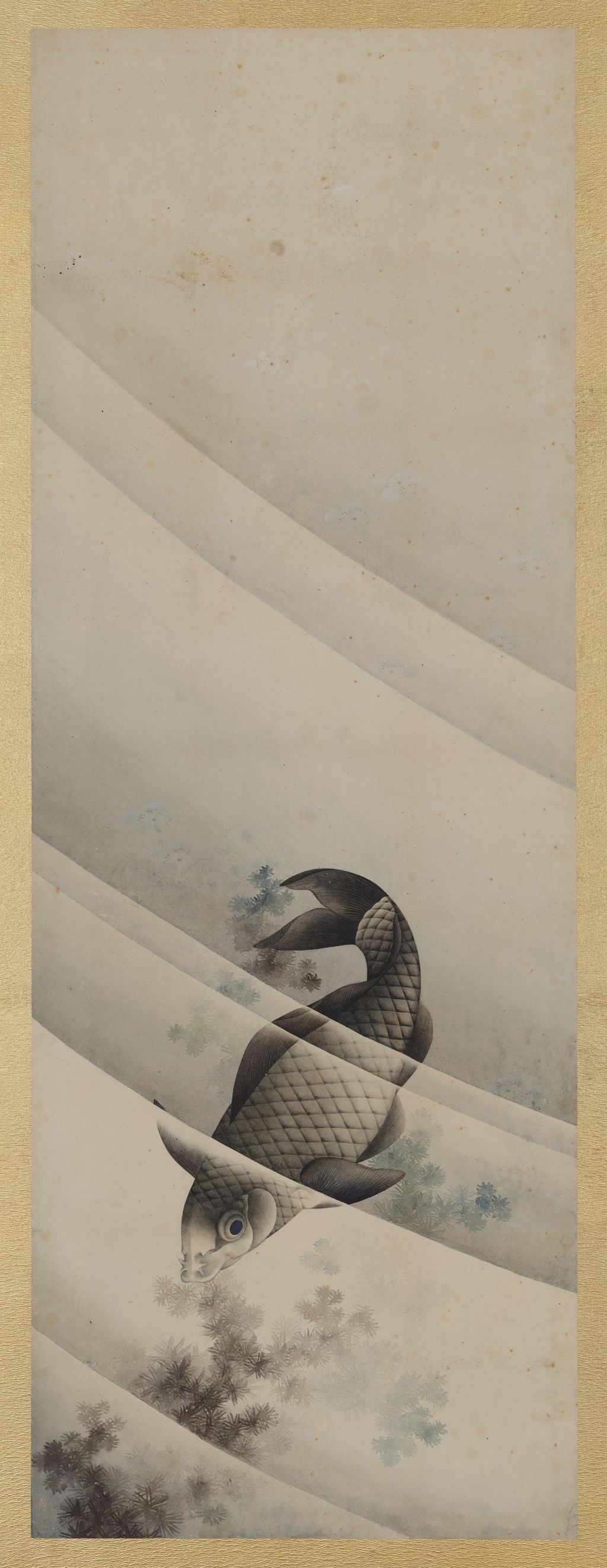
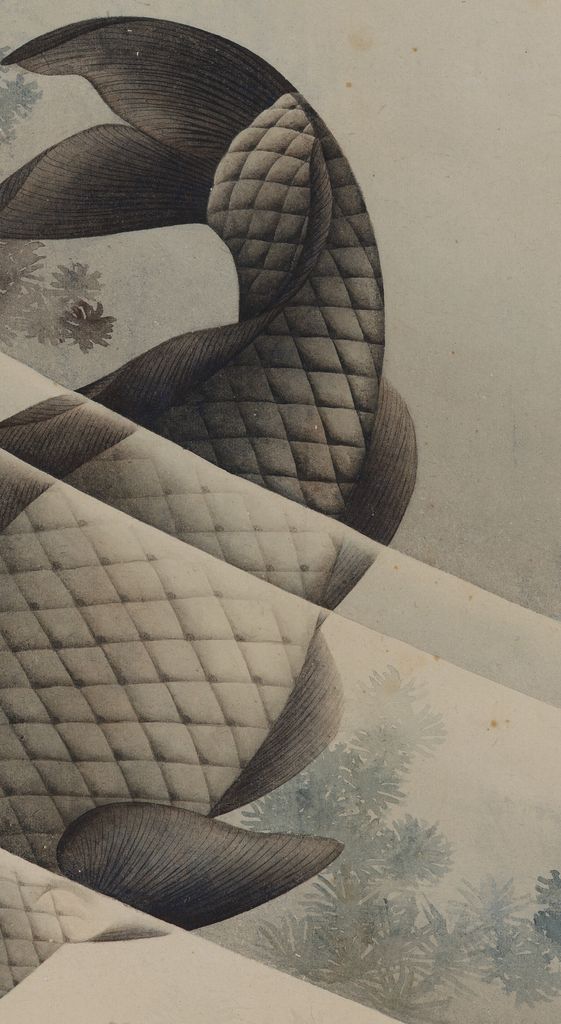
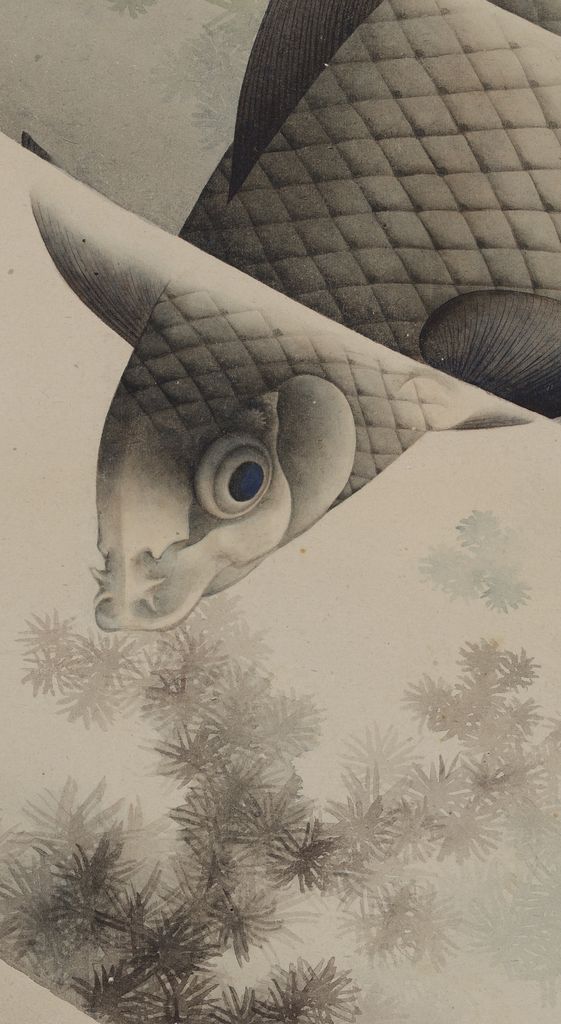
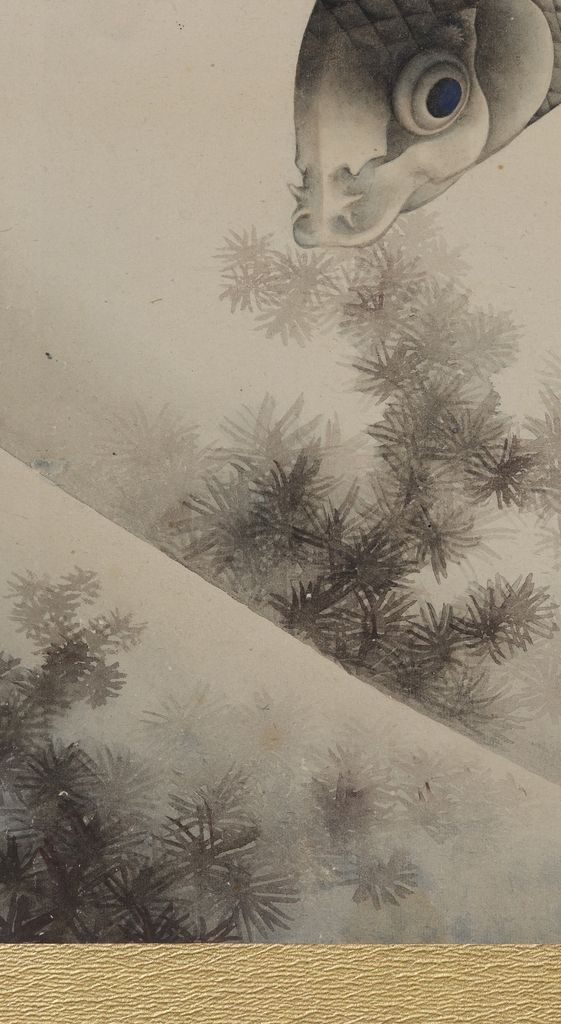
Hokusai worked out a related problem in a documented painting dated 1833. The Freer Gallery’s Six Tama Rivers consists of two six-panel screens painted in ink and colour on paper. One panel shows a carp turning down through pale curves towards water plants. Matthi Forrer associates this image with the Ide River, one of the six waterways invoked in classical poetry. The panel leaves most of the space above the fish open, so the viewer meets broad, lightly painted arcs before the animal appears in the lower half. The shape of those arcs and the fish’s position distinguish it from the narrow waterfall reproduction. [2] [3]
In the Freer photograph the fish is visible in several passages. The tail turns left near the upper end of the body, where the darker scales are easiest to follow. A broad pale curve then cuts across the upper flank. More of the body is visible lower down, through a different span of water, before another light edge passes over it. At the lower end the eye and nose come forward against a light ground. The turns of the body lead down into the plant forms. In the waterfall reproduction the eye is nearly hidden, the tail points down and the water travels much more steeply across the whole height. Each composition makes the viewer locate the carp by degrees, but it leads the eye in its own direction. [1] [2] [3]
The screen panel also gives the fish a relation to the larger work. A narrow upright view is one part of a pair of screens that offer several encounters with water, landscape and human figures. In the Ide panel, the tilt of the water and the placement of the plants give a specific form to moving downstream. The reproduction called Carp Leaping up a Cascade concentrates on the encounter between a fish and the bands that surround it. Looking at the panel on its own makes the two compositions especially easy to compare. Seeing it within the group also restores the setting for the documented painting. [1] [2] [3]
Other carp paintings from Hokusai’s career
Forrer traces several versions of the subject. He describes a painting attributed to around 1805–06 that bears Hokusai’s Tōyō Gakyōjin signature and depicts a carp in a vertical pose with a twisted body and an open mouth. He gives its whereabouts as unknown and mentions a similar unsigned painting. Those details establish that Hokusai was already exploring the subject in brush painting early in the nineteenth century. The dark waterfall reproduction does not show a clearly open mouth or a visible signature, and the catalogue account supplies no match between those works and this image. [1] [3]
The Okada Museum of Art records its Swimming Carp as a hanging scroll in ink and light colour on silk from 1839. Forrer describes that painting’s fish as diving down with its tail above the surface and a substantial part of the middle of the body obscured. He compares it to a signed 1840 silk painting in which the carp’s head and tail are both clear while parts of the body disappear beneath successive streams. In the published 1840 photograph the tail is high at the right and the head is lower and farther left. Both ends of the fish are visible because the broad, gently descending bands leave parts of the body open to view. [3] [4]
Taken together, those paintings show how much difference a few clear features can make. The eyes of the fish in the Freer panel and the 1840 painting help a viewer judge the direction of travel. Their pale bands still interrupt the body, so the impression of depth comes from one shape repeatedly being covered by another. In the dark waterfall reproduction the body is harder to reconstruct. The light bands control nearly the whole image, and one has to read the position of the upper eye and the lower tail as clues. That difference is visible in the images even while the source of the waterfall reproduction remains uncertain. [1] [2] [3]
A separate design with two carp
The Tokyo National Museum’s Carp Ascending a Waterfall is a colour woodblock print. The museum’s Japanese account specifies two fish, one in the pool and the other rising up the fall. The British Museum holds another impression, dated around 1833, and records a large vertical print measuring 52.2 by 23.2 centimetres. It brings steep swathes of pale water together with rocky banks and patches of vegetation. The two-carp article follows the relationship between the upper fish and the one below. The single-carp reproduction provides no comparable second figure or rocky frame. [1] [5] [6]
A tall format could support several answers to the same visual problem. In the two-carp print, the exposed areas of rock make the course of the waterfall easier to establish at a glance. The banks provide resting points from which the viewer can look back into the water. In the dark reproduction almost everything that gives the picture direction belongs to the water itself. The movement of the fish must be read against the movement of the fall, through the narrow places where the body is visible. The difference is a matter of composition and persists across the colour differences visible in reproduced prints. [1] [5] [6]
The same English title can also refer to work by other artists. The Chiba City Museum of Art catalogues Keisai Eisen’s Carp in Waterfall as a colour woodblock print in two vertically joined sheets. In its early impression, a large eye and most of the head are clearly visible high in the design. The long dark-blue streams pass across the body, but its copper-toned scales, more exposed fins and upper inscription give this fish a different place in the picture. Chiba’s example helps explain why the presence of one leaping carp, even in a tall and narrow sheet, cannot identify a design by itself. [1] [7]
The Dragon Gate and the picture’s limits
The British Museum connects Hokusai’s two-carp design to the Chinese story in which a carp that makes it past the falls of the Dragon Gate becomes a dragon. Japan Search explains that the ascending fish became an auspicious image of advancement in Japan. That tradition gives the effort of a fish moving against current a meaning beyond natural history. It can also help explain why artists returned to the subject in different formats and with different treatments of the water. In the single-carp reproduction, the fish remains partly inside the fall and its journey beyond the top is left to the viewer’s imagination. [1] [6] [8]
The most immediate question the picture sets is how to see through moving water. Follow the lower scales up until the light band breaks their pattern. Look for the fin farther right, then look again for the eye above it. The body does not become clearer simply because it is nearer the top. It slips in and out of sight as the water divides it into visible and hidden parts. The Freer panel offers an authenticated example of Hokusai using a comparable device in a different composition. The comparison lets us read what the two pictures do while leaving the single-carp image’s source open. [1] [2] [3]
Works across Hokusai’s career
Annotated Details from Six Tama Rivers, Ide River panel with a swimming carp
Smithsonian National Museum of Asian Art, Freer Gallery of Art. F1904.204–205, photograph FS-F1904.204-205_012. CC0. [2]
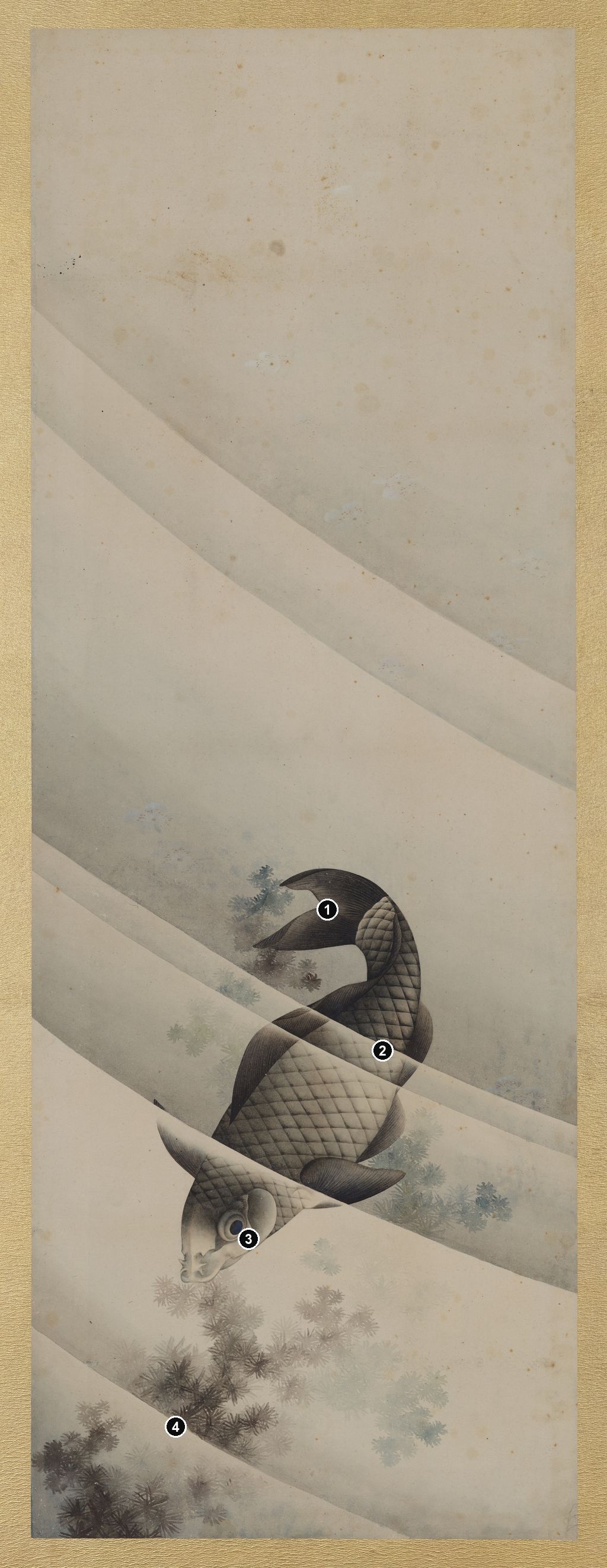
Details from SIX TAMA RIVERS, IDE RIVER PANEL WITH A SWIMMING CARP
Select a detail to look closely.
The tail turns above the body
The forked form changes direction where the fish begins to curve through the current. [2]
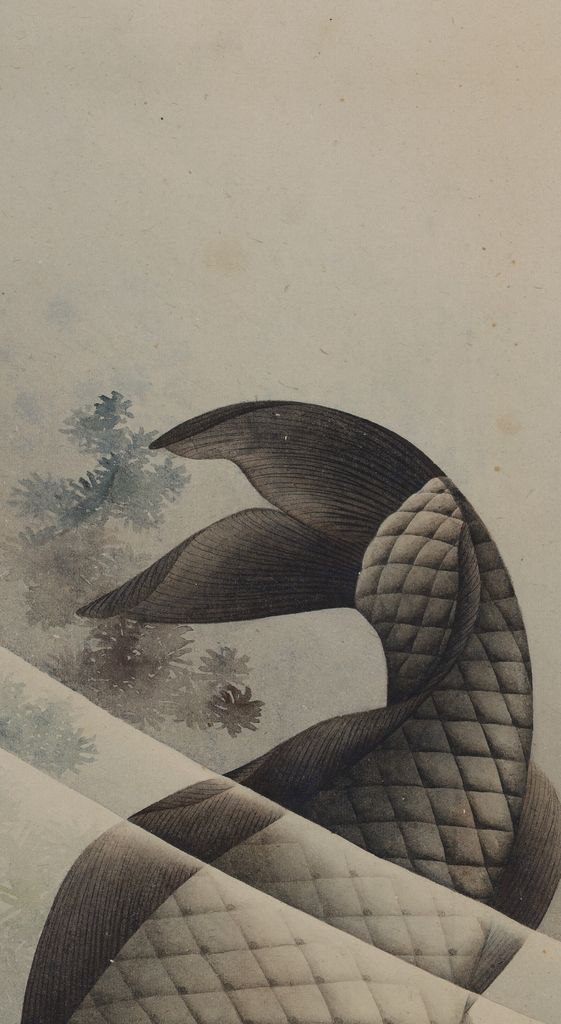
A pale band crosses the scales
The bands allow different amounts of the fish to show as the dark form passes through them. [2]
The face comes into view below
The head appears separately after the interrupted markings along the back. [2]
Plants mark the lower reach
The low plants offer another indication of depth beneath the open water. [2]
Explore Hokusai’s works
Discussion
Look again at the images and ideas explored in Carp Leaping up a Cascade. These editorial prompts invite your observations.
Reader Insights
Where does the changing opacity of the water conceal the fish?
How do the bands of water differ between the painting and the two-carp print?
Join the Conversation
Share a detail, comparison or question about Carp Leaping up a Cascade below.
References
- Wikimedia Commons, Carp leaping up a cascade. Reproduction credited to Visipix. Its description attributes the picture to Hokusai without identifying the original object or holding. View source.
- Smithsonian National Museum of Asian Art, Freer Gallery of Art, Katsushika Hokusai, Six Tama Rivers, 1833, F1904.204–205. Collection record and CC0 image for the painted carp panel, photograph FS-F1904.204-205_012. · Carp panel photograph View source 1. View source 2.
- Matthi Forrer, “Carp in Streaming Water,” in Christie’s object catalogue for Katsushika Hokusai, Swimming Carp, lot 6495956. Discusses early painted versions, the Ide River panel and the signed 1839 and 1840 paintings. View source.
- Okada Museum of Art, tenth-anniversary exhibition checklist, part two, Utamaro and Hokusai, item 35, 遊鯉図 (Swimming Carp), 1839, ink and light colour on silk, one hanging scroll. View source.
- Tokyo National Museum and Japan’s Agency for Cultural Affairs, 葛飾北斎筆《鯉の滝登り》, A-10569-659. Object record and Japanese curatorial description of the two fish. View source.
- British Museum, Katsushika Hokusai, Carp Ascending a Waterfall, 1927,0413,0.14. Object dimensions, impression image and Dragon Gate context. View source.
- Chiba City Museum of Art, Keisai Eisen, 鯉の滝登り〈初摺〉 (Carp in Waterfall, early impression), Imonaka Collection. Object description, measurements and photograph. View source.
- Japan Search, National Diet Library digital gallery Katsushika Hokusai. Japanese interpretation of the carp’s ascent as an auspicious theme. View source.







