


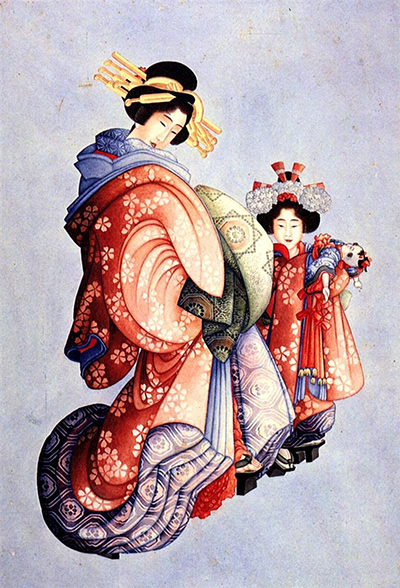
Courtesan and young attendant, attributed to Katsushika Hokusai. Date, medium and holding unconfirmed.
Buy Art Prints Nowfrom Amazon
* As an Amazon Associate I earn from qualifying purchases.
 by Tom Gurney
Tom Gurney BSc (Hons) is an art history expert with over 20 years experience
Published on June 19, 2020 / Updated on November 20, 2026
Email: tomgurney1@gmail.com / Phone: +44 7429 011000
Oiran and Kamuro in Hokusai’s Art
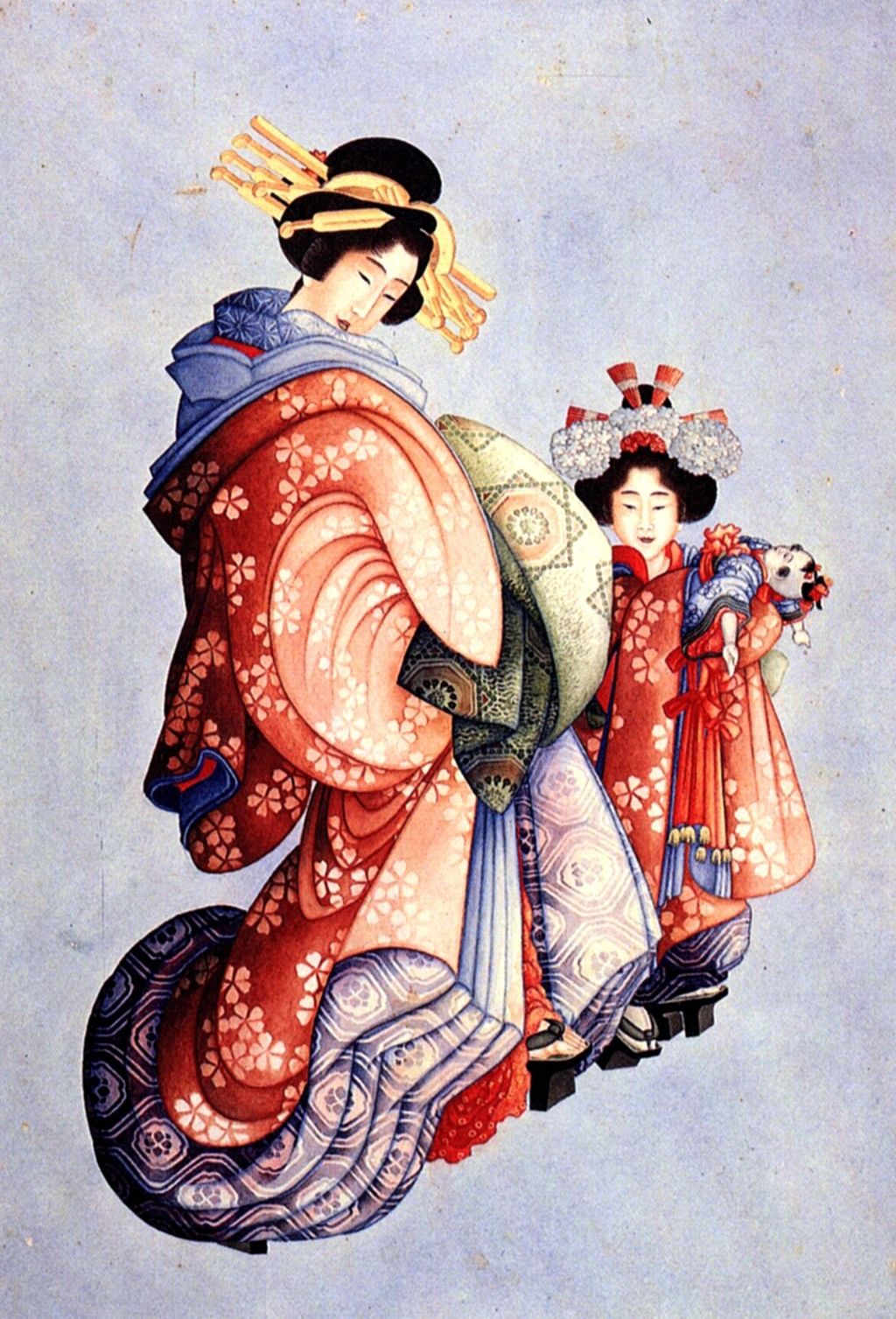
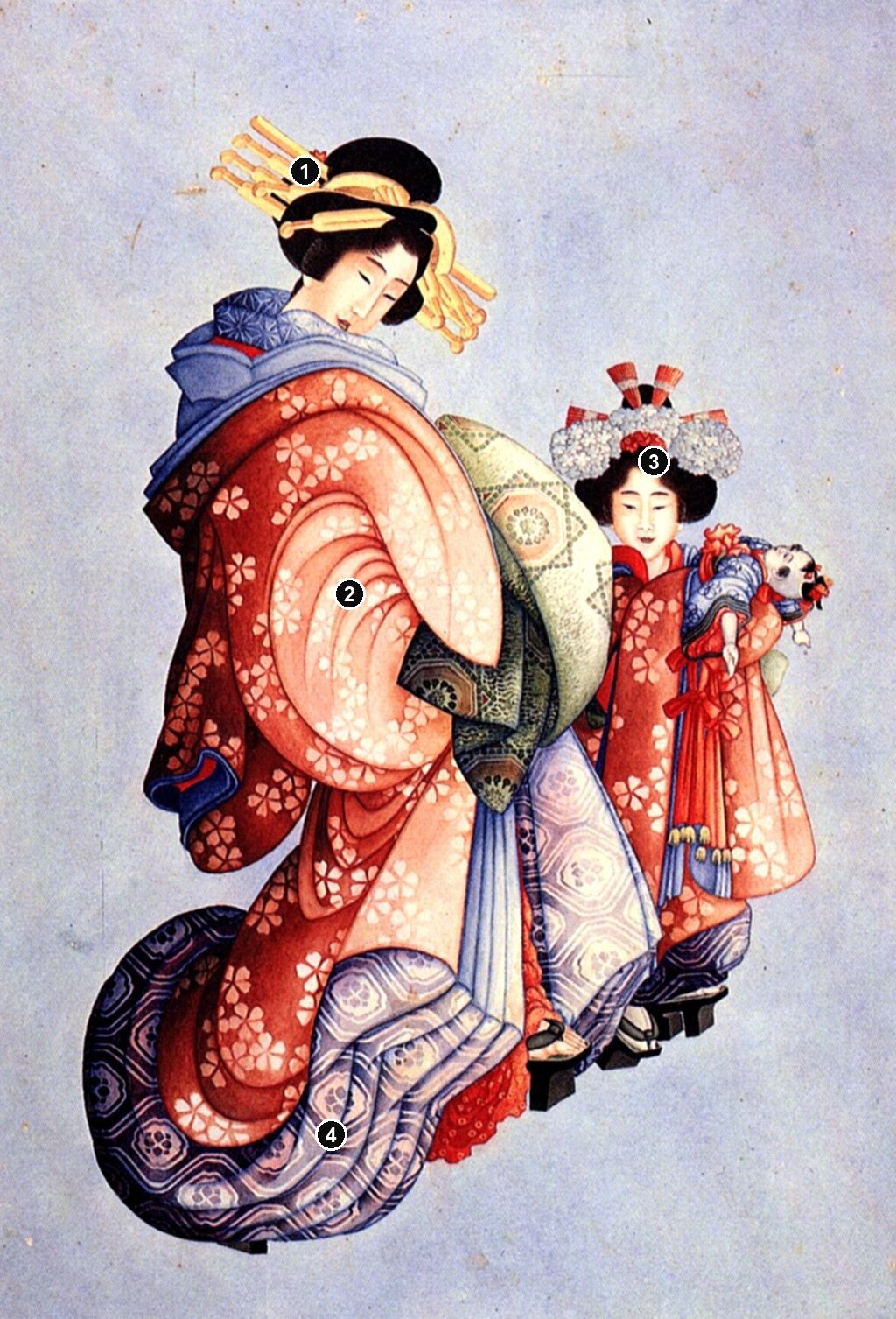
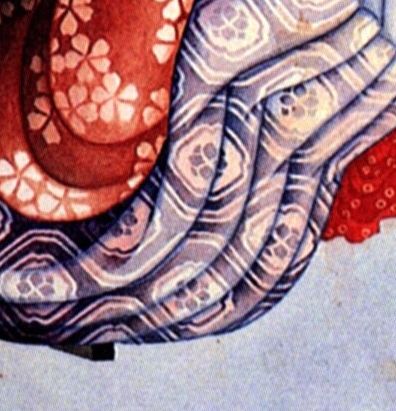
The courtesan bends her head towards the child at her right. Long hairpins extend on either side of her head, the outer red robe curves around the elbow, and a blue and violet hem gathers near the bottom of the image. Behind this sweep of fabric the smaller figure emerges in a red robe of her own. The image circulates under the title Oiran and Kamuro and is attributed to Katsushika Hokusai in the online reproduction. Its physical original, date and medium remain unconfirmed. The relationship in the title also appears in Hokusai’s documented images of courtesans and attendants, including a print the Sumida Hokusai Museum reproduced in its exhibition Hokusai Beauty. [1] [2]
An oiran was a high-ranking courtesan in Edo’s Yoshiwara. A kamuro was a child attendant who served a senior courtesan. The terms describe positions within the district’s hierarchy. Artists represented them together in paintings and prints, often making the difference between the figures legible through dress, posture and scale. Hokusai’s Sumida example gives both figures elaborate hairstyles, then stresses their different places through the size of the hair arrangements and the space their garments occupy. [2] [3] [4]
At a Glance
- ArtistAttributed to Katsushika Hokusai
- ScopeCourtesan and young attendant
Contents
How the two figures occupy the picture
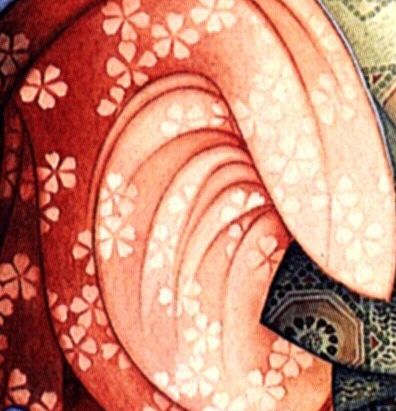
The reproduction with the blue ground gives the greater part of its width to the courtesan. Her head is inclined, but the black mass of hair and the light pins projecting sideways keep its outline distinct. Below her face a blue collar gives way to broad red and pink areas. The widened sleeve turns back on itself in a series of nested bands. Follow the curve down to the lower left and it opens into a train with alternating dark and pale edges. Those changes in colour carry the eye around a garment whose boundaries would be difficult to read as individual folds at this scale. [1]
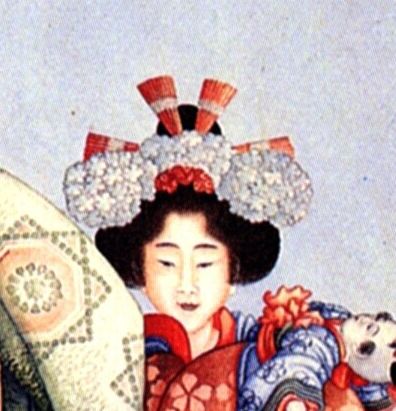
The attendant stands far enough behind the courtesan for part of her robe to be hidden. Her face appears beside a pale patterned fold of the larger figure’s clothing. The two heads make a diagonal across the upper half of the image, while the ends of their hair ornaments project in several directions. Look at the red areas on either figure. The adult’s sleeve contains broad sweeps of pink and orange bounded by dark edging. The child’s garment falls in narrower red and blue lines, giving her a more upright shape. She holds a small object at about shoulder height. Its shape is visible, but the reproduction alone leaves its identity uncertain. [1]
Much of what establishes the pair’s relationship comes from the overlap. There is no clearly delineated street, room or parade route in the blue field. The fabric and the unequal scale of the heads supply the nearest thing to spatial markers. The child’s partial concealment allows the larger silhouette to hold together, even as the red of both garments draws the figures into one group. A different image might make their relation clear by showing an exchange of objects or a shared task. In this reproduction, placing the child just behind the broad red sleeve identifies the two figures as a pair before the viewer has followed where their gazes lead. [1] [3]
Hokusai’s documented prints of the pair
The exhibition checklist for Hokusai Beauty lists two surimono by Hokusai with the same catalogue title, Courtesan and Her Young Attendant (Oiran to kamuro), both placed in the Bunka era, 1804–18. A later Sumida exhibition catalogue identifies a print under that title in the museum’s Peter Morse Collection and records its dimensions as 19.1 by 26.2 centimetres. Shimane Art Museum documents another Hokusai surimono with the same subject in its Nagata Collection, dating its sheet to around 1807–13. Shimane connects the names in its verse to another print and to the Tsubogawa poetry circle. A shared descriptive title can therefore lead to several surviving objects. The catalogue records apply to their own sheets, and the blue-ground reproduction cannot take its date or medium from their titles. [2] [5] [6] [7]
The detail Sumida published in the English exhibition material focuses on the two heads and their layered clothing. In that detail the courtesan looks down and to the left, with several light pins radiating from dark hair. Below, one garment carries rounded blossoms on a dark ground. The attendant’s face appears lower and farther right against pink, patterned clothing. Columns of writing along the left edge mark a part of the print missing from the blue-ground composition. The dense pattern and relatively small size of this surimono invite the viewer to look closely at distinctions that become legible a little at a time. [2] [5]
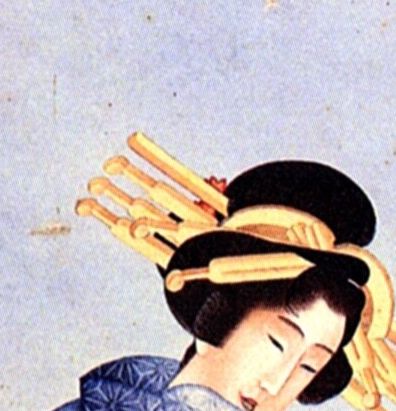
Sumida places the print alongside a model of a style of coiffure known as yoko hyōgo. The relationship between the model and the printed head makes it easier to see the visual work done by the hair. Anchored near the scalp, the pins cross the dark body of the coiffure and extend beyond it in an open cluster. They give shape to the space around the face before the viewer follows the adjacent fold down to the child. Both figures wear visible ornaments. The difference in the width and height of their hair arrangements helps establish two distinct presences within a very compressed grouping. [2]
What clothing and objects tell us about rank
Edo-period pictures often distinguish the child attendant from a shinzō, an older apprentice. The Metropolitan Museum of Art’s hanging scroll Courtesan and her Attendants under a Willow Tree, signed Unchō and dated 1796, offers an unusually clear comparison. The museum identifies a senior courtesan, an adolescent apprentice and two child attendants in the same group. The setting is a spring promenade, with a willow above and poetry supplied by Santō Kyōden and Kyokutei Bakin. The painted silk, poem and tree establish a setting beyond that of the isolated reproduction. They also make the visual division of roles readable within a larger entourage. [3] [8]
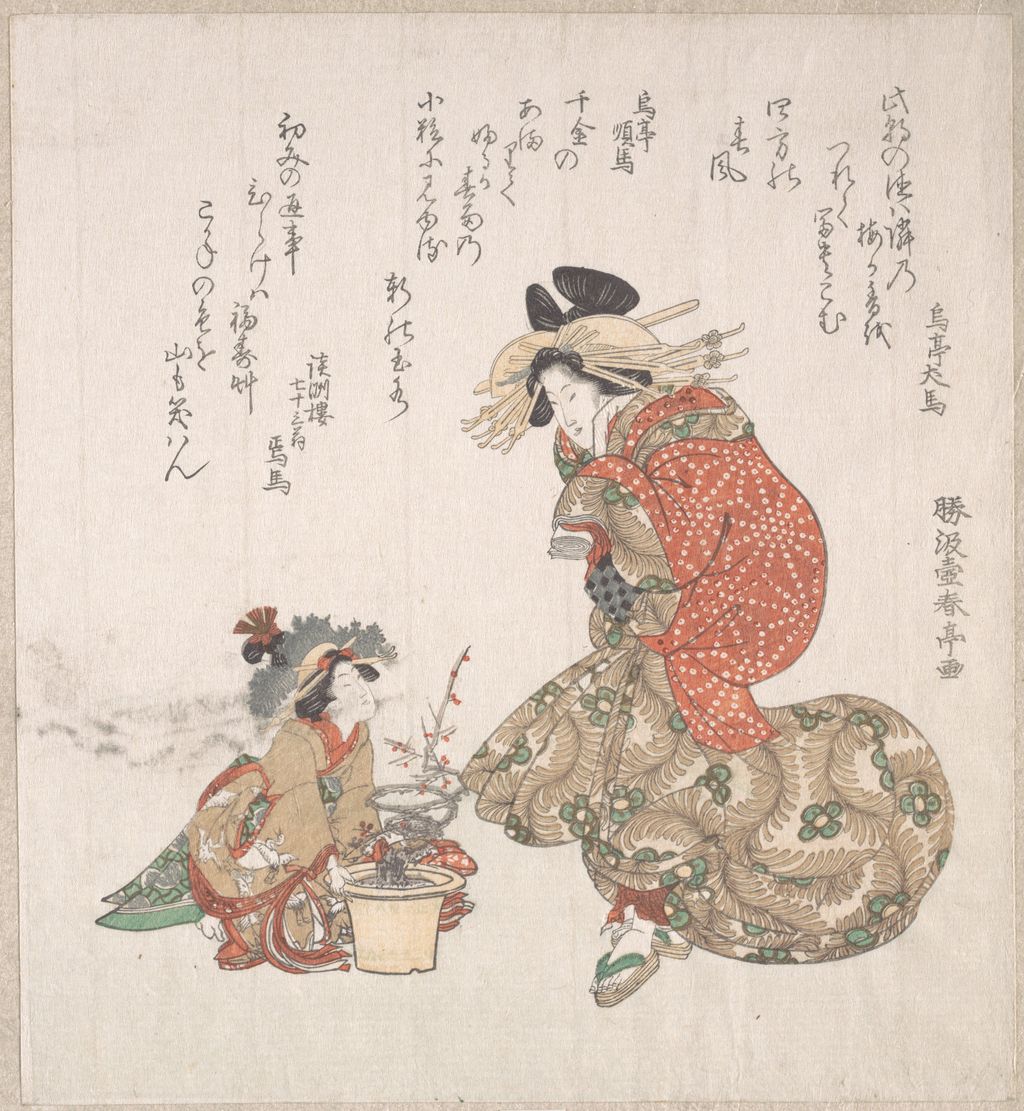
In Katsukawa Shuntei’s Courtesan and her Child Attendant with a Potted Plum Tree, around 1815, the two figures kneel on opposite sides of a small flowering plant. The child is at the left. The courtesan’s red upper robe forms a broad field behind her arm, while patterned fabric spreads across the lower right. The pot occupies the gap between them, with branches extending from a low position. This small print uses an object to draw the figures into a shared activity and gives the child clear space of her own. The case is useful alongside Hokusai’s print because a similar pairing of people works in a different position, with the courtesan’s head inclined towards the centre and the attendant’s nearer to the plant. [2] [9]
Clothing is only one way to signal rank. Figures could be named in inscriptions, sometimes alongside the names of their establishments and attendants. In Chōbunsai Eishi’s print of Hinazuru, the title records the Chōjiya house. The Met explains that Hinazuru was a professional name adopted by successive courtesans. This distinction between a role and a name matters when looking at the two figures in the blue-ground image. The title gives us the positions the two figures represent. It offers no inscription or other evidence to identify particular people. [1] [3] [10]
The changing shape of Hokusai’s painted courtesans
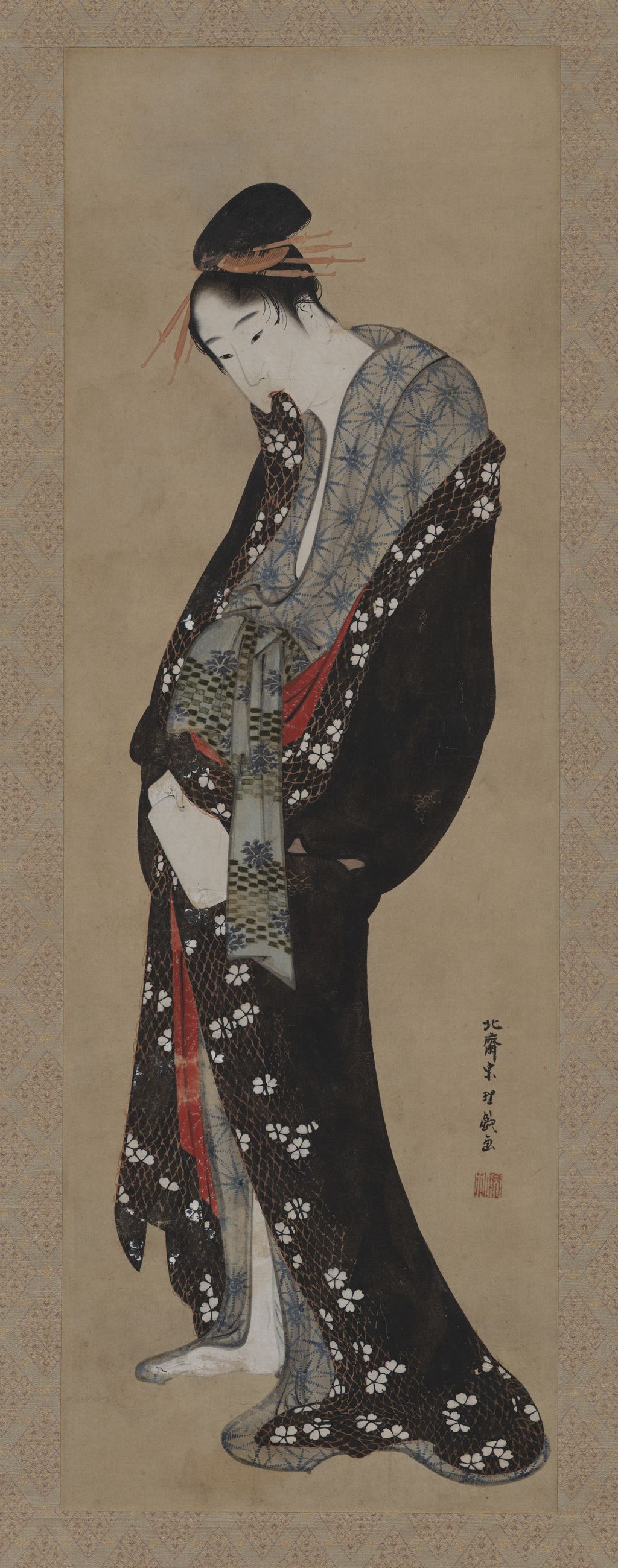
The Freer Gallery’s Courtesan, accession F1903.129, is an authenticated painting in ink and colour on paper, dated about 1796–98. It has a single figure in a narrow hanging scroll. The woman holds part of her garment to her mouth and grips a folded paper. The Smithsonian interprets the gesture and paper together as a possible response to a love letter. Her robe makes a slow reverse curve, swelling across the shoulder and hip before narrowing and opening again at the hem. Small pale blossoms recur across the dark garment. Their spacing makes the silhouette easier to follow where one part of the cloak crosses another. [11]
This painted woman can be compared with the two figures in the Sumida print without assuming a shared production method. The painting’s plain field lets the shape of the standing figure carry much of the image, with the small folded paper conveying action. In the printed detail a second face, the writing and the change from one figured textile to another divide the viewer’s attention. The shifts in pose and scale show how Hokusai could use a few closely observed details either to suggest the private feeling of an individual or to describe the relationship of two figures. The paintings guide and the guide to ukiyo-e woodblock prints give the two media their wider context. [2] [5] [11]
The Yoshiwara behind the images
Prints and paintings helped create the public appeal of a small number of high-ranking women. The costumes and attendants that announced a courtesan’s status also belonged to an economic system controlled by the brothel owners. The University Art Museum at Tokyo University of the Arts describes Edo’s Yoshiwara as a district licensed by the shogunate, where women bound by debts could not freely leave service. The Asian Art Museum’s account also explains that children entering the district could begin by serving a senior courtesan, and that only some were trained in the accomplishments expected of the highest ranks. Work, obligation and restricted movement shaped lives depicted in art through pattern, poise and display. [3] [4]
The smaller figure therefore deserves a sustained look. Her position in a picture tells us something about the choices made in composing it and about the importance of attendants to the public image of a senior courtesan. In the blue-ground reproduction, a face and a set of ornaments emerge around the turns of the larger robe. Shuntei gives the child more open space and an object of shared interest. In Hokusai’s Sumida detail, the child appears close to the senior figure, surrounded by the shifting boundaries of two costumes. Together the works allow us to see several ways a single hierarchy could be made visible. [1] [2] [3] [9]
Works across Hokusai’s career
Annotated Details from Courtesan and young attendant
Attributed to Katsushika Hokusai. Wikimedia Commons, holding unidentified. Public Domain Mark 1.0. [1]
Details from COURTESAN AND YOUNG ATTENDANT
Select a detail to look closely.
Light hairpins extend past the coiffure
The straight bars contrast with the smooth dark shape of the hair. [1]
Colour follows the turn of a sleeve
Curved borders give the large red garment a sense of depth. [1]
The child appears behind the robe
The overlap shows the two figures at different distances and scales. [1]
The hem spreads across the lower edge
The sweep of the outer textile gives the narrow composition a broad base. [1]
Explore Hokusai’s works
Discussion
Look again at the images and ideas explored in Oiran and Kamuro in Hokusai’s Art. These editorial prompts invite your observations.
Reader Insights
How does the shape of the robe help place the two figures?
What signals the difference between the roles of the women and girls shown?
Join the Conversation
Share a detail, comparison or question about Oiran and Kamuro in Hokusai’s Art below.
References
- Wikimedia Commons, Hokusai Oiran and Kamuro.jpg, reproduction sourced to Visipix. The file identifies the image that circulates under this title and supplies no accession for the physical object. View source.
- Sumida Hokusai Museum, Hokusai Beauty: The Brilliant Women of Edo, exhibition guide, pp. 2–3. Reproduces a Hokusai print detail and illustrates the yoko hyōgo coiffure. View source.
- Asian Art Museum, Seduction: Japan’s Floating World. Curatorial account of child attendants, costume, rank and working conditions in the Yoshiwara. View source.
- University Art Museum, Tokyo University of the Arts, Yoshiwara, exhibition outline on licensing and bound service. View source.
- Sumida Hokusai Museum, Hokusai Beauty bilingual checklist, nos. 48–49, two Hokusai prints titled Courtesan and Her Young Attendant. View source.
- Sumida Hokusai Museum, Hokusai and the Lineage of Pictures of Beauties, exhibition checklist no. 91, Peter Morse Collection impression. View source.
- Shimane Art Museum, Nagata Collection exhibition checklist, Oiran to kamuro, nagataⅠ/hok/b/302, and related catalogue discussion of shared verse contributors. Exhibition checklist · Catalogue discussion View source 1. View source 2.
- Metropolitan Museum of Art, Unchō, Courtesan and her Attendants under a Willow Tree. View source.
- Metropolitan Museum of Art, Katsukawa Shuntei, Courtesan and her Child Attendant with a Potted Plum Tree, JP2336. View source.
- Metropolitan Museum of Art, Chōbunsai Eishi, The Courtesan Hinazuru of the Chōjiya Brothel, JP2816. View source.
- Smithsonian National Museum of Asian Art, Katsushika Hokusai, Courtesan, F1903.129, about 1796–98. View source.








