


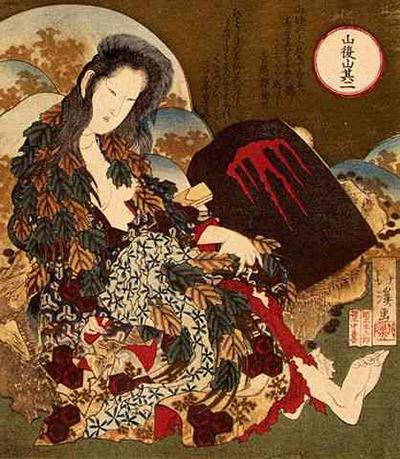
Yamauba seated beside a large axe, designed by Totoya Hokkei.
Buy Art Prints Nowfrom Amazon
* As an Amazon Associate I earn from qualifying purchases.
 by Tom Gurney
Tom Gurney BSc (Hons) is an art history expert with over 20 years experience
Published on June 19, 2020 / Updated on November 20, 2026
Email: tomgurney1@gmail.com / Phone: +44 7429 011000
Yamauba in Hokusai and Hokkei
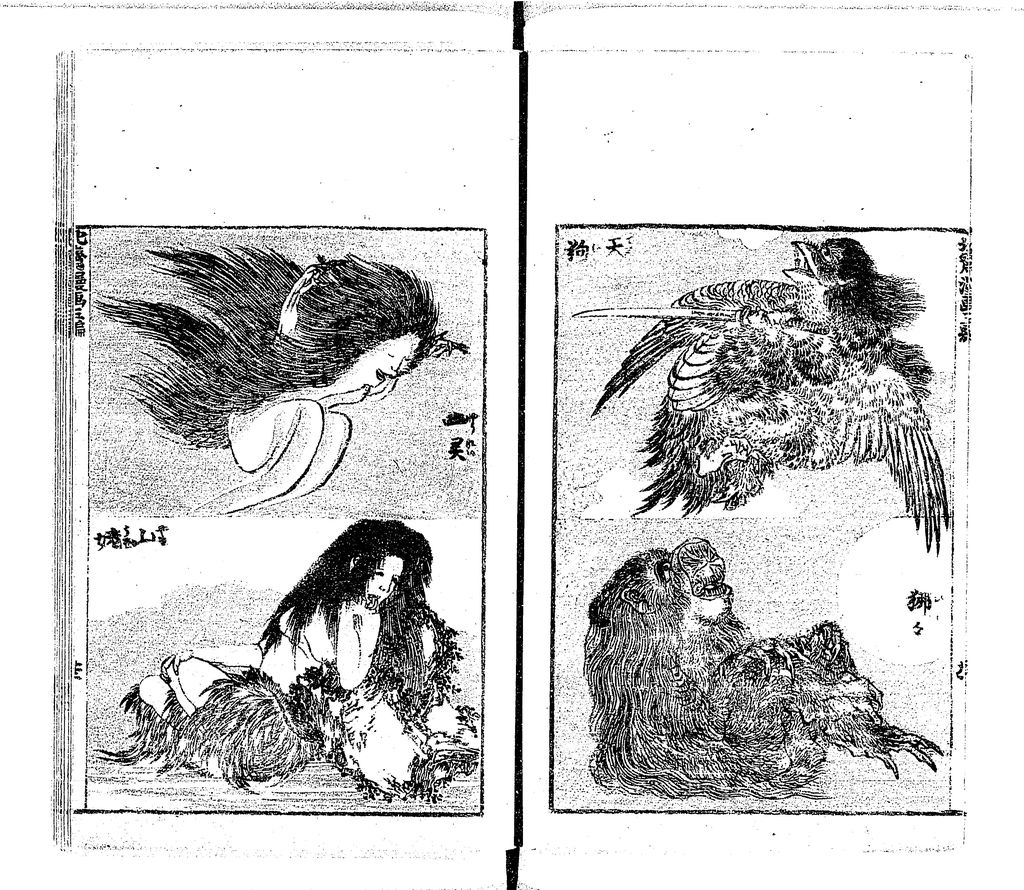
In the colour print above, a woman with loose black hair looks down towards the mountain plants spread over her clothes. Her bare foot extends along the lower edge. A large dark shape streaked with red rises beside her, close to a round title cartouche. The National Gallery of Victoria calls this design Yamauba seated beside a large axe. Its impression bears the signature of Totoya Hokkei, one of Katsushika Hokusai’s pupils. The Metropolitan Museum of Art publishes another impression of the same design. The two museum records identify the work pictured here at the level of the design. The source of the opening reproduction is unconfirmed. [1] [2] [3]
Yamauba, also called Yamamba or Yamanba, is a woman of the mountains in Japanese stories and theatre. Hokusai pictured her with Kintarō, the boy of extraordinary strength associated with Mount Ashigara, and on a page of supernatural figures in his drawing book. In the print with Kintarō she observes a dance. In the book she has her own small space and the printed name 山姥. The pose, lighting and costume change with the setting, and the name can belong to a solitary mountain figure or to a participant in a story with a child. [4] [5] [6]
At a Glance
- ArtistKatsushika Hokusai and Totoya Hokkei
- ScopeYamauba in Hokusai and Totoya Hokkei
Contents
Totoya Hokkei’s woman beside an axe
The great axe makes a broad diagonal across the colour print beside the angle of the woman’s upper body. Its dark shape gives the red marks a strong outline, and scraps of the landscape remain visible between it and the garment. At first the woman’s face seems small against the mass of foliage and patterned textile. The downward turn of her head then gives a direction to the whole figure. Follow it past her face into the layers at the centre, where leaves overlap patterns and loose fabric falls towards the extended foot. The image builds the impression of a mountain presence through the close fit between the wearer, her clothes and the surrounding vegetation. [1] [2]
The open curves behind her head repeat across the background, where blue and pale slopes overlap. Their arcs contrast with the mostly straight edges of the axe. The upper-right cartouche and the dense writing nearby occupy the higher, quieter interval. The cartouche identifies the sheet as number two in the Mountain upon mountain series, according to the National Gallery of Victoria. At lower right, the gallery distinguishes the signature, Hokkei ga, from the red marks. It identifies a seal of Hokkei and records inscriptions for the printer and engraver. Separate names appear on the sheet for separate kinds of work, a detail that is easy to miss in a small reproduction. [1] [2]
The gallery dates its impression to the late nineteenth century, after Hokkei’s death in 1850, and lists it as a second edition in its annual report. The Met dates its catalogued group broadly to the Edo period and lists the 1894 gift from Mary L. Cassilly. That record includes multiple images under the title Bundle of Prints (Untitled). One photograph shows the leaf-covered woman, axe, cartouche and lower inscriptions that identify the same design. The gallery’s smaller published image measurements apply to its own sheet. The museum records therefore let a viewer distinguish the picture designed by Hokkei, the people credited on one impression and the history of the objects that now carry the design. [1] [2] [3]
Yamauba watches Kintarō dance
Hokusai’s Yamauba and Kintarō in the Shimane Art Museum’s Nagata Collection is a privately published print, or surimono, dated by the museum to about 1814. Its Yamauba has long, loose hair and a layered garment. She stands on the right and bends forward under a tree. Toward the middle, the child and animals carry the eye through a knot of bodies, poles and costume. A reddish sun sits high on the other side, across an interval of pale paper. The pair are easy to separate visually. The standing woman keeps her head above the movement, while Kintarō bends into it near the front of the group. [4]
Shimane identifies the performance as a Kashima dance. The museum traces its spread to shrine messengers announcing the oracles of the Kashima deity, and says the dance was popular around Ashigara in the late Edo period. In Hokusai’s scene, a monkey, a hare and a bear participate alongside Kintarō. The museum also points out the gold printing on the objects the boy and monkey carry, called karasu mando. They stand out as a pair above the low figures and help give the eye a route into the scene. The restrained field around them leaves room for this special printing to catch attention. [4]
Look at the gap between Yamauba and those dancing. Her inclining head makes her attention part of the action, even as her feet and lower robe occupy their own patch at the right of the picture. A tree frames the space behind her. In Hokkei’s print, the leaf shapes crowd across the front of the single figure and the axe presses behind her. In Hokusai’s dance, distance between the people, animals and tree makes the mountain read as a place with several things happening at once. That wider staging lets a viewer see Yamauba in relation to a child, the animals and a dance familiar in the setting of the story. [1] [2] [4]
Yamauba on a page of Hokusai Manga
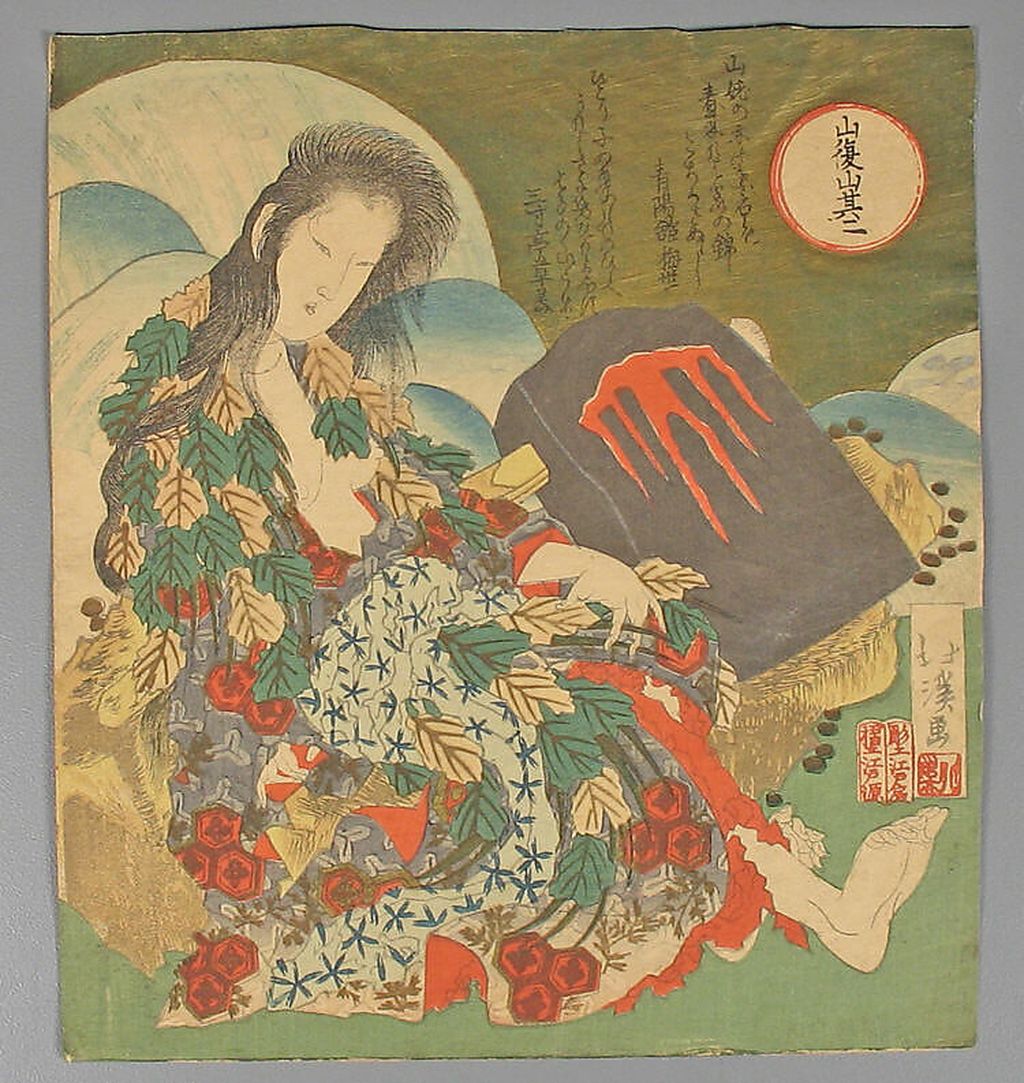
Volume three of Hokusai Manga brings Yamauba into a different kind of space. The Sumida Hokusai Museum dates its third volume to 1815. Japan’s National Diet Library digitised a later copy published by Katano Tōshirō in 1878. In digital image 28, Yamauba appears in the lower compartment of the left page. The caption at the upper left of her compartment names her. The same opening contains a figure above her whose hair streams sideways, and on the facing page the tengu and a hihi occupy separate compartments. The book groups those figures on one opening so that the reader can compare their forms without following a single continuous scene. [5] [6]
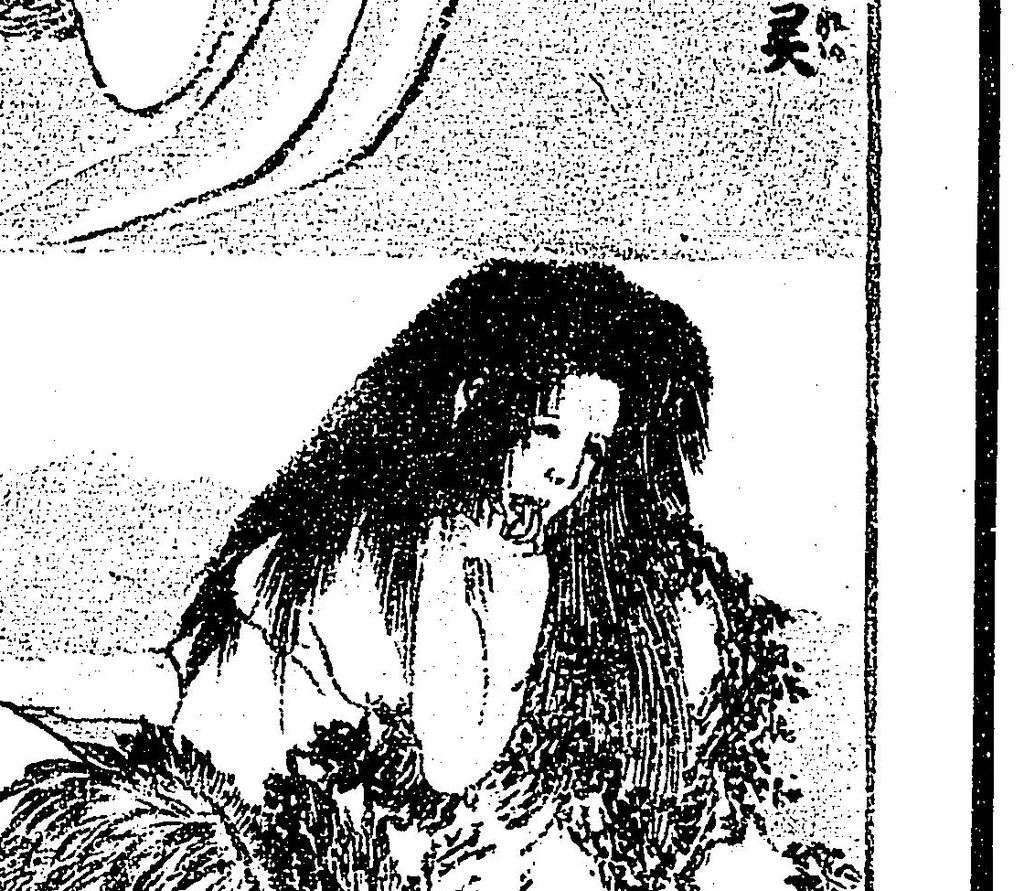
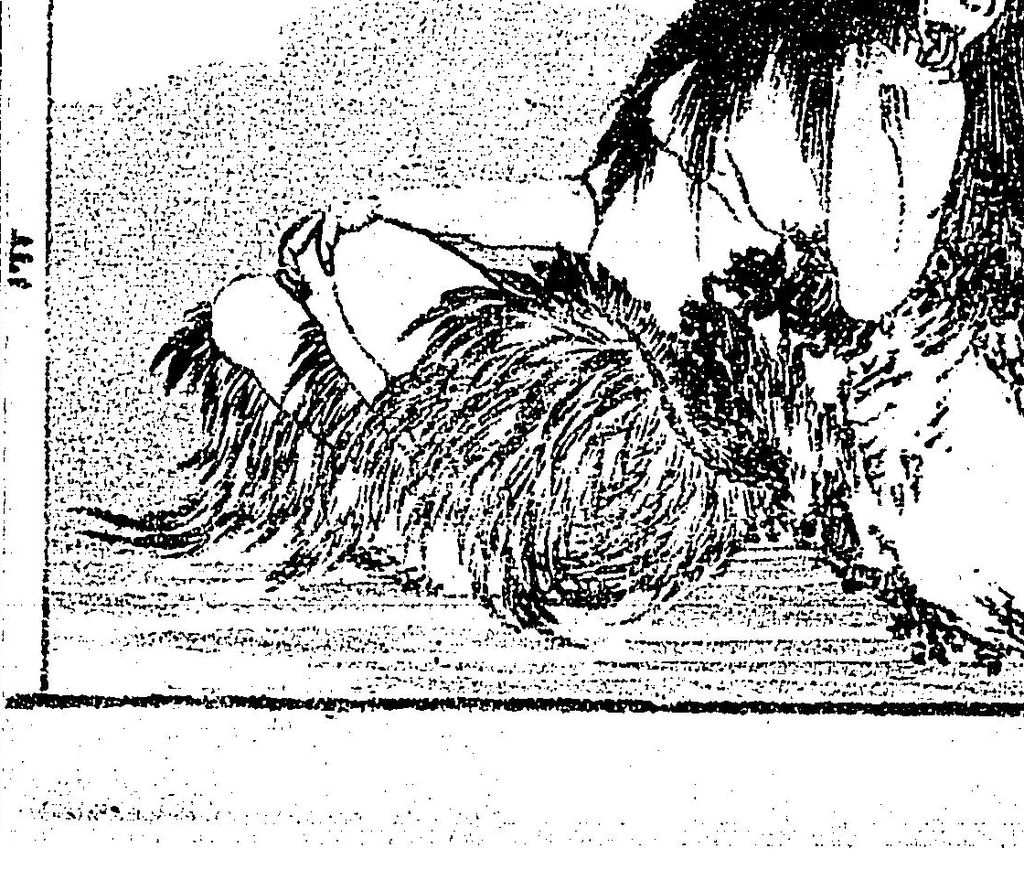
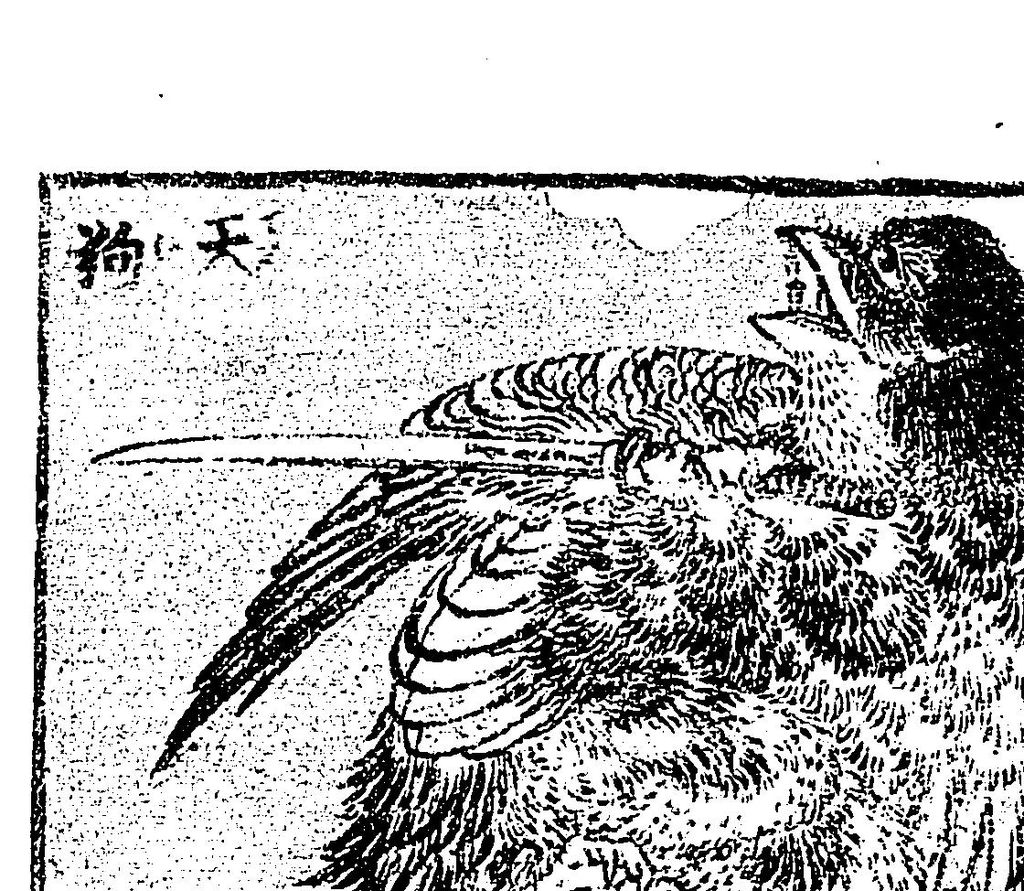
Yamauba’s figure settles across the foot of the frame. One hand is close to her face. Heavy strands fall behind it and spread down across her shoulders, creating large patches of dark ink. The body bends across the bottom, where short marks are packed close together around its outline. A small area of light paper carries the caption above the figure. The right page’s tengu, by comparison, projects its blade sideways into comparatively open space, on a line that reads across the book. Look back across the fold from that blade and the dense linework around Yamauba marks a change in how Hokusai uses the compartment. [6]
The surrounding pages matter to the identity of this image. The sign for Yamauba distinguishes her from the figure above, despite the long hair they share. The visual vocabulary of loose strands and quick turns connects them across the left page, while the captions and printed borders keep their identities distinct. Hokkei’s colour print gives a single figure greater room for contrasting robe patterns and successive shapes of the hillside. Hokusai’s book depends on a few boundaries, the spelling beside the figure and a concentration of marks low on the paper. Its small figure gains force from what a reader notices before and after it. [1] [2] [6]
A name in verse, theatre and a ghost print
An earlier work by Hokusai gives a clue to the uses of Yamauba outside a single picture. Shimane records an 1804 colour book of comic verse, Picture Book of Kyōka: Range after Range of Mountains, published by Tsutaya Jūzaburō. Its entry notes a printed wrapper with Hokusai’s illustration of Yamauba and Kintarō and connects the design to a chorus in the Noh play Yamamba. The chorus calls up the mountain woman’s wandering from mountain to mountain. Readers first encountered that wordplay where they handled the wrapper, before reaching the poems themselves. The child belongs to the wrapper’s illustration, and the museum’s catalogue gives the travelling mountain woman as the point of contact with the play. [7] [8]
In the Noh story an accomplished dancer becomes known for performing the mountain woman’s journey. On a pilgrimage her group accepts shelter from a woman who eventually reveals that she is the figure the dancer portrays. She returns at night to show how she goes round the mountains. The play makes room for a woman who knows that people perform stories about her and who wants to show them something of her own experience. Its two women offer a context for the motif’s range, and Shimane’s wrapper is a documented reuse of language from that tradition in a book of poetry. [7] [8]
The Laughing Hannya belongs to another context. The Library of Congress reads that early 1830s Hokusai print as combining features associated with a hannya and a predatory mountain woman. There the large face and the hands fill much of the sheet. In the dance print and the sketchbook, Hokusai gives Yamauba very different company and physical scale. Hokkei makes her solitary beside the axe, hemmed in by the shapes and textures of the slopes. The images invite a useful comparison across formats. Read the signature on the colour sheet, the label in the drawing book and the museum’s account of the animals’ dance. Each helps establish which artist made the image and which part of the figure’s story a viewer is being invited to consider. [1] [4] [6] [9]
Works across Hokusai’s career
Hokusai Manga, volume three
First issued in 1815Hokusai Manga
From 1814Ōiko Pouring Sake for a Warrior
1820 or 1829 in collection recordsAnnotated Details from Hokusai Manga, volume three, with Yamauba in the lower left
National Diet Library, 1878 printing, image 28. Public Domain Mark. [6]
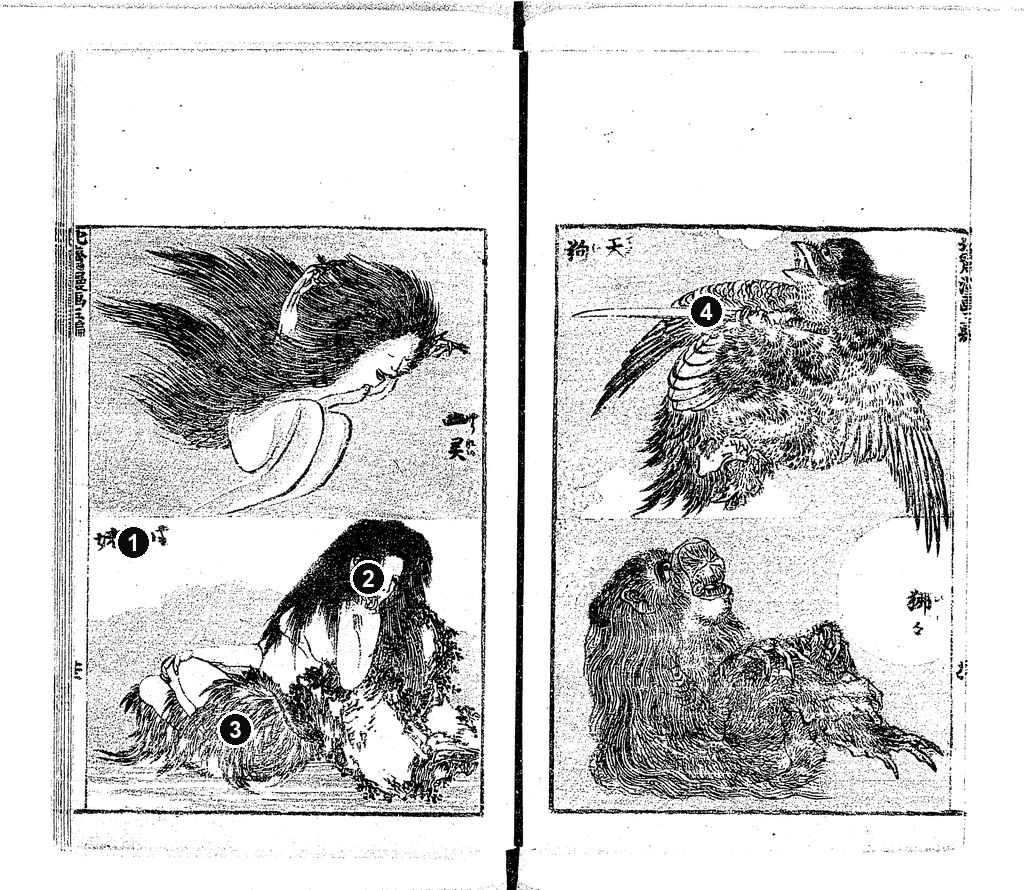
Details from HOKUSAI MANGA, VOLUME THREE, WITH YAMAUBA IN THE LOWER LEFT
Select a detail to look closely.
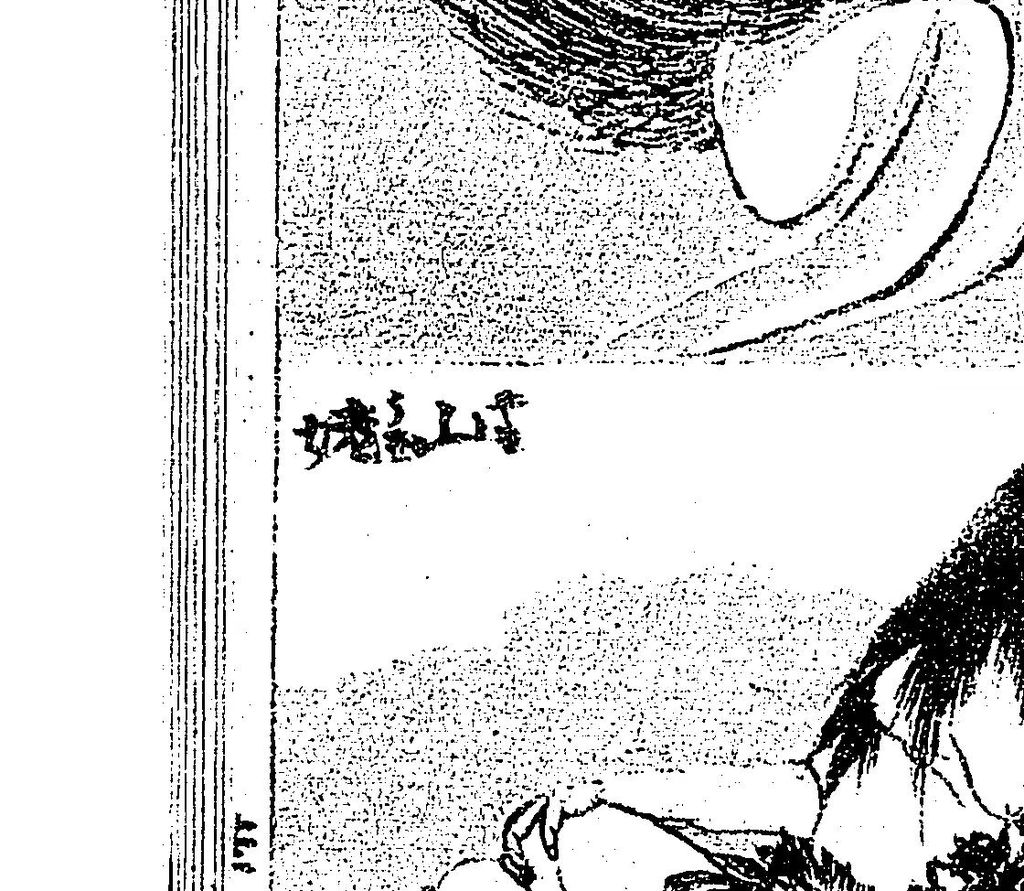
Small characters identify Yamauba
The name is printed close to the edge of the lower-left picture. [6]
The head inclines among loose hair
The hair falls around the face and spreads out across the shoulders. [6]
Uneven strokes spread below her
The short and long marks give the ground below the figure a different texture from her garments. [6]
The tengu’s blade crosses the facing page
The neighbouring figure and its blade show how the opening places several supernatural subjects in view together. [6]
Explore Hokusai’s works
Discussion
Look again at the images and ideas explored in Yamauba in Hokusai and Hokkei. These editorial prompts invite your observations.
Reader Insights
What gives Hokusai’s Yamauba a presence on the printed page?
Where does Hokkei’s design depart from the way Hokusai pictured her?
Join the Conversation
Share a detail, comparison or question about Yamauba in Hokusai and Hokkei below.
References
- National Gallery of Victoria, Totoya Hokkei, Yamauba seated beside a large axe, accession 2001.36. Series title, dimensions, marks and dating. The annual report identifies this impression as a second edition. Collection record · Annual report View source 1. View source 2.
- The Metropolitan Museum of Art, Bundle of Prints (Untitled), JP216. One image in the accession shows the design reproduced here. Collection record · View the matching design View source 1. View source 2.
- Rijksmuseum, catalogue essay by Matthi Forrer accompanying Totoya Hokkei’s Spectacles on a Scroll. Artist’s dates and training with Hokusai. View source.
- Shimane Art Museum, Katsushika Hokusai, Yamauba and Kintarō, Nagata Collection. The Kashima dance, date, format and gold printing. View source.
- The Sumida Hokusai Museum, Hokusai Manga, volume three. 1815 dating and the series as models for drawing. View source.
- National Diet Library, Katsushika Hokusai, Hokusai Manga, volume three, Katano Tōshirō edition, 1878, persistent ID 851648. The pictured opening is digital image 28. Catalogue record · Book opening View source 1. View source 2.
- Shimane Art Museum, Picture Book of Kyōka: Range after Range of Mountains, accession nagataⅠ/sor/c/188, 1804. Hokusai’s printed wrapper and the reference to a Noh chorus. View source.
- The-Noh.com, Yamamba (Mountain Crone), bilingual play text and performance synopsis. View source.
- Library of Congress, Katsushika Hokusai, Warai hannya, item 2005678553. Catalogue description and The Floating World of Ukiyo-e exhibit label. View source.







