


 by Tom Gurney
Tom Gurney BSc (Hons) is an art history expert with over 20 years experience
Published on June 19, 2020 / Updated on November 18, 2026
Email: tomgurney1@gmail.com / Phone: +44 7429 011000
Adam
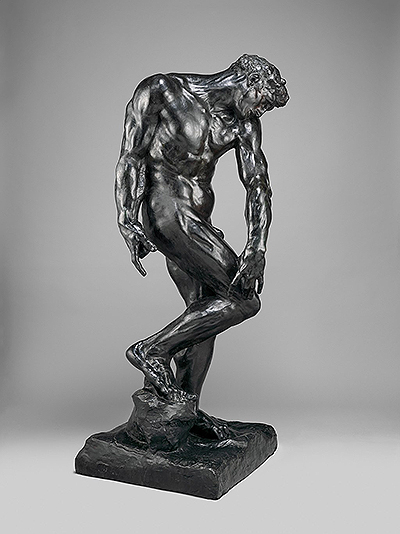
Auguste Rodin’s Adam appears to be learning how to stand. One knee bends and the other leg takes more of the weight. The shoulders are uneven, the head hangs, and the arm extends well below the level of the chest. From some angles an extended finger is among the clearest parts of the silhouette. There is nothing within reach to explain the gesture. The eye follows it back through the arm and into the turn of the body. Rodin gave the first man a position that looks as if it has just been found and may be difficult to keep. [1] [2]
The first man in the Salon
The plaster appeared in the Salon of 1881. In her study of the sculpture, art historian Alicia Faxon traces several titles, including The Creation of Man and The First Man. They give a visitor a different way to read a body that seems to be coming into an awareness of itself. The sculpture leaves that change in progress. The front of the chest and the head are not raised into a confident, upright pose. The arms and legs look as if they could change position as the figure finds its weight. Creation here has an extended duration. The man is there in front of us and still seems to be finding out what that means. [2] [3]
Faxon cites Judith Cladel’s identification of the model as a strongman named Cailloux. That identification belongs to a later account of Rodin’s process. It offers a possibility for how he obtained the particular physical presence he wanted. A model might give him a shoulder or back whose tension he could see clearly, while the subject would still require him to decide where to put each limb. The scale and the turn of the figure matter more to that decision than the ability to attach a name to the man who posed. [2]
Looking at Michelangelo
The Musée Rodin points to Michelangelo’s Creation of Adam on the Sistine ceiling. The fresco gives the outstretched hand a partner in the hand of God. Rodin’s Adam extends a finger too, but the sculpture gives the gesture nothing to meet. The arm runs down across the figure’s space and the viewer has to decide what the direction of the reach might mean. That shift takes a memorable detail from a large scene and makes the tension of the arm part of an encounter with a single body. [1] [2] [3]
The Met’s account also sees a debt to Michelangelo’s sculpture, where a body turning within a narrow space can appear to be struggling free of it. That comparison helps with something the fresco by itself leaves open. Rodin had to make the bend work on both sides of a standing figure. A pose seen in profile can seem almost to fold over one hip. From another side, a turn at the waist makes the chest and legs point in slightly different directions. A viewer can follow those movements through the sculpture and discover how the extended arm relates to the rest of the body. [2] [3]
A figure on the threshold
In a letter to the Ministry of Fine Arts in October 1881, Rodin described figures of Adam and Eve intended to flank The Gates of Hell. Pairing them with the door would have placed two recognisable figures at the edges of a design increasingly crowded with bodies. The idea also gave their poses a setting in which distinctions between standing beside the portal and appearing on its surface could matter. The completed bronze door does not have the flanking pair. The independent bodies survived, and the studio developed other uses for related forms. [1] [2] [4]
In The Three Shades, the Musée Rodin traces the repeated figure to Adam. The inclination of the upper body and descending arm are part of what makes that relationship visible. Repetition changes the gesture. The arms and heads can direct attention into the centre of a group, and the outer bodies mark the limits of a shape seen against the sky. It is also worth comparing the direction of the bent heads. From below the tympanum, their shared inclination forms a single accent over the doorway. Level with one of the independent bronzes, a visitor can take more time over the way the head sinks in relation to one shoulder. In a separately displayed Adam, the hand is left to carry its gesture in relation to the individual body. Comparing these works gives a particularly direct view of how a form could move from one subject to another in Rodin’s studio. [1] [4]
Watch Rodin’s sculpture up close
Five films explore Rodin’s sculpture, from his use of classical models and the figures on his monumental doorway to the work of his studio.
Auguste Rodin – Challenging Beauty
Six sculptures show how Rodin adapted classical models.
Watch on YouTubeThe New York and Tokyo bronzes
The Metropolitan Museum of Art’s account of accession 11.173.1 traces the casting to a visit to Rodin’s studio in July 1910. The sculptor Daniel Chester French and the museum’s Edward Robinson saw the plaster there. The Met commissioned a bronze from it, which Alexis Rudier cast in 1910 or early 1911 according to the museum’s collection history. The paperwork cited by the museum indicates that the figure had not yet been made in bronze or marble. The visit therefore connects an early composition to a bronze produced about thirty years after it was exhibited in plaster. [5]
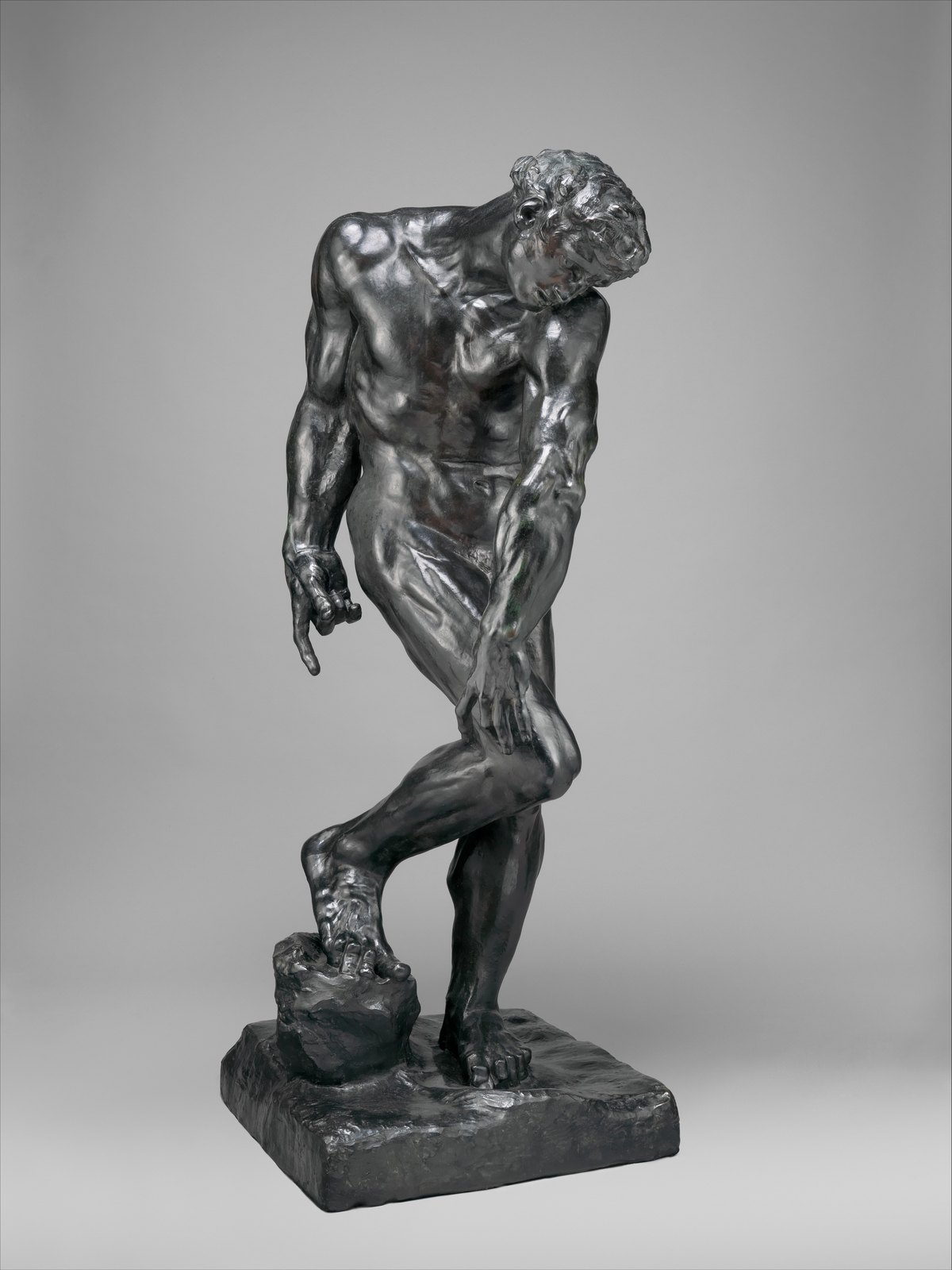
The New York bronze shows the turn through Adam’s shoulder and the arm that crosses the body. The Metropolitan Museum of Art, Gift of Thomas F. Ryan, 1910, 11.173.1. Image source. CC0 / Public domain.
Tokyo’s National Museum of Western Art records a bronze, S.1959-0001, measuring 198 centimetres high. It documents Kōjirō Matsukata’s acquisition from the Musée Rodin in 1919 and cites archive records for the order and related correspondence. The year of the transaction and the 1881 date given for the model answer different questions. The foundry inscription gives another clue to the object’s production. When comparing images of the Paris, New York and Tokyo examples, begin with the cast records. Then look at what holds across the objects: the downward pull of the head, the uneven support of the legs and the bare finger reaching beyond the rest of the figure. [1] [5] [6]
The Tokyo bronze’s provenance also records how far a work could travel after it left the studio. The bronze passed from the Matsukata Collection through French custody before its transfer to Japan in 1959. Once there, it could be considered alongside Tokyo’s Gates of Hell. The separate collection records preserve the dates of each object, while their presence in the same collection allows a comparison Rodin had imagined in architectural terms decades before. [6] [7]
Comparing the three monumental bronzes
The Paris garden bronze, S.01303, was cast by Susse in 1972 for the Musée Rodin. It stands 197 centimetres high, close to the Tokyo bronze’s 198 centimetres. The museums give the same width of 76 centimetres, but list depths of 77 and 84 centimetres respectively. Those figures describe the overall objects. They cannot tell us by themselves whether a difference lies in the base, the figure or the way the measurements were taken. They do tell us why a photograph scaled to the height of the head can hide differences in how much space each bronze occupies. A useful comparison starts with views that include the base and let the viewer follow the arm as it extends beyond the chest. [6] [8]
The Tokyo catalogue locates Rodin’s signature on the right side of the base and the Alexis Rudier mark towards the back on that side. It also gives the price of 35,000 francs in the 1919 acquisition and cites the Musée Rodin’s order records. The Met’s bronze is also associated with Alexis Rudier, but has its own commission and arrived through Thomas Fortune Ryan’s support for the museum’s collection. The foundry name can connect two bronzes to the same producer. The records of the orders explain why one went to New York while the other entered the Matsukata collection. The later Susse bronze shows that the model could continue to serve the Musée Rodin long after both orders. [5] [6] [8] [9]
Looking from Adam to Eve
The Met’s two bronzes offer a chance to test what it would mean to read Adam with Eve. The museum records that they were exhibited together in the gallery opened in 1912. Both figures lower their heads into their shoulders, but Eve draws her arms across herself while Adam extends his downward. From a distance the two closed upper bodies can appear related. Closer up, their arms open up different amounts of space around them. Eve’s pose makes the body look as if it is withdrawing into itself. Adam’s long arm gives the shadow under the torso somewhere to run outwards. As independent bronzes they can be walked around separately. That gives a viewer more opportunity to see their turns than the imagined symmetry of two figures flanking a doorway would suggest. [2] [9]
Tokyo’s object account proposes another point of comparison with Michelangelo, the body of Christ in the Florentine Pietà. The Sistine fresco explains why the extended finger attracted attention. The Pietà offers a way of looking at the large bend through the upper body and the relation between the head and the shoulder. These comparisons can coexist because the standing bronze asks more than one part of the pose to carry meaning. The finger is best seen in a view that frees it from the body’s outline. The lowered head can be followed from another side, where it brings the weight of the upper body back into the figure. [2] [6] [9]
Rodin artworks directory
Discussion
Look again at the images and ideas explored in Adam. These editorial prompts invite your observations.
Reader Insights
After reading “The first man in the Salon”, what detail would you look for in the object or image?
What extra evidence would help you distinguish the artist’s choices from the effects of material, viewpoint or later display?
Join the Conversation
Share a detail, comparison or question about Adam below.
References
- Musée Rodin. Adam. View source.
- Alicia Faxon. An Interpretation of Rodin’s Adam. Metropolitan Museum Journal 17, 1982. View source.
- The Metropolitan Museum of Art. Auguste Rodin (1840–1917). View source.
- Musée Rodin. Multiples, fragments, assemblages. View source.
- The Metropolitan Museum of Art. Rodin at The Metropolitan Museum of Art: A History of the Collection. 1981. View source.
- National Museum of Western Art. Adam, S.1959-0001. View source.
- National Museum of Western Art. The Gates of Hell, S.1959-0045. View source.
- Musée Rodin. Adam, garden bronze S.01303. View source.
- The Metropolitan Museum of Art. Adam, 11.173.1. View source.

 Auguste Rodin.jpg)





