


 by Tom Gurney
Tom Gurney BSc (Hons) is an art history expert with over 20 years experience
Published on June 19, 2020 / Updated on November 18, 2026
Email: tomgurney1@gmail.com / Phone: +44 7429 011000
Ugolino and his Sons
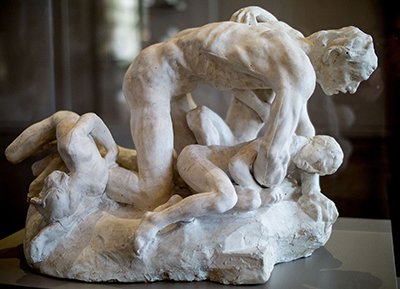
Ugolino crawls over the bodies of his children in Auguste Rodin’s sculpture. His back rises in a long arch, and his face projects beyond the arm that supports him at the front. The children occupy the uneven ground below, where their limbs cross and some nearly disappear into the base. Rodin developed the group for The Gates of Hell from a story in Dante’s Inferno. The Musée Rodin dates its plaster S.01427 to 1881–82. The legacy photograph shows a plaster of the group, with the side view giving a clear account of the distance between Ugolino’s bowed head and the children underneath him. [1] [2] [3]
From the arched back to the base
In the photograph Ugolino’s back runs almost horizontally through the upper part of the group. Near the shoulder it bends more abruptly and leads into the heavy arm below. At the far end the neck projects in the other direction, taking the face out over the edge of the group. Light picks up changes of plane around the brow and cheek. The space directly below the head is darker, making the outline easy to see. His gaze is directed down and away from the line of the back, so the head has a movement of its own within the larger curve. [1] [3]
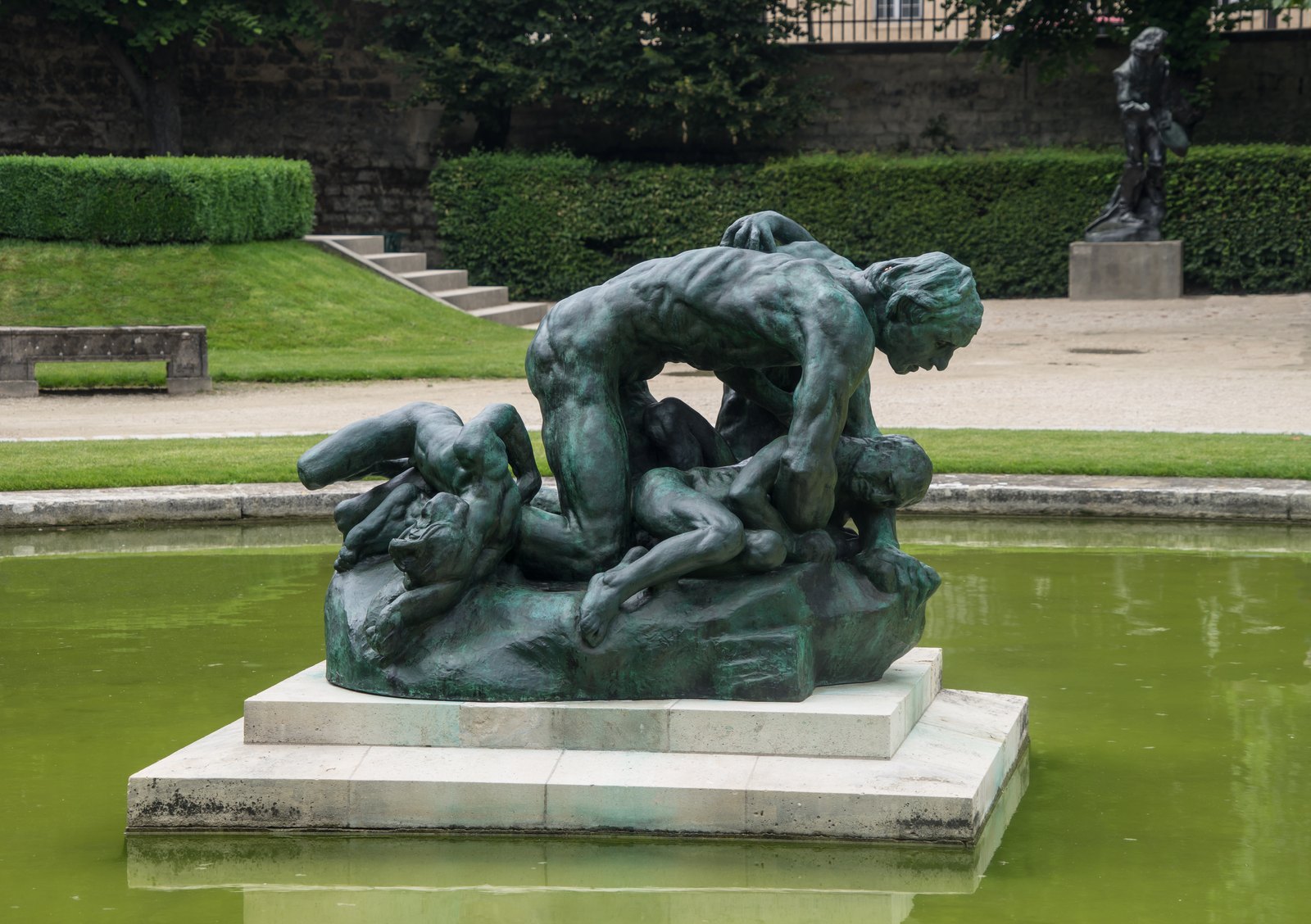
The Musée Rodin bronze shows the arch of Ugolino’s back over the children. Photograph by Jebulon, Wikimedia Commons. Image source. CC0 / Public domain. Resized for the web.
The upper body creates a shelter over parts of the composition while leaving others exposed at either end. At the left, one child’s bent limbs form a knot against the edge of the base. At the right, a face and shoulder emerge close to Ugolino’s supporting arm. The arm interrupts the smaller body in this view, although a slight change of angle would expose more of it. Below Ugolino’s chest, pale forms are visible through a small interval. The legs and arms there are harder to trace separately because the bodies come close together and cast shadows across one another. [1] [3]
The base brings the group together without giving it a level ground. Its front has blunt projections and hollows. A child’s limb extends towards the lip and catches the light in a different way from the rougher material below. Looking from the side allows the eye to follow those changes around the base before returning to the line of Ugolino’s body. The distribution of weight is more apparent from this angle than the number of figures. It tells the viewer that the man is shifting his weight forward while the smaller bodies remain close to the ground. [1] [3]
Dante’s account of Ugolino
In the final circle of Dante’s Hell, Ugolino della Gherardesca is among the souls punished for betrayal. He tells Dante how he was imprisoned with his children and how they died during their confinement. The story binds grief and physical hunger together. The Musée Rodin reads the crawling figure as Ugolino at the point before he gives in to the impulses that the museum associates with the climax of the tale. The sculpture represents the approach to that moment through the body. The long arc of the back directs the face forward, while the arms and knees keep him on the same patch of ground as the figures beneath him. [1] [2]
The placement of the head also gives force to the moment by leaving the direction of his next movement open. His face extends well beyond the nearest of the children, but the downward angle still relates him to the ground where they lie. His body is raised only by the tension in his limbs. Following the arm down from the shoulder makes the strain more evident. The figure depends on the same ground that holds the children and has little space to move through before meeting another body. [1] [3]
Carpeaux and the choices Rodin made
Jean-Baptiste Carpeaux had already made a major sculpture of Ugolino and his sons. In the marble at the Metropolitan Museum of Art, the father is seated and rises to the apex of the composition. The children cluster at his legs. Rodin’s study of the subject included seated solutions, and the Musée Rodin connects one of those designs with early plans for the doorway. A seated figure could give the father’s expression an elevated place above the children. The crawling figure makes it possible to follow his distress across the entire body, from the tilted head to the shoulder, bent hip and knee. [1] [2] [4]
In the completed doorway the group participates in a field of other struggling figures. The museum documents adjustments in developing the group for that setting, where its outward projection and its angle to the door were part of the design. An independent group gives the spectator access to the space beneath Ugolino and the figures distributed around it. From the pictured side, children appear both in front of his limbs and behind them. The eye has to move through that overlap, which makes it possible to perceive the man as being among the bodies even though his torso rises above them. [1] [2] [3]
The plaster and the photograph
The Musée Rodin records S.01427 at 41.5 centimetres high and 60.9 centimetres deep in its English entry. The depth gives the sculpture room for the body to extend well beyond the place where its hands and knees come down. The Musée d’Orsay also catalogues an enlarged plaster of Ugolino. Its record describes the figures being connected with cloth impregnated with plaster, part of the process by which separate figures could become a single sculptural group. The object’s scale and method of assembly belong to its own catalogue record. [1] [5]
The legacy file matches a published view captioned as a plaster in the Musée Rodin. The match is visible in the line of the base, the shadows below the central arm and the reflections in the gallery behind it. The photograph’s caption gives no inventory number. The small plaster in the museum’s collection provides dimensions and a date for comparison, while the photograph supports a close reading of the group without relying on an identification of that particular example. The long side view is especially clear about what separates this composition from the seated treatment: the father’s face and back move across the entire group, and the children occupy the narrow space of the ground beneath them. [1] [3] [4] [5]
Watch Rodin’s sculpture up close
Five films explore Rodin’s sculpture, from his use of classical models and the figures on his monumental doorway to the work of his studio.
Auguste Rodin – Challenging Beauty
Six sculptures show how Rodin adapted classical models.
Watch on YouTubeThe group and a child’s torso in the workshop
A plaster of the full group at the Musée Rodin, S.02390, measures 41 centimetres high and extends nearly 61 centimetres in depth. Those proportions leave room for Ugolino’s movement on all fours and for the children to occupy different positions below him. The museum also holds the plaster torso of one of the sons from the doorway group, S.05742. It identifies the torso as a foundry model and records release agent on the surface. Rodin’s name and a number appear on the fitting that allowed the section to be joined. A different number and a letter are on the right hip. Those marks provide a record of the torso as a piece that could be handled separately. [2] [6] [7]
The museum’s sand-cast bronze S.01146 is close in height to the group plaster. Its record names Griffoul & Lorge as founders and gives June 1889 as a possible casting date. The museum bought it at the Galerie Georges Petit in 1924, where it was presented as probably the first cast. The qualification is part of the provenance. The museum records the sale’s description alongside physical evidence including Rodin’s signature at the back of the base. Together, the two plasters and the bronze show how the composition survives at the scale of individual parts and as a complete group. [6] [7] [8]
Two moments of hunger in Dante’s account
Dante encounters Ugolino already gnawing the head of Archbishop Ruggieri. The count stops to tell what happened in the tower. In that recollection he bites his own hands in grief, a gesture his children read as a sign of hunger. They offer him their bodies and later die around him. The text says that fasting had more power than grief, a line that leaves the sequence open to interpretation. In the encounter outside the story of the tower, Dante makes the act of biting unmistakable. The poem thus gives the reader several gestures, directed at different bodies and taking place at different points in the narrative. [9]
In Carpeaux’s marble, the lifted hands gather attention around the seated father’s mouth. The children can still reach him from below. Rodin’s mature group lowers the father until his weight depends on the hands placed against the ground, spreading the action across the people beneath him. The Musée Rodin describes the moment as preceding the act the viewer might fear. That distinction matters because Ugolino’s forward movement is plain enough to show, while its result is left open. If you approach the work from behind, the broad upper back makes the father’s direction clear before the face becomes visible. Seen from lower down, his head seems to be within the same space as the children rather than the point to which their hands must reach. [4] [2]
From a figure on the door to a group with a ground of its own
The project catalogue for The Gates of Hell describes an earlier plan to place Ugolino seated opposite Paolo and Francesca. Those groups would have offered two distinct ways in which Dante’s speakers return to a moment of their earthly lives. The lovers’ touch could be read against the father’s confinement with the children. The later position occupied by the crawling group creates another relation. The door is now the vertical field to which the figure is attached, and what reads as forward movement can appear to project outward from the surrounding relief. [2]
A separate group makes the floor of the scene easier to see. Its base stays beneath the figures as the viewer moves around, so the placement of each hand and limb becomes a question of physical support. In an enlarged version these contacts can be seen from farther away, even when the viewer is far enough back to take in the shape of the whole family. On the door the same subject must be located among other bodies. The difference helps explain why a record of the portal can establish where the group belongs but a separate casting offers better evidence for some of its views. [2] [1]
What enlarging the group does to the space underneath
The enlarged Orsay plaster is 139.2 centimetres high and 278.6 centimetres deep. Its depth is more than four times that of the 60.9-centimetre Musée Rodin plaster. A visitor standing at the front can therefore see the lowered head at a very different distance from the rear of the group. At this scale a side view becomes especially important. It lets the viewer see how far the children extend in relation to the supports of the father’s body and makes it easier to locate the open space underneath his torso. [1] [5]
The Orsay entry describes that space as central to the work. It also records that the figures were cast separately and linked together with draperies coated in plaster. That method helps explain how an area can read as continuous ground while supporting bodies whose individual contours remain legible. Begin at the foremost hand and look along the plaster toward the children. The routes across the base and through the opening among the bodies alternate as the eye moves. The way the figures were joined had to preserve both kinds of space. [5]
Rodin artworks directory
Discussion
Look again at the images and ideas explored in Ugolino and his Sons. These editorial prompts invite your observations.
Reader Insights
After reading “From the arched back to the base”, what detail would you look for in the object or image?
What extra evidence would help you distinguish the artist’s choices from the effects of material, viewpoint or later display?
Join the Conversation
Share a detail, comparison or question about Ugolino and his Sons below.
References
- Musée Rodin. Ugolino and his children, S.01427. View source.
- Musée Rodin. Ugolin et ses enfants, La Porte de l’Enfer. View source.
- Exhibition photograph of the Musée Rodin plaster. View source.
- Metropolitan Museum of Art. Jean-Baptiste Carpeaux, Ugolino and His Sons. View source.
- Musée d’Orsay. Auguste Rodin, Ugolin. View source.
- Musée Rodin. Ugolin et ses enfants, plaster S.02390. View source.
- Musée Rodin. Enfant d’Ugolin, foundry plaster S.05742. View source.
- Musée Rodin. Ugolin et ses enfants, bronze S.01146. View source.
- Dante Alighieri. Inferno, canto XXXIII, Dartmouth Dante Lab. View source.

 Auguste Rodin.jpg)





