


 by Tom Gurney
Tom Gurney BSc (Hons) is an art history expert with over 20 years experience
Published on June 19, 2020 / Updated on November 18, 2026
Email: tomgurney1@gmail.com / Phone: +44 7429 011000
Gustav Mahler
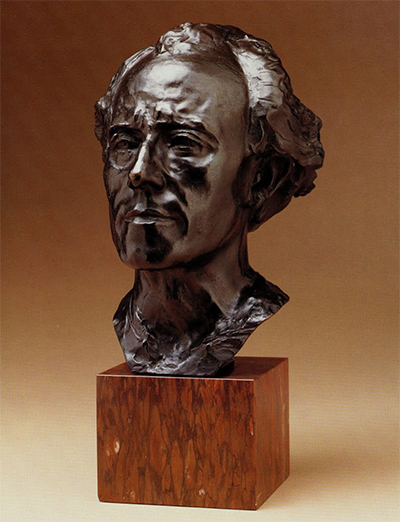
Auguste Rodin’s portrait of Gustav Mahler raises the composer’s head above a rough section of neck and collar. The brow tightens over the eyes, and the hair opens out on either side of a high forehead. In the photograph the dark bronze meets a reddish square support, which gives the head a firm vertical bearing. Mahler sat for Rodin in 1909, the year he took charge of the New York Philharmonic. The sittings yielded several forms of the portrait. There are compact bronze heads, plaster versions with different amounts of support and a marble that the Musée Rodin catalogues under both Mahler’s name and Mozart’s. [1] [2] [3] [4] [5]
From the forehead to the collar
The front of the forehead catches a broad patch of light. Lower down, shorter reflections pick out the ridges that converge above the nose. They cross the line of the brow at several angles, so that a small area of the bronze carries much of the expression. Deep shadows below those ridges leave the eyes harder to see than the large, clearly lit planes above them. The nearer cheek turns sharply below the eye. Follow that turn towards the mouth and the strength of the shadow makes the cheek look leaner than the forehead would lead one to expect. [1] [2]
The head faces slightly away from the camera. The turn gives the hair on the right of the photograph a wider outline, with a particularly bright passage where its surface rolls back from the temple. At the opposite side the edge of the hair stays closer to the cheek. There is a marked change in texture between the hair and the skin. Broad planes define the cheeks and the bridge of the nose. The hair breaks into shallow ridges that change direction, particularly where they run back from the brow. These differences are especially visible because the bronze catches a different amount of light on each surface. [1] [2]
The closely set lips make a quieter horizontal line below the concentrated modelling of the upper face. The neck extends underneath at a slight angle. It flares into the fragment of the collar, whose rough edge remains visible before the sculpture meets the square support. The top of that support is easy to make out on either side of the neck. It gives the viewer a level against which the angle of the head can be read. The photograph offers a particularly clear view of the difference between the relatively smooth jaw and the broken planes at the lower edge of the portrait. [1] [2]
Mahler in Rodin’s studio
The Metropolitan Museum of Art draws on Alma Mahler’s recollections to describe the composer’s impatience with sitting still. The account records something of the time a sculptural portrait demanded from a sitter with his own work to do. The New York Philharmonic’s archives document the changes Mahler was making to the orchestra before he formally took charge in November 1909. The portrait belongs to that year, when posing for Rodin required a conductor accustomed to shaping the actions of an ensemble to let someone else observe him at rest. The studio experience comes to us through recollection, while the bronze makes the result of that observation available from several angles. [1] [5]
The Musée Rodin describes studying the skull as an important part of Rodin’s portrait practice. He looked at sitters from above as well as at eye level. That helps explain the large area of the head available to the viewer around the brow and temples. In a photograph taken from the side, the sweep of the forehead into the crown would take on more importance. Seen nearly from the front, the forehead and the eyes can be studied together. Their different surface depths give the expression its force, even as the angle from which one looks changes the way the light falls across them. [1] [6]
Watch Rodin’s sculpture up close
Five films explore Rodin’s sculpture, from his use of classical models and the figures on his monumental doorway to the work of his studio.
Auguste Rodin – Challenging Beauty
Six sculptures show how Rodin adapted classical models.
Watch on YouTubeMahler and Mozart
The Musée Rodin gives the title Mozart-Portrait de Gustav Mahler to its marble of 1911. The collection record names Aristide Rousaud as carver and gives the width as 99 centimetres. The light stone spreads well beyond the head. This changes the proportions of the entire work and makes more room around the face than the close, upright presentation of the bronze in the photograph. The marble retains its connection to the Mahler sittings through the face and the museum’s documentation. The joint title shows how a portrait could acquire another identity during its development or exhibition. [3] [6]
The Musée d’Orsay records that a bronze acquired by the French state in 1911 was associated with the title Mozart at an exhibition of state acquisitions in 1912. It later entered the Musée Rodin on deposit. The title therefore occurs in records for more than one object. It adds a layer to the history of the portrait without resolving the identity of an individual cast. To follow a particular object, the dates of modelling, exhibition, casting or carving, and acquisition each have to be read in relation to the material and dimensions in its own record. [1] [3] [7]
The bronzes and their supports
The Metropolitan Museum of Art catalogues a bronze 35.6 centimetres high, with 1909 as the work’s date. The National Gallery of Art in Washington records a bronze 34.6 centimetres high, given by Lotte Walter Lindt in memory of her father, the conductor Bruno Walter. The Musée Rodin separately records a bronze head modelled in 1909 and cast around 1910, as well as a bust on a substantial plaster base. Those records show how presentation varies across objects made from the portrait studies. They give useful points of comparison with the photograph, in which the rough edge of the neck is lifted above a reddish square block. The most visible face of the mount shows streaks of brown and red that run vertically, in contrast to the rough diagonal edge of the collar. The flat top also casts a narrow shadow under the bronze where the two materials meet. The exact cast needs firmer identification from a collection image, dimensions or marks. What the photograph makes especially clear is the lift from the squared support through the more irregular collar to the comparatively broad, unbroken forehead. [1] [2] [4] [8]
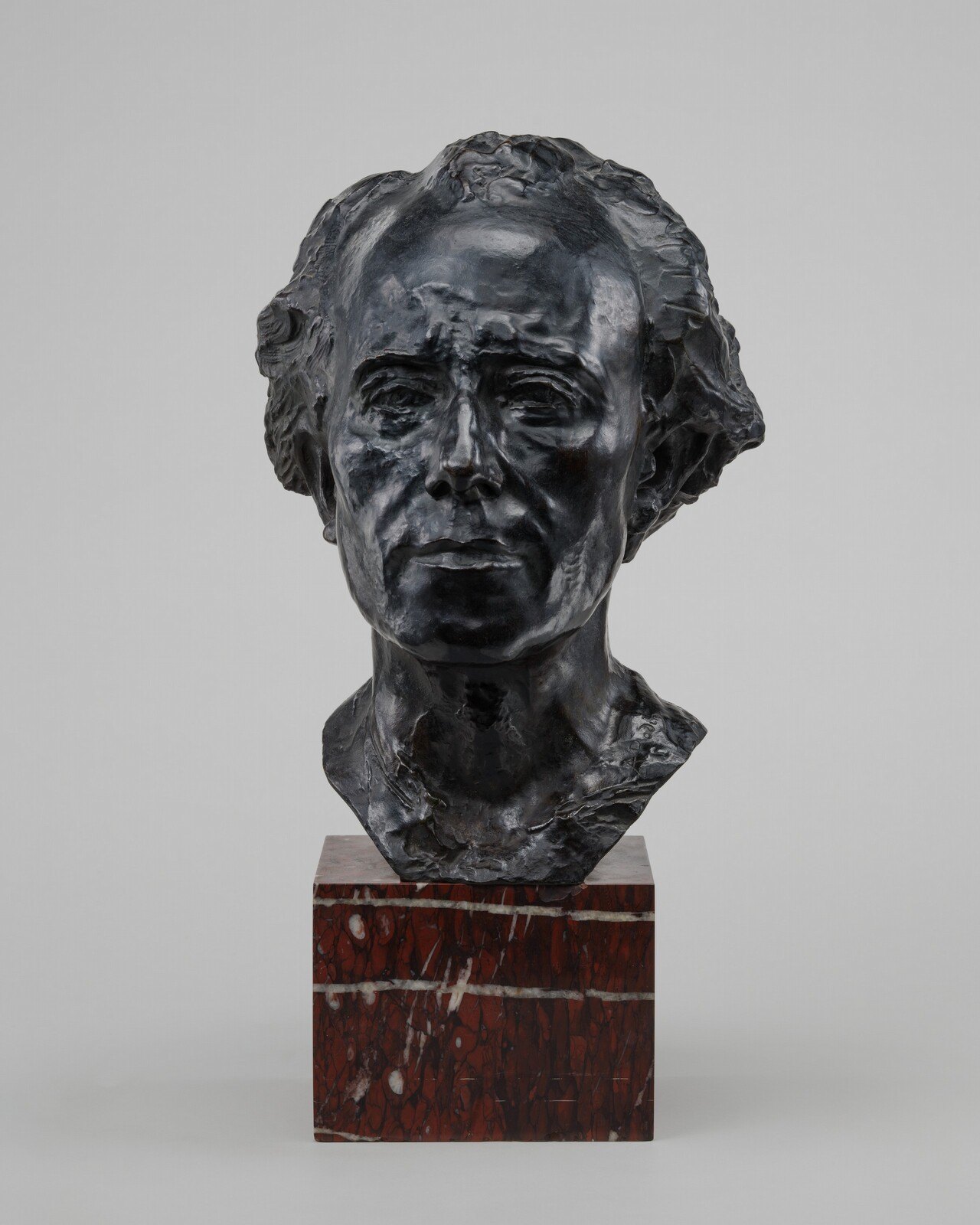
This cast was given to conductor Bruno Walter in 1913. National Gallery of Art, Washington, Gift of Lotte Walter Lindt in memory of her father, Bruno Walter, 1972.78.1. Image source. CC0 / Public domain.
A cast in lead in Vienna
The Wien Museum catalogues another form of the portrait, cast in lead and dated 1909. The head measures 34.5 centimetres high, very close to the height of the Washington bronze. The Vienna museum gives a second measurement of 54 centimetres for the whole object, with 19.5 centimetres for the support. It also records a total weight of 22 kilograms. These are measurements of different parts of the object. At the height of the full assembly, the support occupies a conspicuous share of the vertical outline and helps determine where the composer’s face sits in the viewer’s field of vision. [2] [9]
Lead adds another material to the portrait’s history alongside bronze, plaster and marble. The narrow difference in head height between the Vienna and Washington examples makes that range easy to miss if the measurements are read alone. Comparing material and overall height gives a clearer picture of the forms in which the 1909 portrait circulated. [2] [3] [4] [9]
Rodin artworks directory
Discussion
Look again at the images and ideas explored in Gustav Mahler. These editorial prompts invite your observations.
Reader Insights
After reading “From the forehead to the collar”, what detail would you look for in the object or image?
What extra evidence would help you distinguish the artist’s choices from the effects of material, viewpoint or later display?
Join the Conversation
Share a detail, comparison or question about Gustav Mahler below.
References
- Metropolitan Museum of Art. Gustav Mahler, 1999.363.73. View source.
- National Gallery of Art. Gustav Mahler, 1972.78.1. View source.
- Musée Rodin. Mozart-Portrait de Gustav Mahler, S.01085. View source.
- Musée Rodin. Gustav Mahler, bust on a substantial plaster base. View source.
- New York Philharmonic Archives. Archives features, Mahler and Musicians. View source.
- Musée Rodin. Portraits sculptés. View source.
- Musée d’Orsay. Gustav Mahler. View source.
- Musée Rodin. Tête de Gustav Mahler. View source.
- Wien Museum. Gustav Mahler, inventory 96332. View source.

 Auguste Rodin.jpg)





