


 by Tom Gurney
Tom Gurney BSc (Hons) is an art history expert with over 20 years experience
Published on June 19, 2020 / Updated on November 18, 2026
Email: tomgurney1@gmail.com / Phone: +44 7429 011000
Young Mother in the Grotto
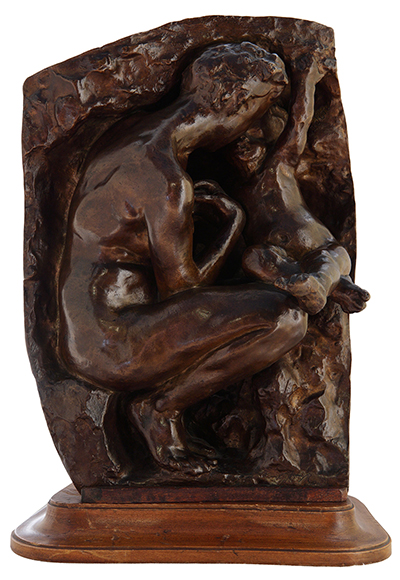
A woman crouches inside a rocky enclosure with a child beside her in Auguste Rodin’s Young Mother in the Grotto. The curve of her back follows the hollow at the left of the sculpture, and her lowered head brings the two figures close together under the overhang. The child occupies a narrow area between her knees and the rising stone at the right. Rodin developed the subject in connection with The Gates of Hell. Bronze and marble examples show how the enclosing rock can make the same mother-and-child grouping appear as an intimate scene apart from the doorway. [1] [2]
How the figures fit inside the grotto
The woman’s crouch determines much of the group’s outline. From the left shoulder, the back curves towards the hip and turns sharply across the bent thigh. The thigh continues almost to the right edge, where the curve of the knee rises towards the child. Below it, the lower leg comes back towards the shadowed area under the body. The eye can follow this circuit from the shoulder to the feet before picking out every point where the figure touches the rock. The room the woman makes for the child comes from drawing her limbs close to her body. [1] [2]
The figures approach each other near the top. The woman inclines her head so that it seems almost enclosed by the stone above her. The smaller face is set deep in the composition, where the surface receives less light. Lower down, a small foot projects towards the right edge. The protruding limb gives the eye a way to find the child’s position at a distance from the face. Between them, some of the darker shapes are difficult to distinguish from the rocky wall. The pose can still be read through the space that the woman’s thigh and bowed shoulders leave around the child. [1] [2]
At the centre, a bent arm makes a small curve within the much larger sweep of the woman’s back. The contours of the arm and the hands lead towards the gap between the figures. This interior gesture remains close to the recessed surface, where light is less continuous than it is across the broad outer planes. It is one of several passages that reward a shorter viewing distance. The main outline establishes the crouch, while the details near the hands and head give the pose its direction towards the other person. [1] [2]
Light and the rocky surface
The legacy photograph shows a brown bronze mounted on a wooden base. Highlights run across the woman’s shoulder and thigh, then break into smaller patches where the surfaces become irregular. The edge of the hollow around her back registers as a dark channel rather than a single line. Near the top, the rock comes forward and creates a comparatively continuous border. At the right it is more interrupted by the child’s body. The difference between those sides gives the enclosure a depth that is easier to see once the eye has followed the smooth areas of the figures. [1] [2]
The Philadelphia Museum of Art describes the contrast in its marble between the smooth bodies and the rough setting, relating Rodin’s handling of the stone to Michelangelo. In the marble, the lighting can give the flesh and rock very similar colours while leaving them quite different in texture. The bronze photograph produces an analogous separation through reflection. Bright points gather on the textured areas of the grotto, while longer highlights move across the thighs and shoulders. Both materials make it possible to see the bodies as part of the enclosure and as forms coming forward into its opening. [1] [2]
At the base the transition is quite different. The support has a rounded rim and an even finish, so its edge remains legible across the width of the photograph. Above it, the bronze varies in shape and texture from one side to the other. That straight lower boundary makes the uneven sides of the enclosure easier to see. [1]
Watch Rodin’s sculpture up close
Five films explore Rodin’s sculpture, from his use of classical models and the figures on his monumental doorway to the work of his studio.
Auguste Rodin – Challenging Beauty
Six sculptures show how Rodin adapted classical models.
Watch on YouTubeA mother and child from The Gates of Hell
The Philadelphia museum links the marble with a mother-and-child pair on the left panel of The Gates of Hell. In an architectural setting, a small figure could be read as part of a field of other bodies. The independent version situates the pair close to the viewer and lets the surrounding material act as a shelter. The way the mother bends over the child and the way her leg closes the bottom of the opening can suggest protection. That impression depends as much on the enclosing space as on the points where the bodies meet. [1] [2]
The museum also notes that Rodin sometimes used mythological titles for drawings of mothers and children. It raises the possibility of reading the child as Eros, the personification of love. The posture supports an interpretation in terms of care even without a specific identity for the pair. The downward angle of the woman’s head draws the eye to the place where the child recedes under the overhang. The island of light on her shoulder stands out because that portion of the bronze turns away from the small shaded area where the figures face each other. [2]
The bronzes and the marble
Philadelphia dates its marble to a model of 1885 carved in 1891. The Museo Nacional de Bellas Artes in Buenos Aires lists a patinated bronze, inventory 7776, measuring 36 by 25.5 by 22 centimetres and dated 1886 in its catalogue. The Musée Rodin records a further bronze that entered Claude Monet’s collection after an exchange of works in 1888. Monet offered a painting from his Belle-Île series and thanked Rodin after receiving the bronze. The sculpture subsequently entered the Musée Marmottan through the bequest of Michel Monet. [1] [2] [3]
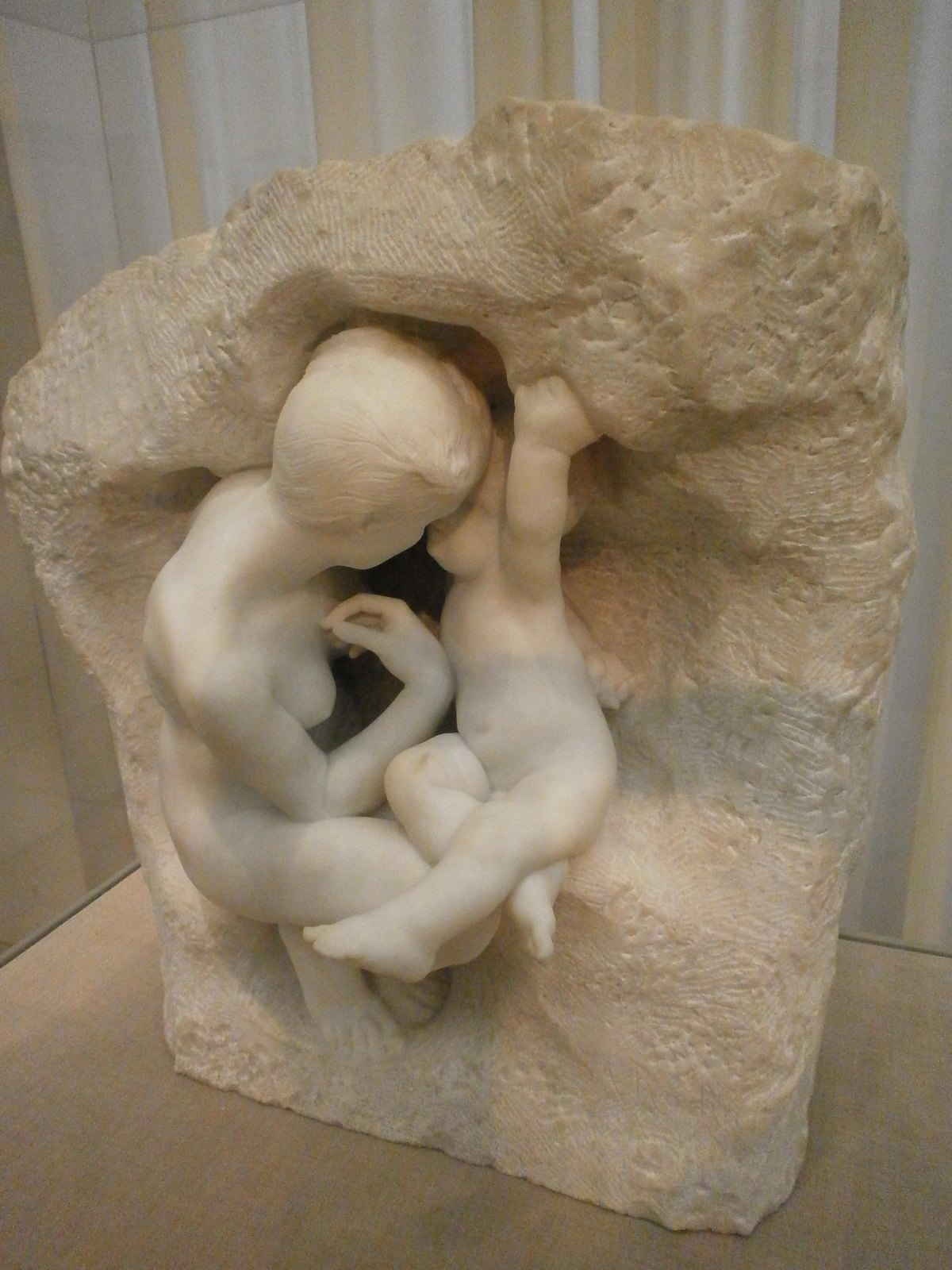
The Philadelphia marble shows the figures and the rough enclosure in the same stone. Wikimedia Commons; sculpture in the Philadelphia Museum of Art. Image source. Public domain. Resized for the web.
These records establish that the subject circulated in several versions, including bronzes during Rodin’s lifetime. The legacy files show the same view and retain details of the bronze and its shaped wooden support. The Buenos Aires object is a close comparison, though the exact cast remains unconfirmed. What the view establishes particularly clearly is the position of the figures relative to the edges of the enclosure. The crouching woman forms a loop from shoulder to knee, and the child comes into view where that loop opens at the right. [1] [2]
The Edinburgh marble and its pointing model
The National Galleries of Scotland call their marble The Young Mother. The Musée Rodin relates it to the grotto composition in its record for plaster S.02193. The Edinburgh marble measures just under 61 centimetres in height. Mrs Craig Sellar bought it from the studio around 1906, and it entered the National Galleries through Sir Alexander Maitland’s bequest in 1965. Its name on the Scottish record shows why it helps to compare the shape of the composition and the museum’s documentation when several groups of a mother and child bear similar titles. [4] [5]
The Paris plaster is catalogued as a pointing model made after the Edinburgh marble. Its materials include unbaked clay and metal nails as well as plaster. The record shows how a finished stone could itself provide a form to transfer. The surrounding material belongs to that process as much as the figures do. A pointing model for this version has to preserve the depth between the two bodies and the surface around them, since the depth of the opening determines how much light can reach the child and the mother’s face. [2] [4] [5]
Rodin artworks directory
Discussion
Look again at the images and ideas explored in Young Mother in the Grotto. These editorial prompts invite your observations.
Reader Insights
After reading “How the figures fit inside the grotto”, what detail would you look for in the object or image?
What extra evidence would help you distinguish the artist’s choices from the effects of material, viewpoint or later display?
Join the Conversation
Share a detail, comparison or question about Young Mother in the Grotto below.
References
- Museo Nacional de Bellas Artes. Jeune mère dans la grotte, 7776. View source.
- Philadelphia Museum of Art. Young Mother in the Grotto. View source.
- Musée Rodin. Rodin and Monet, section on the artists’ collections. View source.
- National Galleries of Scotland. The Young Mother, NG 2290. View source.
- Musée Rodin. La jeune mère, pointing model after the Edinburgh marble, S.02193. View source.

 Auguste Rodin.jpg)





