


 Auguste Rodin.jpg)
 by Tom Gurney
Tom Gurney BSc (Hons) is an art history expert with over 20 years experience
Published on June 19, 2020 / Updated on November 18, 2026
Email: tomgurney1@gmail.com / Phone: +44 7429 011000
Biography
In 1900 Auguste Rodin put on a retrospective in a pavilion near the Pont de l’Alma in Paris. Among the exhibits was the plaster of a door the French state had commissioned twenty years earlier. The decorative arts museum for which it had been intended was still unbuilt, and the door appeared without much of the projecting sculpture that would eventually make it famous. In his own pavilion Rodin could show visitors the work of a lifetime and give them a new view of an unfinished commission. He was approaching sixty. For much of his career, an exhibition committee or a patron’s brief had set the terms on which his work could be seen. At the Alma he arranged the encounter himself. [1] [2]
Learning a trade in Paris
Auguste Rodin was born in Paris on 12 November 1840. At the Petite École, formally the Imperial School of Special Drawing and Mathematics, he studied in an environment that prepared students for work in the decorative arts. Training in drawing gave him a way to learn the structure of a figure and to retain what he had observed. His applications to the École des Beaux-Arts failed three times. An artistic career at that point meant taking paid work where he could find it and using the remaining time for sculpture of his own. [1] [3] [4]
In 1864 he entered the workshop of Albert-Ernest Carrier-Belleuse as an ornamentalist. The same year he met Rose Beuret. She became his long-term companion, and they had a son, Auguste. The organisation of a commercial studio was a formative experience. There could be many finished pieces for each successful model, and a design could be varied to make it useful again. The Musée Rodin traces families of decorative figures from the Brussels years in which accessories, hair, drapery and companion figures change while the underlying model remains recognisable. This was a practical education in how a workshop could turn one piece of modelling into several works. [1] [3] [5]
One early sculpture, The Man with the Broken Nose, had a long route from modelling to public recognition. The Musée Rodin dates the model to 1863–65 and the carving of its marble to 1874–75. The marble was accepted at the Paris Salon in 1875. The portrait’s bent nose and deeply creased face gave the sculptor plenty to work with in the passage between light and shade. The fact that the institution exhibited a carved version years after the model was made is an early example of the distance between the beginning of a Rodin sculpture and its first public appearance. [1]
Brussels, Italy and The Age of Bronze
Rodin moved to Brussels in 1871, following Carrier-Belleuse, who had work there on the new stock exchange. The Musée Rodin dates the start of the exterior groups Africa and Asia to that year. The commission had originally gone to Carrier-Belleuse. Antoine-Joseph Van Rasbourgh and Rodin worked on the groups, and the museum attributes most of the execution to Rodin, whose signature is absent. By 1873 Rodin and Van Rasbourgh had formed a partnership. The date of that partnership and the date at which they began work on the same building mark different points in Rodin’s progress from employee to partner. [1] [3] [4] [9]
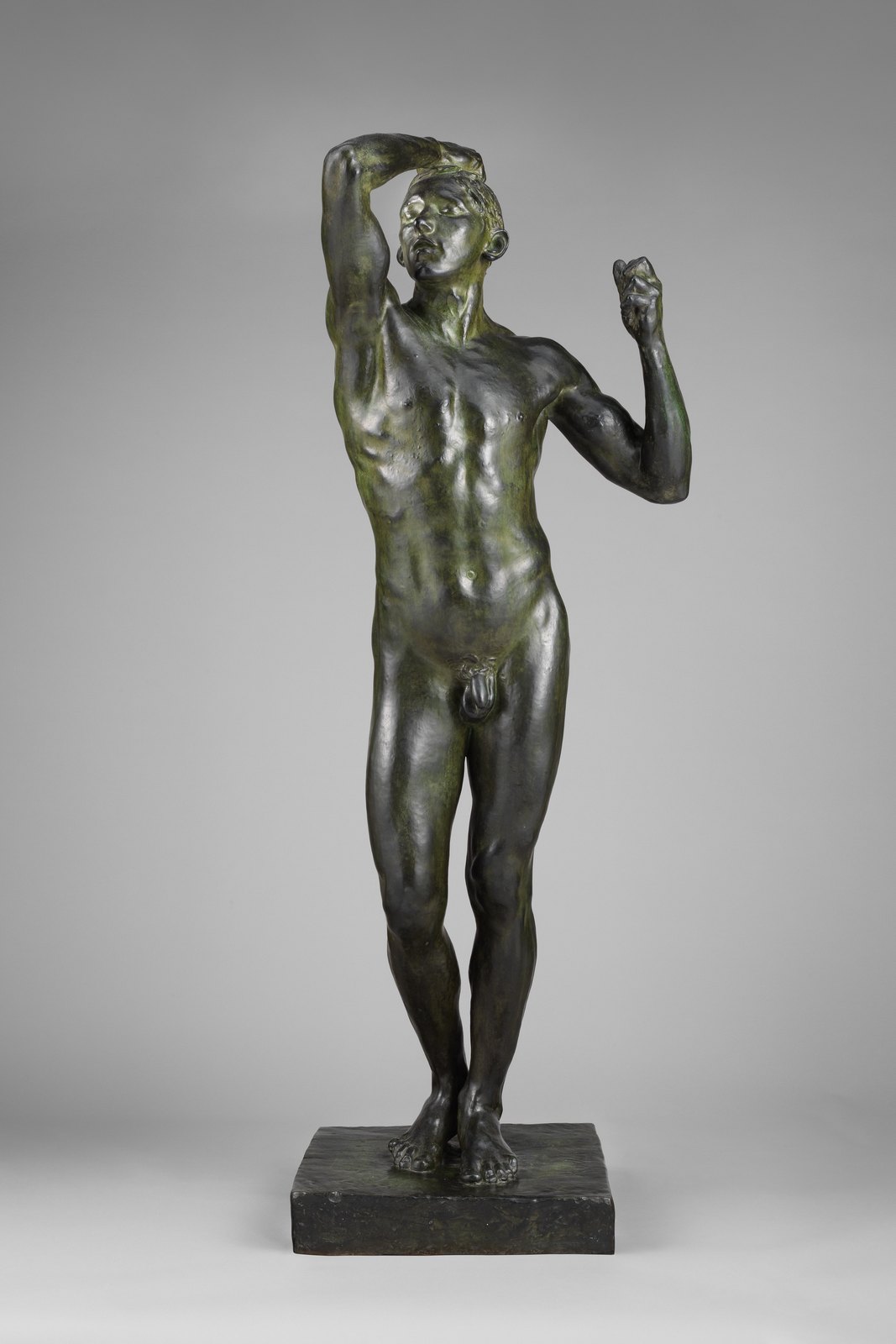
The Met’s bronze represents the figure Rodin developed during his Brussels years. The Metropolitan Museum of Art, Gift of Mrs. John W. Simpson, 1907, 07.127. Image source. CC0 / Public domain. Resized for the web.
The stock exchange called for sculpture at several distances from its viewers. The allegorical groups at the top of the south façade had to make sense when seen from the street. Indoors, Rodin worked on a group of children above figures representing Trade and Industry. The figures below serve as caryatids, human forms arranged as architectural supports. A spectator looking up can read the children and the supporting figures as separate parts of the scheme, then see how their positions belong to the same structure. Other sites gave Rodin variations on that problem. On a residential building on Boulevard Anspach he made two male supporting figures, called atlantes, and a caryatid. Building work required him to think about where a body would appear, how much of it the setting would let the spectator see, and what a pose could communicate from below. Those concerns would recur when he had more control over a commission’s design. [9]
At the same time, Rodin modelled figures for rooms and private collections. The Met’s terracotta Bacchante, also called Grapes or Autumn, belongs to this part of his career. The grapes gathered in the young woman’s hair help identify the subject and make a textured edge against the smooth face. A viewer can examine the fruit from close range and follow the transition into the modelling of her brow and cheek. Compare that with the work a head must do at the top of the stock exchange, where one of the first things a pedestrian can register is which way it turns. The Met relates the terracotta to Carrier-Belleuse’s commercial example. Rodin was learning both how to make a figure legible across a façade and how to reward someone looking at a small object at arm’s length. [4] [9] [23]
Travel brought another kind of education. Rodin passed through Reims on his way to Italy in the mid-1870s and made a broader tour of French cathedrals from autumn 1877. Reims appears again in a drawing of its porches and belfry that the Musée Rodin dates to 1905. The interval gives an idea of how long this strand of observation lasted, eventually reaching print in his 1914 book on the cathedrals of France. In Italy he studied Michelangelo, whose work offered another sustained encounter with figures made for architectural settings. Rodin was also developing the life-size male figure he presented in Brussels in 1877. The Met identifies its Brussels title as Le Vainçu. The Musée Rodin’s plaster catalogue describes the showing as untitled. [1] [4] [9] [24] [25]
At the Paris Salon of 1877 the figure appeared as The Age of Bronze. Its lifelike modelling prompted the suspicion that he had cast it from the model’s body. The accusation mattered to a sculptor whose ability to construct a life-size figure was at the heart of his claim to recognition. The controversy was followed by state acquisition in 1880. That year Rodin also received the commission that gave him the space and resources to work on a much larger scale. It came through Edmond Turquet, the government official who championed his work. [1] [3] [4]
The state commission and the studio
The change from Brussels building work to Paris Salon sculpture still left room for paid decorative design. Carrier-Belleuse brought Rodin into the national porcelain works at Sèvres in 1879, and Rodin worked in its studios until 1882. One of his duties was to develop decoration for shapes already designed by Carrier-Belleuse. At Sèvres a figure could be built up through thin layers of liquid porcelain paste brushed onto the unfired body of a vessel. Rodin also incised designs into the paste. Either process required him to consider how much relief a figure needed to remain legible on a curved surface. In the Pompeii Bucket, Night, catalogued in porcelain from 1882–83, the decoration makes sense as the viewer turns the vessel or moves around it. The shape and the surface together govern how much of the composition is visible at once. [26]
The Sèvres workshops continued to commission work from him after his regular employment ended. The Musée Rodin identifies three vase models supplied between 1887 and 1891 that reuse forms from The Gates of Hell. One surviving example, Limbo and the Sirens, carries Rodin’s signature beneath the motif of Limbo. The collection also contains a firing trial made from a section of that vase’s mould. The two objects offer evidence of how a relief could travel. A group worked out for one upright of a monumental door became part of the decoration of a vase. A section of its mould in turn made it possible to test that design in fired material on its own. The architectural commission and the porcelain work thus shared actual forms while making different demands on the people who modelled, reproduced and looked at them. [26] [27] [28]
The state wanted a doorway for a projected museum of decorative arts on a site associated with the destruction of the Paris Commune. Dante’s Inferno supplied Rodin with subjects for the door. Work on the commission gave him access to an atelier at the Dépôt des marbres, and the scale of the undertaking made assistants essential. A plaster could preserve the form of a clay original, supply a model for work in bronze or marble, and give Rodin material to recombine as he reconsidered a composition. The objects left in the studio show that these functions could continue to overlap over many years. [2] [4] [5] [6]
Camille Claudel entered this professional world with training and ambitions of her own. She studied at the Académie Colarossi at a time when the École des Beaux-Arts excluded women. She shared a studio with other women, and came into contact with Rodin when he took over the supervision previously given by Alfred Boucher. Around 1884 she joined Rodin’s workshop. The two were collaborators and lovers, and she continued to make and exhibit her own sculpture. Her portrait of Rodin is a good place to encounter the relationship from the other side. The heavy brow and alert turn of the head are decisions made by a sculptor observing a fellow artist closely. [6] [7]
The commissions that followed occupied Rodin on several fronts. Calais wanted a monument to commemorate the citizens who offered themselves to Edward III during the siege of the town. The group was commissioned in 1885 and inaugurated in 1895. In 1891 Rodin undertook official work on monuments to Victor Hugo and Honoré de Balzac. Both called on him to make a writer recognisable in sculpture and to decide how much of the sitter’s public identity to express through dress, gesture and setting. The rejection of the Balzac plaster in 1898 made clear how far he and his commissioners differed on what a public likeness should accomplish. [1] [4] [8]
Showing sculpture with Monet
When Claude Monet and Rodin exhibited together at the Galerie Georges Petit in 1889, both had experience of the gallery’s international group shows. In 1886 Rodin’s sculptures had been shown alongside paintings by Monet and Renoir. Another exhibition the following year brought them together with artists including Berthe Morisot and James McNeill Whistler. The opportunity to share a gallery therefore came through relationships already sustained by dealers, exhibitions and critics. Octave Mirbeau’s dinners provided another place for painters, writers and sculptors to meet. The Musée Rodin gives several possible intermediaries for the first meeting between the two artists. Their correspondence and earlier exhibitions establish the friendship more securely than the circumstances of its beginning. [29] [30]
At first the plan called for work by Renoir and Whistler as well. After Petit declined the larger proposal, Monet wrote to Rodin in February 1889 to suggest a show for the two of them. The catalogue would give each artist an introduction, written for Monet by Mirbeau and for Rodin by Gustave Geffroy. In assembling 145 paintings, Monet could show how his practice had changed since the 1860s. Rodin had commissions in progress, including The Gates of Hell, and doubted how much he would have ready. He eventually exhibited 36 sculptures. The show took place while the Universal Exposition was bringing visitors to Paris, but the dealer’s gallery gave the two artists a space in which the objects and essays could be brought together under their names. [29] [31]
The works Rodin sent asked for different ways of looking. The plaster of The Burghers of Calais brought together six figures at the scale of a public monument. The Musée Rodin also records two torsos and two masks. A viewer could go from the spacing of whole bodies to the surfaces of an isolated fragment and consider each as a deliberate exhibit. For a painter with work on the walls, the placement of sculpture had a more immediate consequence. Monet complained to Petit about works being installed in front of his pictures. The Met suggests that the Calais group may have been involved. The complaint gives a concrete sense of how sculpture changed the room. The space it used on the floor also affected which paintings could be seen, from where and at what distance. The challenge returned in a different form in 1900, when Rodin arranged a pavilion of his own. [2] [5] [31]
The friendship also meant living with a work by the other artist. Rodin kept Monet’s Belle-Île on an upper floor of the Villa des Brillants. Monet kept Rodin’s bronze Young Mother in the Grotto in his studio, where, as he wrote in thanks, he could see it regularly. In 1907 he also helped arrange an exhibition of Rodin’s drawings with Durand-Ruel. The painter who had once negotiated wall space with Rodin was now helping find an audience for work most readily shown on walls. The exchange is part of the biography because it shows how repeated encounters with art could lead to practical support. The same person could lend a name to a catalogue, offer a place in a collection, or bring work to a dealer’s attention. [29]
Commission work and the people who carved it
Geffroy and Mirbeau continued to write about work that had to answer to a patron. In 1890 the committee responsible for the Panthéon programme turned down Rodin’s first proposal for a monument to Victor Hugo. The Musée Rodin identifies the two writers and Arsène Alexandre as public supporters of the sculptor in that dispute. In 1898, when the Société des Gens de Lettres rejected his Balzac, defenders included artists, writers and a composer, Claude Debussy. Such support could keep a proposed monument before the public even when an institution declined to install it. The friends who had helped Rodin present his work at a dealer’s gallery could also argue for an interpretation of a work that its commissioners had rejected. [8] [30] [35]
The larger exhibitions coincided with a change in the size of Rodin’s workshop. A Musée Rodin study of correspondence and accounts estimates that about a hundred specialists worked for him at some point, out of about 150 people known to have offered their services. In the 1880s four or five practitioners worked for him in a given year. The number reached 14 in 1899 and 26 in 1902. An annual count includes carvers engaged only briefly alongside collaborators who returned from one year to the next. A short engagement might mean taking measurements from a model for transfer to the marble or correcting a particular area. As commissions multiplied, the capacity to start several objects at different stages became part of how Rodin could meet demand. [32]
Antoine Bourdelle began carving marble for Rodin in 1893. The Musée Rodin shows his Head of Apollo as work by an artist who would develop a distinct approach to the face. The broad structures of the head and the compact boundary around it are worth attending to in their own right. Seeing the work gives some idea of what a biography organised around Rodin’s achievements risks losing. A collaborator might spend part of his working life dealing with the surfaces and dimensions of another sculptor’s models while deciding, in work of his own, how much of a face could be conveyed by a few major planes. Surviving accounts help to identify a practitioner’s work on particular commissions. An independent sculpture shows what that person was trying to achieve with his own forms. [32] [33]
Watch Rodin’s sculpture up close
Five films explore Rodin’s sculpture, from his use of classical models and the figures on his monumental doorway to the work of his studio.
Auguste Rodin – Challenging Beauty
Six sculptures show how Rodin adapted classical models.
Watch on YouTubeA household, a workshop and a collection at Meudon
The move to Meudon took place in stages. Rodin lived first in the Bellevue district and then rented the Villa des Brillants, a house built in 1883 by the painter Delphine de Cool. He rented the villa from 1893 and bought it in 1895. The Musée Rodin traces his subsequent acquisition of adjoining land and the addition of workshops and living quarters through 1909. The house, meanwhile, held sculpture alongside the rooms used for daily life. The upper floors accommodated his bedroom, archives and paintings. The arrangement made it possible to move among objects in very different states of completion without leaving the property. Clay and plaster belonged to the working spaces, while a sculpture could also occupy the rooms in which Beuret and Rodin lived and received people. [14] [15]
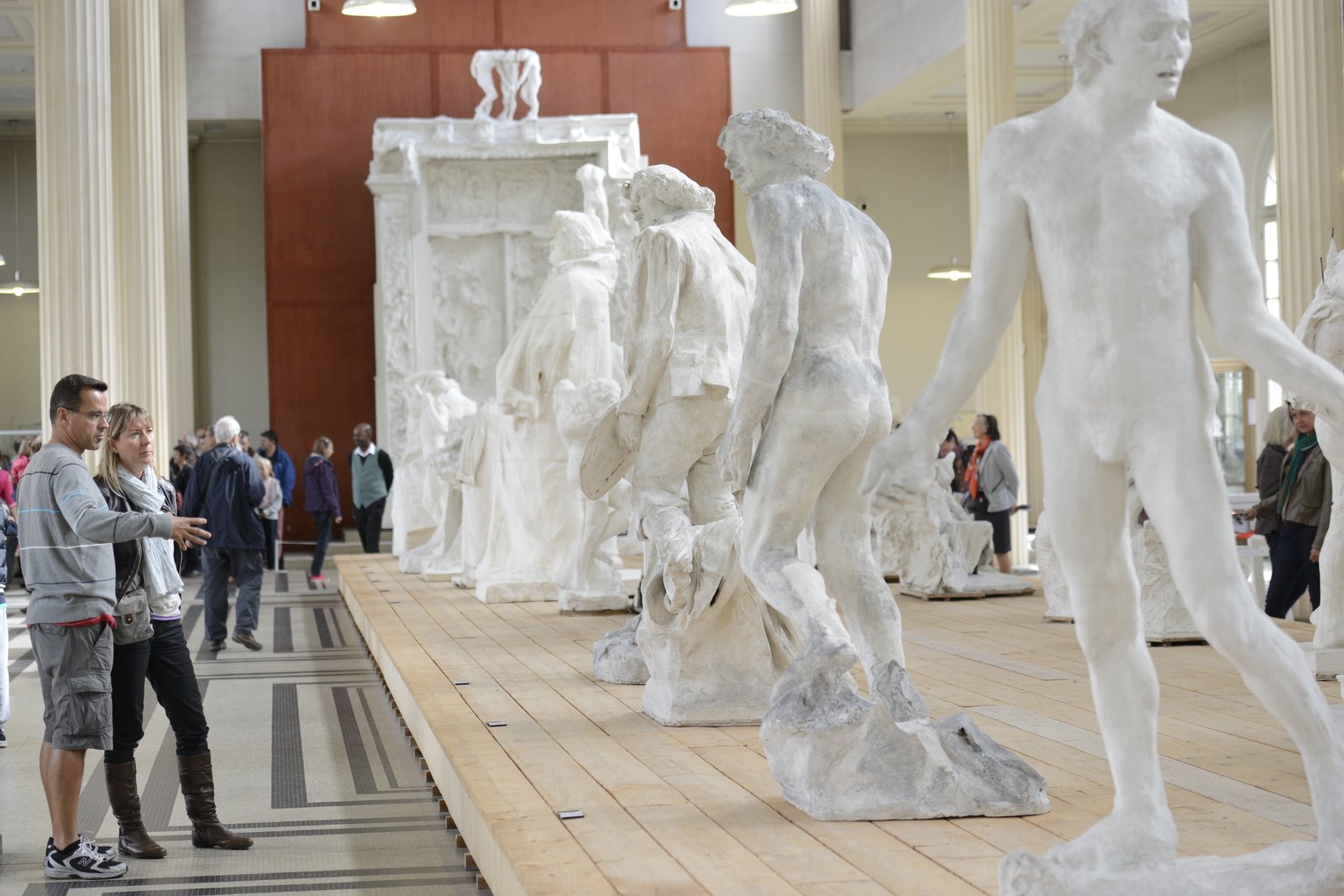
The Meudon site preserves the setting of Rodin’s later home and workshop. Photograph by VilleMeudon, Wikimedia Commons. Image source. CC BY-SA 4.0. Resized for the web.
The role of Rose Beuret in this operation is easy to miss if one follows only the dates of commissions and exhibitions. The Musée Rodin’s account of the villa describes her receiving visitors with Rodin and looking after the household and workshops in his absence. That evidence gives some substance to the frequently repeated description of her as his companion. At Meudon, the work of maintaining a household and the demands of a sculpture studio occupied adjoining ground. The institution records visits by people from different parts of Rodin’s professional world, including the sculptor Antoine Bourdelle, the photographer Edward Steichen and the writer Judith Cladel. Their reasons for coming differed. The site allowed one household to receive them while continuing to accommodate the people and materials needed for Rodin’s work. [14]
The antiquities occupied spaces of their own, but their boundaries with the studio were porous. The Musée Rodin’s study of his Egyptian collection locates small pieces in several parts of the Meudon property, including the reconstructed Alma pavilion, the building devoted to antiquities and the villa’s painting studio. In 1903 Rodin acquired another house, at 15 chemin de Fleury, which became an annex of the Villa des Brillants. His acquisitions therefore changed the layout of his daily working environment. Encountering an ancient sculpture could mean seeing a small object amid other things being handled in a studio or coming upon a large marble under quite different conditions. That range is useful context for his interest in the expressive force of isolated heads, torsos and other partial figures. The presence of an antique at Meudon establishes access and interest. A specific connection to one of Rodin’s sculptures still requires evidence from the works or from an account of his process. [15] [16]
The two exhibition buildings at Meudon belong to different stories. The pavilion associated with the 1900 retrospective had first stood in Paris and was reassembled in the garden. The space built for the antiquities had a front pediment and high arched windows. The Musée Rodin describes an interior derived from a sculptor’s working environment, with storage and a level from which objects could be observed. Pedestals and platforms gave works different heights. Where the public exhibition in Paris placed examples of his own output in relation to one another, the building for ancient objects shows him designing conditions for repeated study. It also helps make sense of Meudon’s later value as a museum site. The interest of the property comes partly from the proximity of objects Rodin collected, objects he worked on and spaces where those two activities could meet. [14] [16]
Portraits and international recognition
His later career drew writers, photographers, collectors and portrait sitters into that world. Rainer Maria Rilke wrote about his work. Hugo von Hofmannsthal, visiting the studio in 1900, saw the plaster study for a small group now known as Man and His Genius and commissioned a bronze. Rilke wrote a poem connected with the work and later helped arrange its sale. The bronze spent years on Hofmannsthal’s desk before passing through a Swiss collection to Berlin. Its story shows how differently a sculpture could enter public life from the way a town monument did. It began with someone seeing a plaster in the studio and imagining a place for the work in his own daily life. [10]
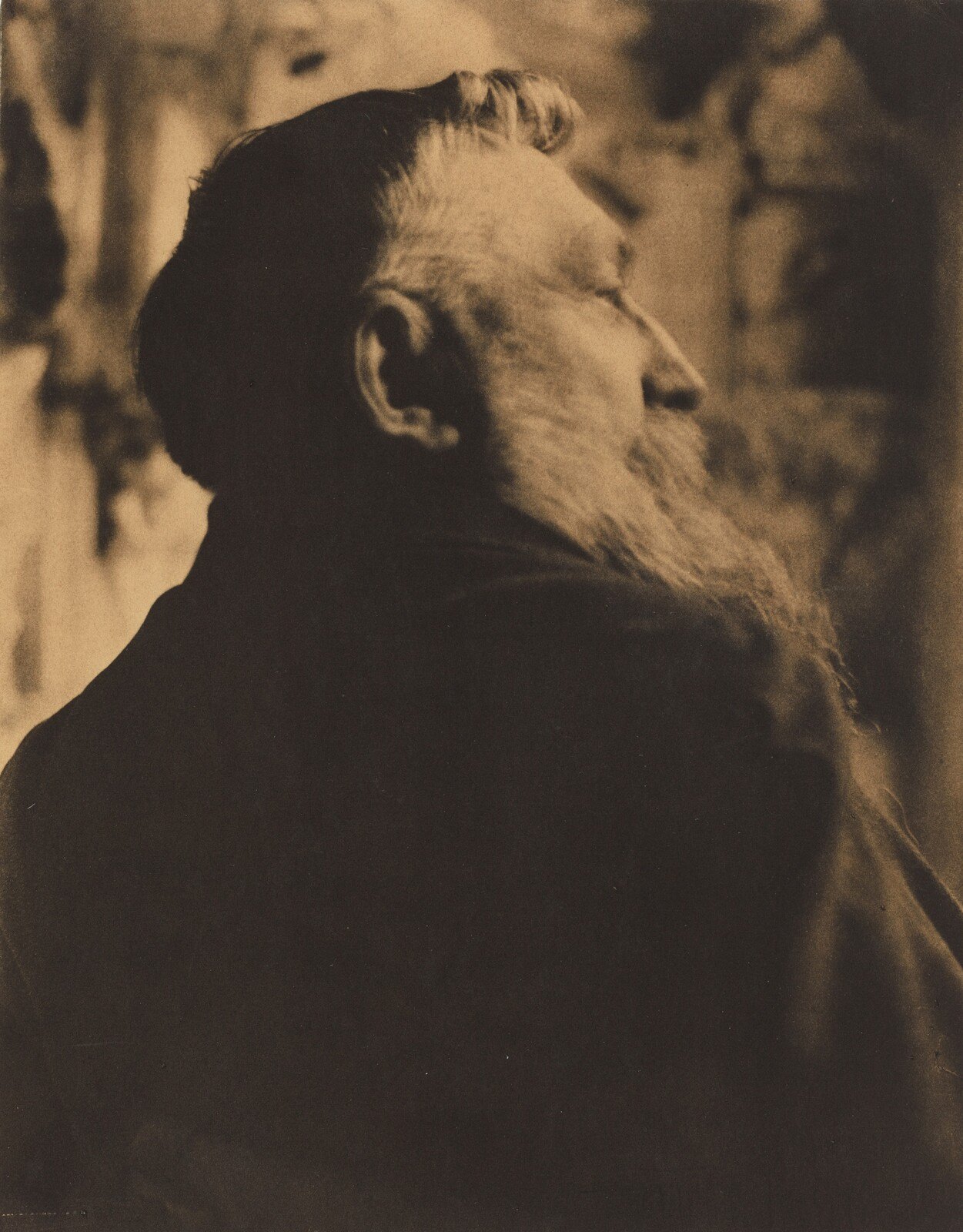
Käsebier’s portrait is evidence of the sculptor’s engagement with photographers visiting from abroad. National Gallery of Art, Washington, Patrons’ Permanent Fund, 2008.65.13. Image source. CC0 / Public domain.
Public recognition widened during the last years. An enlarged Thinker was installed outside the Panthéon in 1906. Contact with performance also sent him back to drawing. In 1906, during King Sisowath’s visit to France, Rodin saw the Royal Cambodian Ballet and made a series of drawings following the dancers’ poses. By then, someone looking for Rodin’s work might find a bronze in a public setting or an intimate study of a hand or a turning body on paper. [1] [11] [12]
An American museum buys the work of a living sculptor
The Copley Society paired the work of Monet and Rodin again in Boston in 1905. The organisers drew from American collections and from the dealer Durand-Ruel, assembling 95 paintings and 11 sculptures. The Boston show depended on objects that could already be borrowed through an American network. Rodin’s work had acquired a public life there through dealers and private owners before the Met committed itself to forming a collection. By making those privately held works available together, the exhibition allowed a sculptor’s audience to grow ahead of the purchases that would give it a permanent place to see his work. [17] [31]
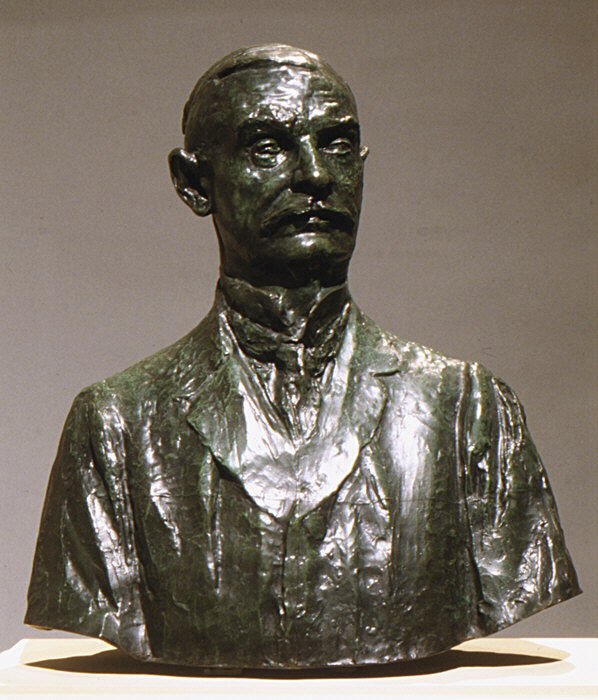
Rodin’s portrait depicts the patron who helped establish the sculptor’s presence at the Metropolitan Museum of Art. The Metropolitan Museum of Art, Gift of Auguste Rodin, 1911, 11.174. Image source. CC0 / Public domain.
The Metropolitan Museum’s 1912 Rodin installation was the outcome of decisions taken in New York as well as in France. In 1906 the sculptor Daniel Chester French, who chaired the museum’s Committee on Sculpture, made the case to its trustees for buying modern sculpture by living artists and named Rodin as a priority. The museum already had ancient sculpture and plaster and bronze casts. A collection of work by a living sculptor could take shape while the artist was still able to advise on purchases, supply examples or make gifts. In 1910 the financier and collector Thomas Fortune Ryan gave the museum $25,000 for Rodin purchases. The Met’s history of the collection also records contributions from Kate Seney Simpson and the roles of its purchasing agent John Marshall and administrator Edward Robinson. [17] [18]
The collection that resulted included objects that travelled through quite different channels. The museum could commission a bronze, acquire a marble made in the studio or receive a work from the artist. The Met’s history describes its early gallery through objects such as the bronze Adam and the marble Pygmalion and Galatea. Although both are human figures with strong contours, they answer to different kinds of light and invite different distances of looking. Seeing such works together offered a student more than an accumulation of examples. One could compare exposed surfaces, the depth of carving or modelling and the ways a pedestal gave one object more visual space than another. Joseph Breck, the author of the museum’s early publication on the collection, described the educational purpose of giving American students direct access to Rodin’s work. [17] [18]
The 1912 photographs show the curators putting that idea into practice. The works sat at different heights and were arranged across a corridor near the Great Hall, mixing sculpture in different media. The view through the gallery brought widely separated pieces into the same line of sight. A surviving view towards the west includes Adam and Pygmalion and Galatea, while the view in the opposite direction includes The Hand of God. The resulting encounter was a museum’s interpretation of the body of work. It differed from seeing a work in Rodin’s crowded studio or from meeting a monument within a public square. In that sense Rodin’s American reputation depended on two sets of decisions, first in choosing which objects should reach the museum, then in arranging a setting where they could be looked at together. [17]
The gathering of a representative collection in New York took place before the 1916 gift from which the Musée Rodin originated. At the Met, individual purchases and gifts built up a collection around one artist within a larger institution. The gift to the French state also carried the artist’s possessions, models and rights, and was tied to the creation of a museum at the Hôtel Biron. The Paris museum opened in 1919, and Meudon followed in 1948. Taken together, these dates give a fuller view of what happened to Rodin’s work while he could still shape its destination and what depended on curators and institutions after his death. [17] [18] [19]
How a London exhibition became a gift
British advocates, among them the writer W. E. Henley and the artist Alphonse Legros, helped find an English audience for Rodin. A subscription organised by supporters brought a bronze Saint John the Baptist to the Victoria and Albert Museum. In July 1914 a collection that included The Age of Bronze, portraits and fragmentary sculptures came to London for a modern French art exhibition at Grosvenor House. The mixture of bronzes, a marble and a terracotta gave a view of the range of work that a single purchase could only suggest. When war began shortly after the show closed, the works stayed in London. The sculptor John Tweed took them into his studio at Rodin’s request. [30] [34]
The V&A’s Eric Maclagan saw the group there and approached the museum’s director, Cecil Smith, about borrowing it. Rodin visited in September, and the museum arranged a six-month loan. Maclagan’s correspondence documents some of the practical difficulties of installing the works when the war had drawn away many of the museum’s workmen. A photograph of the resulting display gives an idea of the space around the sculptures. Rodin saw an arrangement that put his work in a broader museum setting and agreed to give the ensemble. He confirmed the gift on 5 November and signed the declaration on 8 November. The V&A preserves the declaration and records that Rodin understood the gift as a gesture of solidarity with British soldiers fighting alongside the French. [34]
New York, London and Paris therefore received substantial groups of Rodin’s sculpture through three different sequences of events. The Met gathered works through purchases and gifts in the course of building a modern sculpture collection. In London a temporary exhibition and a wartime loan gave the V&A the chance to keep a group assembled for another purpose. In Paris, the destination of the sculptures was part of a longer negotiation that also involved the house and garden in which they would be seen. Those circumstances affected which work audiences in the three cities could encounter together. [17] [19] [20] [34]
The gifts and the museum
In 1908 Rodin rented four ground-floor rooms at the Hôtel Biron for studios. They faced south and opened onto the terrace. The building already housed tenants drawn from several arts, among them the sculptor Clara Westhoff, through whom the museum says Rodin discovered the property. The garden gave him another place to put sculpture and some of the antiquities he had gathered. By 1911 he occupied the entire mansion. The building had become a place where a visitor could see parts of his collection in spaces that Rodin could arrange himself, even while tools, models and more antiquities remained at Meudon. [14] [20]
A letter to the politician Paul Escudier from late 1909 shows that Rodin already had a purpose for keeping the works together. He offered the state his sculpture in several materials, his drawings and the antiquities, specified the Hôtel Biron as their home and sought to continue living there. He described the ancient objects in terms of what artists and workers could learn from them. Preserving the collection under one roof would make it possible to range across subjects and materials as he had done when assembling it. The letter also tied that educational project to a particular property whose future was under discussion. [20]
The state bought the estate in 1911 with plans for administrative offices and a secondary school on the Rue de Babylone side. Other occupants were asked to leave. Following assurances from the government in 1912, Rodin moved a portion of the antiquities from Meudon to Paris. Drawings, sculpture and ancient pieces could now be seen together at the Hôtel Biron before its future as a museum had been settled by law. The move also had consequences for anyone trying to establish what the gift would contain. The inventories had to account for objects in two places, and the lists prepared in the workshop became part of the evidence for how the collection had been distributed. [20] [21]
In 1913 the French fine arts administration asked the national museums to arrange an inventory. Rodin’s secretary Henri Delarue compiled a preliminary list by location at Meudon, and his moulder Paul Cruet prepared other lists. Charles Boreux took stock of the Egyptian antiquities under the direction of Georges Bénédite. In a report from July that year, Georges Bénédite singled out a fragment showing Ramesses I drawing a bow and an inscribed fragment of a stela. He also questioned the authenticity of some pieces. That assessment gives two different kinds of information. The selection tells us something about the objects Rodin wanted around him, while the museum specialists had to assess individual objects and describe them so they could be traced after the gift. The surviving lists grew from work shared between people who knew the layout of the studio and people who knew the objects’ wider archaeological context. [21]
The Musée Rodin dates the three donations to 1 April, 13 September and 25 October 1916. The law accepting them designated the house and garden in Paris for the museum Rodin had proposed. Léonce Bénédite, brother of Georges, took responsibility for the estate and the organisation of the institution as executor. The gifts preserved the material through which it is possible to reconstruct much of Rodin’s working life. The workshop collection includes clay, wax and many plasters. A head kept by itself, a plaster that marks an intermediate stage, and a marble completed for a patron reveal different kinds of labour. They also show how much of a sculptor’s work might ordinarily disappear when a studio was dispersed. [13] [20] [22]
Rodin married Rose Beuret in January 1917. She died shortly afterwards, and he died at Meudon on 17 November that year. The Musée Rodin opened in 1919. Its opening was a posthumous event for which Rodin had laid the groundwork while alive. The late bronze history of The Gates of Hell shows what that distinction means. He had agreed to its reconstruction, but it was cast after his death. One can look back from the bronze to the commission of 1880, the partly stripped plaster of 1900 and the decisions of 1917 without treating any of those dates as the single moment the door came into being. [1] [2] [13]
The museum at Meudon took longer to reach the public. The board was working on a new building there by 1925, and the Musée Rodin archives track the project through its funding, including a gift by the American collector Jules E. Mastbaum, and the correspondence of the architect Henry Favier. The building opened in 1948. Its emphasis on plasters gives visitors a way to read Rodin’s work through the objects that had allowed the studio to preserve and rework a figure. Someone looking at a plaster alongside related forms can compare stages that a biography told only through exhibition dates would compress into a single event. That is one of the consequences of the decision to keep the contents of a workshop as material for study. [5] [19] [22]
Rodin artworks directory
Discussion
Look again at the images and ideas explored in Biography. These editorial prompts invite your observations.
Reader Insights
After reading “Learning a trade in Paris”, what detail would you look for in the object or image?
What extra evidence would help you distinguish the artist’s choices from the effects of material, viewpoint or later display?
Join the Conversation
Share a detail, comparison or question about Biography below.
References
- Musée Rodin. 1840–2015. View source.
- Musée Rodin, Meudon. The Gates of Hell, plaster. View source.
- National Gallery of Art. Auguste Rodin. View source.
- The Metropolitan Museum of Art. Auguste Rodin (1840–1917). View source.
- Musée Rodin. Multiples, fragments, assemblages. View source.
- Musée Camille Claudel. Her arrival in Paris and encounter with Auguste Rodin. View source.
- Musée Camille Claudel. Claudel, Camille. View source.
- Musée Rodin. Le Monument à Balzac. View source.
- Musée Rodin. Sculpture and architecture. View source.
- Staatliche Museen zu Berlin. Rodin – Rilke – Hofmannsthal. Der Mensch und sein Genius. View source.
- Musée Rodin. The Thinker. View source.
- Musée Rodin. Rodin and the Cambodian Dancers. View source.
- Musée Rodin. Sculptures. View source.
- Musée Rodin. Rodin à Meudon, de l’atelier au musée. View source.
- Musée Rodin. Les lieux de la collection. View source.
- Musée Rodin Meudon. Antiques Studio. View source.
- The Metropolitan Museum of Art. Sculpture on the Move: A Century of Rodin at The Met. View source.
- The Metropolitan Museum of Art. Rodin at The Metropolitan Museum of Art: A History of the Collection. View source.
- Musée Rodin Meudon. The Musée Rodin, the artist’s heir. View source.
- Musée Rodin. The Hôtel Biron. View source.
- Musée Rodin. The donation to the French state. View source.
- Adeline Foulon, Musée Rodin archives. Construction du musée Rodin de Meudon et donation Jules E. Mastbaum, finding aid D1/1. View source.
- The Metropolitan Museum of Art. Bacchante (Grapes or Autumn). View source.
- The Metropolitan Museum of Art. The Age of Bronze, bronze cast circa 1906. View source.
- Musée Rodin. L’Âge d’airain, plaster record. View source.
- Musée Rodin. L’Enfer selon Rodin, exhibition dossier, p. 17. View source.
- Musée Rodin. Vase Saigon, Les Limbes et les Syrènes. View source.
- Musée Rodin. Limbo on The Gates of Hell. View source.
- Musée Rodin. Rodin and Monet. View source.
- Musée Rodin. Rodin and modernism. View source.
- The Metropolitan Museum of Art. Auguste Rodin and Claude Monet, The Pursuit of Nature. View source.
- Musée Rodin. Rodin et le marbre, exhibition dossier. View source.
- Musée Rodin. Antoine Bourdelle, Tête d’Apollon. View source.
- Victoria and Albert Museum. The Rodin Gift to the V&A. View source.
- Musée Rodin. Rodin et la littérature. View source.






