



 by Tom Gurney
Tom Gurney BSc (Hons) is an art history expert with over 20 years experience
Published on June 19, 2020 / Updated on November 18, 2026
Email: tomgurney1@gmail.com / Phone: +44 7429 011000
The Age of Bronze
A man stands with his eyes almost closed and a hand raised to his head. The fingers of his other hand close around empty air. His weight bears into one leg while the other gives the body a slight turn. Seen from the front, the lifted arms seem to open out from the chest. Move to the side and the silhouette becomes narrower, with the raised hand and the line of the forehead close together. It is an unusually quiet pose for a work that caused so much trouble. When Auguste Rodin exhibited the figure in plaster in 1877, some viewers thought its resemblance to a living body could only have come from taking a mould directly from one. [1] [2]
A model in Brussels
Rodin worked on the figure in Belgium, where he had been earning his living on decorative and architectural projects. He modelled it from Auguste Neyt, a Belgian soldier, and returned to the work after travelling in Italy in 1876. The scale of the figure made it an ambitious undertaking for a sculptor who had yet to establish himself as the author of a publicly exhibited life-size nude. From the beginning, the standing body was the main subject. The shifts of weight across the hips, the separation of the arms from the torso and the small changes of tension in the shoulders were part of what he had to make convincing in the round. [2] [3] [4]
The plaster went on display in Brussels in 1877 and then at the Paris Salon. Le Vainçu, a title associated with the Brussels display, is usually translated as The Vanquished One or The Conquered Man. The Metropolitan Museum of Art records that at an earlier stage the figure had a band in his hair and held a spear with the left hand. The curve of the fingers makes more sense once you imagine that missing shaft. It would have added a strong vertical to the figure and given the raised arm a practical reason to be there. Its removal made the position of the hand harder to read, and the attention that might have gone to the weapon now goes to the body and the movement of the arm. [1] [4] [5]
The missing spear and the uncertain Brussels title
The sources give different accounts of how the Brussels audience first knew the figure. The Met identifies the title as Le Vainçu. The Musée Rodin’s catalogue entry for one plaster says the work was shown there without a title. The Musée d’Orsay lists Vaincu, Soldat blessé and Homme qui s’éveille among the names associated with the design. These records support the existence of several ways of naming the figure, while leaving the wording of the first Brussels label open. A wounded soldier, a defeated man and a man waking up could all have a hand at his head. They give a viewer different reasons for the same gesture. The range of names makes the removal of the spear more consequential. With the shaft gone, the curve of the fingers still invites the eye to reconstruct a grip. The title alone has to do more work if someone wants to identify the action. [5] [9] [10]
The Met’s account sees a likely connection between the early military attributes and the recent defeat of France in the Franco-Prussian War. The surviving pose leaves that relationship as a possibility attached to a particular stage of the design. A weapon would have made the soldier easier to identify, but it could have given the figure the bearing of someone who had stopped while carrying a familiar object. The open space now beside the torso makes the raised left hand harder to account for in that way. Seen from a position where the fingers appear to reach into the room, their action becomes part of the rhythm of the standing body. That is an observable consequence of the absence of the spear, while the purpose of the earlier version depends on how the evidence for the attributes and titles is read. [5] [9] [10]
An awakening without a fixed story
The Paris title, The Age of Bronze, replaces the suggestion of a defeated individual with an allusion to an early age of humanity. The figure seems to be waking up or becoming aware of something, but very little tells you what that might be. The eyes give little away. The hand at the forehead might be checking an impression or following a sensation. The legs hold the body upright, although the small differences in their position make it look as if the standing pose has only just been found. [1] [5]
The title also describes the material in which many people have come to know the work. That coincidence can be misleading. The object that caused controversy in 1877 was a plaster. The bronze shown at the Salon in 1880 came later. Light spreads quite broadly across a pale plaster and can make subtle changes of volume easier to follow. In bronze the surface may look more varied as the highlights on the chest, ribs and lifted arms change with the illumination. A viewer comparing photographs of different examples is seeing two things at once: the particular movement Rodin set into the form and the way a specific material makes that movement visible. [2] [5] [6]
Why the photographs mattered
The objection to the sculpture turned on how a likeness could be made. Neyt had posed as a living model. What Rodin’s critics suspected was that the sculptor had used the body itself to produce moulded elements of the figure. For an artist who had spent months shaping the work, that charge put his skill and independence into question. The National Gallery of Art records that Rodin had the photographer Gaudenzio Marconi photograph both Neyt and the sculpture in 1877. Setting the images beside one another gave people who had never entered the studio an opportunity to compare a man and the artwork made from observing him. [2] [4]
The comparison is useful today for a related reason. A photograph can show where the model is standing, the angle from which the body is seen and the position of the limbs. The sculpture has to sustain its pose from every side. It lets Rodin decide how much of each turn or shift to carry through from chest to hip to foot. The National Gallery records that an inquiry in 1879 upheld the originality of the modelling. The French state acquired the work in 1880, and the bronze shown that year at the Salon met a very different reception from the plaster shown three years earlier. Rodin also received the state commission for The Gates of Hell in 1880. The change in his circumstances was considerable. He now had the chance to build a whole doorway out of the same close attention to the movements of individual bodies. [2] [4] [6] [7]
Two subjects in Marconi’s prints
The Musée Rodin holds albumen prints of both subjects. Ph.03580 identifies Auguste Neyt as the man who posed for the work. Another print, Ph.00272, carries his name in an annotation whose attribution to Rodin the museum leaves uncertain. Ph.02742 is a photograph of the plaster, dated 1877 and credited to Marconi as photographer and Rodin as sculptor. The two credit lines tell us something the appearance of a photographed body alone could leave in doubt. One subject could respond to a request about the pose while the other could only be turned or lit differently. The prints differ in width, and the catalogue also records the larger mount of the plaster photograph. An apparent difference in the size of a shoulder or a hand on the page is therefore insufficient evidence about the scale of the actual bodies. [14] [15] [16]
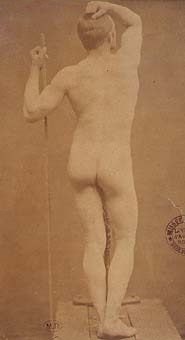
Marconi’s photograph records the model’s pose. Compare the position of the hips, feet and raised arm with the sculpture. Photographs by Gaudenzio Marconi, via Wikimedia Commons. Image source. Public domain. Resized for the web.
The Washington catalogue describes Rodin’s attention to a sequence of profiles. This is an especially useful way to approach a standing nude. A silhouette at one angle gives a relation between the head and the lifted arm. In another view, the height of the elbow can stay almost constant while the space between arm and chest changes markedly. For someone inspecting the plaster in Paris in 1877, an impression of fidelity from the front might have been hard to square with the individual decisions visible farther around the figure. A comparison of photographs can begin to make those decisions available. It is still necessary to match the angle of one subject to the other before drawing conclusions from the difference. The most informative unit may be a sequence of details across several views, rather than one pair of outlines that seem either to match or to diverge. [2] [14] [16]
The accusation of taking a mould from Neyt’s body also obscured the amount of time for which he had to work at the pose. The National Gallery of Art dates his first sessions to October 1875 and describes repeated changes through the end of the following year. It cites Charles Tardieu’s complaint that the sculpture depended too closely on a model he found commonplace. The criticism is revealing beside the more technical charge of life moulding. Both take likeness as their point of departure. One objects to the look of the ordinary body; the other supposes that the sculptor must have found a way around the labour of making it. Marconi’s pictures provided a way to inspect the labour of two people, the man who repeatedly posed and the sculptor who made lasting decisions about what would be seen in the plaster. [2] [14] [15]
What changed between the two Salon appearances
Orsay dates the Brussels display to January 1877 and identifies L’Étoile belge as the newspaper in which the life-moulding accusation appeared. The allegation was thus in print before the same year’s Paris Salon. The model’s presence in the studio was common ground. The dispute was over how Rodin got from the body he could observe to the surface he exhibited. Bringing the model and sculpture into comparison could help show where a kneecap, shoulder or foot had been interpreted. The camera recorded a position and a particular light. A convincing comparison would also have to account for differences due to those conditions. What mattered was whether a run of differences could be explained by modelling and changes in the pose, rather than by assuming that a visible likeness proved direct transfer. [2] [9]
The 1880 show offers a separate documentary point. Orsay’s Salon database records L’Âge d’airain as a bronze statue in the printed exhibition catalogue. Its object entry for RF 676 names the Thiébaut frères foundry, gives the May 1880 state order at 2,200 francs and records the third-class medal. The transaction concerns a bronze cast. The Washington catalogue separately describes state acquisition of the original plaster and payment for the bronze. Reading the records together gives a firmer chronology than attaching one purchase price or one material to both acts. A figure that had entered public debate through a plaster could be judged at the Salon as a cast in metal after the official inquiry had upheld the originality of the modelling. [2] [9] [11]
The bronze’s next destinations changed the conditions in which the pose could be seen. The state sent it to the Dépôt des marbres in 1880. Orsay records an allocation to the Musée du Luxembourg for the lawns in 1884 and placement in the garden in January 1885. The bronze later entered the museum and passed to the Louvre before it was assigned to Orsay in 1986. An open garden makes the figure liable to be seen first against a moving background, from the angle a path happens to provide. In a gallery there is normally more opportunity to hold the outline against one field of colour or light. The shift in setting can bring the arms and the shape between them into focus even when neither the cast nor the design has changed. [9]
A plaster and two bronzes
The National Gallery of Art in Washington records its full-scale plaster as a cast of 1898 from a model of 1875–76. Its catalogue notes small differences between some early plasters and later examples, including the absence of the outer form of the right ear in some examples and the addition of a fig leaf in later ones. Those differences give the apparently self-contained figure a material history of its own. They also show why comparison photographs need to be dated and identified before they are used to describe Rodin’s decisions in 1877. The Metropolitan Museum of Art lists a full-size bronze modelled in 1876 and cast around 1906, alongside a reduced bronze made in the nineteenth century. These objects are separate examples of a design that was already well known by the time some of them were made. A date attached to one of them can be perfectly accurate and still tell you little about when Rodin first worked with Neyt. [2] [5] [8]
The full-size figure lets an observer compare the stance with their own body. You can see how the lifted elbow changes where the chest turns and how far the head drops before the fingers meet it. At a reduced scale the bend of the limbs reads quickly as an outline, and it is easier to see how empty space divides the raised arms from the torso. Both give a way into the work that so unsettled viewers at the Salon of 1877. A single standing body, with very little to identify it beyond the act of standing and raising its arms, was enough to make them ask how a sculpture could appear so close to a person. [2] [5] [8]
The plaster as an object students could draw
Washington’s plaster, 1991.183.1, is 180 centimetres high. The National Gallery’s acquisition research identifies the Pennsylvania Academy of the Fine Arts as the institution that ordered it from Rodin in 1898, through Paul Wayland Bartlett. It specifies that the plaster was produced between June and August of that year and lists its appearance at the Academy’s annual exhibition in 1899. These dates belong to the object’s arrival in American art education. A student assigned to draw it could take time over relations that someone passing a Salon exhibit might have missed. Holding a position off to one side would let a student trace the depth at which the open hand begins to overlap the ribs. A change of station would give a second answer to the same drawing problem. The cast was still being used in classes many decades after that first acquisition. [2]
The drawing setting was a practical use for a full-size work in plaster. It could preserve the positions of features whose exact shape was at issue in debates over Rodin’s modelling. Yet the National Gallery’s catalogue also identifies differences between plasters, including the omitted shell of the right ear in the Washington example. The figure’s use as a model for students need not rest on the claim that this was the object that went to Brussels or Paris in 1877. A student could learn from the same figure at almost the same bodily scale while attending to the surface of a plaster that was produced two decades later. That is why the years of modelling and the date of the cast both matter on the same label. [2]
Watch Rodin’s sculpture up close
Five films explore Rodin’s sculpture, from his use of classical models and the figures on his monumental doorway to the work of his studio.
Auguste Rodin – Challenging Beauty
Six sculptures show how Rodin adapted classical models.
Watch on YouTubeTwo American acquisitions and their surfaces
The Met identifies its full-scale bronze, 07.127, as a Rudier cast around 1906 and a gift of Kate Simpson in 1907. Its height is 182.9 centimetres. An installation photograph identified by the museum shows it in 1919 at the base of the Grand Staircase, near the opening to the Rodin display. In that position, the figure could be seen while a visitor was still moving through the larger building. The planted leg and the raised arm give a passer-by two contrasting lines to follow before deciding to stop. The installation history identifies this as a particular display of Simpson’s bronze. It also makes the museum’s entrance and the destination of the viewer part of the history of how the sculpture was seen. [5] [12]
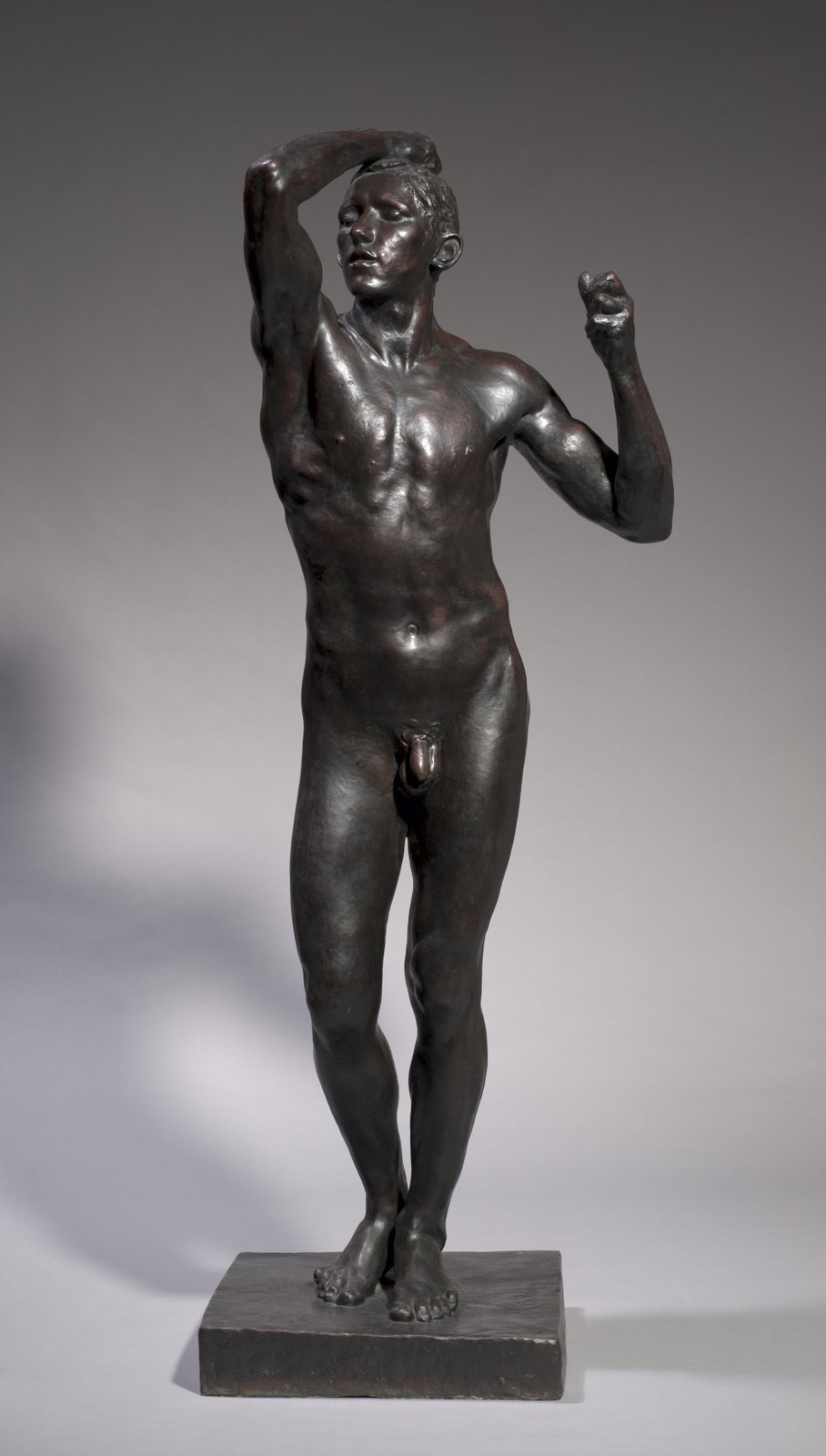
The Cleveland cast shows the reddish patina Rodin chose for Ralph King’s bronze. The Cleveland Museum of Art, Gift of Mr. and Mrs. Ralph King, 1918.328. Image source. CC0 / Public domain.
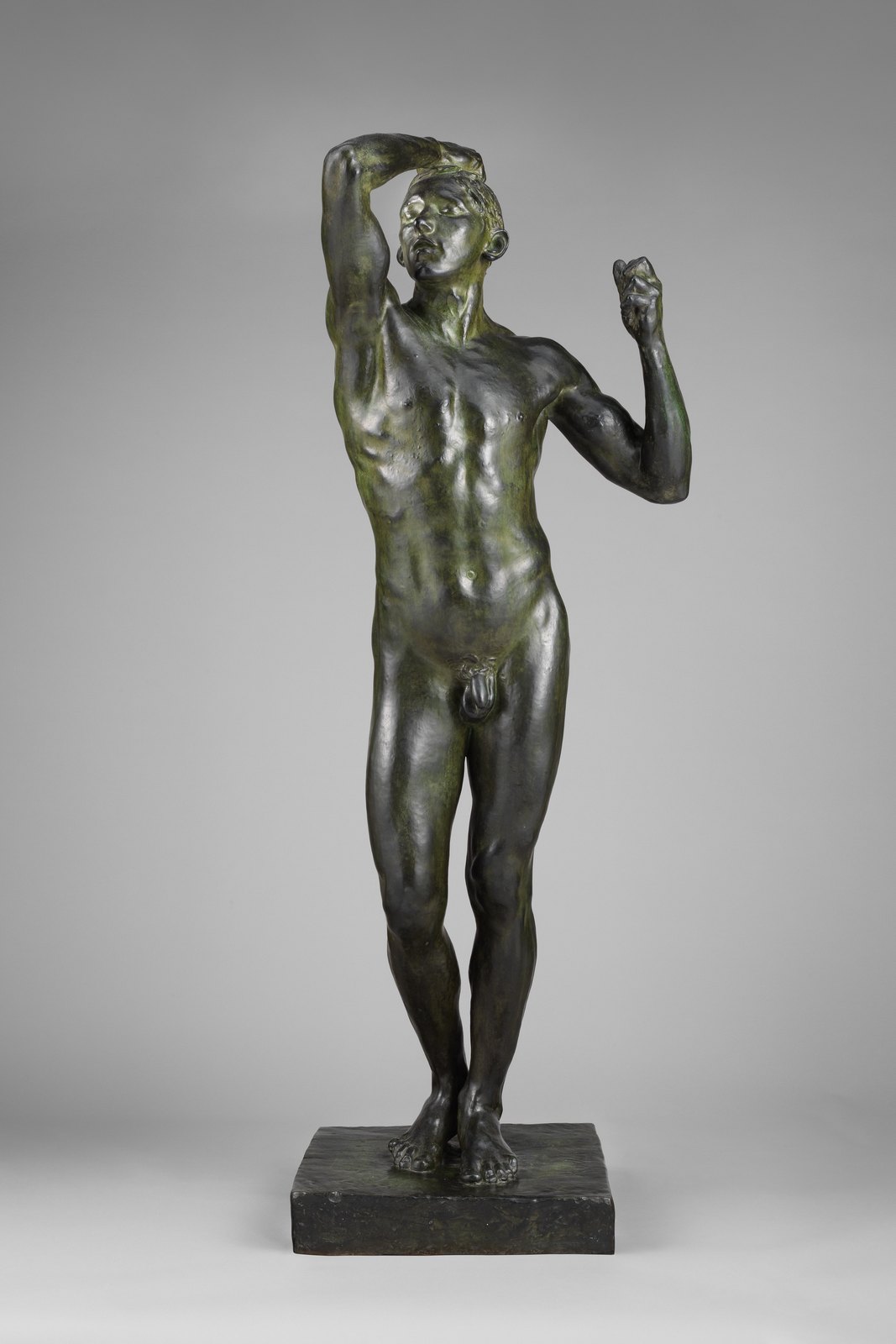
This Met cast offers a comparison with Ralph King’s reddish Cleveland bronze. The Metropolitan Museum of Art, Gift of Mrs. John W. Simpson, 1907, 07.127. Image source. CC0 / Public domain. Resized for the web.
The Cleveland Museum of Art records a different commission for its bronze, 1918.328. Ralph King placed the order in 1916 with the museum in mind. Its curators describe Rodin’s supervision of the casting and the reddish patina he favoured for this object. The appearance of the bronze is therefore evidence of a choice made late in the artist’s life about how the early figure should look in metal. Reddish and darker areas can affect the way light moves across the body, especially where the ribs turn into the flank. A reproduction that evens out the colour may still show the raised arms and the disposition of the legs. It gives much less of the object’s history of finishing. [13]
The Washington bronze associated with Kate Simpson is yet another object. The National Gallery of Art identifies 1942.5.10 as a bronze cast in 1903–04 and purchased by Mr and Mrs John W. Simpson in 1905. At 104.1 centimetres high, it is much smaller than her gift to the Met, and it appeared in Boston’s Renaissance and Modern Bronzes exhibition in 1908. In that setting the figure could be compared with other work in the same material rather than with the academy’s full-size casts. The graphic effect of the arms at a reduced scale aids a different way of looking. The whole reach of the bent limbs and the turn at the hips can be held in view over a shorter distance. The two Simpson objects give one collector’s name two distinct places in the American exhibition history. Accession number, size and cast date tell the reader which bronze a record or photograph describes. [5] [17]
Cleveland’s account traces inquiries on King’s behalf to 1915, through museum director Frederic Whiting and the intermediary Frank Purdy. It dates the casting to 1916, while the shipment left Paris in March 1918 and reached Cleveland on 17 May. Rodin could oversee the bronze and determine its finish without ever seeing how it would look in the museum for which it was acquired. The distance between those dates also explains why a label for a lifetime bronze can record a museum accession from after Rodin’s death. The reddish patina belongs to the making of the bronze. The 1918 entry belongs to the journey whose arrangements had already begun years earlier. [13] [18]
Choosing a bronze surface for a room in Copenhagen
Carl Jacobsen confirmed his order for a full-size bronze in October 1900, as part of an order for six works for the Ny Carlsberg Glyptotek. His next commission makes clear what a particular finish could mean to the collection. In December 1901 he offered 10,000 francs for a bronze of Saint John the Baptist. He asked for a green patina closely matching The Age of Bronze because the two were to stand beside one another. That request concerns the finish of the new figure and identifies the earlier work as its point of comparison. In September 1902 Rodin reported that Saint John had been cast but still needed patination. From the two letters one can follow the desired relation between the statues from the collector’s idea for his gallery to an operation still to be carried out in the workshop. [19] [20] [21]
A matching finish can direct attention to differences in pose. In The Age of Bronze the closed eyes and lifted arms draw attention upwards within a narrow stance. Saint John extends a gesture away from the body and has a stride to match. If two adjacent works share a colour, the eye can follow those different directions without first having to adjust from a pale surface to a dark one. The letter documents the intention to put the two together. It leaves the finished appearance of either bronze to be established from the objects and their records. That limit matters when comparing the green requested in Copenhagen with the reddish finish described in Cleveland. The commissions concerned different bronzes, for different rooms and audiences. The existence of one documented preference is part of the reason to look for the history of a particular surface before treating it as the standard finish for the composition. [13] [20] [21]
The Matsukata bronze and its dates
The National Museum of Western Art records the Tokyo bronze as S.1959-0002. It is 181 centimetres high and has an Alexis Rudier mark at the right rear of the base. The museum places the purchase for Kōjirō Matsukata around February 1919, through Léonce Bénédite, citing correspondence with Suzuki & Co. The price recorded there is 30,000 francs. The date beside the title is 1877 and pertains to the model. The museum supplies no precise casting year in that field. The inscription and the purchase account tell us how to distinguish the physical bronze and tie it to the collector’s acquisition, while leaving the manufacture date less precisely defined than the dates for the independently catalogued bronzes in Cleveland and New York. [5] [13] [22]
The Tokyo entry records sequestration in France in 1944 and traces the bronze through the later settlement and transfer to Japan in January 1959. It entered the collection in April of that year. The record of a Tokyo exhibition in 1960 is therefore part of a much later public history than the January display in Brussels. It also points to a useful difference between a catalogue of one collection and an account of the design. For the museum, identifying the bronze means showing how it passed through successive owners and authorities. An interpretation of the pose may start in Brussels or with Paul Gsell’s account of seeing the sculpture at Meudon. Those descriptions can be brought together as evidence about the composition, while the transfer and exhibition dates apply to the object that arrived in Tokyo. [9] [22]
Reading three foundry records
The Musée Rodin’s S.06778 is a full-size bronze sand cast by Georges Rudier in 1962. Its height is 180 centimetres, close to the Tokyo bronze and the Washington plaster. The museum records the foundry inscription and a dated Musée Rodin mark. For a viewer, the resemblance in scale makes comparison of the standing poses useful. For someone trying to identify a photograph, it shows how little a description such as “life-size Rodin bronze” can establish. Orsay’s bronze names Thiébaut frères and has its own state order. The Tokyo work names Alexis Rudier and has a documented route into the Matsukata Collection. A further reason for recording the founder’s first name is that the 1962 bronze also bears the surname Rudier, but it belongs to a different workshop record and a different part of the design’s history. [9] [22] [23]
The Paris collection also holds an example at the intermediate scale. S.00870 measures 105 centimetres, close to the Washington Simpson bronze. The Musée Rodin dates that model to 1903–04 and dates the individual sand cast only to before 1952. Its entry records an Alexis Rudier mark at the right rear and an internal signature. The Washington catalogue’s 1903–04 bronze date, 1905 purchase and 104.1-centimetre height concern a separate example. A measurement may establish that two objects belong at about the same scale without dating them to the same year. These two records make it possible to identify the dimension of the model before going on to ask when each bronze was made and where it circulated. [17] [24]
Two standing figures at the Salon of 1880
The catalogue of the 1880 Salon lists two standing men by Rodin in different materials. L’Âge d’airain was entered as a bronze statue and Saint Jean prêchant as a plaster statue. They were at the same exhibition, though the entries alone do not tell us whether a visitor could see both from one position. There is an additional reason to keep the media straight. A bronze Saint John now at Orsay has its own 1881 Salon entry. Bringing modern photographs of the two bronzes together can be illuminating as a comparison of poses. It would give the wrong impression of what a visitor to the 1880 exhibition encountered, since one of those sculptures was then presented in plaster. [9] [11] [25] [26]
Both designs give the body a task without supplying all the things that might commonly identify it. The Musée Rodin points out that Saint John lacks the cross and the scroll sometimes used to identify the Baptist. His extended arm and open stride nevertheless belong to a work called Saint John Preaching. The exhibition title gives the arm a direction and purpose. In The Age of Bronze, the hand that once held a spear offers a different problem. The gripping position survives, but the title does little to specify an object or an audience for the gesture. Seen together, the designs show how much a pose can convey before the viewer even decides what kind of story it comes from. One has a way of addressing the space ahead. The other keeps drawing the eye back to the person standing with his arms raised. [1] [5] [25] [27]
Foot placement makes the difference in address more apparent. In The Age of Bronze a viewer can begin at the planted leg and watch the shifting weight pass into the hips. The small turn then earns attention because the legs occupy so little space. In Saint John, the length of the stride is immediately visible. To follow the body, the eye travels from one foot to the other and then out towards the gesture. The change in scale matters as well. The Met describes the preaching figure as over life size. The proportions of The Age of Bronze had made the relation between model and sculpture a subject of dispute. The larger saint could still be studied against the figure of a particular sitter, but his size and stride give a passer-by a different impression of what he is doing. [2] [3] [26] [30]
Two uses of a studio photograph
The Musée Rodin records Charles Michelez’s photograph of the plaster Saint John between the Bust of Bellone and the head of The Man with the Broken Nose. It dates the print to about 1889. Rodin used ink and gouache around the three sculptures to separate them visually from the studio. This image therefore allows a comparison with the Marconi prints made in 1877. In the earlier pairings, the relation of a living man to a work in plaster was at issue. For the later photograph, Rodin could work on the print to reduce the effect of the surroundings and make different sculptures register clearly in one frame. The image still records their presence in the studio, and the changes made to it also record what he wanted a viewer to see. [14] [16] [27]
The name Pignatelli comes from a different kind of source from the annotation identifying Neyt. The museum’s account of Michelez’s photograph recounts how Rodin remembered Pignatelli presenting himself as a model and striking a pose that suggested a walking man. That recollection helps explain the interest of the stride. It does not turn the photograph of the plaster into a photograph of the sitter. A reader can put the evidence together without letting one object do the work of two. The Marconi prints document the living sitter and the sculpture as separate subjects. The Michelez print documents several sculptures as arranged in the studio and, through the applied ink and gouache, an artist intervening in how those sculptures would appear on paper. [14] [15] [16] [27]
What remained when Rodin took the figure apart
The studio gave Rodin a further way of studying the stance once the object had served its first purpose. The Musée Rodin describes how The Walking Man was assembled using a torso and legs from work connected with Saint John. The torso had spent years in the studio. When it was joined to the legs, Rodin kept the join visible, and the upper body pitched slightly forward and turned left. He could keep the stride with no head to tell the viewer where to look and no extended arm to explain what the man was doing. The direction had to come across through the torso and the positions of the feet. In The Age of Bronze, the missing spear allows the fingers to remain active even after the thing they held has gone. In the later work the arms themselves are absent. The pose must convey movement through the parts that survive. [1] [28] [29]
The sequence from the Brussels figure to the later assemblage helps clarify what is meant by modelling a body. A model can hold a pose for a time in the studio. A sculptor can take some of its relations farther than others, fix them in plaster and later work from the plaster as something already made. The fragments of Saint John show that even then the parts could be turned into the material of a new decision. In the Brussels figure, the trouble began because the pose was so persuasive as the record of one body. In The Walking Man, the join announces that elements need not start together for the resulting pose to have force. Between those cases there is room for both sustained attention to a model and substantial changes made once the model has gone. [2] [27] [28] [29]
A Salon reconstructed a century later
The National Gallery of Art’s 1981 exhibition Rodin Rediscovered opened with a reconstruction of a typical Paris Salon of the 1870s. The museum records 29 sculptures in that part of the installation and a sequence of galleries that eventually brought visitors to a new cast of The Gates of Hell. The arrangement offers a useful contrast with the terms of a single object label. The label can identify the competing accounts of the first display and the year of a bronze. A room of other sculpture can give a sense of the choices available to a late nineteenth-century viewer of a standing figure. It can also show how quickly someone moves from one work to another in an exhibition. A response to the lifelikeness of Rodin’s nude came in the midst of other proposals for what sculpture should do, and comparison was already part of the way its first audience looked. [2] [31]
For Washington audiences, the exhibition offered a setting quite different from the one for which the city’s 1898 plaster had been commissioned. The academy had put the cast to use in teaching. A student drawing the figure could return to the standing body over several sessions and work out how a contour seen from one side relates to the volume seen from another. The reconstructed Salon proposed a shorter encounter and a wider field of comparison. A visitor could notice the same raised elbow or turn of the hip, then turn to see how another sculptor had dealt with a standing figure. The contrast helps explain why both the history of a particular cast and the history of its display matter. They tell us what viewers were in a position to notice. [2] [31]
Rodin artworks directory
Discussion
Look again at the images and ideas explored in The Age of Bronze. These editorial prompts invite your observations.
Reader Insights
After reading “A model in Brussels”, what detail would you look for in the object or image?
What extra evidence would help you distinguish the artist’s choices from the effects of material, viewpoint or later display?
Join the Conversation
Share a detail, comparison or question about The Age of Bronze below.
References
- Musée Rodin. The Age of Bronze. View source.
- National Gallery of Art. The Age of Bronze, plaster cast of 1898. View source.
- The Metropolitan Museum of Art. Rodin: The B. Gerald Cantor Collection. View source.
- National Gallery of Art. Auguste Rodin. View source.
- The Metropolitan Museum of Art. The Age of Bronze, bronze cast circa 1906. View source.
- The Metropolitan Museum of Art. Auguste Rodin (1840–1917). View source.
- Musée Rodin. 1840–2015. View source.
- The Metropolitan Museum of Art. The Age of Bronze, reduced bronze. View source.
- Musée d’Orsay. L’Âge d’airain, RF 676. View source.
- Musée Rodin. L’Âge d’airain, plaster record. View source.
- Musée d’Orsay, Base salons. L’âge d’airain, bronze entry for the 1880 Salon. View source.
- Elyse Nelson. Sculpture on the Move, a Century of Rodin at The Met. The Metropolitan Museum of Art. View source.
- Cleveland Museum of Art. The Age of Bronze, 1918.328. View source.
- Musée Rodin. Gaudenzio Marconi, Auguste Neyt, Ph.03580. View source.
- Musée Rodin. Gaudenzio Marconi, Auguste Neyt, Ph.00272. View source.
- Musée Rodin. Gaudenzio Marconi, The Age of Bronze in plaster, Ph.02742. View source.
- National Gallery of Art. The Age of Bronze, Simpson bronze, 1942.5.10. View source.
- Cleveland Museum of Art. Rodin, 100 Years. View source.
- Carl Jacobsen. Order to Auguste Rodin, 21 October 1900. Ny Carlsberg Foundation. View source.
- Carl Jacobsen. Letter to Auguste Rodin, 18 December 1901. Ny Carlsberg Foundation. View source.
- Auguste Rodin. Letter to Carl Jacobsen, 1 September 1902. Ny Carlsberg Foundation. View source.
- National Museum of Western Art. The Age of Bronze, S.1959-0002. View source.
- Musée Rodin. L’Âge d’airain, S.06778. View source.
- Musée Rodin. L’Âge d’airain, moyen modèle, S.00870. View source.
- Musée d’Orsay, Base salons. Saint Jean prêchant, plaster entry for the 1880 Salon. View source.
- Musée d’Orsay. Saint Jean-Baptiste. View source.
- Musée Rodin. Charles Michelez, St John the Baptist, Man with a Broken Nose and the Bust of Bellone, Ph.00667. View source.
- Musée Rodin. Multiples, fragments, assemblages. View source.
- Musée Rodin. The Walking Man. View source.
- The Metropolitan Museum of Art. St. John the Baptist, bust. View source.
- National Gallery of Art. Rodin Rediscovered. View source.

 Auguste Rodin.jpg)




