


 by Tom Gurney
Tom Gurney BSc (Hons) is an art history expert with over 20 years experience
Published on June 19, 2020 / Updated on November 18, 2026
Email: tomgurney1@gmail.com / Phone: +44 7429 011000
Torso of Adele
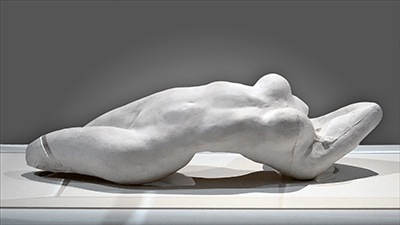
Auguste Rodin’s Torso of Adèle arches above the surface on which it rests. The hips and shoulder area take the weight at either end, and light passes beneath the middle of the body. Rodin left the figure without a head and with its limbs incomplete. The Musée Rodin dates its terracotta version to before 1884 and connects the study with Adèle Abbruzzesi, one of Rodin’s models. He used the torso again, adapting it for a figure on The Gates of Hell and for the woman in Eternal Springtime. In the independent fragment, the space below the body makes the arch itself the focus. [1] [2] [3]
The arch above the support
The legacy photograph looks across the torso from near the level of the display surface. A broad form at the left follows the hip towards the waist. It rises away from the surface, and a pale opening shows through beneath it. At the right the body touches down again below the shoulders. That interval makes the extent of the bend easier to judge than the outer outline alone. The upper edge has several pronounced curves, while the lower edge describes the lift of the body in a single sweep. The shadow on the shelf and the light beyond it locate the areas that meet the support. [1] [2] [4]
At the right, part of an arm extends upwards and away. The end of that fragment is blunt and lies close to the upper outline. It takes the eye beyond the point where the shoulder rests on the shelf. At the other end of the work the form finishes in a shorter, slanting edge. The viewer can read these ends as sections through a body and also as the limits of the object. The torso has an overall direction from the low mass at one end to the lifted remnant at the other, even when it is seen without the rest of the figure. [1] [2] [4]
The photograph is especially clear at the upper chest. Several rounded areas catch the light at different heights, and transitions between them indicate the turn of the body around its own length. By looking underneath, the viewer can follow the bend from the hip to the shoulder. By looking across the upper surface, the viewer can also see a rotation. Both movements help account for the unevenness of the silhouette. A view from above would give more prominence to the breadth of the torso, while this low view makes the lift between the two points of support particularly legible. [1] [4]
Adèle and the modelled surface
The Musée Rodin describes Adèle Abbruzzesi as a favoured model whose flexibility and strength informed several figures. Its French entry raises the possibility that this study was begun as early as 1878 for a caryatid. The museum’s dating of the terracotta to before 1884 gives a firmer indication of the period. The retained name makes the role of a model visible even though the work offers no facial likeness. A viewer sees a specific disposition of shoulders, hip and chest, all parts whose relations would have mattered to a sculptor studying a body in motion. [1] [5]
Clay let Rodin build the changes of volume from waist to rib cage and adjust the points where the outlines bend. The museum describes his practice of modelling clay directly or pressing it into a mould before reworking it. In its terracotta Torso of Adèle, the changes in depth are shallow across parts of the abdomen and more pronounced near the shoulders. The pale example in the legacy photograph makes those differences visible through light rather than through a strong change of colour. Reflections broaden on the rounded areas, while slight hollows retain shadow even where the figure is lit from above. [1] [2] [4]
The width of the shadow also varies near the cut ends. Just under the hip it lies close to the contour, becoming broader towards the raised centre. The display surface makes that change visible without concealing the small irregularities in the edge of the plaster. [2] [4]
Watch Rodin’s sculpture up close
Five films explore Rodin’s sculpture, from his use of classical models and the figures on his monumental doorway to the work of his studio.
Auguste Rodin – Challenging Beauty
Six sculptures show how Rodin adapted classical models.
Watch on YouTubeFrom fragment to figure
Rodin added arms and legs to a version of the torso for the upper left of The Gates of Hell. The Musée Rodin describes its function there as a link within the larger composition. The long curve of the body could connect forms across the doorway, with the added limbs carrying its direction beyond the limits visible here. As a separate object, the fragment invites attention to the point where the curved back rises over its support. In the larger ensemble, its place among other figures gives that curve a further job. [1] [3]
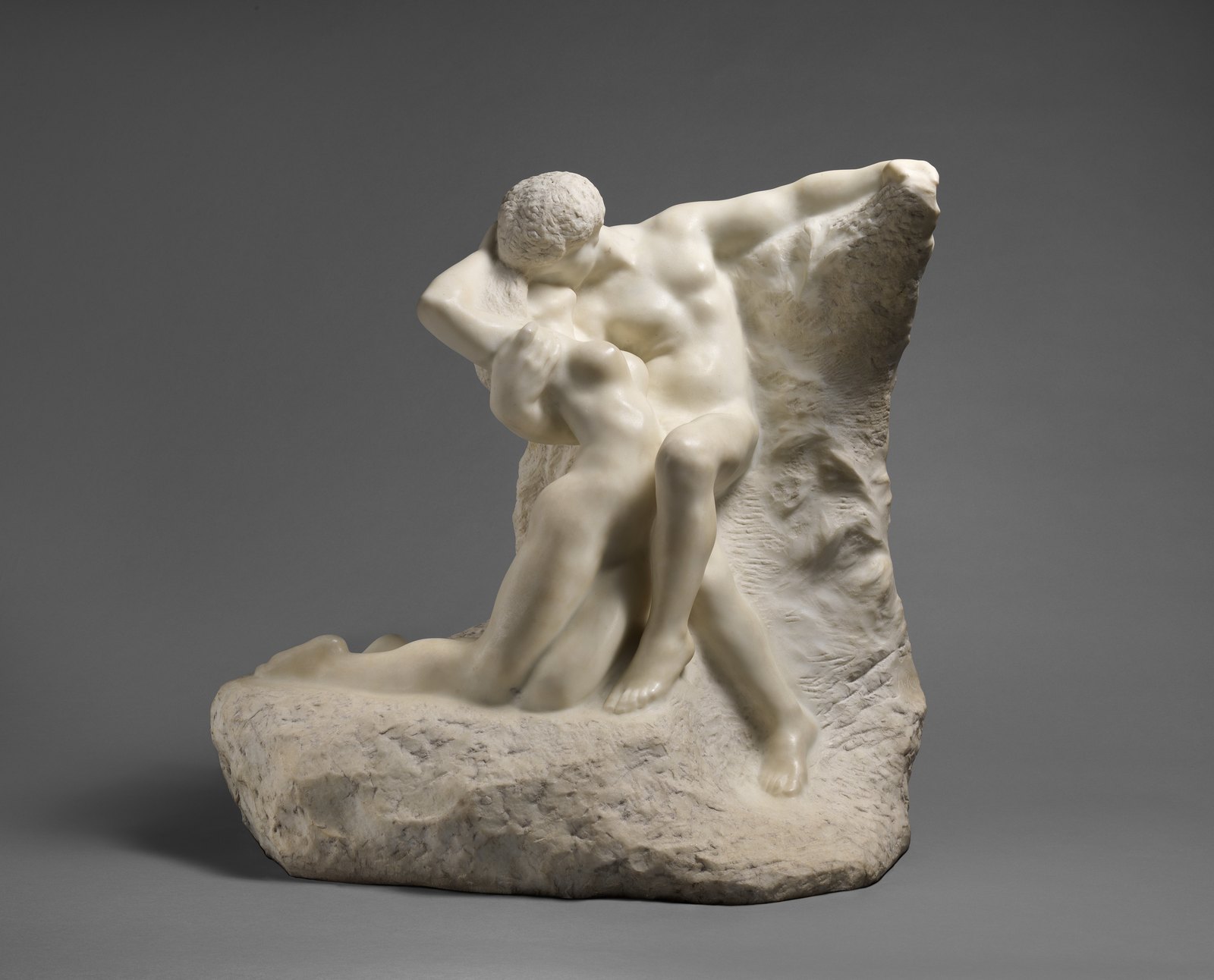
The Met’s Eternal Spring shows the arch of the torso within the completed two-figure composition. The Metropolitan Museum of Art, Bequest of Isaac D. Fletcher, 1917, 17.120.184. Image source. CC0 / Public domain.
Rodin also developed the torso into the woman in Eternal Springtime, adding a head and modifying the figure. The marble Eternal Spring at the Metropolitan Museum of Art shows how the arch can lead into an embrace. The woman turns towards a partner, and the contact between them gives the backward bend a direction within the group. In the fragment the same stretch is visible across the pale opening near the shelf. The two sculptures give the viewer different ways to locate the force of the movement, one through a relationship between bodies and the other through the shape of a body over the ground. [1] [3] [6]
Terracotta and plaster examples
The Musée Rodin terracotta S.01177 is 37.5 centimetres long and 11 centimetres high. A separately catalogued plaster, S.02221, has a length of 41.5 centimetres and is recorded without a support. The examples show how changes of material and dimensions can accompany a recognisable arrangement. The plaster’s record also documents several workshop markings, which are valuable when the silhouette alone cannot distinguish one version from another. [1] [2]
The legacy image matches a photograph taken at the 2017 Ciao Italia! exhibition in Paris. Its caption identifies the sculpture as a plaster from the Musée Rodin and does not give an accession number. The picture shows a strong shadow beneath the arch and a pale band of the shelf behind it. Those visual details can be compared directly across the two images. The inventory number of the photographed plaster remains open. The terracotta and catalogued plaster provide separate points of comparison for the central curve and the different ways Rodin left the extremities of the study. [1] [2] [4]
Seams on an unsupported plaster
A further Musée Rodin plaster, S.01223, shows how a cast can keep traces of its mould. The catalogue identifies a network of seams left by a reusable piece mould. It dates the example to 1882 and records its acquisition through Rodin’s 1916 donation. Like S.02221 it is described as a torso without a support, but it is a little longer at 44.6 centimetres and has its own record. The seam network belongs to the plaster’s production. It gives a reader a reason to look separately at an abrupt line made where sections of a mould touched and the longer line of the modelled back. [2] [7] [8]
The two plasters preserve different clues about work in the studio. S.02221 carries a note referring to a mould at Meudon. The catalogue for S.01223 identifies how the plaster was made from evidence on its surface. Both help account for the survival of related forms, while the records leave open whether they came from the same mould. In a tightly framed image of the torso it may be difficult to locate the marks or seams. The object numbers make it possible to compare those images with photographs of the underside and edges, where the treatment of each plaster is easier to study. [2] [7] [8]
Rodin artworks directory
Discussion
Look again at the images and ideas explored in Torso of Adele. These editorial prompts invite your observations.
Reader Insights
After reading “The arch above the support”, what detail would you look for in the object or image?
What extra evidence would help you distinguish the artist’s choices from the effects of material, viewpoint or later display?
Join the Conversation
Share a detail, comparison or question about Torso of Adele below.
References
- Musée Rodin. Torso of Adèle, terracotta S.01177. View source.
- Musée Rodin. Torse d’Adèle, plaster S.02221. View source.
- Musée Rodin. Multiples, fragments, assemblages. View source.
- Jean-Pierre Dalbéra. Exhibition photograph of Torso of Adèle, 2017. View source.
- Musée Rodin. Torse d’Adèle, French collection entry. View source.
- Metropolitan Museum of Art. Eternal Spring, 17.120.184. View source.
- Musée Rodin. Torse d’Adèle, plaster S.01223. View source.
- Musée Rodin. Moulage. View source.

 Auguste Rodin.jpg)





