



 by Tom Gurney
Tom Gurney BSc (Hons) is an art history expert with over 20 years experience
Published on June 19, 2020 / Updated on November 18, 2026
Email: tomgurney1@gmail.com / Phone: +44 7429 011000
Monument to Balzac
Auguste Rodin’s Balzac seems to lean back from an encounter you can only guess at. His enormous robe holds the body in a single upright mass, while the head projects from the collar and turns into the light. Seen from below, the face is a cluster of abrupt changes: the brow gives way to a cheek and the uneven surface beside an eye. The body moves more slowly into view. Much of it can only be inferred through the folds. Rodin worked separately on the head and on the figure beneath the robe, then brought them together in a monument where each does something different. [1] [2]
A commission for a writer
The Société des Gens de Lettres commissioned the monument in 1891. Honoré de Balzac, who had died in 1850, had to be reconstructed from records and the testimony of others. The Museum of Modern Art documents Rodin’s use of models who resembled him and his efforts to have clothing made to the writer’s measurements. The resulting monument gives little immediate evidence of that investigation. A viewer can see the effort concentrated in the head and in the bearing of the body. The studies reveal how much work went into making those two things seem to belong together. [2] [3]
The task involved deciding what a public sculpture could tell a passer-by about someone whose principal activity had taken place at a desk. A book or pen could have identified the profession from a distance. Rodin did without those implements. The robe alludes to what Balzac wore while working at home, but the full effect depends on the way the garment holds a space in front of the figure. Nothing has been placed in that space to tell us what the writer is doing. The face and the angle of the shoulders suggest someone present and alert, a figure who could face the viewer even while absorbed in his own affairs. [1] [2] [4]
Zola, the Palais-Royal and the problem of a likeness
Émile Zola helped bring Rodin and the literary society together. The Musée Rodin traces their discussions to the spring of 1891, when Zola made the case for Rodin as a sculptor whose work he understood in terms of naturalism. The formal commission followed in July. The intended destination was the Palais-Royal in Paris. The distinction between the approach and the formal commission matters because the monument was an undertaking by a society, even though one writer’s advocacy had helped secure it. Zola could judge an artist’s suitability on the evidence of earlier work. The society would eventually have to decide whether a particular statue answered the terms of its commission. The proposed site also gave the commission a public scale. People could be expected to encounter the sculpture while doing something other than looking for a portrait of Balzac. The monument had to hold their attention before they had the chance to study it up close. [7] [8]
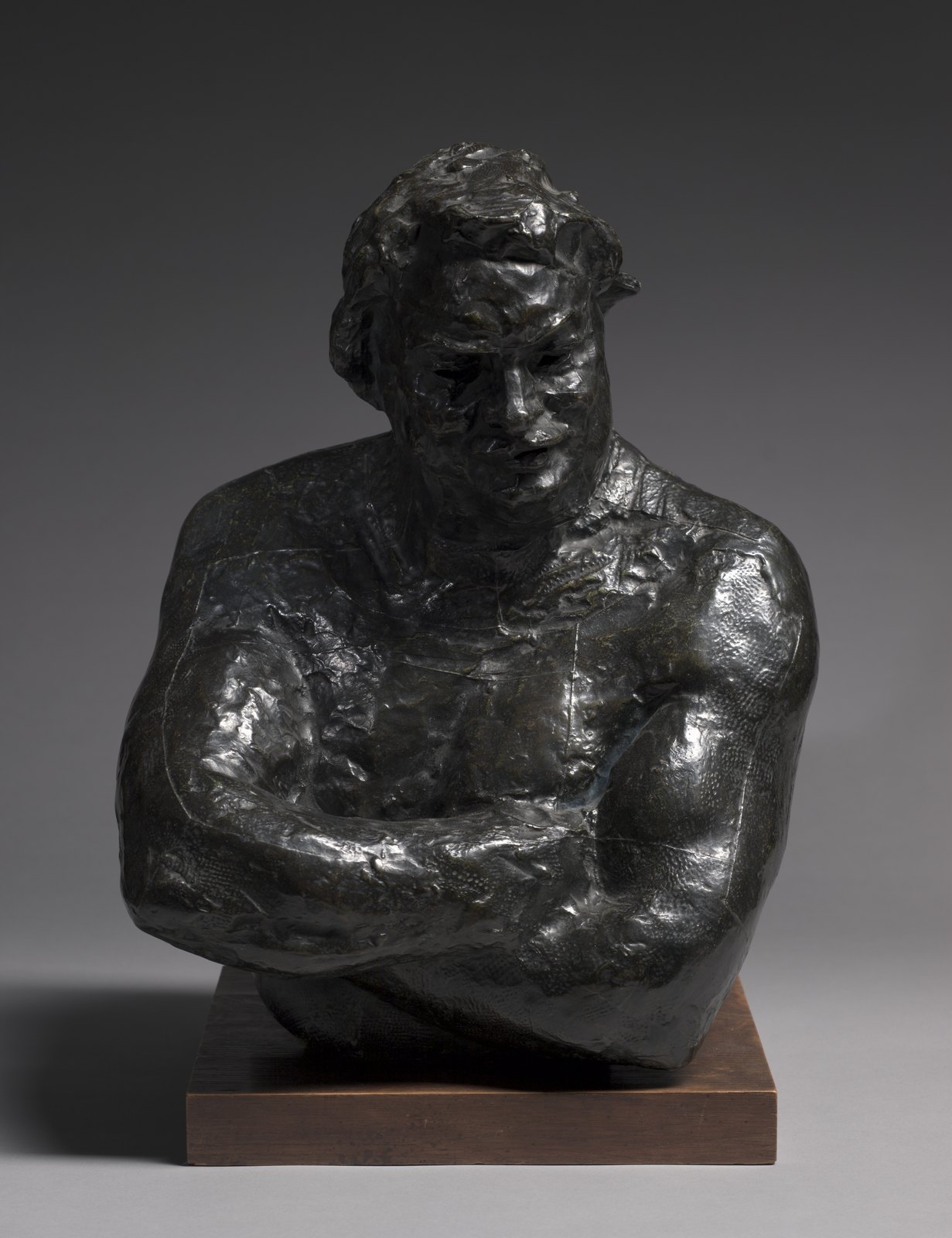
This early bust study records Rodin’s search for a likeness before he settled on the final monument. The Cleveland Museum of Art, Bequest of Edgar A. Hahn, 1972.277. Image source. CC0 / Public domain.
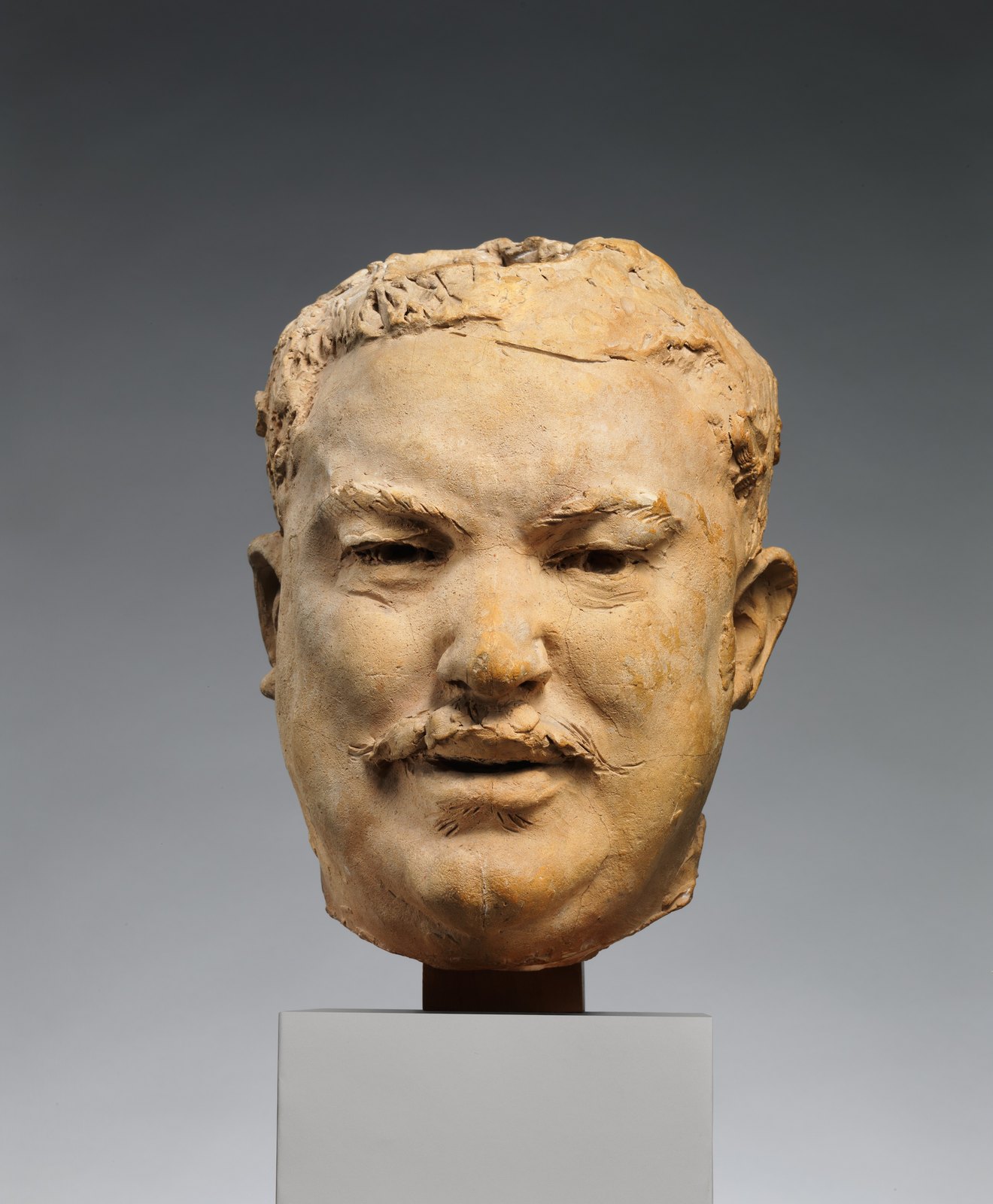
Rodin’s original terracotta of 1891 records his early search for Balzac’s likeness. The Metropolitan Museum of Art, Rogers Fund, 1912, 12.11.1. Image source. CC0 / Public domain. Resized for the web.
Rodin had a number of places to look for the writer’s appearance. The Musée Rodin records a painted portrait by Louis Boulanger, sculpture by David d’Angers and a photographic image derived from Louis-Auguste Bisson’s daguerreotype. Nadar made a reproduction for Rodin around 1892. The daguerreotype offered evidence of a particular occasion on which Balzac presented himself to a camera. A painted portrait gave Rodin another artist’s decisions about pose, scale and the treatment of clothing. A sculpted likeness could be examined for the way the face held its shape away from the front. Taken together, the sources supplied more information than any one view. They did not solve the problem of how to give those observations a single three-dimensional form for the proposed setting. [8] [9]
What Estager could offer a sculptor
The original terracotta head of 1891 at the Met records another method. Rodin travelled to Tours, where Balzac had lived, looking for men whose features might help him imagine the writer at different angles. The museum identifies the sitter for the head as Estager, known to Rodin as the conductor of Tours. The study has a furrowed brow and a broad, heavily modelled face. A person sitting in front of the sculptor offered the chance to see those features change as the head moved, or as light passed from the front of the face onto its side. The museum titles the terracotta Honoré de Balzac, while its record identifies the living man whose head Rodin modelled. The two names describe the commission for which Rodin was working and the body from which he took observations. [7] [10]
A later head at the Met lets a reader follow some of the changes. The museum dates the model to about 1892–93 and the bronze to 1980. Georges Rudier’s cast preserves a head whose brow and eyes stand out as deeper changes in the surface. The dimensions help with the comparison. The head measures 30.5 centimetres high without its marble base. A photograph cropped to the face can make it appear monumental, but the object itself could be examined as a study at a short distance. The eyes made that close view demanding. Their shadow interrupts the surface beneath the projecting brow, and at an oblique angle it can take less of a line to suggest the direction of the gaze. Enlarging such an effect for an outdoor monument involved judging which forms would register before a viewer came near. [1] [10] [11]
The Met’s Final Study for the Monument to Balzac makes a third point of comparison. The model dates to 1897 and the museum’s bronze was cast by Georges Rudier in 1972. At 106 centimetres high, it preserves the relation of the head to the gown without reproducing the scale of the 270-centimetre garden bronze in Paris. The study allows one view to take in the face, collar and much of the robe. In the monument, a spectator standing close needs to look up, and can follow those parts one at a time. The dates of the two bronzes tell a different story again. The 1972 casting preserves a design from before the 1898 Salon. The 1935 casting presents the monument after the final design had been exhibited. The object in metal that was made earlier can therefore represent the later stage of Rodin’s modelling. [1] [12]
What the committee saw before the Salon
The society had already commissioned Henri Chapu to make a monument. His death reopened the question of who would carry it out. Hélène Marraud’s chronology for the Musée Rodin distinguishes the vote for Rodin on 6 July 1891 from Zola’s official announcement on 14 August. In August Rodin travelled through Touraine with Camille Claudel, taking in Tours, Chinon and Saché. He noted two portraits in the museum at Tours. The trip belonged to the first phase of his inquiry. When Marraud describes his return to Touraine in September 1892, she places his encounter with Estager on that later visit. The Met dates its Estager terracotta to 1891. Those records supply different dates for the early portrait work, and the identification of the sitter gives firmer ground for comparison than a single date for the modelling session. [8] [10] [16]
The society’s committee visited the studio on 9 January 1892. It saw three sketches that gave Balzac different ways of occupying a public site. In one he stood in a frock coat. In another he leaned against an armchair. In the third he stood in a monk’s robe. The committee preferred the third and asked Rodin to move ahead with the final sketch. The chair would have given the viewer a familiar object against which to judge the body. The monk’s garment made more of the figure’s own silhouette. The committee’s early choice makes its rejection six years later more specific. Members had been willing to consider a robed figure. What they saw in the completed plaster depended on the extent to which Rodin let the fabric hide the body and concentrated expression in the head. [4] [16]
By December 1892 Rodin had told the society he would miss the expected delivery in February 1893. As he continued to work, he ordered a three-piece suit from Balzac’s former tailor, Pion. The suit gave him physical evidence about the volume a garment had to contain. It belonged to an inquiry that also tested what visitors would accept as a likeness. The committee objected to an early nude with a prominent abdomen and suggested representing Balzac at a younger age. The same breadth that a tailor’s measurements helped establish could be unwelcome in a work expected to honour the writer. In the final version the robe still gives Balzac physical breadth. Its uninterrupted front conceals much of the anatomy that had made the early study contentious. [3] [15] [16]
The delay put pressure on the arrangement between patron and sculptor. By autumn 1894 the members disagreed over whether to ask Rodin to renounce the work, take it away from him, or let him finish at his own pace. The compromise called for the return of 10,000 francs in advances and gave Rodin freedom from a delivery deadline. Jean Aicard, who had succeeded Zola as president, resigned in November over the committee’s treatment of Rodin and explained his decision in an open letter. The dispute had become public before the monument itself was publicly available. People following the commission in the press could form views about the delay and a patron’s authority years before they saw what Rodin had made. [16]
Finding the body under the robe
The Musée Rodin preserves studies ranging from a nude Balzac to a figure in a monk’s habit. In one investigation into the dressing gown, Rodin used an actual garment and stiffened it with plaster. A real piece of clothing gave him folds that would respond to gravity and to the weight of the material. Fixing those folds let him see how the gown would look apart from a living model. He could follow the rise of a sleeve and the depth of a crease as he would any other passage of sculpture. The ordinary garment became a source of information about light and volume. [2] [4]
From the front of the final monument, much of the robe runs down in long, relatively open passages. The sleeves suggest where the arms might be. There is no clear outline of either hand. At the shoulder a fold can make the figure seem wider than it really is. Around the side the surface settles differently, and the folds that seemed incidental from the front describe a body standing behind them. The fabric lets Rodin make the outline broad while keeping the exact position of the limbs open to interpretation. [1] [4]
The head acquired a different kind of clarity. Rodin began from the problem of resemblance and worked towards a face that could carry expression at monumental scale. Up close its forms register as planes and changes of direction. From a distance the light gathers them into a brow and a single look. The face does much of the work that hands or furniture would do in a more conventional portrait. The shape of the robe slows the eye before it reaches that abrupt concentration above the collar. The change of pace between the two surfaces is particularly clear when the monument is seen outdoors. [1] [3]
How a garment became a plaster study
The Musée Rodin dates its plaster Study for Balzac’s Dressing Gown, S.00146, to April 1897. It is 148 centimetres high and weighs just over 35 kilograms. It gives the impression that a garment has been left standing after the person who wore it stepped away. The sleeves and folds still describe where a person’s weight might have been, and the plaster has feet. Seen beside the monumental figure, the study makes it easier to ask how much of the finished pose can be carried by clothing alone. The gown was an identifying detail that the Société des Gens de Lettres wanted included. The unusual decision was to give it enough breadth and continuity to control the outline of nearly the entire monument. [1] [4] [13]
The museum’s research connects the gown with a study for a different commission. A version of a headless nude of Jean d’Aire, one of the Burghers of Calais, supplied the form on which the textile was arranged. A useful body could thus pass from a medieval civic subject to a monument to a novelist. The evidence concerns a particular workshop operation. It helps account for the placement of fabric over shoulders and crossed hands even though the finished robe gives few indications of who might be inside it. The arrangement also shows the practical value of keeping earlier plasters. A figure study that had already served one purpose in the studio could hold a textile in the desired pose while a second form was worked out over it. [13] [14]
The robe study also keeps details that can be checked against a photograph. Eugène Druet’s view of the studio at the Dépôt des marbres records the plasters of the gown and the Balzac while work on the mould was under way. The surviving study has a seam up the back that the museum interprets as evidence that the cloth was divided into two panels before it was positioned. These sources have different limits. The photograph shows what could be seen from one side of the work at the moment the camera was there. The plaster preserves evidence of contact with the fabric that can be examined under different lighting and from more than one direction. Together they allow a reconstruction of some of the choices involved in the moulding, even though the original arrangement of the support inside the gown remains uncertain. [13] [14]
Testing the moulding evidence at Meudon
For its 2024 exhibition Corps In•visibles, the Musée Rodin tested the evidence by making a new robe study at Meudon. The team used a modern mannequin and made a garment in ribbed cotton velvet for the experiment. Those choices gave the conservators a way to test how a heavy piece of cloth might behave. They found that the long folds on the front needed support to stay in place. It is easy to read those folds as the ordinary consequence of cloth hanging down, especially at the distance from which one usually sees the monument. The experiment showed how much work it took to keep a fold in precisely the position that would later look effortless. [14] [15]
The conservators also tested how to retain the cloth’s surface. Applying plaster to fabric already in place left runs that obscured the weave. Wetting the textile before soaking it in thin plaster gave them a way to fix its form without losing as much detail. Their reconstruction used a mould that then had to be broken away to free the new plaster. This result shows that an impression preserving fine texture is compatible with careful preparation and adjustment of the cloth. The experiment establishes what worked on the modern mannequin and fabric. The historical photograph and plaster remain the evidence for what can be assigned to Rodin’s workshop. [13] [14]
That difference in evidence matters when looking back at the monument. A fold could begin as something that had to be propped or coaxed into place. In the bronze it becomes a passage between areas of light, and may remain visible farther from the figure than the smaller changes in the sculpture’s texture. The face still supplies a much more abrupt interruption at the top. The museum describes Rodin as seeking an even passage of light across the robe. Studying how the fabric was supported makes that intention easier to see in the finished work. Each long fold has to bring the eye upward while allowing part of the surface to be taken in as one large shape. [1] [4] [13] [14]
Watch Rodin’s sculpture up close
Five films explore Rodin’s sculpture, from his use of classical models and the figures on his monumental doorway to the work of his studio.
Auguste Rodin – Challenging Beauty
Six sculptures show how Rodin adapted classical models.
Watch on YouTubeThe plaster at the Salon
Rodin exhibited the plaster in 1898 at the Salon of the Société nationale des beaux-arts. It appeared alongside the French state marble of The Kiss. The pair offered viewers the same artist working at a large scale with two strikingly different effects. In the lovers, one body turns into the other and the hands are clearly legible. Balzac’s body is held inside fabric, and the head has to carry a larger share of what the visitor sees. The task in one case was to give a literary encounter a physical form. In the other it was to make a public likeness of a writer. [2] [5] [6]
The society rejected the Balzac. The Musée Rodin’s account of the reception records criticism of the monument’s recognisability and of its departure from the conventions of public sculpture. This was a commission for a writer people already had an idea of. A plaster standing above them in an enclosing gown could seem an insufficient likeness, or a likeness of something other than the physical man. The complaints are a clue to what an audience could expect from civic portraiture in 1898 and to how far Rodin had shifted attention from identification to the impression of a presence. [2] [3] [5]
What the press saw in the plaster
The Salon catalogue identifies Rodin’s entry simply as Balzac in plaster. The material mattered to the way a viewer might understand what they saw. Orsay’s account preserves comparisons to a snowman, a standing stone and a statue still wrapped for transport. Each takes a visible characteristic of the displayed work and turns it into an objection. A snowman has a white surface and a broad shape with few features. A standing stone can hold its ground in a landscape with very little indication of a person. The image of a statue still wrapped implies that the clothing hid something that would ordinarily be revealed before the public arrived. Taken together, the comparisons show how readily viewers could describe the outline even while questioning whether it carried enough information to function as a portrait. [16] [23] [28]
Orsay also records André Fontainas’s response, which located the work’s activity in the upturned head, the features and the folds of the garment. Features that some viewers saw as signs of a figure still awaiting completion could give another viewer something to follow. A long passage of fabric carries the eye towards the head without directing it to a hand or a book along the way. Once the head is reached, the transitions are abrupt. There is less distance between the changes in the mouth, nostrils and brow than between the large folds below. Fontainas’s account gives a sense of the order in which the features could seize a viewer’s attention. It also helps explain why Steichen could later strip back so much of the detail with moonlight and still present a recognisable image of Rodin’s monument. [5] [23] [25]
The timing of the controversy also brought the commission into contact with the Dreyfus affair. Zola had helped secure the commission in 1891. By the time of the Salon his public defence of Alfred Dreyfus had led to his own trial for libel. The Musée d’Orsay identifies several supporters of Rodin’s statue who also backed Dreyfus, including Gustave Geffroy and Georges Clemenceau. Marraud’s chronology records that Rodin put aside the idea of a subscription for a public installation partly because he feared having it associated with the affair. A subscription could have carried the monument beyond the authority of the literary society, but it would also have put the names of its supporters in public view. The surviving record permits a distinction between the people who defended the statue and the grounds on which the society rejected it. The association complicated the prospect of erecting the work even while disagreements about the portrait and its robe continued on their own terms. [16] [29]
From enlargement to the committee’s vote
Henri Lebossé enlarged the figure in 1897 and delivered it on 25 October, after which retouching and moulding took several more months. Marraud’s chronology records that Rodin asked for Claudel’s opinion during this final stage. She favoured the enlarged statue over the sketches she had seen. In March 1898 Rodin informed the society that the work was finished. The commissioners wanted the plaster shown at the Salon before it was cast. A model of the final design could therefore leave the studio and reach a full public audience while the proposed monument still existed only in plaster. Its future in bronze remained in the hands of the commissioning body. [12] [16]
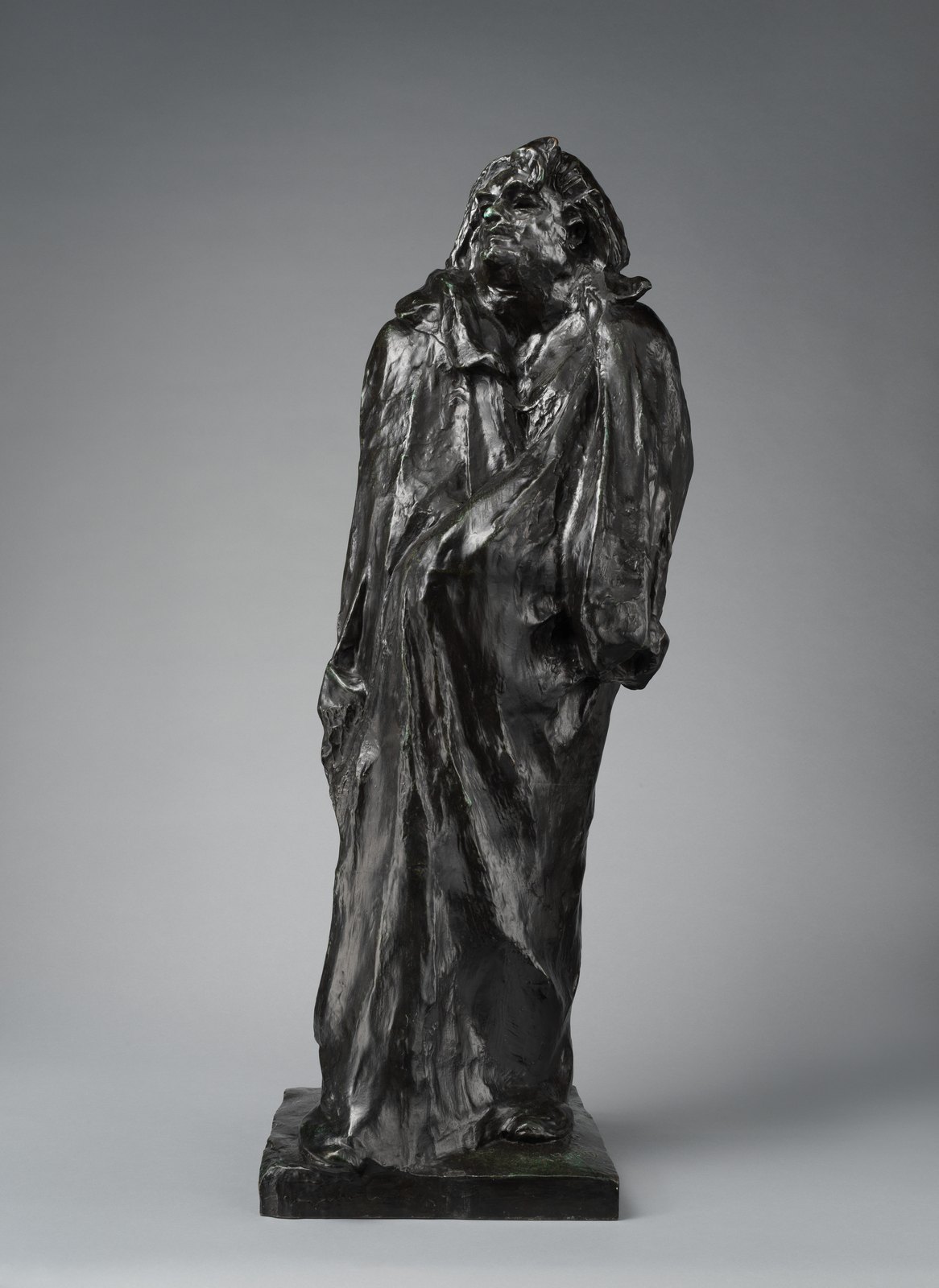
The Met’s final study shows the robe gathering the figure into a single mass. The Metropolitan Museum of Art, Gift of Iris and B. Gerald Cantor Foundation, 1984, 1984.364.15. Image source. CC0 / Public domain.
The Salon opened on 30 April. On 9 May the society’s committee voted against the exhibited plaster and said it could not recognise in it the statue it had commissioned. That wording makes the dispute more precise than the report of a scandal alone. Whether the work could be called a likeness was also a question about what the society believed it had bought. Rodin took the plaster back to Meudon and declined to pursue compensation. The journey from that decision to the eventual bronzes went through the survival and later interpretation of a sculpture the society had refused to install. [1] [16]
Moonlight and bronze
Ten years later Edward Steichen photographed the plaster at Meudon. By working at night he could use light that reached the figure very differently from the light of a Salon. The photographs bring out the slope of the head and the broad whiteness of the robe as the outline disappears into the surrounding darkness. They offer a view that a passer-by standing beside the sculpture could never hold for long. Alfred Stieglitz exhibited the prints at his 291 gallery in New York in 1909, then published them in Camera Work in 1911. The sequence gave viewers in the United States access to the plaster as Steichen had seen it, more than two decades before the bronze now in the Musée Rodin garden was cast. Steichen also made paintings connected with the sessions. The Musée Rodin identifies a surviving example, Shrouded Figure in Moonlight, in the Sheldon Museum of Art. The sculpture was already circulating through different media well before MoMA acquired its own bronze. [5]
Rodin died before the monument was cast in bronze. The Musée Rodin’s garden example, S.01296, was made by the Alexis Rudier foundry and stands 270 centimetres high. The museum’s public presentation and detailed inventory give different dates, 1935 and 1931, for that accession number. The Museum of Modern Art records its own bronze as a cast of 1954. The 1898 date that accompanies both versions refers to the finished design and its exhibition history. The dates of their metal belong to separate objects. Steichen’s photographs record the light on plaster at Meudon. The changing light on these bronzes shows what a later casting and a new setting bring to Rodin’s figure. [1] [3] [5] [17]
Three views by moonlight
The titles of the photographs give three points in a night’s work. In The Open Sky, made at eleven, the plaster rises above a dark landscape, with light still available to describe its front. Towards the Light, Midnight changes to a horizontal format in the Met’s example. The space to either side matters because the figure no longer occupies the frame as it does in the upright print. In The Silhouette, made at four in the morning, the head and shoulders are much easier to read by their outer edge than by the modelling of the face. The succession gives the viewer a way to compare the work from several angles. It also progressively takes away the detail by which one could ordinarily identify an image as a portrait. In the last view, even a spectator familiar with the sculpture may have to work from the sweep of the robe and the projected head. [5] [24] [25]
The Met dates its Open Sky exposure to 1908 and the printing of its copy to 1909. It records exposures of up to an hour during the session. For that length of time the plaster remains in position while the illumination changes. This produces an image whose light accumulates differently from what someone present at Meudon could see in a brief look. The finished print also has a material history. In MoMA’s exhibition records the Met examples of Open Sky and Towards the Light are direct carbon prints, while The Silhouette is a gum bichromate print. The difference matters when considering where the plaster seems to dissolve into the sky. The luminous edge in a print reflects decisions taken during exposure and in making the print. A title that names the time of night can suggest a direct record of the scene, while the photographic objects show how much work went into giving each account its particular tonal range. [5] [24] [25]
The three prints also establish a later point of comparison with Eugène Druet’s view of the plaster and gown study in the studio. Druet shows two pieces of evidence for a work still being made. Steichen takes one of the pieces outside and gives its outline a setting of its own. The change incidentally leaves aside much of what a photograph of studio work can show, including objects that give the plaster a familiar scale. In the night photographs, a tree line or a patch of sky has to do some of that work. The head can consequently look larger or farther away than a photograph made with walls and workshop objects visible. The two settings give different evidence about the same design, and the difference is visible before either photographer’s technique is identified. [5] [14] [24] [25]
From the gallery to the printed page
Stieglitz’s journal Camera Work gave the three views a precise order. In the double issue numbered 34–35, published in 1911, they followed Steichen’s portrait of Rodin. The plates occupy successive openings on pages 7, 9 and 11. To go from the first to the third, a reader turned pages. The journal then offered writing about Rodin and reproduced drawings by him, including a Cambodian dancer. This gave the reader several ways to understand Rodin’s work in one issue. Steichen’s portrait offered a view of the sculptor, the three plates offered successive views of an object that many readers could never have seen, and the drawings showed Rodin making choices in a medium that could itself be reproduced on paper. [5] [26]
An example at the University of Michigan Museum of Art makes that publication history tangible. Its Open Sky is a photogravure connected with the journal, while the Met’s similarly titled object is a direct carbon print. The repeatable image and the particular sheet of paper are two things to identify. A caption giving only the title and the year of the exposure leaves out why one image may have reached a reader of a periodical and another a collector of photographs. Steichen’s views eventually circulated in museum exhibitions devoted to photography, where the viewer could compare prints for size and process. The bronze also reached public collections, but its installation has a different history from the circulation of the photographs. Steichen’s series helped establish a public image of the monument during the decades in which a bronze still had no place on boulevard Raspail. [22] [24] [25] [26] [27]
The two Balzacs in the streets of Paris
After rejecting Rodin’s plaster, the literary society turned to Alexandre Falguière. The sculptor gave Balzac a seat and set one of the writer’s hands on his crossed knee. The bench provides a horizontal line across the figure and a point from which to follow the posture into the back and shoulders. A hand resting on a knee can suggest someone interrupted in thought. With Rodin’s figure, the nearer equivalent is the head emerging from the robe, where the sense of attention comes without a clearly indicated activity for either hand. In Paris the two designs became monuments to the same writer. They gave a passer-by quite different ways to approach the idea of someone thinking. [1] [18] [19]
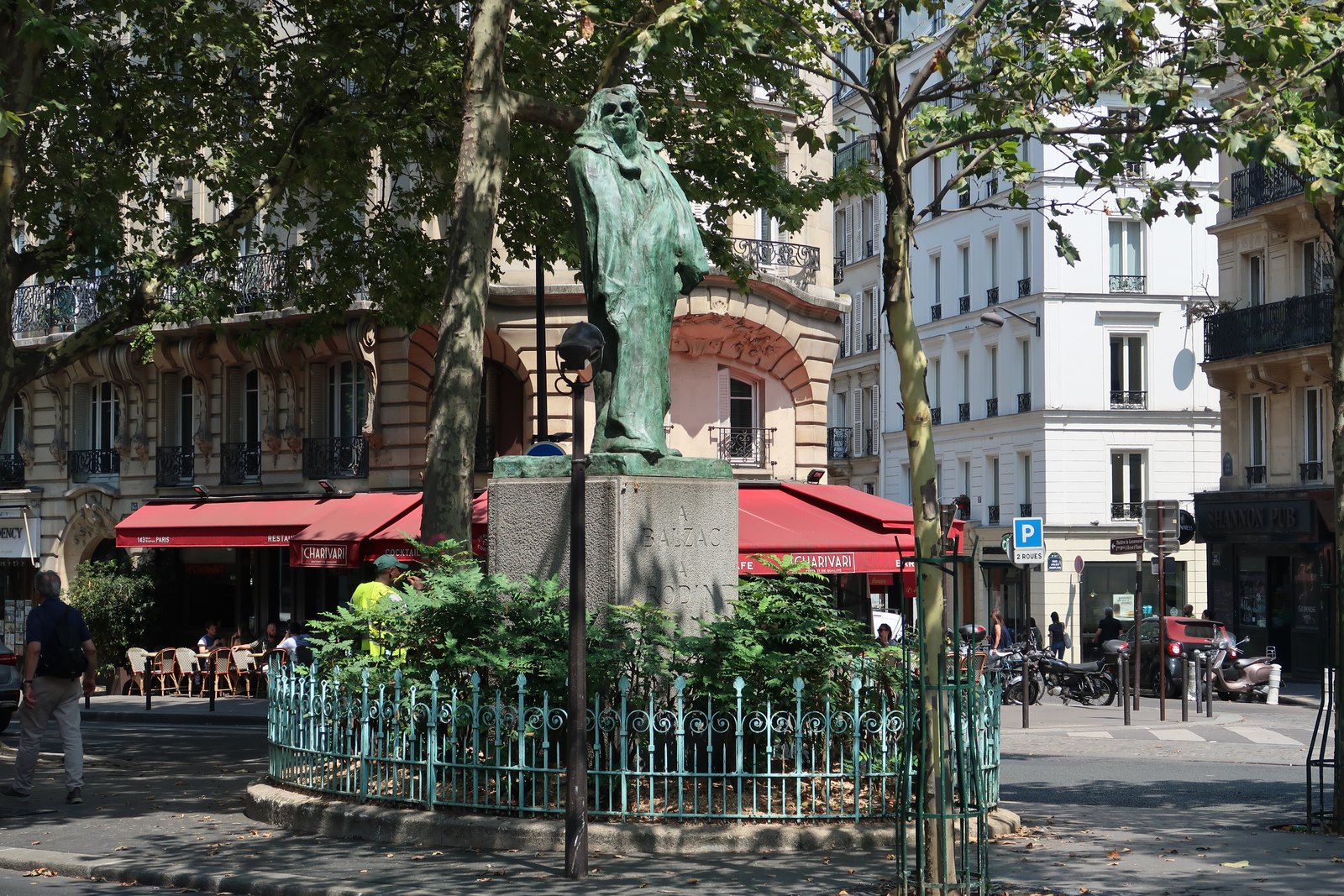
The public setting shows the height at which pedestrians encounter the robed figure. Photograph by Celette, Wikimedia Commons. Image source. CC BY-SA 4.0. Resized for the web.
Falguière died before the marble was finished. The Maison de Balzac identifies his definitive model as the one exhibited at the Salon des artistes français in 1899 and credits Paul Dubois with executing the marble. A Carnavalet postcard record credits Laurent Marqueste with its completion. Both accounts place the public unveiling in 1902. A photograph in the Carnavalet collection identifies the place as the corner of the avenue de Friedland and rue Balzac. The image and the museum’s surviving reduction are evidence for different things. The photograph establishes a civic occasion around the large sculpture. The small version preserves the relation between the figure and seat at a size where a viewer can follow the gesture of the hands closely. [19] [20] [21]
Rodin’s figure reached an outdoor public site through a different committee. In 1936 Paris councillors proposed erecting it at the urging of a group led by Georges Lecomte. At the unveiling on 1 July 1939, Charles Despiau and Aristide Maillol, both vice-presidents of the committee, removed the covering. The list of speakers includes Jean Vignaud of the Société des Gens de Lettres. A representative of the body that had originally commissioned the work was therefore present at a ceremony organised several decades after its refusal. The monument archive also records a dedication on the pedestal honouring both Balzac and Rodin from their admirers. The inscription made the sculptor one of the people commemorated by the installation at the junction of the boulevards Raspail and Montparnasse. [18] [22]
A plaster with its own exhibition history
The Orsay plaster carries two numbers, S.163 in the Rodin collection and DO 1986 2 for its deposit at Orsay. Its catalogue dates the design to 1898 and describes the physical plaster as taken from a piece mould after 1900, with the seams trimmed. The exhibition list includes the 1898 Salon and the Alma showing in 1900, and several subsequent entries explicitly question whether this particular example was shown. For Vienna in 1901 and Düsseldorf in 1904 the evidence allows a history of the design’s exhibition with the identity of the plaster still open. The moulding information is more definite than an exhibition list when identifying which material object can have stood in a room at a particular date. [16] [23]
Orsay records a height of 285 centimetres and a weight of 220 kilograms for its plaster. Even within a gallery that gives it room, the head can remain high above someone who comes close. The surface offers a different view of the folds from what a bronze out on a boulevard can give in changing daylight. A study photographed vertically or cropped to the head may emphasise the face and omit the long run of the robe. The visitor can step back, follow the narrowing near the shoulder, and see where the neck emerges as part of that larger shape. This is one reason to identify the particular cast and its setting when comparing an account of the monument to an image of it. [1] [22] [23]
Rodin artworks directory
Discussion
Look again at the images and ideas explored in Monument to Balzac. These editorial prompts invite your observations.
Reader Insights
After reading “A commission for a writer”, what detail would you look for in the object or image?
What extra evidence would help you distinguish the artist’s choices from the effects of material, viewpoint or later display?
Join the Conversation
Share a detail, comparison or question about Monument to Balzac below.
References
- Musée Rodin. Monument to Balzac, S.01296. View source.
- Musée Rodin. Monument to Balzac. View source.
- Museum of Modern Art. Monument to Balzac, bronze cast in 1954. View source.
- Musée Rodin. Study for Balzac’s Dressing Gown. View source.
- Musée Rodin. Rodin and Steichen. View source.
- Musée Rodin. The Kiss. View source.
- The Metropolitan Museum of Art. Auguste Rodin (1840–1917). View source.
- Musée Rodin. Rodin et la littérature. View source.
- Musée Rodin. Rodin, le laboratoire de la création, exhibition dossier. View source.
- The Metropolitan Museum of Art. Honoré de Balzac, terracotta study, 12.11.1. View source.
- The Metropolitan Museum of Art. Head of Balzac, 1985.111. View source.
- The Metropolitan Museum of Art. Final Study for the Monument to Balzac, 1984.364.15. View source.
- Musée Rodin. Étude de robe de chambre pour Balzac, S.00146. View source.
- Musée Rodin. Experimental reconstruction of the moulding of the dressing gown study. View source.
- Musée Rodin. Corps In•visibles, exhibition. View source.
- Hélène Marraud. Detailed chronology of Rodin’s Monument to Balzac, pp. 160–171. Musée Rodin and Hermann. View source.
- Musée Rodin. Balzac, detailed inventory entry S.01296. View source.
- Ville de Paris. Paris, un musée à ciel ouvert, les écrivains. View source.
- Maison de Balzac. Statuette de Balzac assis. View source.
- Musée Carnavalet. Postcard of Falguière’s Balzac. View source.
- Musée Carnavalet. Inauguration of the Balzac monument at avenue de Friedland and rue Balzac. View source.
- Musée d’Orsay. Monument à Balzac, boulevard Raspail, monument archive. View source.
- Musée d’Orsay. Balzac, plaster, DO 1986 2. View source.
- The Metropolitan Museum of Art. Steichen, Balzac, the Open Sky, 33.43.46. View source.
- Museum of Modern Art. The Original Copy, Auguste Rodin and the photographic enterprise. View source.
- Alfred Stieglitz, ed. Camera Work, nos. 34–35, 1911. Modernist Journals Project. View source.
- University of Michigan Museum of Art. Steichen, Balzac, The Open Sky, 2012/1.214. View source.
- Musée d’Orsay, Base Salons. Balzac (plâtre), 1898 Salon entry. View source.
- Musée d’Orsay. Les artistes du musée d’Orsay et l’affaire Dreyfus. View source.

 Auguste Rodin.jpg)




