


 Auguste Rodin.jpg)
 by Tom Gurney
Tom Gurney BSc (Hons) is an art history expert with over 20 years experience
Published on June 19, 2020 / Updated on November 18, 2026
Email: tomgurney1@gmail.com / Phone: +44 7429 011000
The Kiss
In Auguste Rodin’s The Kiss, two bodies make contact at a few narrow points. The woman winds an arm around the man’s neck. His hand opens on her thigh. Their heads meet above the turn of their shoulders, and their legs lie across one another at different angles. Walk around the marble and the embrace repeatedly opens and closes. From one position the backs form a broad surface. From another, the arms leave a space through which you can see the other figure. Rodin has made the approach to a kiss something a viewer can follow with their eyes. [1] [2]
Paolo and Francesca
The figures began as Paolo and Francesca, the lovers Dante encounters in the second circle of Hell. In the fifth canto of the Inferno, Francesca tells how she and Paolo read about Lancelot and Guinevere and came to kiss. Rodin’s group still carries a clue to that episode. Look for the book near Paolo’s hand. It is a small feature, easy to overlook when the bodies first catch your attention. Once you find it, the book gives the lovers a shared occupation that preceded their embrace. It is also a reminder of how a story the two read together becomes the story told about them. [1] [2] [3]
Rodin developed the group while working on The Gates of Hell. The doorway offered many other opportunities to represent entangled figures and bodily distress, and the lovers were conceived in relation to that larger arrangement. The Musée Rodin explains that Rodin set the group aside from the portal by 1886. The work’s balance and sensuality give it a different mood from many of the figures he kept around the doors. See it alone and you have time to follow the swing of Francesca’s torso and the intervals between their bodies. On a crowded door, the couple would have shared that attention with the other episodes around them. [1] [4]
The broader title has helped the sculpture travel beyond its literary context. It can be understood immediately as a couple turning towards one another. Dante adds something more specific. The lovers recall a moment that led to their deaths and their punishment, while the sculpture arrests that moment at a point when little of the later violence is visible. Rodin treated Paolo and Francesca in other works, including a marble in the National Gallery of Art. They give readers another way to see how the same story could produce quite different relationships between two sculpted figures. [2] [5]
Two moments in the lovers’ story
In Dante, Francesca tells the story after the lovers are already dead. The book was in front of them earlier, when they were alone and their attention passed from the story to one another. A sculpture of the kiss fills the present moment with something a reader of the poem receives indirectly, through Francesca’s account. That difference helps explain the effect of the almost hidden book. It asks the eye to attend to an object needed for the earlier moment, while the rest of the group shows the moment in which reading has given way to action. The book can be found close to Paolo’s hand, but the large movement of the group runs upward towards the faces. [2] [3]
The Musée Rodin describes the early placement on the lower left leaf opposite Ugolino. The two groups would have shown sharply different kinds of proximity. In one, the figures turn towards one another through an arm and the meeting of the heads. In the other, the father moves low among the bodies of his children. At that stage the portal offered the possibility of reading across from one group to the other. Both are episodes recalled within the journey through Hell. The way bodies are joined lends each episode its own immediate feeling. Once the kissing group had been set apart, that conversation across the leaves was no longer an ordinary part of looking at it. [2] [3] [12]
The group the Musée Rodin identifies as its replacement shows the lovers clinging to one another in Hell. In the independent Kiss, the seat gives them somewhere to rest, and the woman’s arm circles a head that has time to turn towards her. In the other design, clinging belongs to the condition of the figures after death. The difference is one reason to begin with the depicted action when comparing works called Paolo and Francesca. The National Gallery of Art’s marble under that title, for example, has its own approximate date of 1909 and is wider than it is tall. That format alone tells the viewer to look for a composition distinct from the rising pyramid of The Kiss. [2] [5]
The independent group was exhibited in 1887. The Musée Rodin records that it was known for a time as Francesca de Rimini before acquiring the title used today. The earlier title gives the woman’s name and a place in a literary history. The later one names an action the viewer can recognise without that preparation. Following the back of Francesca’s arm gives a reason to keep her individual movement in view even for someone chiefly interested in the group as an embrace. The titles distribute attention differently, and the history of their use helps explain how a work attached to one episode acquired an audience beyond readers of Dante. [2] [12]
The state marble in Paris
The French state commissioned an enlarged marble in 1888. The commission took nearly a decade to reach public display. The Musée Rodin records that Rodin exhibited it in 1898 alongside his plaster monument to Balzac. It is an odd and revealing pairing. The lovers turn into a shared space, and their faces matter partly for where they meet. Balzac’s raised head emerges above a single enclosing robe. The two works offer different ways for Rodin to organise a recognisable human presence, using proximity and the exposed body in one instance and mass and concealment in the other. The Paris marble entered the Musée du Luxembourg in 1901 and transferred to the Musée Rodin in 1919. [1] [6]
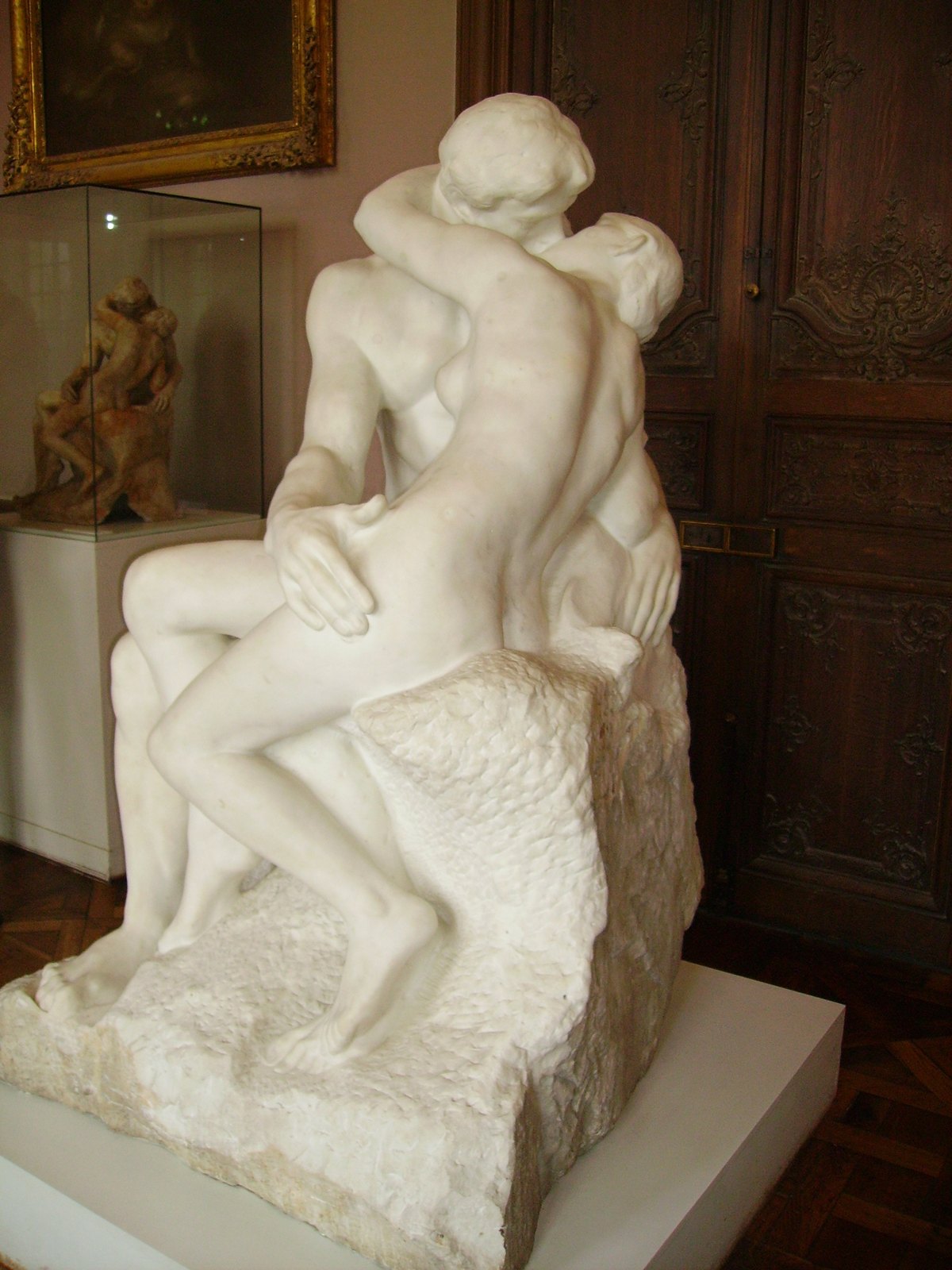
The Musée Rodin holds the large marble commissioned by the French state. Photograph by Yair Haklai, Wikimedia Commons. Image source. CC BY-SA 4.0. Resized for the web.
The stone is central to the effect. Look where the surface of the figures meets the rougher seat on which they rest. Changes in the light pick out shifts of texture and show how abruptly some of the smoother contours emerge. An ankle or a forearm can be given a clean edge against the stone beneath it. At the same time, the parts that look most mobile remain supported by other parts of the sculpture. The marble turns a small movement into something you can follow around an object that has to support its own weight. [1] [7]
The marble at the Salon and in a photograph
The Paris museum’s object file identifies Jean Turcan as the practitioner and Carrara marble as the material. It gives the height as 181.5 centimetres and the weight as 1,500 kilograms. Those figures make the ease of the visible movement all the more striking. There is an enormous mass of stone, and the sculptural solution lets the eye travel lightly up the outside of a bent leg. At the base the rougher stone bears the whole action, while at a shoulder or forearm a projecting contour can appear to leave that mass behind. The object record names the carver. The surface offers another kind of evidence through the way the two bodies are finished and supported. [7] [12]
Eugène Druet photographed the marble at the 1898 Salon of the Société Nationale des Beaux-Arts. The Musée Rodin dates the exposure to May or June and catalogues a gelatin silver print as Ph.01025. Its record identifies the view as three-quarter, a useful description for a sculpture that can seem to change arrangement as one walks around it. Seen in a photograph, the interval between two arms stays the same for as long as the viewer looks. If the man’s back hides part of the woman’s torso, it continues to do so. A museum visitor can take a step and see how the hidden form joins the visible one. The photograph supplies an early view of the Paris marble when people encountered it in the Salon. [12] [13]
The Musée Rodin associates Druet’s photograph, provisionally, with the illustrations to Georg Pauli’s 1899 essay on Rodin in the Swedish journal Ord & Bild. It is possible to locate the subject and author of the photograph independently of identifying which impression or reproduction a journal used. An image can preserve a recognisable view of the work yet carry a different date and history from the sculpture. With the 1898 print there is enough information to locate a particular encounter and compare it with later ways of showing the group. The proposed connection with Pauli’s essay belongs to a second enquiry about how that view reached readers abroad. [13]
The Copenhagen and London marbles
Carl Jacobsen, the Danish brewer and collector, saw Rodin’s exhibition in Paris in 1900 and commissioned a version for Copenhagen. The Ny Carlsberg Glyptotek’s sculpture, carved in 1901–03, belongs to a collection Jacobsen was building through a continuing relationship with the artist. His correspondence with Rodin shows what a commission involved beyond choosing a subject. The collector was bringing a work into a particular setting in Copenhagen and acquiring it within a wider interest in contemporary French sculpture. [8] [9]
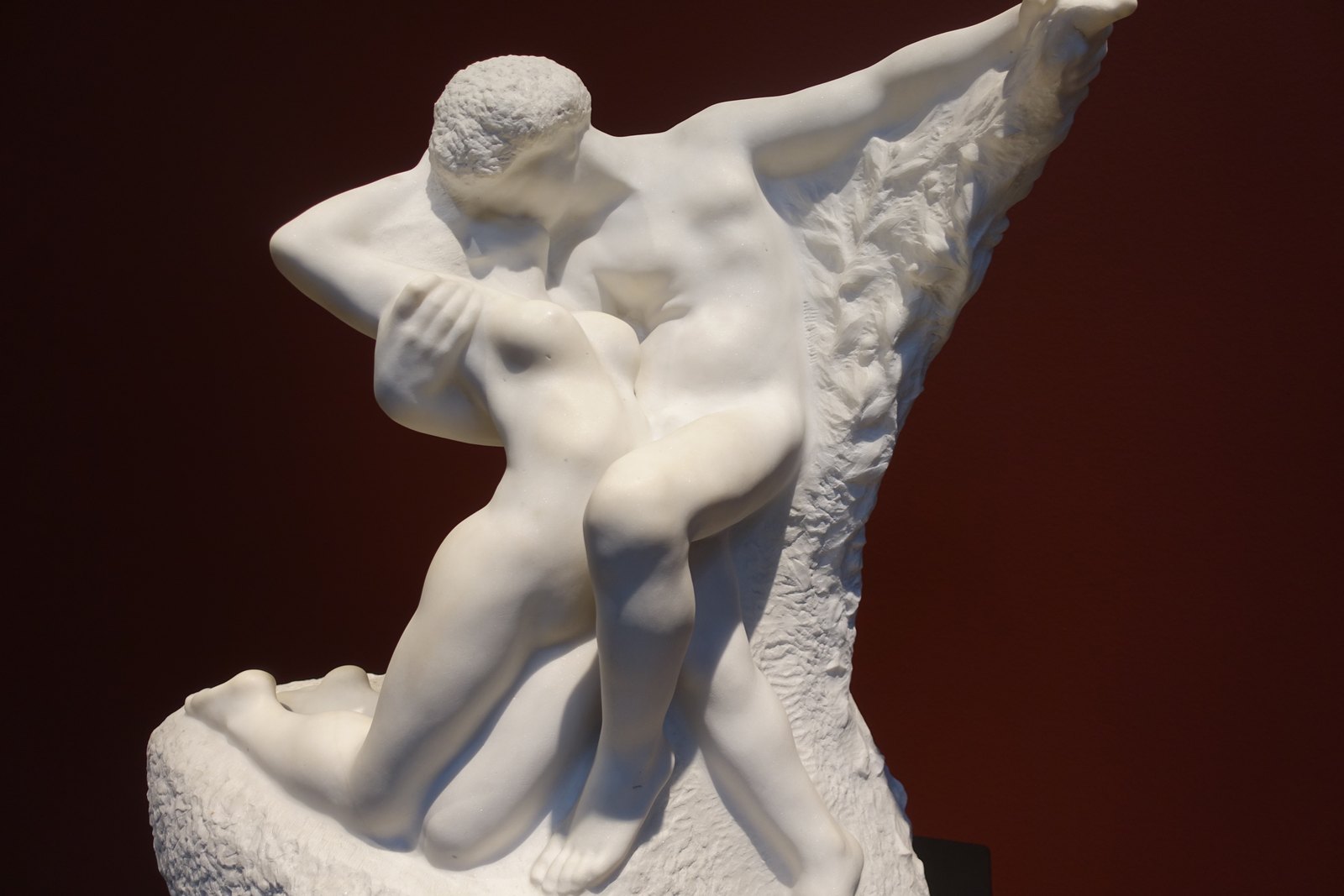
The Copenhagen carving is Jacobsen’s commission, a separate object from the marble made for Warren. Photograph by Joseolgon, Wikimedia Commons. Image source. CC BY-SA 4.0. Resized for the web.
The London marble came from another commission, for the American collector Edward Perry Warren, who lived in England. Tate dates its Pentelican marble to 1901–04. The Paris display of 1898 therefore predates the carving of these other large marbles. The dates on the separate works belong to their own commissions and fabrication. They can all lead back to Rodin’s earlier design for the lovers without giving any one of the three stones the same history as another. [1] [8] [10]
The differences are worth looking for when the comparison can be made from similar angles. Find the edge where a calf meets the seat, or watch where a shoulder catches the light above the other figure’s arm. In a photographed view, some changes come from the stone and the way it has been worked. Others come from the height of the camera, the direction of the light and how closely the photographer has cropped the base. A full view makes it easier to see what each exhibit asks of a visitor who can move around it. The Paris, Copenhagen and Tate pages follow those three examples individually.
What Jacobsen and Warren asked Rodin to make
Carl Jacobsen’s letter of 21 October 1900 puts The Kiss at the end of a list of six commissions for the Ny Carlsberg Glyptotek. The other five were bronzes, including The Burghers of Calais, The Age of Bronze and three portrait busts. For the lovers he asked for Carrara marble and specified that the work should match the scale of the original. The 70,000 francs in the letter covered all six commissions, with the cost of the block to be reimbursed separately. The size of the order changes the story of the Copenhagen marble. The Glyptotek was acquiring a group of works from which visitors might learn how Rodin handled a civic monument, a single standing figure, several likenesses and an intimate pair. The marble was given a distinct material within that larger commission. [9] [15]
The letter also records requests that can be tested against the stone. Jacobsen refers to the finishing of the man’s left leg and to the possibility of removing some rough marble near the left side of his chest. The two points have different force in the document. Jacobsen writes that Rodin agreed to attend to the leg and would consider the chest without committing himself. Both concern the line at which anatomy emerges from the block. A collector asking for the same composition was also asking whether the carver might finish a passage differently. The letter supplies evidence for the request, while the finished marble can establish how far the request made it into the carving. [15]
Rodin’s reply of 1 September 1902 gives a glimpse of overlapping work. He could tell Jacobsen that Saint John the Baptist had been cast, while allowing more time for its patina. He gave an estimate for the group from Calais and said work on the marble was continuing, without committing himself to a date. There is no single moment at which a studio could truthfully say that every work in the same order was equally advanced. On 23 February 1904 Jacobsen wrote that the marble had arrived and thanked Rodin for it. In the same letter he asked about two outstanding plasters, the cost of the block and the final payment. The marble could already be an object of admiration while the collection and its display were still being put together. [16] [17]
Warren’s commission, made in the same autumn of 1900, was a separate agreement. Christopher Skelton-Foord’s account for New College records the 12 November contract for a Pentelican marble at 25,000 francs and gives 28 July 1904 as the date of completion. The contract also specified the completion of the male figure’s genitalia. It is a precise instruction about a part of the body and belongs to the evidence for Warren’s commission. The Copenhagen correspondence instead records Jacobsen’s particular attention to the leg and the rough stone around the chest. Read together, the agreements show how a shared design could be the basis of two quite different conversations about what should be visible in a new carving. They also explain why the date of the agreement, the date of completion and the date of arrival should be kept distinct when comparing the marbles. [10] [15] [18]
Plaster and smaller bronzes
A plaster model, such as the large example in Meudon, helps explain how the design could be transferred into marble. Points measured on a model give the carver a set of depths to reach in the stone. The Musée Rodin describes how a pointing machine could preserve the scale of a model and how a set of compasses could transfer measurements at a different size. This is part of the reason a sculptural composition could be adapted for more than one patron. It also explains why dates of modelling and carving may appear separately in a collection record. The work of the studio continued after the pose had been established. [2] [7]
The composition circulated as a bronze at reduced sizes as well. A Barbedienne edition, for instance, could put the intertwined figures in reach of a collector who had no room for a marble pair approaching life size. Small scale draws the gaze to the group as a whole. At the scale of the large marbles there is room to watch one gesture at a time and to change where the bodies touch in your field of view by taking a few steps. The lovers that first belonged to Rodin’s crowded doorway have reached viewers in places as different as a sculpture gallery, a plaster collection and a private room. [2] [11]
Watch Rodin’s sculpture up close
Five films explore Rodin’s sculpture, from his use of classical models and the figures on his monumental doorway to the work of his studio.
Auguste Rodin – Challenging Beauty
Six sculptures show how Rodin adapted classical models.
Watch on YouTubePlaster taken from the marble
The route from a plaster to a marble could also run in the opposite direction. The Musée Rodin catalogues S.00174 as a large plaster taken from the Paris marble. Its archive links casts taken from that stone to the pointing models used for the Copenhagen and Tate versions between 1900 and 1904, and for the Philadelphia copy in the following decades. The plaster could carry information about what another carver had already worked out in the stone. If a carver wanted to know how far a bent elbow projected from the torso, the cast preserved the relationship in a form that could be handled and measured. In that sense the first state marble was both a finished sculpture and a source of information for work on later versions. [7] [14]
The object histories are easiest to follow if the physical plaster is identified before its part in the process is described. A large plaster can stand on its own in a gallery, just as it can serve as a workshop reference. A photograph might show the modelling of the thigh exceptionally clearly and reveal little about whether that plaster preceded a particular carving or recorded it after the fact. The museum archive’s attribution of S.00174 to the Paris marble gives a direction to the transfer for this object. That relationship does more to explain the closeness of some of the forms across the full-size examples than a general reference to their shared subject or attribution. [2] [7] [14]
Plasters at the original and monumental scales
The Musée Rodin records two plasters at the original scale whose measurements are close enough that height alone would be a poor way to identify them. S.02834, dated around 1885 in the collection portal, is 86 centimetres high. It has graphite and is catalogued as a pointing model. S.03960 is just half a centimetre taller. Its record notes a release agent and a signature on the right side of the rocky seat. The first weighs 35.8 kilograms and the second 45. Those numbers describe different physical objects, although the relationship of the bodies makes each recognisable as the same design. A working mark has more evidential value than a familiar silhouette when identifying which of these plasters appears in a workshop photograph. Neither catalogue record identifies its plaster as the piece exhibited in 1887. [28] [29]
Graphite on S.02834 is a reason to look differently at the contours. A museum visitor often follows a drawn mark as though it were a line the sculptor wanted to make visible in the final composition. On a pointing model, marks can indicate places from which to take measurements for a transfer. A point has to be understood in relation to other points around it. Consider the rim of the book, the wrist beside it and the rock below. Even if a carver can reproduce all three positions in the block, the nature of the transitions between them remains to be worked out. The book must appear to have an edge, the wrist to bear weight, and the rock to provide support. The markings can carry a set of relationships forward while leaving considerable work to the practitioner. [7] [28]
The large plaster S.05717 offers another comparison. The Musée Rodin’s detailed inventory describes it as a cast from marble, built with fibre and wooden reinforcement. At 189 centimetres high it weighs 148 kilograms. The Paris marble is slightly shorter in the museum’s measurements and weighs about ten times as much. Those entries give a sense of the difference between moving a workshop plaster and handling a stone group. They also show why a plaster of monumental size could be useful in transferring a design even when a finished marble already existed. It was still a substantial object that needed structural support, and it carried the full-scale relations of the bodies in a form that could be used again. [12] [30]
The inventory dates also need to be read with care. The museum’s public essay gives a date around 1882 for the large version, while its detailed record dates the physical plaster S.05717 to around 1888–98 and classifies it as a mould of marble. The paired entry for S.00174 describes another large plaster connected to the same workshop practice. A date near 1882 helps place the invention of the group. A larger cast taken from a marble documents the continuation of the design through the workshop. A statement that Rodin displayed an enlargement in plaster in 1898 is evidence about an exhibition. It does not follow that either of the two surviving large plasters can be identified as that exhibit on the strength of the shared catalogue description. [2] [14] [30]
The Philadelphia copy and the Barbedienne bronze
Henri Gréber’s marble of 1929 belongs to the history of the design after Rodin’s death. The Philadelphia Museum of Art records that Jules Mastbaum commissioned the copy in 1926 for the new Rodin Museum and that the Musée Rodin authorised it. The archive in Paris relates the Philadelphia project to the same family of pointing models associated with the Copenhagen and London works. The institutional record identifies Gréber as the maker. This allows the marble to be compared to those made during Rodin’s lifetime while giving proper weight to the new carver and the purpose for which the copy was commissioned. It was a way for a new museum to exhibit the design at a scale that would otherwise have required borrowing an existing marble. [14] [19] [20]
The museum accounts also make the setting part of the work’s story. A broad central gallery under frosted glass was designed to accommodate large figure groups, including this copy. Smaller rooms served plasters and drawings. The marble could therefore be seen as a full-scale study of the embrace within a collection that also offered evidence of how Rodin developed figures. That placement lets the eye judge the space between the bodies across a room before a visitor approaches the stone and sees where a contour turns into shadow. In Philadelphia the chapter on making the marble and the chapter on making a museum belong together. [19] [20]
The Barbedienne bronze in the Musée Rodin, S.02809, provides a different measure of how the design circulated. The collection file calls it the model for the first reduction, gives a height of 71.1 centimetres and specifies sand casting. It dates the bronze to 1898 and records its transfer to the museum in 1920 after the contract expired. It can therefore document the smaller-scale production while the Paris state marble documents the renewed public life of the large group in the same year. The reduction preserves enough separation between the arms and the torsos for the embrace to remain legible at close quarters. In bronze, a shallow recess between the figures may read principally as a dark shape where the lighter surface of a marble shows a more gradual turn. The choice of material adds another possibility for the design even when the positions of the two bodies are familiar. [12] [21]
A reduction with a dedication
The National Gallery of Art in Washington holds a Barbedienne bronze that allows a close comparison with the 71.1-centimetre model for the first reduction in Paris. The Washington cast, 1942.5.15, is just 24.7 centimetres high. Its base carries a founder’s mark and a small inset naming the Collas mechanical reduction process. The book remains present in Paolo’s left hand. At this scale it costs very little to change the angle of looking far enough to see the book, yet it is also easy to overlook it when taking in the entire silhouette. The hair, bent limbs and rough seat occupy nearly the same field of vision. Looking closely becomes an act of picking out one area within a composition that can be apprehended almost at once. [21] [22]
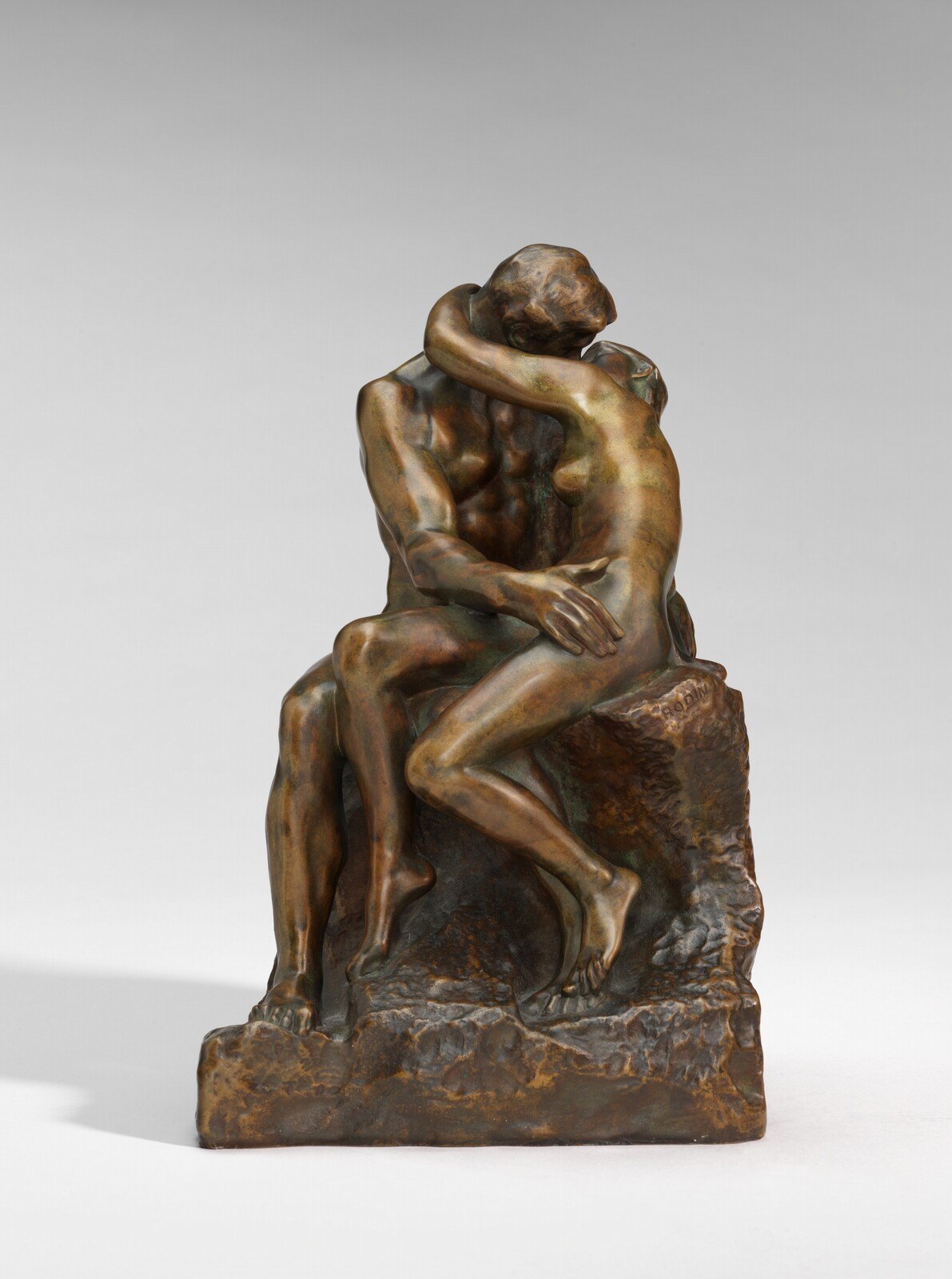
Rodin presented this small bronze to Kate Simpson in 1902. National Gallery of Art, Washington, Gift of Mrs. John W. Simpson, 1942.5.15. Image source. CC0 / Public domain.
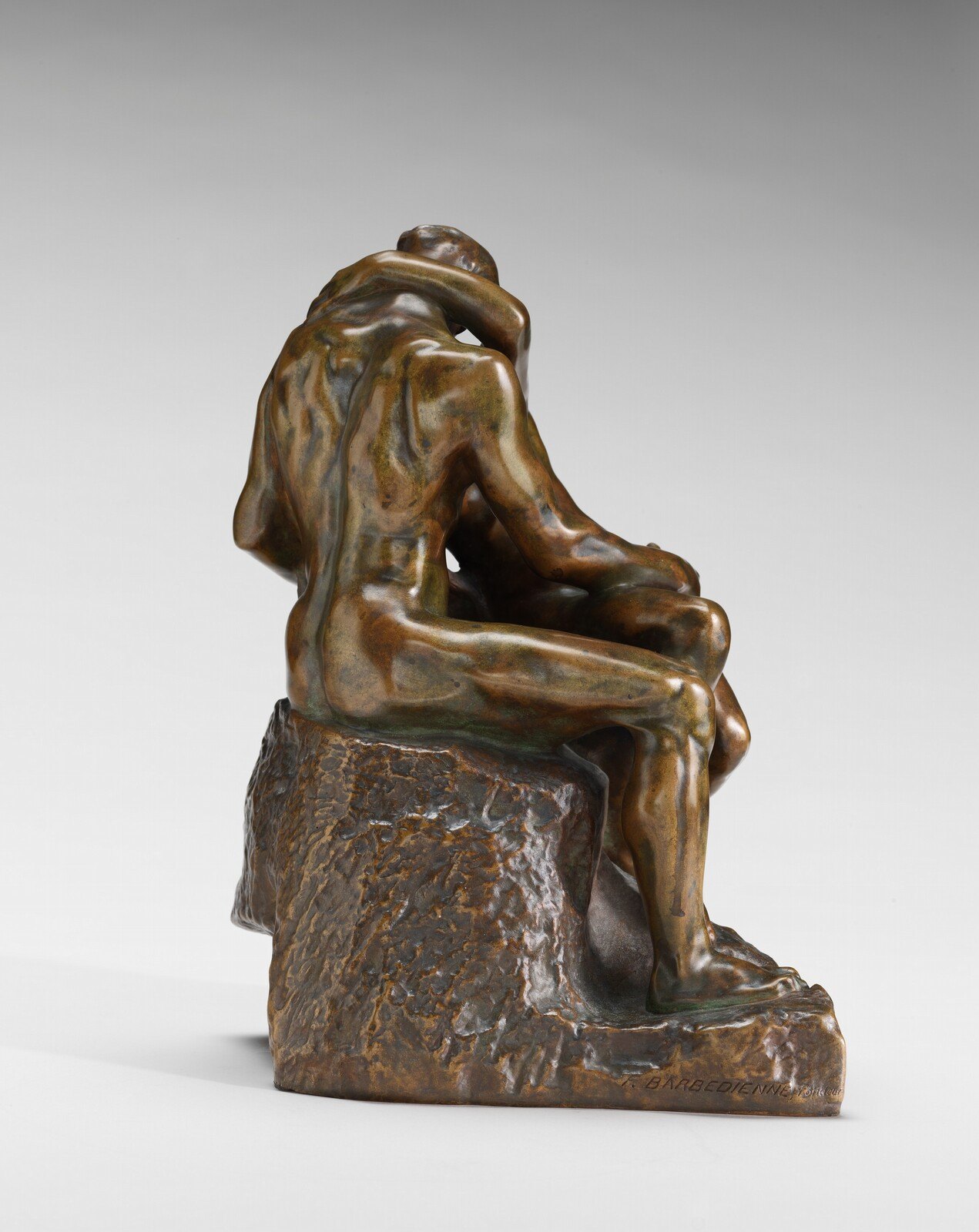
Turning the small bronze changes which limbs are visible and how the figures overlap. National Gallery of Art, Washington, Gift of Mrs. John W. Simpson, 1942.5.15. Image source. CC0 / Public domain. Resized for the web.
This bronze also has something the large marbles do not share. Rodin inscribed it for Kate Simpson in September 1902 in memory of her time in his studio, where she had sat for a portrait bust. The museum records indices of different kinds on this one object, from her dedication to the founder’s name and a mark stamped inside the cast. At the scale of a gift, the surface around the figures had room for such an addition. The dedication gave this Kiss a connection to a particular exchange between sculptor and patron even though many other examples of the design circulated. A photograph framed tightly around the figures might preserve the visual information needed for comparing gestures while losing the very evidence that would allow this object to be connected to Simpson. [22]
The Cantor Foundation records that Barbedienne offered the composition in four sizes during the period from 1898 to 1918. The existence of those sizes had a consequence for the American museum attempting to buy the sculpture. In its account of the acquisitions for the new Rodin gallery, the Met describes how Edward Robinson had considered a terracotta Kiss that proved to be a cast. The museum also records that it could not obtain a bronze of the design directly from Rodin because the model and casting rights had gone to Barbedienne. The two decisions call for different sorts of evidence. A museum that hoped to buy a first piece of modelling had to determine how the terracotta had been made. For the bronze it had to contend with an arrangement governing who could make and sell the versions then on offer. [23] [24]
The Warren marble in a house and a town hall
Warren’s marble passed between settings that gave very different viewers a chance to see it. The recorded history of Lewes House places it in a building known as Thebes from 1906. It moved to the Lewes town hall in 1914 and was returned to Thebes in 1917. The change to municipal space matters because the work had been commissioned to an individual collector’s terms. The qualities of surface and anatomy specified in the agreement travelled into a setting where visitors were less likely to know why they had been asked for. A record of the return to the house gives the public display an endpoint. The sequence itself establishes who could encounter the sculpture in different settings more clearly than any later anecdote about the audience’s reaction. [18] [25]
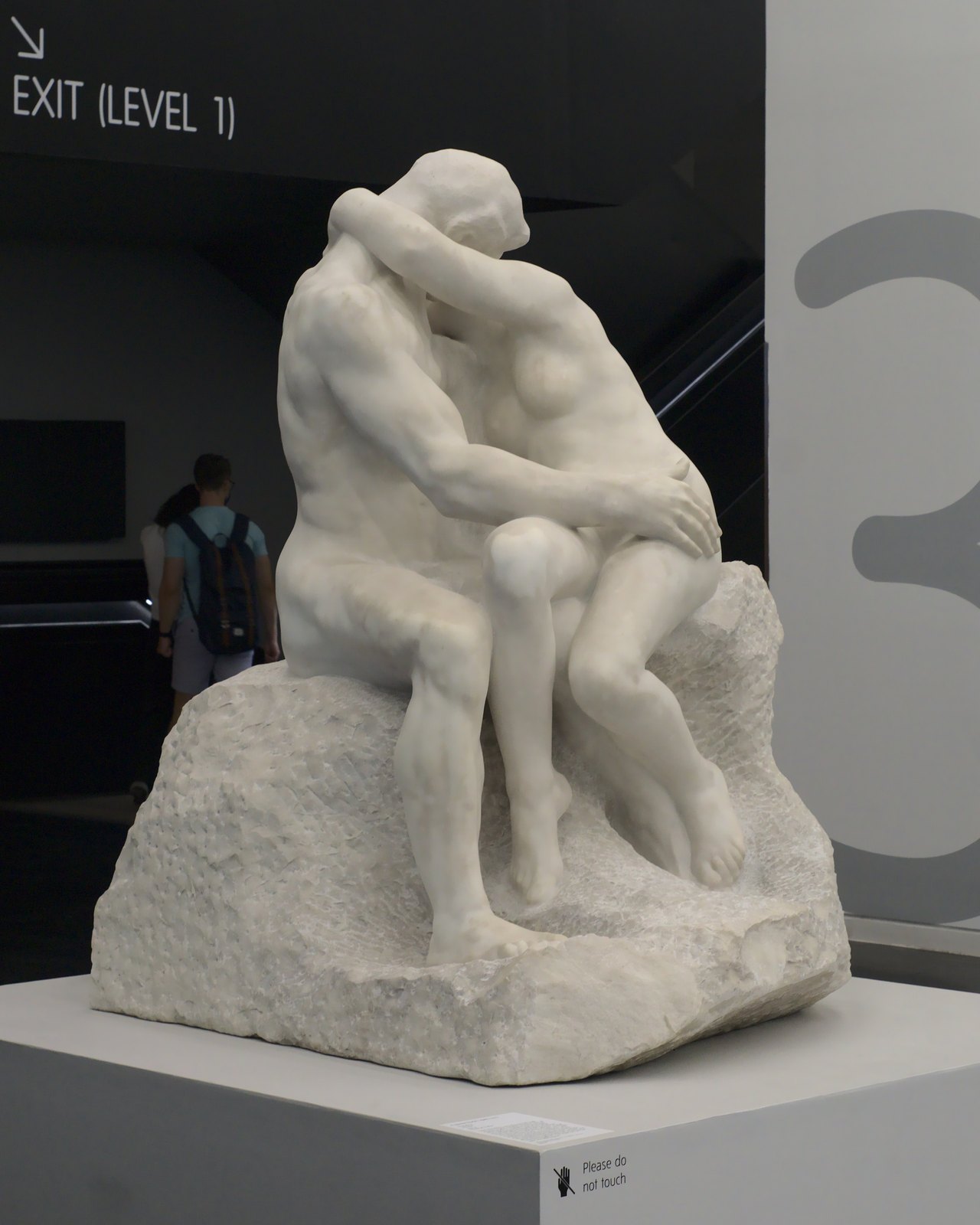
Edward Perry Warren’s commission later entered Tate’s collection. This view records its display in 2021. Photograph by Caeciliusinhorto, Wikimedia Commons. Image source. CC BY-SA 4.0. Resized for the web.
Tate’s collection data gives the sculpture the accession number N06228, records its acquisition in 1953 and dates the marble to 1901–04. The date range describes the making of the object, while the later year describes its entry into the collection. That distinction is especially important here because the collector, the municipal display and the museum are all associated with the same marble. A picture of any one of the other large versions might look convincing alongside Warren’s name. The accession number helps put the correct work back in the account. It also makes it easier to compare the conditions under which it was made with those under which the marble would later be seen. [18] [25] [26]
Another embracing couple in Philadelphia
The Philadelphia presentation in 2017 brought Gréber’s marble copy into a group of sculptures about embraces. It included a bronze of Camille Claudel’s The Waltz. The pairing makes visible one feature that The Kiss can make easy to overlook. Rodin’s seated lovers change direction readily above the rock, but the seat holds their lower bodies within a fairly compact space. In Claudel’s group the inclination of the dancers runs through their bodies into the stance of their legs. Drapery follows that turn and carries it beyond the body. Look at how an arm crosses behind a shoulder in each. The seated group shows an embrace gathering two bodies towards a point. The dancers maintain contact while the movement seems to carry them through the point at which the viewer has caught them. [20] [27]
The Musée Camille Claudel traces the development of the drapery to discussions over a proposed marble. The first version was initially judged unsuitable for the commission because the dancers were nude. Claudel developed a draped version, but the marble commission did not go ahead. She later worked on a smaller version with less drapery that circulated in multiple materials. Viewed alongside Rodin’s group, this history draws attention to an element of the comparison that can be seen in the objects themselves. In the dancers, cloth could become a means of giving movement a larger outline as well as answering the objection to nudity. In the lovers, the analogous work of holding the silhouette together is carried by intertwined limbs and rock. The exhibition placed the works close enough for these alternatives to become visible in one visit. [20] [27]
A monumental bronze with its own public history
The Musée Rodin records a full-size bronze with a history of manufacture and ownership quite different from the reduced casts. RFR.00024 was made by Eugène Rudier in 1934 using the Alexis Rudier mark. The date the museum assigns to the creation of the design is 1888–98, but that range concerns a preceding phase. The name on the bronze requires care for the same reason. The mark names the foundry business under which the object circulated, while the catalogue identifies the person who cast it. Taken together with the dimension and medium of the Paris marble, those records explain why a photograph of a monumental Kiss in Paris might represent either stone carved during Rodin’s lifetime or a bronze cast well after it. [12] [31]
The museum records that the bronze was made for the dealer Herman d’Oelsnitz. It was understood to be a possible case of wartime spoliation when it was recovered from Germany in 1949. The Musée Rodin’s entry gives the later conclusion of its provenance research, which found that the work had not been looted, and notes that it remains entered in the recovery inventory. In this case an inventory can preserve the history of a recovery and the earlier uncertainty about it even after research has changed the institution’s assessment. It is possible to identify this bronze through its RFR number without treating that number as a verdict about the circumstances in which the work changed hands. [31]
The cast was placed in the gardens of the Hôtel de Matignon in 1980, then in the Tuileries in 1998. The Musée Rodin records its return in 2023 and formal assignment in 2024. The photograph of Druet’s marble at the Salon had fixed one angle on an object inside an exhibition. A photograph of the bronze outdoors would do something different. Trees, paths and the distance from which a photographer could approach would become part of the image. Sun would pick out a particular band of shoulders and arms. The same sculpture seen later at the museum could appear to come from an entirely different encounter even when the turning forms are familiar. The movements of the bronze supply a way to date and interpret such views without giving the outdoor setting to every version. [13] [31]
Looking across the objects brings the book back into focus. It is close enough to the body to disappear from some views, and small enough that a distant view of the Tuileries bronze would hardly need to register it at all. It is still legible in the much smaller Simpson bronze when the point of view allows it. Neither the narrowing of the field in a photograph nor the immense physical size of a public institution’s cast indicates how much of the composition a viewer will actually see. Standing where the book comes into view and then moving until it vanishes gives a practical sense of what the design carries and what one encounter with it leaves out. That movement puts the reader back in the moment before the lovers turned towards each other. [3] [22] [31]
Rodin artworks directory
Discussion
Look again at the images and ideas explored in The Kiss. These editorial prompts invite your observations.
Reader Insights
After reading “Paolo and Francesca”, what detail would you look for in the object or image?
What extra evidence would help you distinguish the artist’s choices from the effects of material, viewpoint or later display?
Join the Conversation
Share a detail, comparison or question about The Kiss below.
References
- Musée Rodin. The Kiss. View source.
- Musée Rodin, Meudon. The Kiss, large model. View source.
- Dante Alighieri. Inferno, canto V. Columbia University, Digital Dante. View source.
- Musée Rodin. The Gates of Hell. View source.
- National Gallery of Art. Paolo and Francesca. View source.
- Musée Rodin. Le Monument à Balzac. View source.
- Musée Rodin. Marble carving. View source.
- Musée Rodin. Rodin and modernism. View source.
- Ny Carlsbergfondet. Bringing Rodin to Copenhagen. View source.
- Tate. The Kiss, 1901–04. View source.
- Christie’s. Le Baiser, second reduction. View source.
- Musée Rodin. Le Baiser, S.01002. View source.
- Musée Rodin. Eugène Druet, the marble at the 1898 Salon, Ph.01025. View source.
- Musée Rodin. Le Baiser, grand modèle, S.00174. View source.
- Carl Jacobsen. Letter to Auguste Rodin, 21 October 1900. Ny Carlsberg Foundation. View source.
- Auguste Rodin. Letter to Carl Jacobsen, 1 September 1902. Ny Carlsberg Foundation. View source.
- Carl Jacobsen. Letter to Auguste Rodin, 23 February 1904. Ny Carlsberg Foundation. View source.
- Christopher Skelton-Foord. Ned Warren’s ‘Jack in the Pulpit’. New College Notes, 2022. View source.
- Philadelphia Museum of Art. Henri Gréber, Copy of Rodin’s The Kiss. View source.
- Philadelphia Museum of Art. Museum Honors 100 Years of Rodin and 2012 annual report. View source 1. View source 2.
- Musée Rodin. Le Baiser, réduction n° 1, S.02809. View source.
- National Gallery of Art. The Kiss, 1942.5.15. View source.
- Iris & B. Gerald Cantor Foundation. In Rodin’s Studio. View source.
- The Metropolitan Museum of Art. Rodin at The Metropolitan Museum of Art, a history of the collection. View source.
- Parks & Gardens. Lewes House. View source.
- Tate. Collection dataset, object N06228. View source.
- Musée Camille Claudel. The Waltz. View source.
- Musée Rodin. Le Baiser, pointing model S.02834. View source.
- Musée Rodin. Le Baiser, plaster S.03960. View source.
- Musée Rodin. Le Baiser, large plaster S.05717. View source.
- Musée Rodin. Le Baiser, bronze RFR.00024. View source.
 Auguste Rodin.jpg)
 Auguste Rodin.jpg)






