


 Auguste Rodin.jpg)
 by Tom Gurney
Tom Gurney BSc (Hons) is an art history expert with over 20 years experience
Published on June 19, 2020 / Updated on November 18, 2026
Email: tomgurney1@gmail.com / Phone: +44 7429 011000
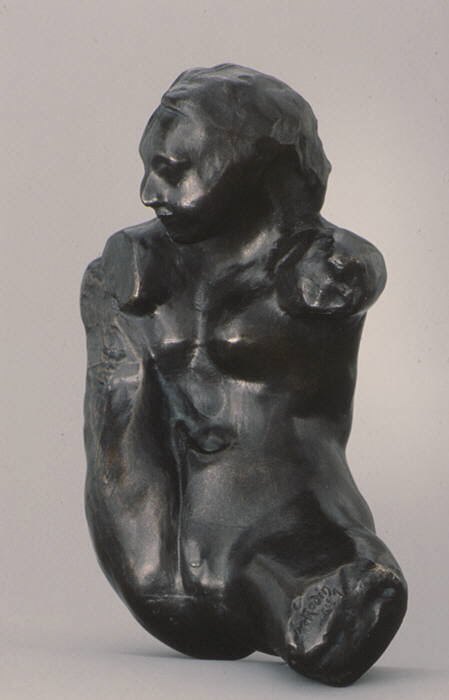
Iris, Messenger of the Gods (with head)
In the pictured version of Auguste Rodin’s Iris, a woman throws her head back as one leg rises to the side. One hand reaches along that leg towards the foot, while the other arm ends above the elbow. The lower leg bends back beneath the body. There is little visible support, and the figure has the appearance of being suspended in the middle of a movement. Rodin developed versions of the pose in connection with his projects for a monument to Victor Hugo. The winged figure intended for the monument, the large headless sculpture and the study that retains its head each arrange the body differently. [1] [2] [3] [4]
A figure held above the ground
The photograph shows the head nearly frontally but from below. There is a sharp upward turn from the throat to the chin. The face consequently appears smaller than it might at eye level. Light picks out a few planes near the cheeks and brow while the side of the neck continues down into the shoulders. The head gives the body a direction of attention. Even when the features are hard to read, the viewer can see that the face points away from the hand and foot that extend across the picture. [1] [2]
The raised leg makes a strong diagonal. Its knee approaches the shoulder on the same side, and the shin and arm make two adjacent lines that reach to the foot. The two lines are close enough to appear joined until the eye follows them back towards the body. There the arm leads to the shoulder and the thigh turns down into the pelvis. The narrow spaces between the limbs clarify where they come together and where they move independently. Across the chest, the shorter arm has a broad edge before it stops. That clear ending gives the opposite shoulder a more compact outline. [1] [2]
The other leg passes down through the right of the image, bends sharply and returns towards the centre. Its foot and the short vertical piece below it offer the only visible meeting with a level surface. The position makes it hard to read the figure as a person standing on that leg. The knee is forward and the hip is already moving sideways. From this angle the projection of the upper leg is balanced by the position of the lower knee on the opposite side. The torso gives the two movements a continuous path from the neck to the hips. [1] [2]
A small shift in viewpoint would change the amount of overlap between the extended arm and the shin. In the photograph their edges nearly coincide close to the foot, while more light separates them farther up. The dark bronze also carries a few brighter patches along the thigh and abdomen. They help distinguish the large planes of the body where the dark edges of adjacent forms are difficult to follow. [1] [2]
A messenger above Victor Hugo
The name Iris refers to the messenger of the gods in Greek mythology. In Rodin’s projects for a monument to Victor Hugo, the figure could represent inspiration passing towards the poet. The Met describes a design known as The Apotheosis of Victor Hugo, in which the writer stands above figures rising from the sea, with Iris flying above his head. The Musée Rodin records that the figure was given wings and positioned in a dive in the 1897 project. This was one solution in a long history of revisions to the monument. It helps explain why a pose that seems difficult to sustain on the ground could be useful to a sculptor planning a figure high above a spectator. [3] [4] [5]
The finished marble monument unveiled in Paris in 1909 should be distinguished from the plan that placed Iris above a standing Hugo. The plans show Rodin trying different ways to make poetic inspiration visible around the author. In the raised figure, the physical action can be read before the viewer identifies any mythological subject. Wings, the position over the poet and the descent through the air would have made her role clearer within the proposed monument. The independent study brings the turn of the head and the movement of the limbs within easier reach of the eye. [3] [4] [5]
Watch Rodin’s sculpture up close
Five films explore Rodin’s sculpture, from his use of classical models and the figures on his monumental doorway to the work of his studio.
Auguste Rodin – Challenging Beauty
Six sculptures show how Rodin adapted classical models.
Watch on YouTubeThe head and the change in orientation
The Musée Rodin dates the plaster Étude pour Iris, avec tête, S.02440, to 1890–91. The study is 46.5 centimetres high. The Art Gallery of South Australia dates the model for its bronze to 1891 and the cast to 1970. In its record the signature is on the instep of the figure’s left foot, a place a photograph may leave in shadow. The Cantor Arts Center’s checklist documents another study with head, dated around 1891. The term with head also appears in the Met’s historic Cantor exhibition catalogue for a much smaller object without the limbs. Title, scale and the exact form of the figure are consequently all relevant to identification. [1] [2] [6] [7]
The Musée Rodin also documents the enlarged, upright treatment without a head and with one arm reduced further. The headless figure concentrates attention on the wide separation of the legs and the exposed torso. In the study illustrated here the uplifted face and the surviving portion of the shorter arm give the eye two additional stops near the top. The presence of the face makes the apparent direction of movement particularly clear. In the winged design the body was meant to be understood in its downward relation to the poet. These changes show how the same bend of a thigh or twist at the waist can operate in several directions according to the way the work is supported and viewed. [1] [2] [3] [4]
The legacy photograph shows a dark bronze with a head, two legs, a long reaching arm and the shortened end of the other arm. It is consistent with the larger study with head documented in plaster and in later bronze examples. The exact cast requires a match to an object photograph or details such as its dimensions and marks. The photograph’s close framing is particularly clear about the bend of the supporting leg and the reach of the other. Both departures from an ordinary upright stance let the spectator imagine the body in the air. [1] [2] [6]
The torso without a base
The Musée Rodin records S.03733 as a medium-size plaster torso without a base. It stands 30.6 centimetres high. The right shoulder carries a letter V and the number Z59. Those details distinguish it in the collection from the larger plaster study with a head. The shoulder marks also put attention on a place that can seem incidental in the complete gesture. With the reach of the limbs removed, the relatively small turn from the shoulder into the trunk is easier to read as a change in direction. [1] [8]
The Met’s small torso isolates part of the form associated with Iris. The Metropolitan Museum of Art, Gift of Iris and B. Gerald Cantor Foundation, 1984, 1984.364.5. Image source. CC0 / Public domain.
On the winged figure designed for the Hugo project, the pose suggested a body moving down from above. In the independent versions where the legs survive, their angles guide the viewer’s first reading of the body. The torso offers fewer cues about how to place the figure in the air or above a support. Its relationship to those versions can still be read in the way the ribcage and abdomen turn. The museum’s separate record confirms that a viewer can study that movement on an object of its own. [3] [4] [8]
Rodin artworks directory
Discussion
Look again at the images and ideas explored in Iris, Messenger of the Gods (with head). These editorial prompts invite your observations.
Reader Insights
After reading “A figure held above the ground”, what detail would you look for in the object or image?
What extra evidence would help you distinguish the artist’s choices from the effects of material, viewpoint or later display?
Join the Conversation
Share a detail, comparison or question about Iris, Messenger of the Gods (with head) below.
References
- Musée Rodin. Étude pour Iris, avec tête, S.02440. View source.
- Art Gallery of South Australia. Iris, study with head, 962S13. View source.
- Musée Rodin. Iris, messenger of the gods. View source.
- Metropolitan Museum of Art. Iris, Messenger of the Gods. View source.
- Metropolitan Museum of Art. Auguste Rodin (1840–1917), Victor Hugo commissions. View source.
- Cantor Arts Center, Stanford University. Rodin: The Shock of the Modern Body, checklist. View source.
- Metropolitan Museum of Art. Rodin: The B. Gerald Cantor Collection, nos. 60–61. View source.
- Musée Rodin. Iris messagère des dieux, medium torso without base, S.03733. View source.

 Auguste Rodin.jpg)





