


 by Tom Gurney
Tom Gurney BSc (Hons) is an art history expert with over 20 years experience
Published on June 19, 2020 / Updated on November 18, 2026
Email: tomgurney1@gmail.com / Phone: +44 7429 011000
The Falling Man
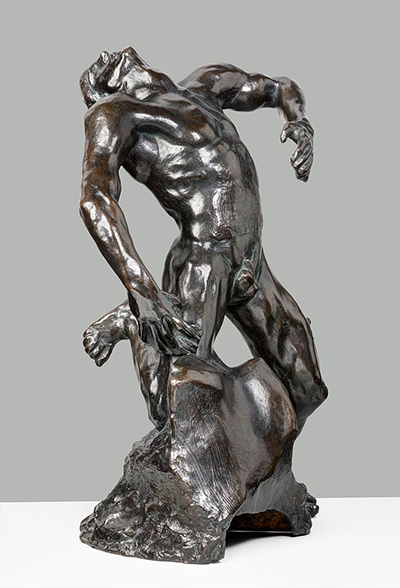
The head of Auguste Rodin’s The Falling Man goes back as the chest rises and the lower body buckles against a rocky support. One arm hangs near the rock. The other bends beside the shoulder and ends in a hand that turns down towards the open space. It is hard to tell, at first glance, what those hands could grasp. The pose becomes easier to understand alongside the figure on The Gates of Hell and the related group I Am Beautiful. Rodin changed the figure’s position and surroundings, giving the arch of its body a different purpose in each composition. [1] [2] [3]
The body and its support
In the photograph, the rock rises between the bent legs. One foot projects at the left and catches the eye because the toes are visible against the grey background. The downward arm runs in front of this foot and continues towards the top of the rock. The other leg frames the right edge of the support. Its broad thigh turns into a sharply angled knee, and the change of direction is visible even where the shin passes behind the base. Much of the sculpture’s weight is gathered in the lower half, but the relation of the legs to one another makes that weight feel unevenly distributed. [1] [4]
The line from the lower abdomen to the top of the chest curves first outwards and then back. Reflections on the bronze follow this change of plane. They form broad patches near the ribs and narrower streaks down the hanging arm. The neck disappears into a dark angle near the shoulder. Above it the face catches a small area of light. The raised shoulder and bent arm mark the other limit of the arch. The fingers at the end of that arm hang in the open, separated from both the chest and the bent leg below. [1] [4]
The rock itself looks different on either side of the hand. A wide face near the centre reflects the light and shows closely spaced surface marks. To the left the support breaks into uneven planes, especially near the ground. The flatter area provides a surface against which the turn of the knee is easy to read. The irregular edge below it leads the eye away from the body and back into the solid base. From another side of the bronze, the upper body might overlap more of the support, giving a clearer view of the projecting foot and a shorter apparent reach to the bent arm. [1] [4]
A fall above the left door
The Musée Rodin places The Falling Man at the upper edge of the left leaf of The Gates of Hell, where the figure passes over the moulding that separates the door from the upper field. The museum describes the action as an attempted escape that ends in a backward fall. At door height the rock of the independent figure is replaced by the setting of the moulding and neighbouring bodies. The backward arch carries the figure out towards the spectator and away from the surface. The Met draws attention to the raised arms of the doorway figure and the kneeling stance of its freestanding bronze. [1] [2]
There is a practical difference in how one sees the two poses. A spectator below the doorway sees the projection of the torso from underneath. Its head and arms have to register quickly, near the crowded space above the door leaves. At the height of a museum plinth, the outline can be followed gradually from the rock to the face. The rocky base makes the downward pull immediately visible, while the height of the rising chest carries the body away from it. The possibility of moving around the independent figure also makes its rotation easier to see. [1] [2]
Watch Rodin’s sculpture up close
Five films explore Rodin’s sculpture, from his use of classical models and the figures on his monumental doorway to the work of his studio.
Auguste Rodin – Challenging Beauty
Six sculptures show how Rodin adapted classical models.
Watch on YouTubeFrom a single figure to a pair
In I Am Beautiful, the man’s arms form part of a two-figure group. The woman, adapted from Crouching Woman, is turned and lifted, and her compact pose fills space in front of his chest. The backward curve of his torso now suggests the effort of supporting her. The Philadelphia Museum of Art presents the group as the combination of two figures Rodin conceived for the doorway. The Musée Rodin’s dedicated doorway catalogue suggests a different sequence. It proposes that the falling figure probably derives from the pair, pointing to the way the arms and hands still look as though they enclose a partner. The close relationship is visible in the poses even where the sequence is a matter of interpretation. [2] [3] [5]
The reunion of the figures changes the outline most clearly above the man’s shoulders. The raised arm of the single bronze ends against the background. In the pair, the bent legs and back of the woman crowd that space, and the viewer has to trace the arm around a body to see where it ends. [3] [5]
Rodin also isolated the torso. The Musée Rodin’s doorway catalogue illustrates a large plaster of around 1904, known as Torse d’homme Louis XIV. The Leopold Museum catalogues a related bronze body study as Falling Man. Torso of a Young Man. Looking at a torso in isolation takes away the evidence provided by the feet, rock and hands. The arch and the change in angle between pelvis and shoulders have to carry the sense of motion. Seen next to the complete figure, the fragment makes those changes easier to locate in the full pose. [2] [6]
Comparing the bronzes
The Metropolitan Museum of Art dates the modelling of its version to about 1882 and records that the Godard Foundry cast its bronze in 1982. The bronze at the Los Angeles County Museum of Art is close in height and was cast in 1972. Museo Soumaya documents a 1981 Godard cast and a separate study cast in 2000. The photographed figure shares the bent free arm and raised rocky support visible in published views of the freestanding design. Small photographs can establish those features reliably, while the foundry mark, number and measurements are better ways to identify an individual bronze. The figure is particularly legible in the space between the hanging fingers and the support. That interval gives the viewer room to see how far the chest has moved from the place where the body bears its weight. [1] [4] [7]
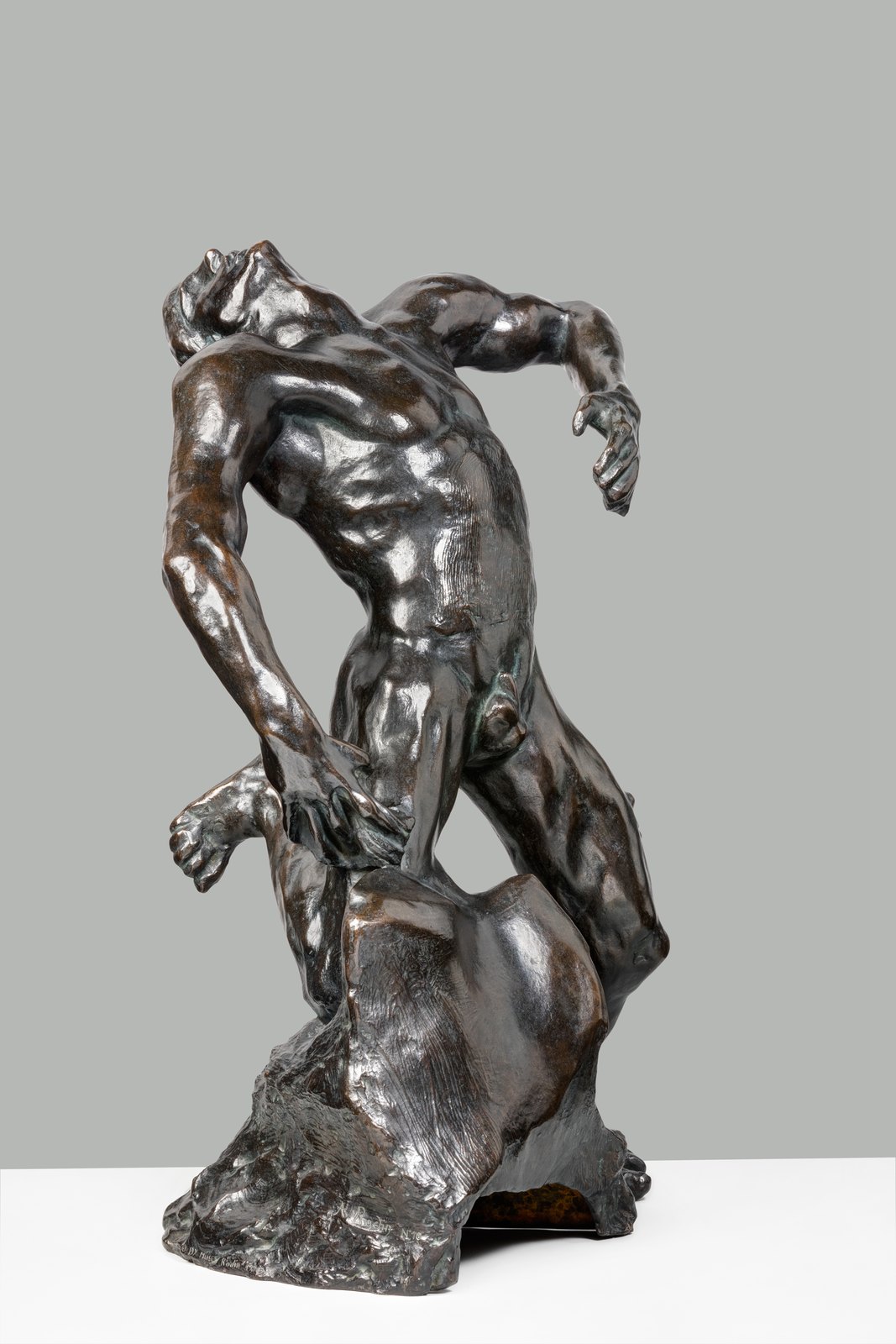
The Museo Soumaya example gives a separate view of the body in descent. Image courtesy of Museo Soumaya, Wikimedia Commons. Image source. CC BY-SA 4.0. Resized for the web.
The marks left by mounting
The Arkın collection records a 1973 cast by Susse, 58.5 centimetres high. Its treatment of the abdomen offers a clue to the figure’s architectural use. The collection identifies the ridges there as traces reproduced from the plaster, and interprets the roughened area as a surface prepared for attaching the figure to the portal. On the independent bronze this area can be inspected alongside the more continuous modelling of the chest and shoulders. The difference preserves something of how the plaster was handled when it was part of a larger object. [2] [8]
The same collection relates a version of this figure to A Man with a Serpent. There both feet reach the ground. In the independent Falling Man, one knee rises, making the body’s relationship to the support markedly uneven. The two solutions give the backward bend different consequences. One puts the strain into a pair of legs reaching roughly the same level, while the other sets the lifted knee against the direction of the torso. [8]
Rodin artworks directory
Discussion
Look again at the images and ideas explored in The Falling Man. These editorial prompts invite your observations.
Reader Insights
After reading “The body and its support”, what detail would you look for in the object or image?
What extra evidence would help you distinguish the artist’s choices from the effects of material, viewpoint or later display?
Join the Conversation
Share a detail, comparison or question about The Falling Man below.
References
- Metropolitan Museum of Art. The Falling Man, 1986.155.2. View source.
- Musée Rodin. L’Homme qui tombe, La Porte de l’Enfer. View source.
- Philadelphia Museum of Art. I Am Beautiful. View source.
- Los Angeles County Museum of Art. The Falling Man, M.73.108.22. View source.
- Musée Rodin. I am Beautiful. View source.
- Leopold Museum. Falling Man. Torso of a Young Man. View source.
- Museo Soumaya. November 2017 collection publication, p. 25. View source.
- Arkın Rodin Collection. The Falling Man, RCG0009.2-04. View source.

 Auguste Rodin.jpg)





