


 by Tom Gurney
Tom Gurney BSc (Hons) is an art history expert with over 20 years experience
Published on June 19, 2020 / Updated on November 18, 2026
Email: tomgurney1@gmail.com / Phone: +44 7429 011000
Brother and Sister
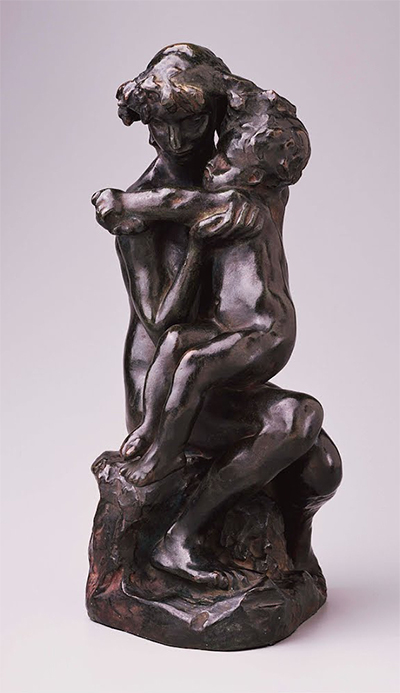
An older girl holds her younger brother against her in Auguste Rodin’s Brother and Sister. He turns his face towards hers, and she lowers her head until their hair almost forms a continuous outline. The compact bronze at The Phillips Collection in Washington, DC, is just over 38 centimetres high. It concentrates the action between the faces, across the arms and down where the feet meet the rough support. The composition is generally dated to about 1890. In this photograph of the Phillips bronze, the figures’ closeness is clear before the details of either face become easy to read. [1] [2]
How the figures fit together
The boy’s arm crosses the front of the group almost horizontally. It forms a short bridge between the rounded forms of the chest and shoulder. The sister’s fingers come into view from below, where they curl around his upper arm. Look first at that hand, then follow her arm downward to see how the narrower part of the limb fits alongside the boy’s body. The gesture is small, but the weight of the boy seems to depend on it. Rodin gives the viewer evidence of how they are holding together without spreading the figures so wide that their heads lose contact. [1] [2]
The girl bends her head downward, and the boy’s head tips in the opposite direction. Their profiles make a narrow interval between them. This gap is easiest to find after following the bright edges of their hair, because the faces are partly in shadow. In the Phillips photograph the taller figure’s downward gaze gives her face a stillness that contrasts with the long upward turn of the boy’s neck. The two have very different postures at that point. The higher line of the sister’s head makes her seem to gather the smaller figure towards her. [1]
The lower bodies make the support more legible. The boy’s lower legs come down together, and his feet are close to the upper edge of the rough base. A much larger foot extends lower down. Follow it back to the sharp bend of the sister’s knee, which widens the group on the side where the boy’s torso curves in. In the photograph, those different levels of feet keep the pair from reading as two figures standing on the same ground. The group is assembled vertically, with the smaller body carried well up into the space of the larger one. A second angle lets the eye check where each leg disappears behind the next form. The toes at the lower level remain sharply visible against the base, giving that foot a firmer visual footing. [1] [2] [3]
A subject drawn from ordinary care
The Phillips Collection connects the sculpture to the subject of maternal care in Rodin’s earlier work. Its account compares the group with his mother-and-child designs of the 1860s and 1870s, in which figured drapery and more pronounced twists reflected his training in the decorative trade. The two siblings here have little around them to occupy our attention. The rough material runs low around the feet, while the backs and shoulders show the difference in the children’s size. The subject becomes clear through the work required to hold someone close. The girl bends and gathers the boy in. He leans into her, with his arm drawn across the narrow front of the sculpture. [1]
The title tells us that the children are siblings. Their relative ages and the way he is supported are visible, while the precise family relationship is supplied by the name. The Musée Rodin notes that the 1916 donation inventory used the title La petite sœur for a cast. That wording leads the eye to the older child and the work she is doing to keep the pair in place. Brother and Sister gives each a place in the title and encourages people to see the child’s movement as well as the girl’s care. The difference is especially apparent in a low view, when the crosswise arm can lead the eye towards the boy before it reaches his sister’s face. [1] [4]
Watch Rodin’s sculpture up close
Five films explore Rodin’s sculpture, from his use of classical models and the figures on his monumental doorway to the work of his studio.
Auguste Rodin – Challenging Beauty
Six sculptures show how Rodin adapted classical models.
Watch on YouTubeThe bronze in Washington and other versions
The Phillips bronze, object 1642, arrived through the estate of Katherine S. Dreier in 1953. The collection describes the composition as widely illustrated around the turn of the century and records examples in plaster and marble as well as multiple casts in bronze. The Metropolitan Museum of Art dates its own bronze to 1890 in the object entry. Its published collection history records a 1908 recommendation to commission a bronze from Rodin, with the model believed to have been finished about 1890 or 1891. Those dates can both be meaningful on the same page. One locates the design in the sculptor’s career, and the other places an individual bronze in the history of a museum collection. [1] [2] [5]
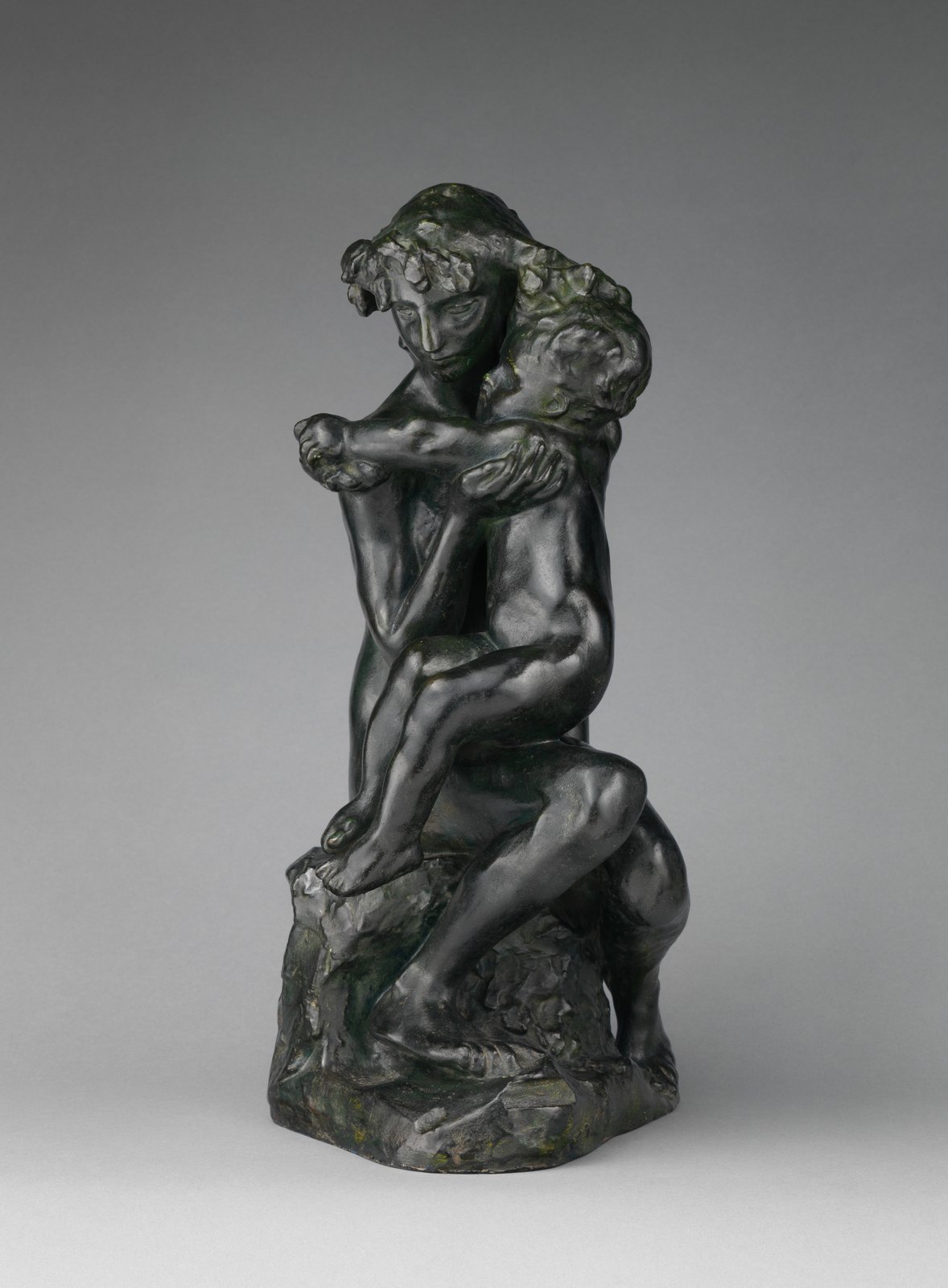
The Met bronze provides a comparison with the Washington version. The Metropolitan Museum of Art, Rogers Fund, 1908, 08.265. Image source. CC0 / Public domain.
The Musée Rodin records a bronze cast by Alexis Rudier in 1922. An internal mark helped the museum connect it with Kōjirō Matsukata. The bronze now in the National Museum of Western Art in Tokyo has its own record, which describes a purchase by Matsukata around 1919 and gives the location of the signature and the foundry mark at the rear of the base. Those two documented histories give a reason to check the marks and the object numbers carefully. A shared collector’s name and foundry can occur in the history of different bronzes, and a photograph from the front can leave the identifying evidence out of view. [3] [4]
A plaster in the Musée Rodin adds a different piece of evidence. The museum records that a fragment of a nude child once had a separate inventory number and was later recognised as belonging to that example. The connection tells us something about the way the group has survived and been catalogued. It also offers a reason to return to the compact arrangement of the finished bronze. The boy forms a distinct volume, apparent in the shoulder, the curve of the side and the feet, yet small points of contact make him read as part of a single balanced group. Look back to the girl’s hand under his arm. Without that contact the upright composition would feel quite different. [1] [6]
The seated figure before the group
The Musée Rodin identifies the older figure with Rodin’s Galatea, which it relates in turn to Camille Claudel’s Young Girl with a Sheaf. Claudel’s terracotta, now in the Musée Rodin, gives the comparison a surviving object. In the independent figure the bent posture gathers attention around the seated girl and her own arms. In Brother and Sister, the arrival of the child gives the inclination of the head and upper body a new direction. Seen together, the works show how a similar posture can express absorption in one sculpture and attention to a second figure in another. [7] [8] [9]
The Jordan Schnitzer Museum of Art has exhibited a marble version dated 1901–04, crediting both Rodin and Claudel in its guide. That is the attribution given there for the marble. The Phillips and Metropolitan catalogues identify Rodin for their bronzes. Keeping the credits attached to the specific objects lets readers follow the relation with Claudel’s work while preserving the information each museum provides for its version. [1] [2] [10]
Rodin artworks directory
Discussion
Look again at the images and ideas explored in Brother and Sister. These editorial prompts invite your observations.
Reader Insights
After reading “How the figures fit together”, what detail would you look for in the object or image?
What extra evidence would help you distinguish the artist’s choices from the effects of material, viewpoint or later display?
Join the Conversation
Share a detail, comparison or question about Brother and Sister below.
References
- The Phillips Collection. Brother and Sister, object 1642. View source.
- Metropolitan Museum of Art. Brother and Sister, object 191081. View source.
- National Museum of Western Art, Tokyo. Brother and Sister, S.1959-0021. View source.
- Musée Rodin. Frère et soeur, bronze S.00975. View source.
- Metropolitan Museum of Art. Rodin at The Metropolitan Museum of Art: A History of the Collection, pp. 15–18. View source.
- Musée Rodin. Frère et soeur, plaster S.02423. View source.
- Musée Rodin. Frère et Soeur, reproduction and composition note. View source.
- Musée Rodin. Camille Claudel. View source.
- Musée Rodin. La Jeune Fille à la gerbe, S.06738. View source.
- Jordan Schnitzer Museum of Art. Auguste Rodin research guide. View source.

 Auguste Rodin.jpg)





