


 by Tom Gurney
Tom Gurney BSc (Hons) is an art history expert with over 20 years experience
Published on June 19, 2020 / Updated on November 18, 2026
Email: tomgurney1@gmail.com / Phone: +44 7429 011000
Bacchantes Embracing
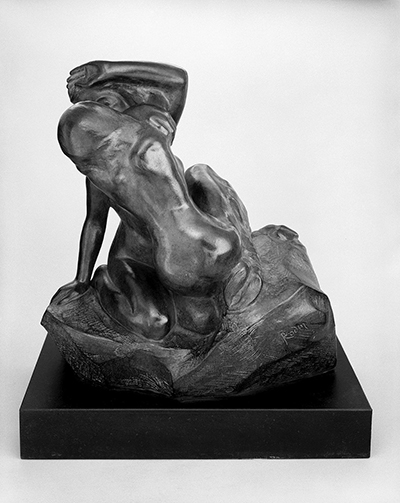
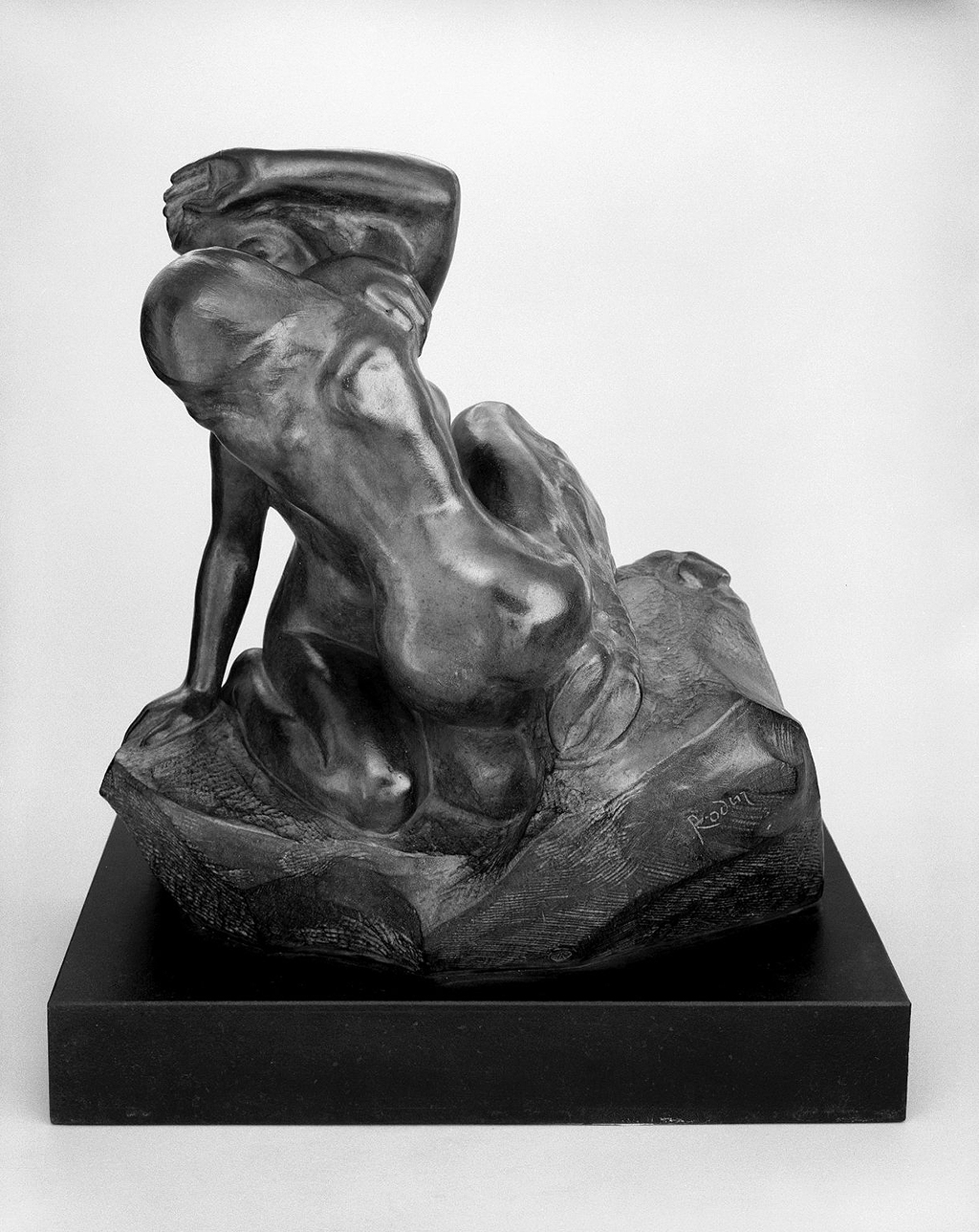
Two women lean into one another above a rough base in Auguste Rodin’s Bacchantes Embracing. From the back, the nearer figure’s spine and shoulder form a long rising curve that ends close to the other woman’s head. A raised forearm hangs above them, and a second arm extends down to the base. These two gestures set the limits of the composition. Between them, the bodies are so close that the movement of one is often easier to understand by tracing the other. The group survives as a small bronze, including examples in Cambridge and Tokyo, and in a larger version represented by a later cast at the Musée Rodin. [1] [2] [3]
How the figures hold their position
Begin with the hand against the base. It is well away from the bulk of the two bodies, and the arm above it gives that side of the sculpture a clear line. Move up from the hand and the line passes behind the broad back of the nearer figure. The support is easy to see in a view that makes the arm stand out against the background. A slight turn makes parts of the limb disappear behind a shoulder or torso. This is one reason a rear or oblique photograph can show more of the construction of the group than a view chosen for the faces. [1] [2] [3]
At the top of the group, a bent forearm crosses the head. One can trace it across the light before losing it among the clustered forms below. The position of the arm makes a strong top edge, with little space between it and the bodies. Compare that part with the arm extending down to the base. At this point the forearm also partly hides the nearer face. The inclination of the heads is consequently easier to judge by following the meeting of the shoulders and necks. From behind, that meeting reads as a turn through the whole upper body. The upper arm folds back into the group. The lower one reaches away from its centre. Their directions give the embrace enough breadth to read from a distance. The figures retain a compact outline even though the arm at the bottom makes a small opening alongside the body. [1] [2] [3]
The uneven base is an important part of this arrangement. Its raised areas interrupt the line of the thighs, and the lower parts of the figures appear to sink into or press against it. The upper back presents a much smoother passage of modelling. Where a photograph catches light on it, the eye can travel from shoulder to waist in one movement. The rougher base repeatedly breaks that movement into shorter lines. An oblique view lets us see both finishes from the same distance and judge how much of the sense of pressure comes from the transition between them. The contact of the hand with the support becomes easier to locate against those changes in texture. [1] [2] [3]
Watch Rodin’s sculpture up close
Five films explore Rodin’s sculpture, from his use of classical models and the figures on his monumental doorway to the work of his studio.
Auguste Rodin – Challenging Beauty
Six sculptures show how Rodin adapted classical models.
Watch on YouTubeA classical title and a place on the portal
Bacchantes, also known as maenads, were the female followers of Dionysus, or Bacchus. Classical art often shows them in motion. A Roman marble relief at the Metropolitan Museum of Art, for example, gives a dancing maenad’s movement much of its force through the folds of her clothing. The fabric runs close to the body in one place and flies away from it in another. Rodin’s title gives his group a connection with that tradition. Here the physical relation between two bodies carries much of the movement. Their legs stay close to the ground, and the positions of the two arms make the turn of the upper figures unusually easy to follow. [1] [2] [4]
The Fitzwilliam Museum dates the invention of the group to before 1887 and says Rodin added it to the reliefs in the lower part of The Gates of Hell. That monumental doorway places figures against one another and against a larger architecture. A bronze displayed by itself lets the viewer walk around the forms that the relief would hold within a larger field. The back and the low point where a hand bears against the ground become available on their own. The life of the composition as an independent object also makes room for the title about the women’s embrace to shape how a viewer approaches it. [2] [5]
The Tokyo museum’s provenance preserves a different set of words. It records the sale through Léonce Bénédite to Kōjirō Matsukata around February 1919 under Trois danseuses, with Damnées added in pencil. The record illustrates how a transaction could use a name different from the one attached to the work today. The group has two figures under its current title, and the earlier entry belongs to the documented history of the bronze. The association with the damned makes sense in the context of the doorway, while the present title gives greater weight to what the two women are doing. [1] [2] [5]
Three bronzes, three records
The Fitzwilliam Museum dates its bronze to about 1899 and names Léon Perzinka as founder. The record gives the sculptor’s signature at the rear outer edge and Perzinka’s mark near the front corner of the base. The Tokyo museum identifies an Alexis Rudier mark on its bronze and a Rodin signature at the right front. It records the work’s transfer to the Japanese government and its entry into the museum in 1959. The catalogue date for the work and the date that bronze arrived in the collection describe different stages in its history. [1] [2]
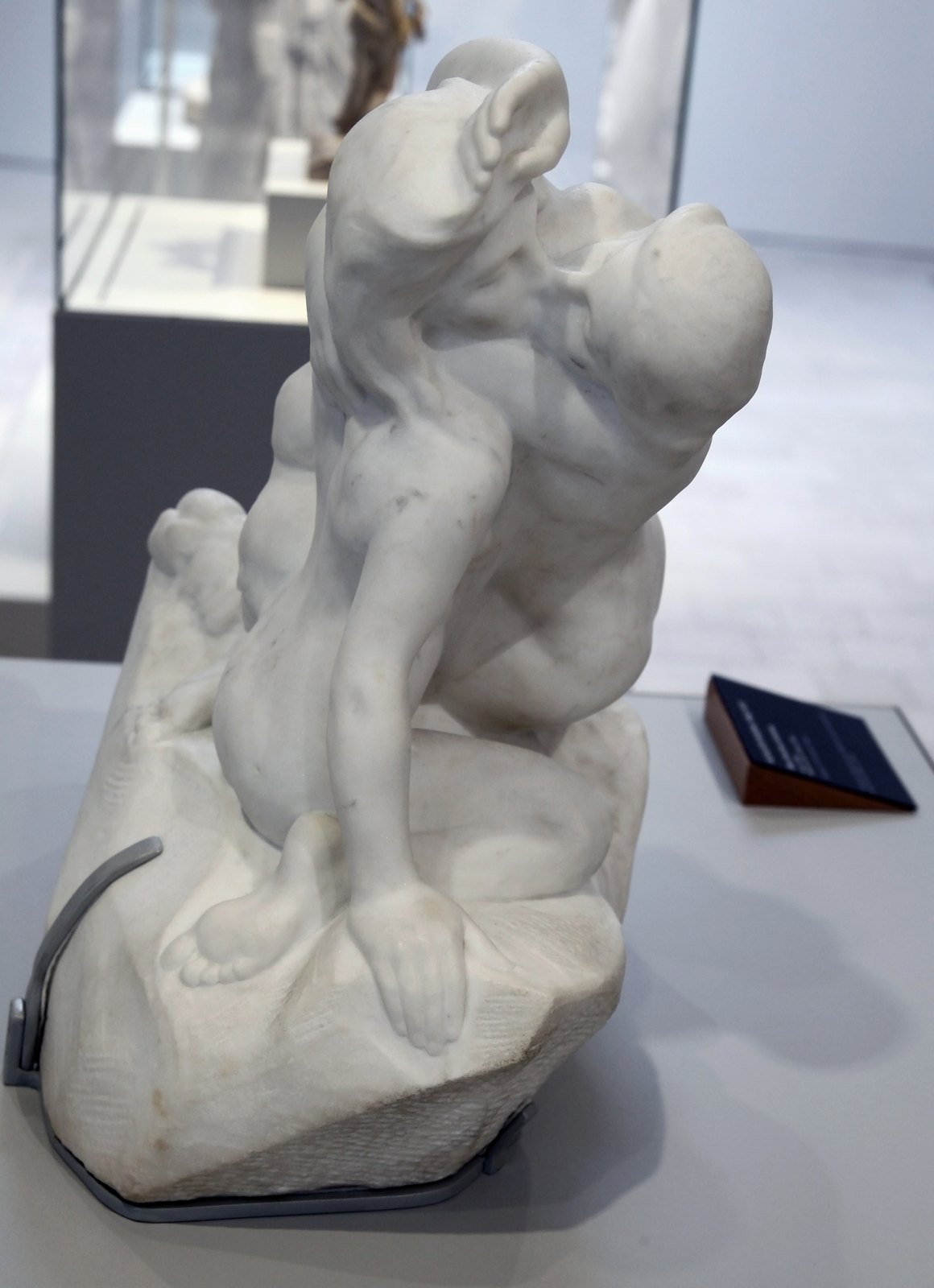
The marble exhibited at the Musée Camille Claudel provides a comparison in stone for the bronze versions. Photograph by Vassil, Wikimedia Commons. Image source. CC0 / Public domain. Resized for the web.
The Musée Rodin lists its large-model bronze at almost 39 centimetres high and records that Alexis Rudier cast it in 1927 for the museum. The bronze in Tokyo stands 18 centimetres high. The difference affects what the viewer can see at a given distance. At the scale of the larger bronze it is easier to linger over the transitions at the shoulder and the edges of the supporting rock. The smaller design holds the same problem within a span short enough for the relation between the raised arm and the bracing hand to register together. In reproductions the displayed size can obscure that difference, so the object dimensions and the position of the marks are worth checking alongside the image. [1] [2] [3]
A plaster in Monet’s collection
The Musée Marmottan Monet documented a small plaster of the group that belonged to Claude Monet, with a dedication from Rodin addressing the painter as a master. Its exhibition materials also record another example that belonged to Georges Clemenceau. Monet’s plaster measures just 18 centimetres in height, close to the scale of the Tokyo bronze. A plaster at that size could move between artists and collectors as a personal object, carrying an inscription particular to the recipient. The Tokyo bronze carries its own provenance. Placing these objects alongside one another gives a sense of how the same tangle of limbs could travel as a small sculpture in several materials, while its base and inscriptions preserved details of individual ownership. [1] [6]
Rodin artworks directory
Discussion
Look again at the images and ideas explored in Bacchantes Embracing. These editorial prompts invite your observations.
Reader Insights
After reading “How the figures hold their position”, what detail would you look for in the object or image?
What extra evidence would help you distinguish the artist’s choices from the effects of material, viewpoint or later display?
Join the Conversation
Share a detail, comparison or question about Bacchantes Embracing below.
References
- National Museum of Western Art, Tokyo. Embracing Bacchantes, S.1959-0003. View source.
- The Fitzwilliam Museum. Deux Bacchantes s’enlaçant, M.2-1966. View source.
- Musée Rodin. Bacchantes s’enlaçant, large model S.01122. View source.
- Metropolitan Museum of Art. Marble relief with a dancing maenad. View source.
- Musée Rodin, Meudon. The Gates of Hell. View source.
- Musée Marmottan Monet. Monet collectionneur, exhibition dossier. View source.

 Auguste Rodin.jpg)





