


 by Tom Gurney
Tom Gurney BSc (Hons) is an art history expert with over 20 years experience
Published on June 19, 2020 / Updated on November 18, 2026
Email: tomgurney1@gmail.com / Phone: +44 7429 011000
La France
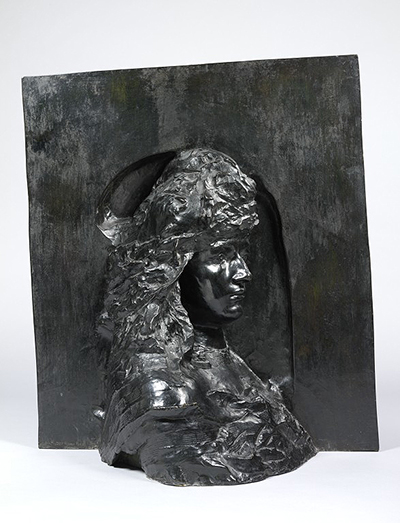
In Auguste Rodin’s La France, a helmeted figure turns her face within an arched recess. The head and shoulders project from the flat bronze panel, with the nearer shoulder coming far enough forward to carry a broad reflection. The face is modelled more smoothly than the helmet and armour around it. The legacy photograph matches the Victoria and Albert Museum’s bronze high relief A.39-1914. Its form developed from a portrait associated with Camille Claudel, and versions of the design have been identified as a Byzantine princess, Saint George and a personification of France. [1] [2] [3]
The face inside the arch
The curve of the arch is clearest just above the helmet. It continues down behind the face, where darkness makes a narrow interval between the nose and the upright edge. On the other side the helmet overlaps much of the arch. This gives the head the appearance of having turned within the recess. The top edge of the panel remains straight above it, establishing a boundary that belongs to the whole object instead of to the figure. The perspective of the photograph makes that edge rise towards the right. The arch and the face are visible within that slight angle, creating a frame that changes as the observer moves. [1] [4]
The face catches light at the forehead, nose and lips. The surfaces between them turn gradually into shadow, especially near the eye and beneath the cheek. The helmet collects light in a much more broken way. Bright marks describe ridges that cross one another and then spread down one side of the head. The Musée des Beaux-Arts de Dijon draws attention to the difference between these treatments in its own relief. The fine planes of the face remain distinct, even though the lighter patches on the helmet take up more space. They become easier to pick out as the viewer follows the sharper edge of the nose. [1] [3] [4]
Around the shoulders, the projection of the armour gives the bust greater depth. A bright oval on the nearer shoulder stands out against the vertical panel. The chest below turns away from that reflection and the modelling divides into broad planes with small marks between them. At floor or table level, the forward edge of the bust reaches beyond the panel. This helps to explain how the work can be described both as a bust and as a high relief. The figure has substantial volume, while the recess fixes the background from which it emerges. [1] [4]
The dark panel also has marks of its own. At the left, light catches a broad patch interrupted by streaks running down from the top edge. Those marks remain shallow beside the densely worked surface of the helmet. The panel frames the profile while leaving the deepest shadows at the point where the head passes in front of the arch. [1] [4]
From Camille Claudel to a public figure
The V&A traces the face to Rodin’s portraits of Camille Claudel. It notes that features of another sitter, Mariana Russell, entered the design as it evolved. A photograph of the work in progress by Jacques-Ernest Bulloz in 1903 is evidence for the use of a cast of Claudel’s face in developing the final form. The helmet and armour change the way the likeness presents itself. A head based on a specific person can suggest a public or historical figure when these additional forms are placed around it. In the relief they also change the scale of the outlines, enlarging the head on one side and giving the shoulders a more substantial profile. [1] [3] [5]
The Musée Camille Claudel dates its bronze study to around 1902–03 and places it before the high relief. It records titles including Byzantine Princess and Empress of the Late Roman Empire. The names show the importance that costume acquired as the bust developed. The helmet gave the portrait a historical character even when it was taken away from the plaster or bronze panel. In the relief the arch adds a further suggestion of architecture. It makes the bust seem to occupy a distinct place with its own background, even though the photograph shows little more than the panel itself. [1] [2]
Watch Rodin’s sculpture up close
Five films explore Rodin’s sculpture, from his use of classical models and the figures on his monumental doorway to the work of his studio.
Auguste Rodin – Challenging Beauty
Six sculptures show how Rodin adapted classical models.
Watch on YouTubeSaint George and La France
The V&A identifies an earlier relief at Glasgow with the title Saint George. It records that Rodin gave the work to Glasgow University when he received an honorary degree in 1906. The museum distinguishes that orientation from the later reversed version. Right and left can be confusing in descriptions of these casts. In the legacy view the head looks towards the right edge of the photograph, which is the direction of the figure’s own left. The V&A record describes the earlier face as looking to its own right. The two orientations are part of the sculpture’s history and provide a way to tell related reliefs apart. [1] [3] [4]
The V&A and Dijon connect the head under the name La France with the monument to Samuel Champlain at Crown Point in New York, unveiled in 1912. The addition was France’s contribution to the commemoration. A head associated at different times with a ruler and a saint could thus refer to France in an international setting. Rodin presented the separate high relief to the V&A in 1914, when the work carried the same title. These two objects had different functions, one as part of a monument and the other as a sculpture with an architectural surround of its own. [1] [3]
Busts and related bronzes
The National Gallery of Art in Washington records a bronze La France dated 1904. The Simpsons purchased it from Rodin in 1906 and it entered the gallery in 1942. Its exhibition history gives another title, La Minerve, for its showing in Boston in 1908. Philadelphia holds a bronze Study for La France, modelled in 1904 and cast in 1926. These records show that the name applies across objects with different dates, dimensions and settings. The arched panel, the direction in which the head turns, and the pattern of light on the nearer shoulder match the published view of the V&A relief. Those features make it possible to assign the pictured object to that collection while following the histories of the other bronzes separately. [1] [4] [6] [7]
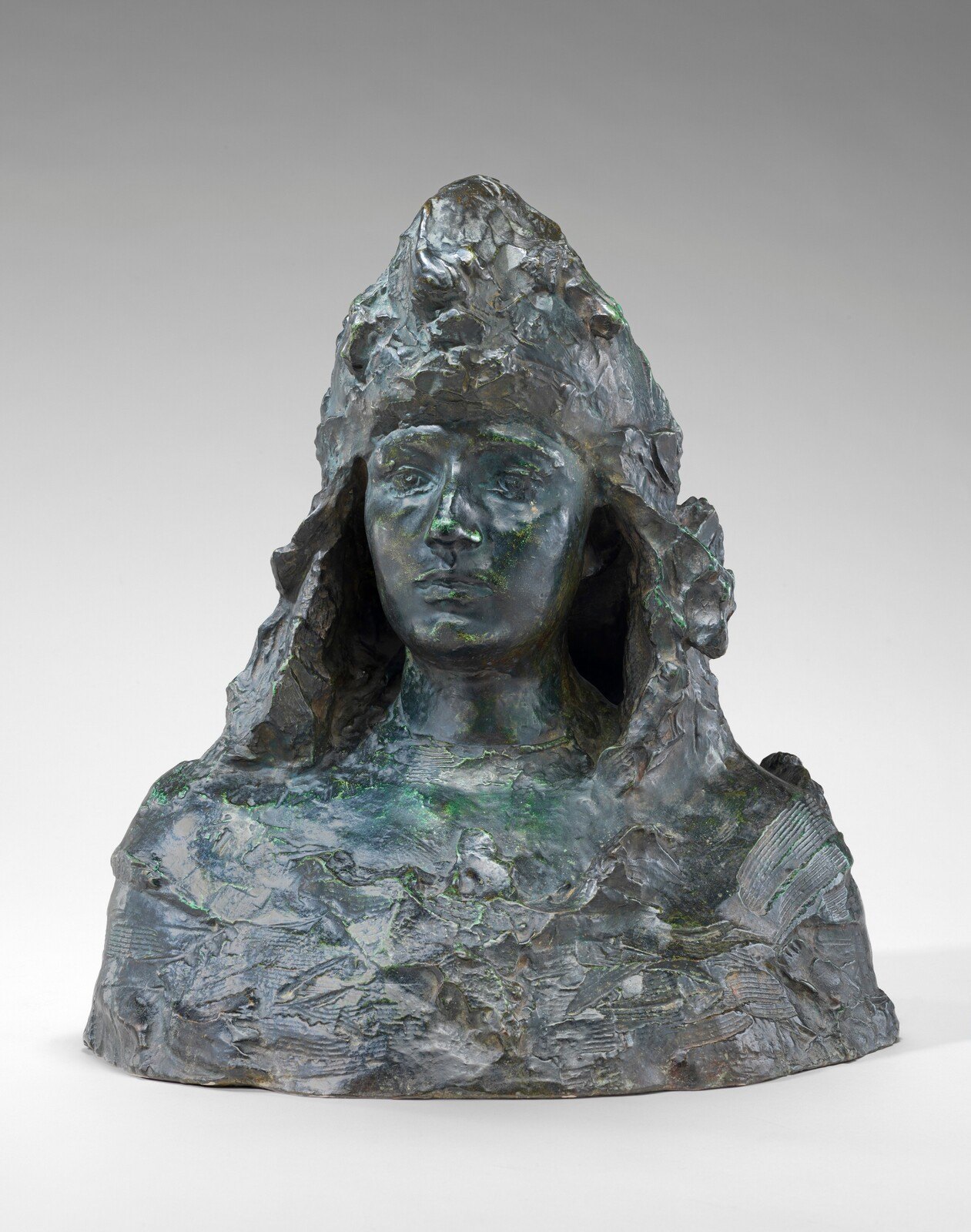
The National Gallery of Art’s La France gives a separate collection example of the bust. National Gallery of Art, Washington, Gift of Mrs. John W. Simpson, 1942.5.9. Image source. CC0 / Public domain.
A bust on the Champlain memorial
The Musée Camille Claudel traces an enlarged version of the bust to a gift from the French state to the United States for the memorial to Samuel de Champlain at Crown Point, New York. The memorial is also a lighthouse overlooking Lake Champlain. The state’s guide locates it in a landscape that preserves traces of the French and British occupation of the peninsula. In a gallery, the helmet and face can be examined as an independent sculpture. At Crown Point the bronze also belongs to a larger commemorative structure whose position connects it to the history of the lake. [2] [8]
The Washington bronze has a separate exhibition history. The National Gallery of Art records that it was shown in Boston in 1908 as La Minerve, identified there as a portrait of Mlle. Claudel. That label predates the title La France recorded for 1912 by the Musée Camille Claudel. The Boston entry kept the sitter’s name visible alongside a mythological title. At Crown Point, the association with France gives the bust a public role within a memorial to a named explorer. The records show how a title and a setting can carry distinct parts of the same design’s history. [2] [6] [8]
Rodin artworks directory
Discussion
Look again at the images and ideas explored in La France. These editorial prompts invite your observations.
Reader Insights
After reading “The face inside the arch”, what detail would you look for in the object or image?
What extra evidence would help you distinguish the artist’s choices from the effects of material, viewpoint or later display?
Join the Conversation
Share a detail, comparison or question about La France below.
References
- Victoria and Albert Museum. La France, A.39-1914, collection record. View source.
- Musée Camille Claudel. La France, 2010.1.29. View source.
- Musée des Beaux-Arts de Dijon. La France ou Saint-Georges. View source.
- Victoria and Albert Museum. La France, collection image 2006AX9990. View source.
- Musée Rodin. Camille Claudel. View source.
- National Gallery of Art. La France, 1942.5.9. View source.
- Philadelphia Museum of Art. Study for La France. View source.
- New York State Parks. Crown Point walking guide. View source.

 Auguste Rodin.jpg)





