


 by Tom Gurney
Tom Gurney BSc (Hons) is an art history expert with over 20 years experience
Published on June 19, 2020 / Updated on November 18, 2026
Email: tomgurney1@gmail.com / Phone: +44 7429 011000
Drawings
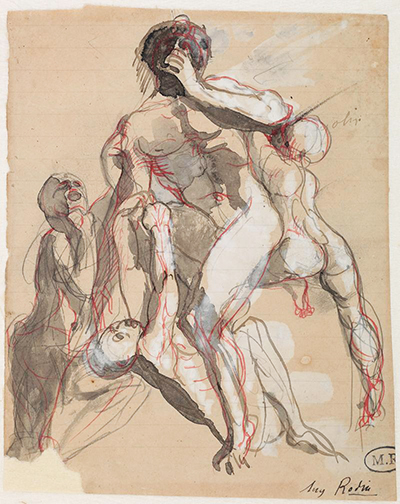
At the Musée Rodin there is a drawing of Ugolino surrounded by three children. Dark ink gathers around the adult’s face as he raises a hand towards it. On the back of the sheet is another composition, with a rider among four figures. In a later study of a Cambodian dancer, a comparatively open sheet gives a line at the wrist room to carry much of the movement. Between those works lies a change in what drawing could do for Auguste Rodin. The ink can give a scene weight and darkness. A little graphite and watercolour can describe the direction in which a body is turning. The papers are worth looking at for the things they make possible in their own right. [1] [2] [3]
Drawing in the dark
The Musée Rodin groups many of the sheets made around the years of The Gates of Hell under the name dessins noirs, or black drawings. Dante supplied a number of their subjects. Rodin could follow individual episodes on paper while developing the portal, and the drawings gave him room to explore scenes with a different distribution of bodies and shadows. The Ugolino drawing, D.07627, is dated to about 1880. Graphite, brown and red inks and touches of gouache bear down on a small sheet measuring about seventeen and a half centimetres high. The catalogue records the name Ugolino near the top and a signature near the bottom. [1] [2]
Compare that drawing with Rodin’s sculptural group. In the sculpture the count crawls among the bodies of the children. The viewer follows the weight of the figure close to the ground. The drawing brings the children around a more upright man and directs attention towards his face, where the hand interrupts the view. Ink can gather several forms into a single shadow or leave an isolated line easy to see. A sculpture must organise the corresponding pressures through solid bodies and the spaces between them. The two approaches belong to Rodin’s sustained interest in the same narrative. Each can make a different stage of the story occupy the viewer’s attention. [2] [4]
Even within the dark drawings, the materials can vary. The Musée Rodin’s entry for Ombres enlacées identifies tracing paper and lists the facsimile publication of Rodin drawings associated with Octave Mirbeau and the Maison Goupil among its references. Thin paper could be a working surface for carrying a contour from one place to another. Reproduction could subsequently take the image to someone who had never handled the sheet. These are two distinct moments in the life of a drawing. One concerns how Rodin could make changes to a line. The other concerns what a reader might encounter on a printed page. [5]
Selected drawings
Following a moving body
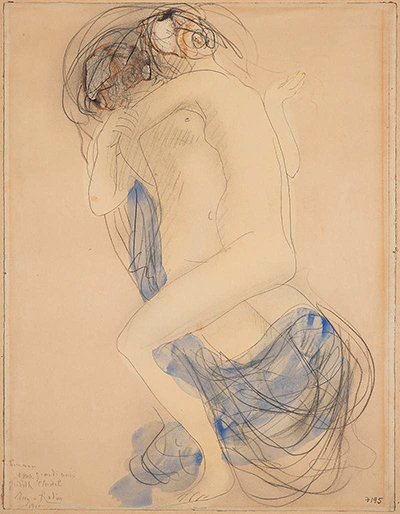
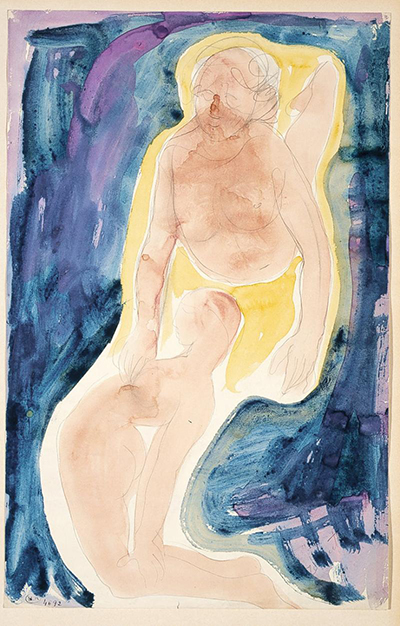
The museum describes a shift around 1890 towards drawings made from moving models. A line can follow the outside of a figure for a short distance and then disappear where Rodin’s eye moves to another part. Where there are several marks along one edge, the drawing may show the trace of a correction or more than one impression of a pose. Thin watercolour can give a group of lines a shared area of colour without deciding exactly which line is the edge of the body. A closer view lets you see the pencil and the wash doing different things. [1] [6]
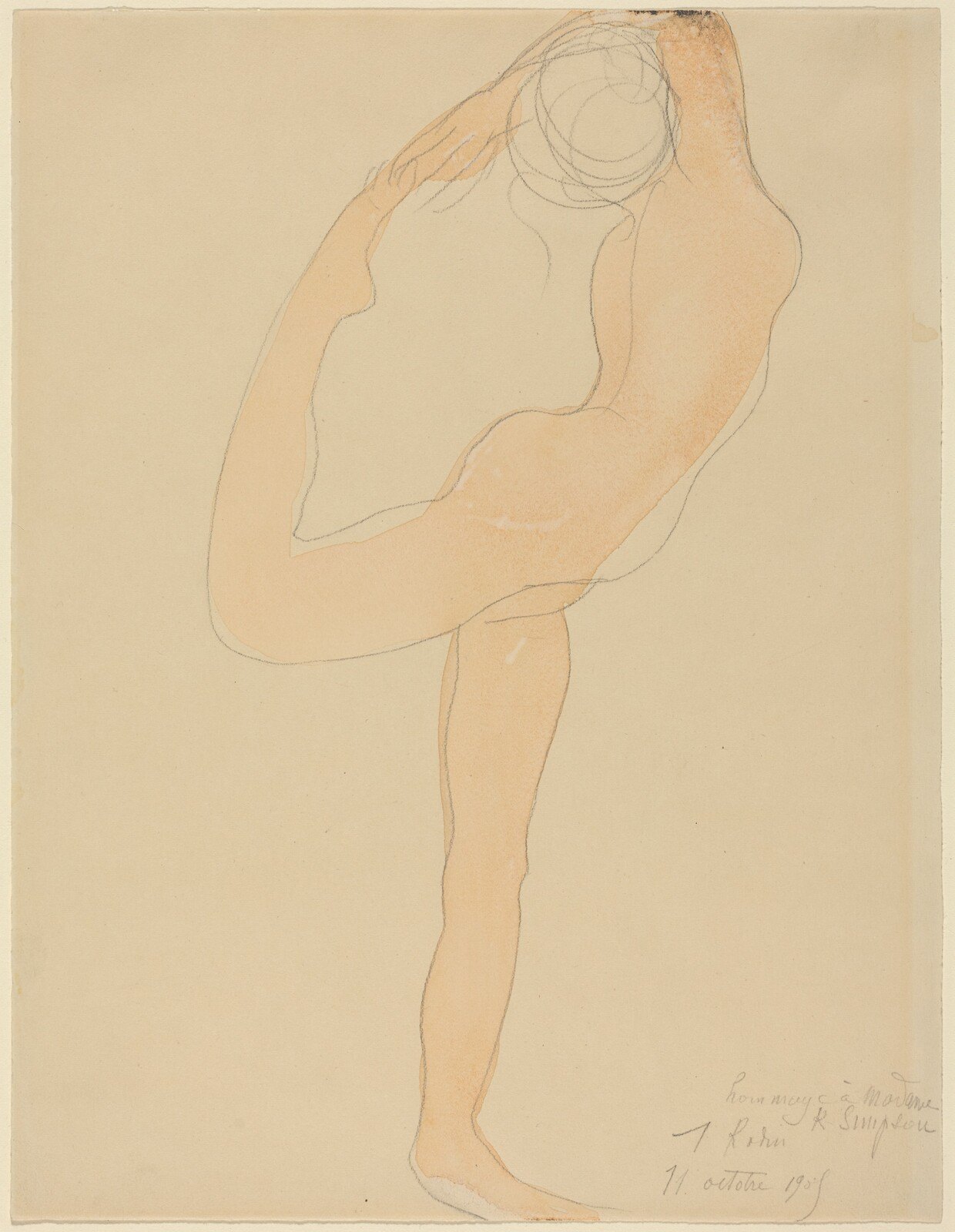
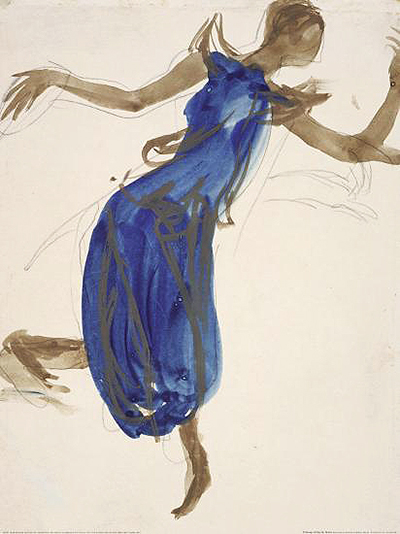
Rodin dedicated this 1905 study to Kate Simpson. Wash fills the form without covering the graphite outline. National Gallery of Art, Washington, Gift of Mrs. John W. Simpson, 1942.5.36. Image source. CC0 / Public domain.
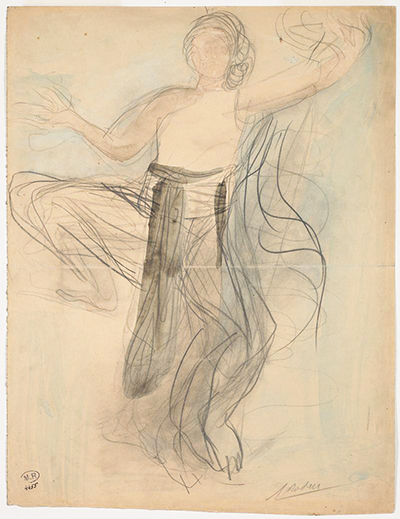
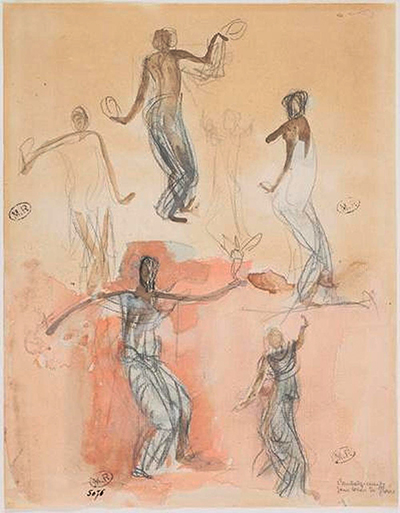
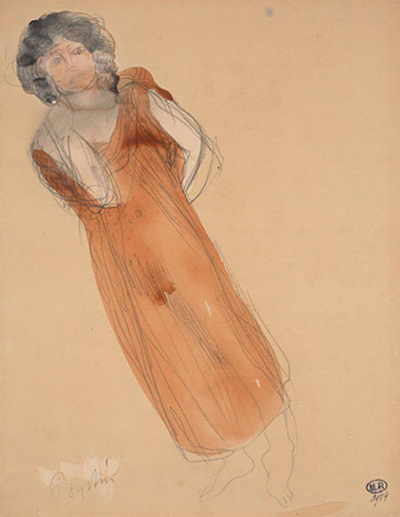
The Cambodian dancer drawings make those choices especially apparent. The Royal Ballet of Cambodia travelled to France in 1906 during the visit of King Sisowath. Rodin saw the troupe in Paris and followed it to Marseille. The hands and arms attracted particular attention. On a single frontal study the smallest marks can establish the direction of a gesture. On a sheet with several dancers the eye has more opportunities to compare changes in reach and posture. These are choices made by a particular observer during a brief encounter with a highly developed dance practice. The Cambodian dancers overview follows the visit and the sheets in their own context. [3] [7] [8]
Tracing, cutting and combining
Looking at a figure could continue after the first drawing was made. In its exhibition Dessiner, découper, the Musée Rodin followed the stages by which Rodin traced outlines, selected lines, applied colour and moved shapes about on new supports. Sometimes he cut around a figure so that he could try it in another position. The resulting figure could keep a recognisable pose while acquiring completely different surroundings. These methods give the paper its own means of assembly. Two bodies traced from earlier drawings could be brought close enough to touch, or separated so that the empty shape between them took on greater importance. [6]
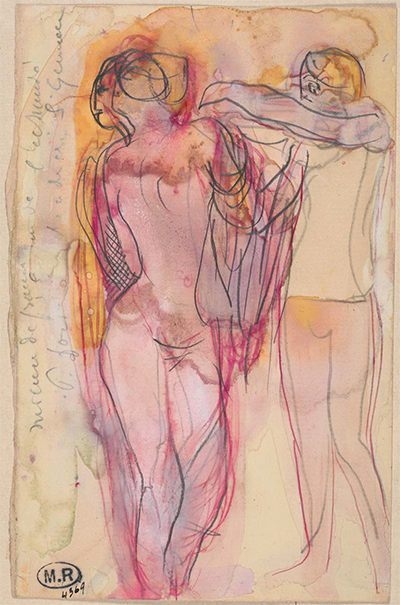
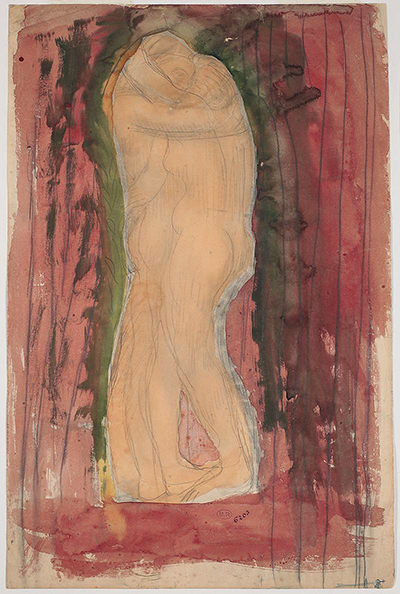
In Standing Embracing Couple, Profile View, the museum traces the outline to a related drawing now in Weimar. In the later sheet the figures occupy a field broken by vertical strokes. That change in setting affects where the pair seems to stand and what the colours around them are doing. The story of the line is easy to miss if each version is considered by itself. When the sheets are compared, the persistence of an outline makes the changes in atmosphere easier to see. Rodin could carry a part of the drawing forward and make it do different work in the new arrangement. [9]
A Mouvement de danse in the Musée Rodin makes a useful comparison with the dancers’ sheets. Its title identifies a hand and a foot meeting behind the head. Watercolour and blue pencil accompany that compact silhouette, which is quite different from the upright balance of a frontal dancer. Side by side, the drawings show the range of poses Rodin could describe with a short run of line. [10]
Comparing sheets in a collection
A drawing’s title often tells you only the pose or the number of figures. It is worth paying attention to the size, medium and inventory number before making a comparison. Keep track of which side of the paper is shown. The rider on the reverse of the Ugolino drawing occupies the same physical sheet as the prisoners. Another drawing of a similarly posed person could have been traced or made afresh, or be attributed differently by its owning museum. Those particulars can change the way two related images fit together. They can also tell you something valuable that their subject alone could never give you: how the paper was used and what the artist kept available for further work. [1] [2] [6] [9]
Watch Rodin’s sculpture up close
Five films explore Rodin’s sculpture, from his use of classical models and the figures on his monumental doorway to the work of his studio.
Auguste Rodin – Challenging Beauty
Six sculptures show how Rodin adapted classical models.
Watch on YouTubeWhen an apparent pencil line is printed
The Met’s The Embrace shows how much a drawing could change after the first sketch from life. The museum describes Rodin’s practice of tracing or copying a composition onto another sheet, applying washes and returning to parts of the line with graphite. In this example, yellow and blue watercolor mixed with gouache meet energetic graphite strokes. The color and the strengthened line belong to successive decisions about how to present the couple. The trace could therefore be the beginning of another drawing, with its own balance of contour and tone. [11]
Other sheets repeat a composition by a different means. The Met’s paper conservators examined what had been catalogued as a drawing of two figures. Under a microscope the lines proved to be printed. The museum now catalogues it as a lithograph by Auguste Clot after Rodin, and identifies the drawing behind the print in the Musée Rodin. The Met also records a hand-drawn copy made from a reproduction in the November 1900 issue of La Plume. These cases document two different ways Rodin’s lines reached another sheet. One depended on a lithographer’s ability to imitate the marks of a drawing. The other depended on someone copying a published image in ink. Under examination, the surface and the publication record give the resemblance a history. [12]
When drawing became an exhibition in its own right
In 1903 Rodin exhibited nearly three hundred drawings at the eighth Berlin Secession. The Musée Rodin traces this exhibition to a change in his working life in the late 1890s, when drawing had become a daily practice. The number of sheets matters. One study in a display of sculpture can make drawing look like a preparatory step toward another medium. A roomful of drawings asks the eye to compare marks on paper across many poses. Viewers can see an arm described by a continuous line in one sheet and follow a broken contour across the next. The drawn figure can sustain attention through the handling of the line and wash alone. [13]
The Musée Rodin used the scale of Berlin as a point of reference for its own exhibition La saisie du modèle, which brought together three hundred drawings from 1890 to 1917. The museum described a tension that becomes apparent across the late work. A line can register the immediate turn of a body and also pull away from the colour that seems to fill it. Look first for the foot bearing the figure’s weight, then for the edge of a patch of pigment. A wash can end before the pencil ends, or run across the line at the hip. Such discrepancies show how looking at the movement and deciding what to do with the surface could become separate tasks. [13]
When a picture resembles the original closely enough to mislead
The Met’s investigation of suspect drawings traced one sheet formerly associated with Rodin’s Spring to an actual drypoint of that subject. The museum now identifies the sheet as a forgery by Ernest Durig. The direction of the relationship matters. A sketch made in preparation for the print could show Rodin working through a pose before committing it to the plate. Durig’s drawing instead borrows a subject already published by Rodin. The existence of a genuine counterpart is thus a reason to examine the purported study more closely. It is possible to borrow a motif while losing the organisation of space, proportion and weight that makes it legible. [14]
Another Met sheet was copied from a reproduction in the November 1900 issue of La Plume. The museum compares the two side by side. Its account identifies departures in the copy that become clearer when the printed source is alongside it. The evidence here is more specific than an opinion about whether a drawing looks fluid enough to be Rodin. The dated reproduction supplies a plausible intermediate object and lets you see which contours the copyist followed. It also explains how a work can be connected with Rodin’s designs without having been drawn by Rodin. [14]
Rodin’s collaboration with the lithographer Auguste Clot presents a different problem. Clot’s illustrations for Octave Mirbeau’s Le Jardin des supplices imitate the look of pencil and watercolour with sufficient precision that a print was once taken for a drawing in the Met’s collection. A printed line may retain the appearance of a searching pencil stroke. The title of the book, the print process and the roles the collaborators played establish a different history for the object than its apparent medium might suggest. When a drawing is reproduced in a book or appears in the collection catalogue, the medium field is as useful as the title. [14]
The drawings that readers encountered as an album
In 1897 the collector Maurice Fenaille financed an edition of 125 numbered copies of Les dessins d’Auguste Rodin, also known as the Goupil or Fenaille album. Octave Mirbeau wrote the preface. The Musée Rodin describes about 142 facsimiles made by photogravure, primarily from wash drawings inspired by Dante. Fenaille already owned some of the sheets. The album gave them a second existence as pages in a sequence. A reader could turn between images that originally belonged to different sheets or owners, while the collector could keep or lend the originals separately. [15]
That distinction is useful when reading images associated with The Gates of Hell. The original sheet can supply information about ink, paper, an inscription or what appears on the reverse. A photogravure supplies evidence about which composition was reproduced and how it was presented to readers in 1897. The album is therefore part of Rodin’s history as a draughtsman even though its pages are prints. It preceded the nearly three hundred drawings exhibited in Berlin. One format put Rodin’s work before readers through an edition; the other presented it to visitors through an exhibition. [13] [15]
Rodin artworks directory
Discussion
Look again at the images and ideas explored in Drawings. These editorial prompts invite your observations.
Reader Insights
After reading “Drawing in the dark”, what detail would you look for in the object or image?
What extra evidence would help you distinguish the artist’s choices from the effects of material, viewpoint or later display?
Join the Conversation
Share a detail, comparison or question about Drawings below.
References
- Musée Rodin. Dessins. View source.
- Musée Rodin. Ugolin entouré de trois enfants, D.07627. View source.
- Musée Rodin. Danseuse cambodgienne de face, D.04437. View source.
- Musée Rodin. Ugolin et ses enfants. View source.
- Musée Rodin. Ombres enlacées. View source.
- Musée Rodin. Dessiner, découper. View source.
- Musée Rodin. Rodin and the Cambodian Dancers. View source.
- UNESCO. Royal Ballet of Cambodia. View source.
- Musée Rodin. Couple enlacé debout, de profil. View source.
- Musée Rodin. Mouvement de danse, un pied et une main joints derrière la tête. View source.
- Metropolitan Museum of Art. The Embrace, 10.66.6. View source.
- Ashley E. Dunn, Metropolitan Museum of Art. Not Rodin: Misattributed Drawings in The Met Collection. View source.
- Musée Rodin. La saisie du modèle: Rodin, 300 dessins 1890–1917. View source.
- Ashley E. Dunn, Metropolitan Museum of Art. Not Rodin: Misattributed Drawings in The Met Collection. View source.
- Musée Rodin. Mécènes, commanditaires et collectionneurs de Rodin, Maurice Fenaille and the 1897 album. View source.

 Auguste Rodin.jpg)





