


 by Tom Gurney
Tom Gurney BSc (Hons) is an art history expert with over 20 years experience
Published on June 19, 2020 / Updated on November 18, 2026
Email: tomgurney1@gmail.com / Phone: +44 7429 011000
Psyche
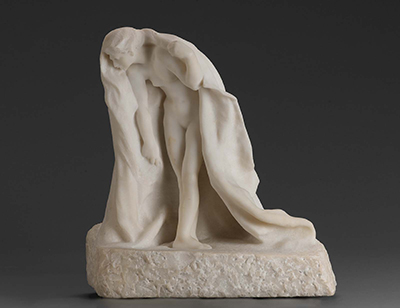
A woman bows her head and peers into the space beside her in Auguste Rodin’s Psyche. A great sweep of fabric opens around her, exposing a leg and much of her torso before meeting the stone at her feet. The marble, made in 1899, belongs to the Museum of Fine Arts, Boston. It evokes the moment when Psyche steals a look at Cupid while he sleeps. The viewer follows the direction of her head and the folds below it, while the sleeping figure remains outside the composition. The size and shape of the fabric suggest how quietly she has drawn near and how suddenly she could move. [1] [2]
The figure inside the folds
The silhouette rises on the left in an almost continuous stretch of marble from the base to the head. From there the shape curves over the back and descends in a wider sweep on the right. The two sides of the fabric meet the base at different distances from the figure. The shorter drop on the left stays close to the downturned face, while the longer one spreads out to the right, leaving pale ridges along the upper edges of the folds. This extension gives the sculpture its width, even though the bent figure occupies a relatively narrow band through its centre. [1] [2]
The photograph makes one leg easy to follow all the way to the foot. Light falls along its shin and the top of the foot, while the deeper space behind it is shaded by the fabric. Above it a hanging arm and the curve at the shoulder establish a different line of movement. The arm reaches partway down and stops, and the leg continues to the base. The difference gives the viewer a sense of bodily weight beneath the much broader gesture of the cloth. At the foot, the boundary between the figure and the top of the block is thin and quite distinct. [1] [2]
The base presents an irregular face beneath a comparatively even upper surface. The brighter points on its front sit close together, making its texture visible from farther away than the small changes in the figure’s face. The folds mediate between those surfaces. Some have a smooth, broad slope that takes the light like the shin, while others lie deeply enough in shadow to look almost detached. Where the edge on the right turns along the base, it looks as if a length of heavy fabric has settled after being drawn back. The hand and head emerge farther above, where the same stone takes much finer curves. [1] [2] [3]
Psyche’s secret glimpse
Psyche’s story gives the lowered head a reason for being there. Cupid visits her without letting her see him. She brings a lamp to look at him while he is asleep, and a drop of hot oil wakes him. The visit that had depended on darkness becomes a moment of exposure and separation. In the Boston marble the bowed head and the body bending beneath the cloth concentrate attention on the approach. The subject can be read from the way Psyche inclines into the space in front of her, while the area she looks towards remains available to the viewer’s imagination. [1] [4]
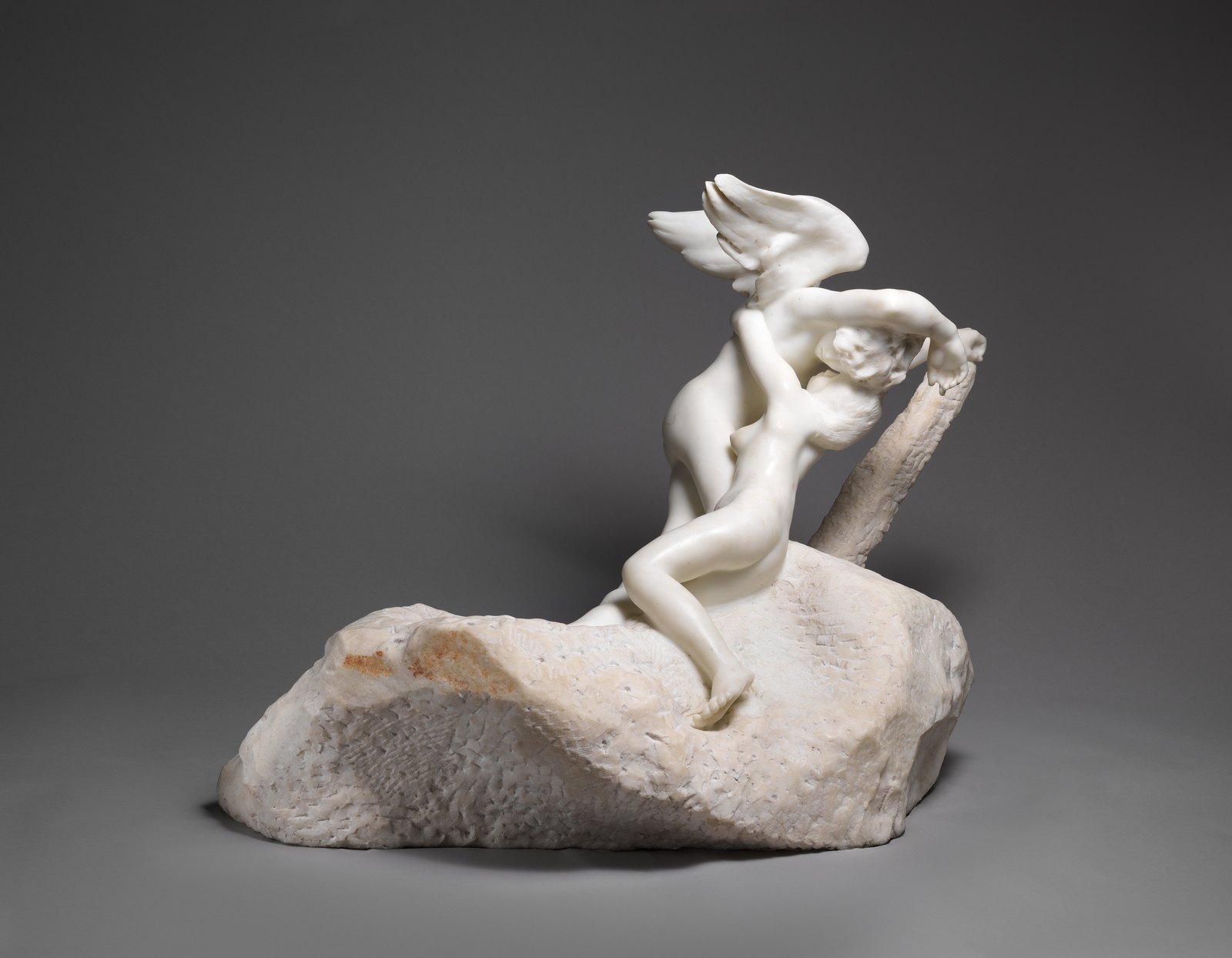
Rodin’s Cupid and Psyche at the Met gives a second treatment of the story and makes Cupid’s wings part of the composition. The Metropolitan Museum of Art, Gift of Thomas F. Ryan, 1910, 10.63.1. Image source. CC0 / Public domain.
Rodin treated the story differently in a marble at the Metropolitan Museum of Art. In that Cupid and Psyche, the winged god begins to rise while Psyche clings to him across an unusually long block. The viewer can follow the line of her body to the figure she is trying to hold. In the Boston sculpture the continuing line belongs to the cape. It falls towards the foot and turns out along the stone, while her attention goes in the other direction. The positions of the two bodies in the Met sculpture give the episode a clear action. The solitary Boston figure can dwell on a quieter part of the tale and let the eye linger on the hesitation of the person about to look. [1] [4]
Watch Rodin’s sculpture up close
Five films explore Rodin’s sculpture, from his use of classical models and the figures on his monumental doorway to the work of his studio.
Auguste Rodin – Challenging Beauty
Six sculptures show how Rodin adapted classical models.
Watch on YouTubeMarble and the workshop
The Boston marble is about 74 centimetres high and nearly as wide. Getty’s record credits Rodin with the design and the studio’s professional artisans with carving under his supervision. It records his signature on the right rear edge of the cape, a surface outside the principal view reproduced here. The location makes sense when considering the work as an object to walk around. Seen from the front, the openings in the drapery reveal parts of the figure. A turn around the block gives more prominence to the longer stretch of cloth and to the thickness of the stone that makes it possible. [1]
The Musée Rodin has drawn attention to the role that marble played in Rodin’s treatment of subjects from antiquity. In Psyche, the muted changes of tone bring the cloth and body close to one another. The turn of an edge or the depth of a fold can therefore register a change from fabric to skin more clearly than a difference in colour. When exhibited in a room with directional lighting, the curved planes around the shoulders and head can change noticeably with the viewer’s position. The Museum of Fine Arts has described how the white stone helps evoke the stillness of a scene at night. [1] [2] [3]
In the frontal view, the dark shape between the leg and the right side of the cape is widest close to the base. It narrows higher up where the cape hangs near the hip. Following that taper back towards the shoulder helps show how the cloth changes the depth of the standing figure. [1] [2]
From Paris to Boston
Rodin exhibited the marble in his 1900 show at the Pavillon de l’Alma in Paris. The historian Henry Adams saw it there and bought it for his niece Louisa Chapin Hooper Thoron. It went on loan to the Museum of Fine Arts in 1904 and entered the collection by gift in 1975. These details belong to the Boston work, accession 1975.738. The sculpture in the front photograph can be recognised by the relation of the bowed head to the straight leg, the fold curving out at the right and the shape of the coarse front of the base. Those features remain legible from a slightly different angle in a photograph of the Boston installation. [1] [2] [5]
A marble under photographic light
The Musée Rodin preserves Eugène Druet’s gelatin silver photograph of a marble under the title Psyche Carrying Her Lamp. The museum dates the print to before April 1914 and records its entry as a donation in 1916. Its photograph is 36 centimetres high, while the outer support reaches 54. Those measurements refer to the mounted object in the archive. The name, date and support give this printed view a history independent of the date when the Boston marble was carved. [1] [6]
A photograph holds the boundary between the drapery and the unworked block in a single pattern of light. In person that boundary can look sharper or softer as the viewer moves around the sculpture. Druet’s image gives viewers one historical view of how the marble could be presented. The Getty and Boston records document the specific work that Henry Adams bought. Together the records show how the composition circulated as stone and as an image on paper. [1] [2] [6]
Rodin artworks directory
Discussion
Look again at the images and ideas explored in Psyche. These editorial prompts invite your observations.
Reader Insights
After reading “The figure inside the folds”, what detail would you look for in the object or image?
What extra evidence would help you distinguish the artist’s choices from the effects of material, viewpoint or later display?
Join the Conversation
Share a detail, comparison or question about Psyche below.
References
- Getty Research Institute, Cultural Objects Name Authority. Psyche, Museum of Fine Arts, Boston, 1975.738, drawing on the MFA object record. View source.
- Museum of Fine Arts, Boston. Impressionist Gallery Unveiled. View source.
- Musée Rodin. Rodin, Flesh and Marble. View source.
- Metropolitan Museum of Art. Cupid and Psyche and Rodin at The Metropolitan Museum of Art. View source 1. View source 2.
- Philadelphia Museum of Art. Rodin centenary exhibitions and collection histories. View source.
- Musée Rodin. Eugène Druet, Psyché portant sa lampe, Ph.01360. View source.

 Auguste Rodin.jpg)





