


 by Tom Gurney
Tom Gurney BSc (Hons) is an art history expert with over 20 years experience
Published on June 19, 2020 / Updated on November 18, 2026
Email: tomgurney1@gmail.com / Phone: +44 7429 011000
The Three Shades
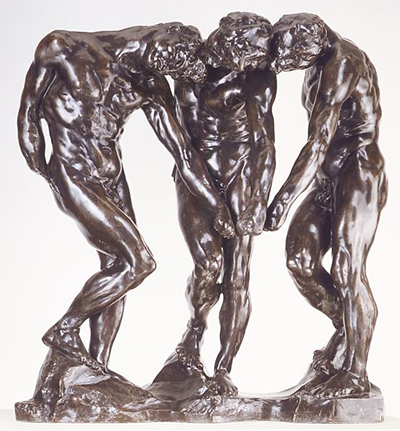
Three men bend their heads towards the centre of Auguste Rodin’s The Three Shades. Their arms descend towards the same small space, and their legs take the weight in poses that look different from the front. Rodin made the group by turning three versions of a single figure to face different directions. He placed them above the entrance of The Gates of Hell, where they look down over the doorway and its other inhabitants. Freestanding bronzes give a viewer a chance to walk around them and see how often the same turn of the head, hip and knee comes into view. [1] [2]
A repeated figure seen from three positions
In the photograph the man in the middle appears almost frontal. His bowed head sits above a torso whose chest and abdomen are clearly visible. The men at either side show more of the side of the same torso. At the left, the thrust of one hip and the bend of the knee make a sharp change of direction. At the right, the supporting leg offers a longer run of light below the hip. The positions of those legs are easier to compare after looking at the shoulders, which join the heads in a shallow arc across the top of the bronze. [1] [2]
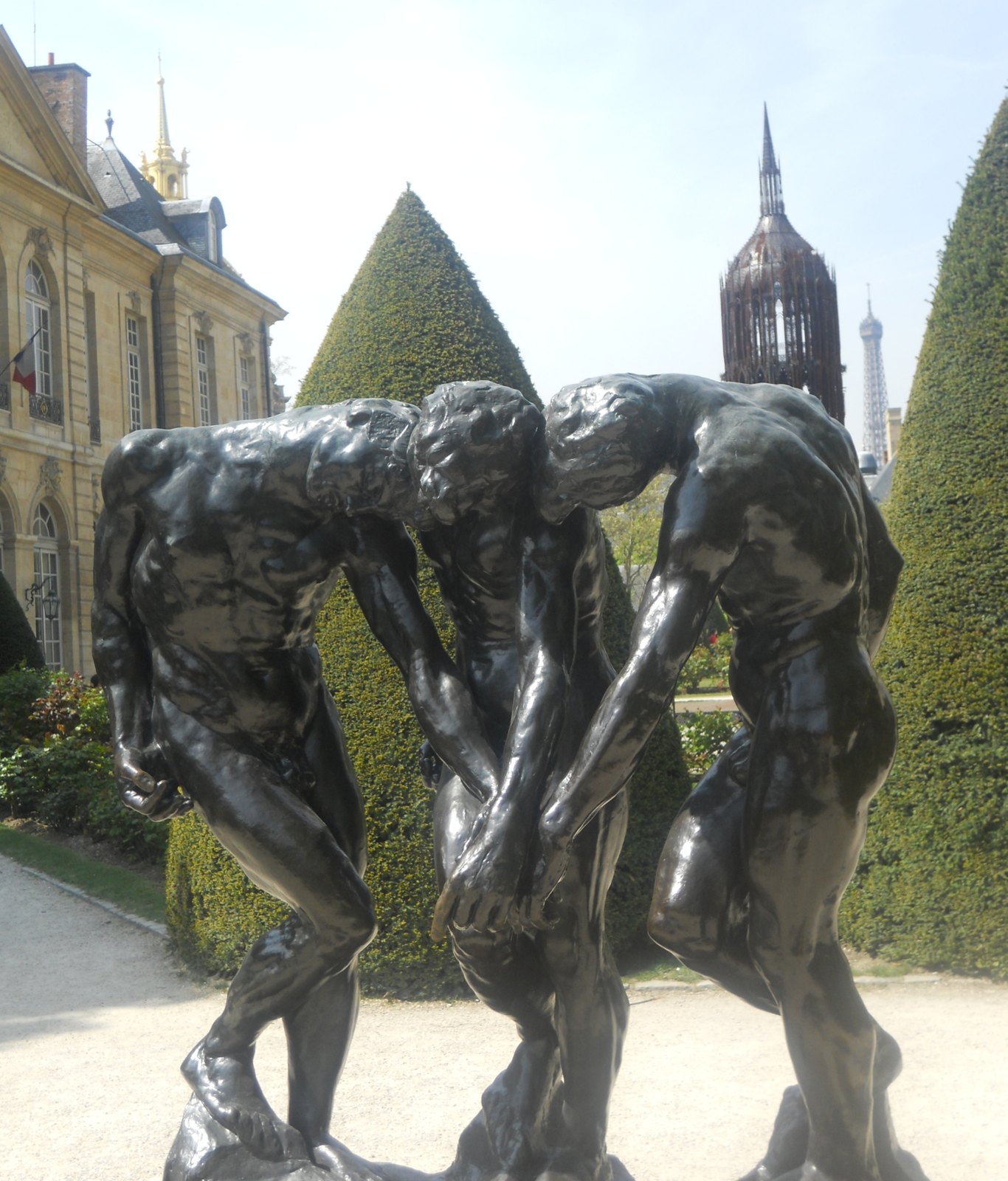
The three figures repeat the same pose at different angles, drawing their extended arms toward a common point. Photograph by Erik Drost, Wikimedia Commons. Image source. CC BY 2.0. Resized for the web.
The arrangement changes the apparent action of each man. An arm that looks as though it reaches forward on one figure is visible more nearly along its length on another. One of the farther arms partly disappears into the narrow space between the torsos. The resulting overlaps are strongest around the centre, where the ends of the lowered arms gather. There, the lightly modelled shifts in the surface are harder to pick out than the large shadows separating the bodies. The arm furthest out at the left is easier to trace because it hangs close to the outline. [1] [2]
The gaps through the group also differ. Between the central body and each outer figure, a wedge of background opens below the arm. The front photograph shows those openings as pale areas between dark stretches of bronze. Their size changes as the spectator moves around the work and the legs come into or move out of alignment. A turn around the base can make one of the outer figures occupy the middle of the composition. The sculpture offers several possible centres depending on where the viewer stands, even as the bowed heads and lowered arms repeatedly bring attention back to the encounter between the three bodies. [1] [2]
The body Rodin adapted from Adam
The Musée Rodin traces the individual pose to Rodin’s Adam, modelled in 1880–81. The curators connect both works to his interest in Michelangelo, particularly the torsion of the figures known as the Slaves. In The Three Shades the most visible distortion is where the neck drops so far to one side that the line from the shoulder into the head is almost horizontal. The bend also changes the shape of the chest below it. From the front one side appears compressed, while the opposite shoulder and arm extend away to create the long descent towards the middle of the bronze. [1] [3]
Rodin could develop a new composition from the figure by casting more than one version of it and changing the direction in which each faced. The single statue had its own balance through the legs and an exaggerated fall of the head. Brought together, the three repeat that movement without occupying the same outline. The shoulders meet high above the centre while much of the space below stays open. Every bowed head helps sustain the impression of an encounter even when the viewer sees one body chiefly from the back. Repetition is the means by which the group acquires much of its variety. [1] [2] [3]
Watch Rodin’s sculpture up close
Five films explore Rodin’s sculpture, from his use of classical models and the figures on his monumental doorway to the work of his studio.
Auguste Rodin – Challenging Beauty
Six sculptures show how Rodin adapted classical models.
Watch on YouTubeAbove The Gates of Hell
The shades are souls of the dead. The Musée Rodin reads their gesture in relation to the warning above the entrance in Dante’s Inferno, which tells those who enter to abandon hope. Rodin arranged the group high above the centre of his sculptural doorway. From below, the bowed heads lean into the spectator’s field of vision and the arms lead back down towards the figures on the doors. The heights of the bodies and the depth of the casting help the group stay legible against the surrounding architecture. [1] [2]
Seen apart from the doors, the three figures keep looking down, though the gesture terminates inside the sculpture’s own space. The upper line of shoulders and heads then carries a different emphasis. It can make the men seem to depend on one another to complete a movement that each is already making individually. At the bottom, uneven ground beneath the feet helps maintain the angles of the three bodies. The bases of some groups are shallow enough for the spectator to notice how abruptly a bent leg meets the bronze below. [1] [2] [4]
The height of the original placement also changes which parts of the figures overlap. A spectator low down sees the underside of the arms against the chests, whereas a frontal photograph at the level of the bodies puts the bent knees and planted feet on a more equal footing with the heads. [1] [2]
Two scales and several bronzes
The Musée Rodin’s 97-centimetre bronze S.01191 was sand-cast by Alexis Rudier in 1928. The Metropolitan Museum of Art’s example measures 97.2 centimetres high and was cast by Georges Rudier in 1969 from a model the museum dates between 1881 and 1886. The Musée Rodin also records a monumental version, S.06411, measuring 191.5 centimetres high. It dates that large model to 1902 and identifies the Coubertin foundry as the maker of its 1988 cast. The Met’s collection catalogue discusses the addition of hands in the enlarged version, a difference that can change the look of the area where the lowered arms converge. [1] [2] [4] [5]
Those catalogue dates describe particular objects and stages in Rodin’s development of the group. The legacy photograph shows a bronze in which three bowed heads, staggered legs and converging arms are visible against a pale background. The viewpoint keeps the feet and the shadows between the bodies in sight. The available comparison records establish the composition, while the photograph offers too little information about scale and casting marks to identify the particular bronze with confidence. [1] [2] [5]
Marking the sections of three figures
The Musée Rodin’s plaster S.03970 stands 97.4 centimetres high. The museum records release agent on its surface and identifies it as a foundry model. Several numerals are recorded on sections of shoulders and arms. The right figure also has a mark at the front of its base, and the middle figure carries another at the top of its head. The marks let a reader follow how the museum describes individual sections even where the repeated bodies are easily confused. A designation such as the shoulder of the right figure identifies that part by its position in the group. The model retains physical evidence of how the whole was prepared for reproduction. [6]
In the finished 1928 bronze the three bodies share a single field of colour and a spectator can follow their inclination into the centre. The foundry plaster provides a complementary way to read the group. One can trace where an arm belongs, check the nearest shoulder and then return to the point where several similar silhouettes overlap. In an assemblage of repeated figures, a connection that looks immediate from one angle can be difficult to follow from another. The marks identify parts of the model, while the bronze invites the spectator to work out those connections by moving around it. [1] [3] [6]
Rodin artworks directory
Discussion
Look again at the images and ideas explored in The Three Shades. These editorial prompts invite your observations.
Reader Insights
After reading “A repeated figure seen from three positions”, what detail would you look for in the object or image?
What extra evidence would help you distinguish the artist’s choices from the effects of material, viewpoint or later display?
Join the Conversation
Share a detail, comparison or question about The Three Shades below.
References
- Musée Rodin. The Three Shades, S.01191. View source.
- Metropolitan Museum of Art. The Three Shades, 1984.364.17. View source.
- Musée Rodin. Multiples, fragments, assemblages. View source.
- Musée Rodin. Les Trois Ombres, grand modèle, S.06411. View source.
- Metropolitan Museum of Art. Rodin: The B. Gerald Cantor Collection, entry for The Three Shades. View source.
- Musée Rodin. Les Trois Ombres, foundry plaster S.03970. View source.

 Auguste Rodin.jpg)





