


 taken by Pierre Choumoff.jpg)
 by Tom Gurney
Tom Gurney BSc (Hons) is an art history expert with over 20 years experience
Published on June 19, 2020 / Updated on November 18, 2026
Email: tomgurney1@gmail.com / Phone: +44 7429 011000
Photograph of Les Bourgeois de Calais (The Burghers of Calais) taken by Pierre Choumoff
In this photograph of Auguste Rodin’s The Burghers of Calais, pale figures fill the foreground of a dark interior. One man at the right stands tall with his hands low. Near the centre another inclines his head towards a lifted hand, while a figure at the far right is visible mostly through his raised arms. The oblique angle makes some of the men easy to distinguish and leaves others partly hidden. The photograph is attributed to Pierre Choumoff. The Musée Rodin catalogues several photographs by Choumoff of the plaster group, including a signed gelatin silver print made in the chapel of the Hôtel Biron. [1] [2]
Who comes forward in the photograph
Begin at the right, with the figure nearest the camera. His shoulders carry broad lengths of fabric that descend almost to the ground. The head lifts above a relatively quiet stretch of cloth, and the vertical folds make his posture seem unusually steady. Hands beyond his shoulder break that vertical line. They belong to another figure, whose face is harder to separate from the background and the nearby bodies. The angle allows one man to dominate the picture without giving him all the attention. The more closely we study his outline, the more details of the figure behind him begin to emerge. [1] [3]
On the left, a narrow figure is seen in profile. His raised hand lies well away from his head, where the dark interior makes it easy to pick out. Another face appears just beyond his shoulder. The available spaces between the figures are therefore as important as their outlines. An open patch beside a wrist can make an entire gesture visible, while a much larger piece of sculpture can disappear directly behind another man. In the middle, the figure with his forearm lifted has a more compact outline. His lowered face draws the eye into the group after the extended arm on the left has led it outwards. [1] [3]
The photographer also leaves part of the room in view. At the left a separate pale sculpture stands on a darker support, and behind the group a post and an arch supply a measure of the figures’ height. The floor recedes beside the plaster and makes its position in the room easier to understand. A tighter detail would give more prominence to the faces or hands, but the visible gaps beside the group tell us where the camera stood in relation to it. The lighter figures have a strong edge where they meet the wall. Elsewhere their outlines are interrupted by the lighter parts of the interior. Look at the top of the rightmost head, where the framework behind it makes the brow harder to follow. The edge of the cloak is easier to find against the dark below, especially where it approaches the hand. This change within the same figure makes the room part of the photograph’s effect. [1] [2]
A plaster of a public monument
Calais commissioned the monument in the 1880s to commemorate six men who offered themselves at the end of the English siege of 1346–47. The Musée Rodin describes how Rodin developed the men as individuals within a group, with separate studies for bodies, drapery and hands. The bronze was installed in Calais in 1895. The photographed plaster offers another way into the design. Pale cloth and flesh catch enough light to bring out shallow folds, while the room puts the figures against a background very different from an open square. In the picture, the depth of the group is evident wherever a lit figure cuts off part of a darker one. [1] [3] [4]
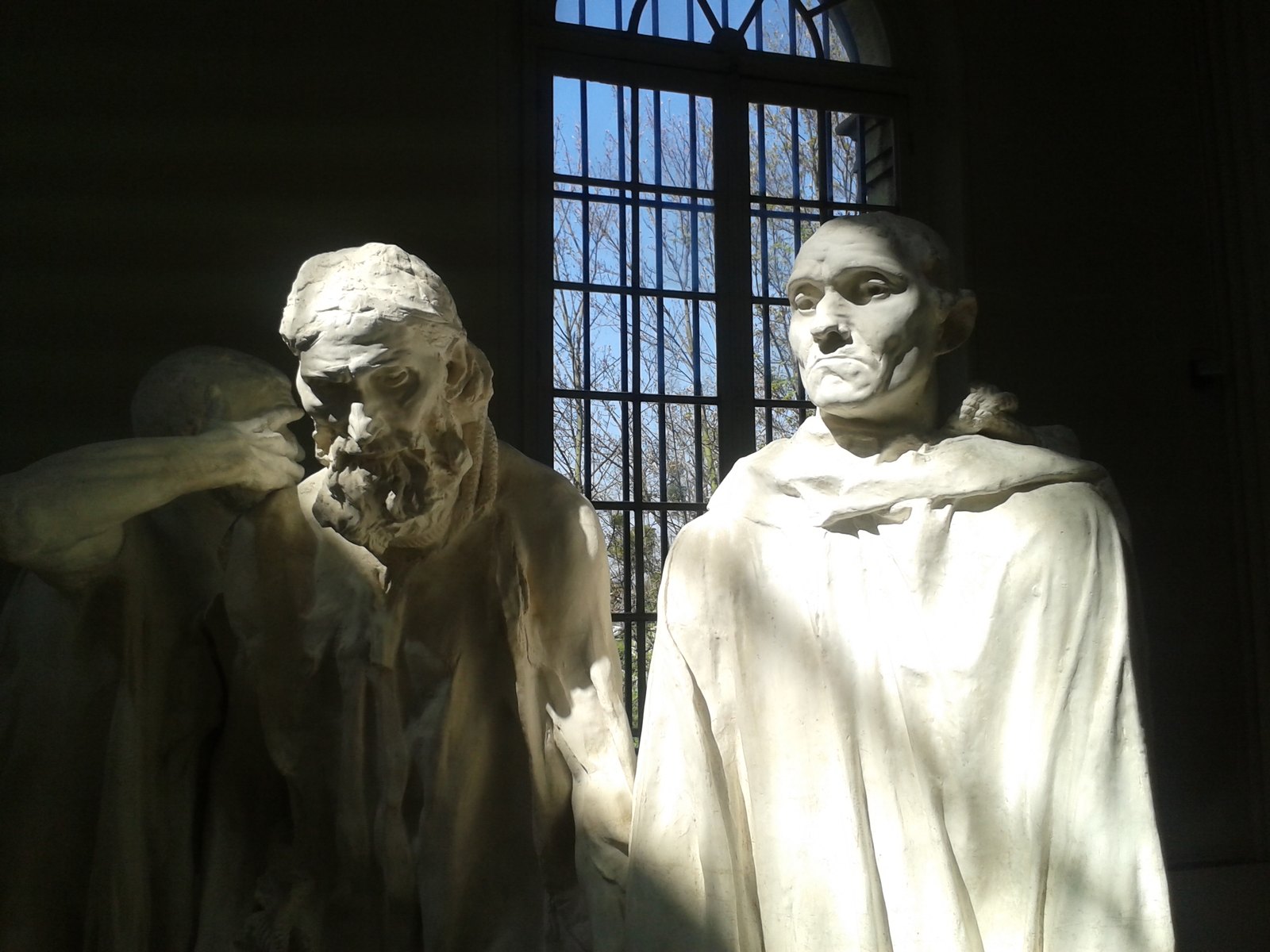
The modern photograph at Meudon isolates two figures for comparison with Choumoff’s view of the group. Photograph by Adoc, Wikimedia Commons. Image source. CC BY-SA 4.0. Resized for the web.
The museum records Rodin’s interest in two very different settings for the monument. It could be raised high so that the figures were seen against the sky, or placed close to the ground, where their bodies would meet the spectator more directly. A photograph adds another decision about height and distance. Here the nearest figure appears large as much because he is close to the camera as because of anything about his original scale. The figures behind him recede by degrees. Their stature and their relative prominence in the image are therefore best understood from the group and the camera position together. [1] [3]
The frame includes only one direction of approach. A visitor walking around a cast can make a face come into view simply by taking a step, and the sequence in which gestures appear changes with every turn. In the photograph those relationships stay fixed. This helps when looking at small details, because we can return repeatedly to the same hand and see exactly what is visible around it. It also gives the picture an order of its own. After looking at the tall figure to the right, try reading across from the raised hand at the left. The men seem to gather more gradually when the eye starts at that side. [1] [3] [4]
Watch Rodin’s sculpture up close
Five films explore Rodin’s sculpture, from his use of classical models and the figures on his monumental doorway to the work of his studio.
Auguste Rodin – Challenging Beauty
Six sculptures show how Rodin adapted classical models.
Watch on YouTubeChoumoff and the photographic record
The Musée Rodin separates the makers of the objects in its entry for the chapel print Ph.03343. It names Choumoff as the author of the photograph and Rodin as the sculptor. It describes a gelatin silver print measuring 18 by 23.8 centimetres and records the photographer’s signature. The archive also lists other Choumoff photographs of the plaster under the same general title. These are records of individual images, and their accession numbers are needed when describing a particular sheet. A reproduction cropped close to the scene can retain the figures and the setting while losing the margins where further identifying evidence might appear. [1] [2]
Choumoff’s photographs in the Musée Rodin archive include portraits and records of events around the sculptor as well as photographs of works. In this view the room connects the image with a place, and the relative light on the sculptures makes that setting easy to inspect. The plaster itself presents gestures meant to hold their shape as people move around it. The photograph has its own visual emphasis, giving one face, one sleeve and a few hands unusual prominence from a single position. That emphasis is part of what makes it worth looking at as a photograph and alongside the monument it records. [1] [2] [5]
Another view of sculpture in the chapel
The Musée Rodin also holds Choumoff’s Œuvres de Rodin dans la Chapelle, Ph.10161. Its catalogue identifies Victor Hugo as the photographed subject and gives the chapel at the Hôtel Biron as the place of creation, the same location it records for the plaster Burghers in Ph.03343. The Hugo photograph is vertical, at 23.7 by 17.6 centimetres. The signed print of the Burghers is horizontal, at 18 by 23.8 centimetres. Those proportions give the two subjects different kinds of space on paper. The group of six needs room across the frame for bodies that turn and step away from one another. A vertical view can give more weight to how a sculpture rises in the chapel. [1] [6]
The second photograph also carries Choumoff’s studio stamp at the lower right. The stamp identifies a photographer and a Paris address, while the catalogue identifies where the exposure was made. Keeping the two locations distinct makes the print intelligible as both a record of a display and an object issued from a photographic practice. [6]
Rodin artworks directory
Discussion
Look again at the images and ideas explored in Photograph of Les Bourgeois de Calais (The Burghers of Calais) taken by Pierre Choumoff. These editorial prompts invite your observations.
Reader Insights
After reading “Who comes forward in the photograph”, what detail would you look for in the object or image?
What extra evidence would help you distinguish the artist’s choices from the effects of material, viewpoint or later display?
Join the Conversation
Share a detail, comparison or question about Photograph of Les Bourgeois de Calais (The Burghers of Calais) taken by Pierre Choumoff below.
References
- Musée Rodin. Pierre Choumoff, Monument des Bourgeois de Calais (plâtre), Ph.03343. View source.
- Musée Rodin. Photographs of the plaster monument, including Choumoff’s Ph.03345 and Ph.01204. View source.
- Musée Rodin. Monument to The Burghers of Calais. View source.
- Musée Rodin, Meudon. Monument aux Bourgeois de Calais. View source.
- Musée Rodin. Photographs including Pierre Choumoff’s records of Rodin and his funeral. View source.
- Musée Rodin. Pierre Choumoff, Œuvres de Rodin dans la Chapelle, Ph.10161. View source.

 Auguste Rodin.jpg)





