


 by Tom Gurney
Tom Gurney BSc (Hons) is an art history expert with over 20 years experience
Published on June 19, 2020 / Updated on November 18, 2026
Email: tomgurney1@gmail.com / Phone: +44 7429 011000
Adonis Awakens
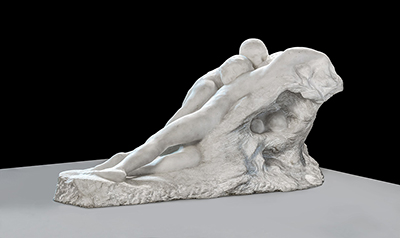
A reclining man and a more upright woman share a low block of stone. The woman’s body rises beside him while his remains close to the ground. The irregular mass around the pair gives them a place to rest and makes some parts of their bodies harder to separate from their surroundings. Auguste Rodin’s Adonis Awakens is also recorded under the title The Resurrection of Adonis. The two names invite slightly different ways of looking. One suggests a body stirring out of sleep. The other makes that stillness part of a story about death and return. Rodin gives the interval between the two figures enough space for either reading to begin there. [1] [2] [3]
Two names for the composition
The French national collections database records Le Réveil d’Adonis as an alternative title for Résurrection d’Adonis. Its entry for a Musée Rodin example describes a mythological scene with Adonis reclined and a seated nude woman. That description identifies the relation of the figures without requiring the viewer to decide what is about to happen. The difference matters when you look at the work. Adonis’s lowered position suggests he is still far from acting, while the woman has enough of an upright stance to direct attention towards him. The story depends on the difference in their bearing. One figure seems able to respond. The other remains partly absorbed into the stone. [1]
Adonis was loved by Venus, and in Ovid’s Metamorphoses a boar kills him. Venus returns to find him and changes his blood into a flower. That episode gives a context for the sculptor’s treatment of Adonis without supplying a line-by-line script for either of his groups. A title about awakening or resurrection leaves a different possibility open from the course of events Ovid describes. In the sculpture, the relative height of the figures and the separation of their heads are visible evidence. Naming an exact moment of the myth requires more than recognising two bodies under a title. [1] [3] [4]
Death and awakening
Rodin also made a composition known as The Death of Adonis. There Venus grieves over Adonis’s body. A catalogue for a marble of Le Réveil d’Adonis describes the two designs as companions and connects the model for the awakening to the late 1880s. Seen together, the groups show how different actions can take shape around a reclining body. An upright companion can draw the eye towards the face, while a body brought closer to the corpse can make mourning seem to weigh the surviving person down. Both arrangements depend on what happens to the space between the bodies and how much of the block continues to frame the encounter. [3] [5]
This pairing also makes the word “awakens” worth taking seriously. A viewer can look for a turn of the body or a change in the woman’s position that draws the man out of his stillness. Much of his weight still seems to lie in the supporting stone. The sculpture leaves the distinction between rest and return suspended in the position of the limbs. A scene of death elsewhere in Rodin’s work makes that suspension more apparent. Once you know that the sculptor made a separate treatment of Adonis’s death, comparison gives the titles something specific to do. They guide attention to different ways the people relate to one another. [1] [3] [5]
Watch Rodin’s sculpture up close
Five films explore Rodin’s sculpture, from his use of classical models and the figures on his monumental doorway to the work of his studio.
Auguste Rodin – Challenging Beauty
Six sculptures show how Rodin adapted classical models.
Watch on YouTubeThe Soumaya marble and the Paris plaster
The Musée Rodin’s record for S.02996 identifies a plaster moulded from the marble in the Museo Soumaya in Mexico City. It measures 44.5 centimetres high, 86 wide and 40 deep. Those figures belong to the plaster. They establish the proportions of an object that can be studied in Paris, and the museum’s description establishes its relationship to the marble. The two objects share a form closely enough for the plaster to be used in comparing their modelling. A feature such as the edge of a raised knee can continue across the two even though the materials carry light differently. [2]
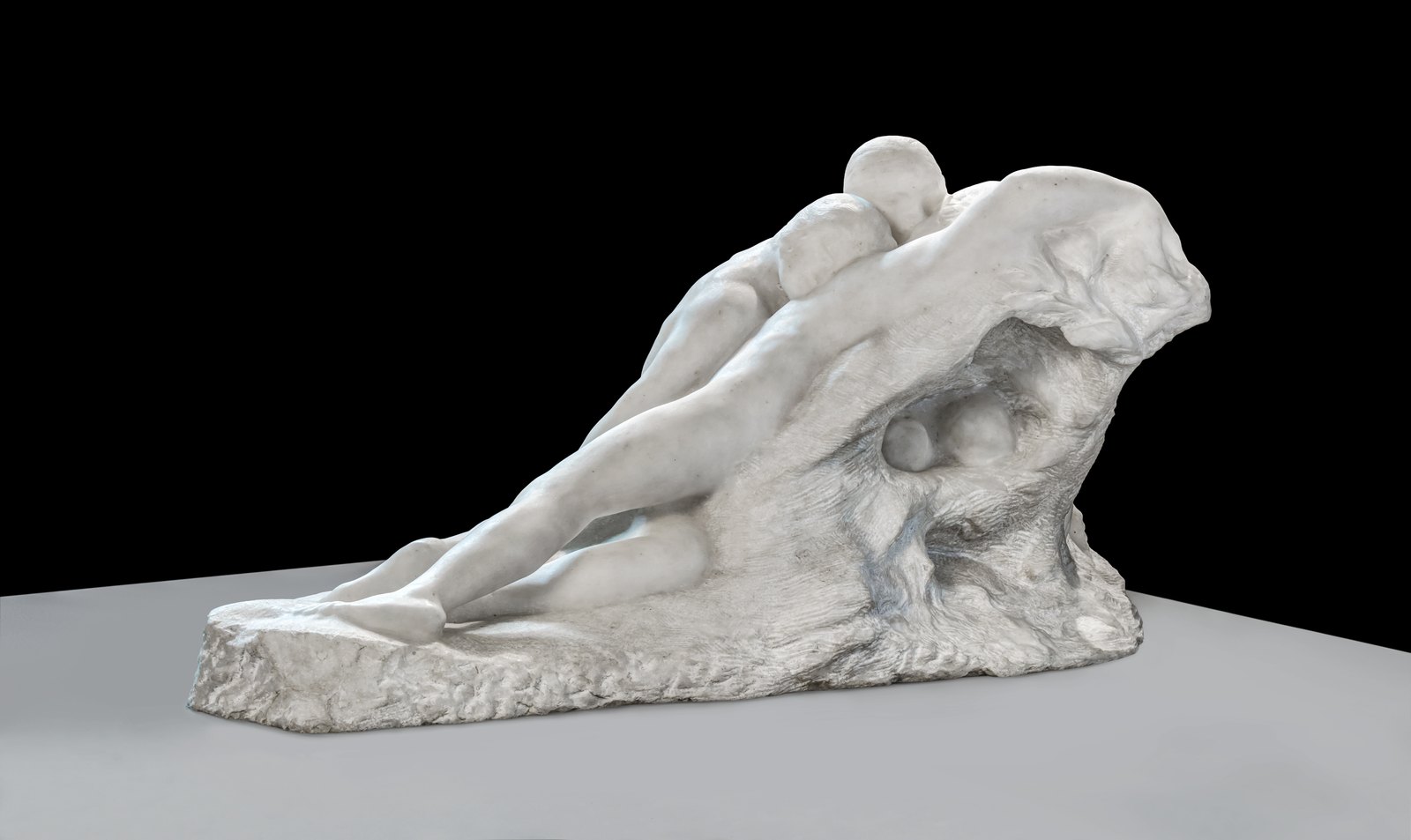
The Museo Soumaya marble gives a documented view of how the figures emerge from the block. Museo Soumaya, via Wikimedia Commons. Image source. CC BY-SA 4.0. Resized for the web.
The fact that the plaster was taken from a marble is important. A sculptor’s plaster can also be used as a model before a marble is made. These are distinct relationships, even if both objects bear the same title. In this case the museum describes the direction of the process explicitly. A date for the model belongs to the earlier invention. A date for an individual marble or plaster belongs to a separate episode. A marble with the same title appeared in the Christie’s catalogue, which gives details of its history. Its dates require a separate reading from the Paris plaster record. [2] [3] [6]
Joconde identifies the Paris example in its own entry as S 3541. That number is another reminder that searching by title will bring up more than one object. The catalogue’s description of the man as dead can also be compared with the language of awakening in the alternative title. The combination leaves a question for the viewer about whether the sculpture shows a change that is already happening or one that the companion hopes to bring about. [1] [2]
Look at the stone around the figures
The broad setting is easy to overlook if you begin with a tight photograph of the upper bodies. Look for the rougher passages at the ends of the block and follow them towards the man. In some places the transition makes a limb feel protected by the stone. In others the visible mass suggests how hard it would be for someone to lift themselves free. The upright woman creates one of the few strong movements above that low field. Her position lets the eye rise and come back down towards him. Those lines across the sculpture can help disclose the action even when no one agrees on the precise meaning of a gesture. [1] [2] [3]
Rodin’s other reclining groups show how often he could return to that problem. In Adam and Eve Sleeping, the stone keeps the two bodies low and close. In Adonis Awakens, a stronger difference of height allows a contrast between the still figure and his companion. The groups reward being compared from similar angles, with enough of the rough material visible around them to see what it contributes. Look for where each figure separates from the mass and for how the pair begins to make sense as a whole. [2] [7]
Reading the two Paris plasters side by side
The Musée Rodin’s detailed entry gives the smaller plaster, S.03541, a width of 38.5 centimetres. The plaster taken from the Soumaya marble, S.02996, is 86 centimetres wide. Both are catalogued under the title La Résurrection d’Adonis. A close photograph could give them nearly the same apparent size, although the viewer would need to stand farther away to see the larger object in full. The catalogue records dimensions of the complete plasters, including their supports. These figures establish the scale of the encounter without establishing how closely every part of one body corresponds to its counterpart in the other version. [1] [2] [8]
The smaller plaster has a V mark and the number Z101 on the back of the mound. These marks provide a way to identify that object if a photograph shows the reverse. A frontal view is better evidence for the relationship between the two bodies, but can leave those identifying details out altogether. The entry for the larger plaster explains its connection to the Soumaya marble. The smaller plaster’s entry gives no comparable link to that carving. Together the entries let the viewer compare two scales of the composition while keeping open the question of when the smaller version was made and how it relates to the marble. [1] [2] [8]
Rodin artworks directory
Discussion
Look again at the images and ideas explored in Adonis Awakens. These editorial prompts invite your observations.
Reader Insights
After reading “Two names for the composition”, what detail would you look for in the object or image?
What extra evidence would help you distinguish the artist’s choices from the effects of material, viewpoint or later display?
Join the Conversation
Share a detail, comparison or question about Adonis Awakens below.
References
- French Ministry of Culture. Résurrection d’Adonis, also known as Le Réveil d’Adonis. Joconde. View source.
- Musée Rodin. La Résurrection d’Adonis, S.02996. View source.
- Christie’s. Le réveil d’Adonis, marble. View source.
- Ovid. Metamorphoses, book X. Perseus Digital Library. View source.
- Musée Rodin. La mort d’Adonis. View source.
- Musée Rodin. Marble carving. View source.
- Musée Rodin. Adam et Ève, marble S.01059. View source.
- Musée Rodin. La Résurrection d’Adonis, S.03541. View source.

 Auguste Rodin.jpg)





