


 by Tom Gurney
Tom Gurney BSc (Hons) is an art history expert with over 20 years experience
Published on June 19, 2020 / Updated on November 18, 2026
Email: tomgurney1@gmail.com / Phone: +44 7429 011000
Paolo and Francesca
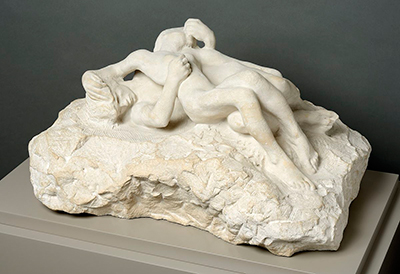
A pair of intertwined bodies lies across a broad expanse of rough stone in the sculpture pictured here. The lower figure’s head tips back at the left. Two legs descend to the right, and a bent arm rises into the background above them. Auguste Rodin returned several times to Paolo and Francesca, the lovers Dante encounters in the second circle of Hell. The recumbent version brings their bodies into contact with a thick, irregular mass whose surface is visible almost all the way around the pair. The National Gallery of Art in Washington holds a marble titled Paolo and Francesca, dated about 1909. The Musée Rodin also documents related versions, including a marble with clouds in its title. [1] [2] [3]
The figures across the stone
The photograph gives unusually clear access to the front of the stone. Across the lower third, broken edges and shallow cavities cast fine shadows. The forward leg is easier to trace because its surface changes more gradually under the light. Its toes reach down almost to the edge of the stone. Nearby, the line of the other foot meets one of the darker grooves among the rougher forms. The contrast between the two kinds of surface makes the smoother limbs seem to travel over the block. Where a heel touches down, a shallow shadow is all that keeps the foot distinct from the stone around it. [1] [2]
On the other side, the tilted head is low enough to appear almost embedded in its support. The profile turns upward towards the smooth mass above it, which narrows as it approaches the cluster of hands near the centre. A forearm rising from the stone provides a relatively clear route through this overlap. It leads the eye in a different direction from the legs, back towards the upper bodies. At the top, a small opening beneath the raised arm admits the darker background. The opening is modest in the photograph, but it makes that arm easier to follow than the limbs that meet against the stone. [1] [2]
Seen from this angle, the stone occupies much of the space below the bodies and extends farther forward. The wide margin at the front allows time to register the ridges and changes of depth before the eye reaches the figures. A view from the side would bring the overlapping legs closer together in perspective and make the depth of the block more apparent. From this position both feet remain visible, and the gap at the top makes the highest gesture visible against the background. The sculpture offers a sense of forward movement through the descending legs even though the pair is held against a substantial base. [1] [2]
From Dante’s second circle
Dante meets Paolo and Francesca in canto V of the Inferno. Francesca speaks to him about reading a tale of courtly love together. The story within the story is the romance of Lancelot, and reading it leads to the lovers’ first kiss. They are killed by Francesca’s husband and condemned to Hell. Dante encounters them in a circle where the souls are blown about by the wind. The poem gives Francesca the account of their life while it gives Dante the sight of the couple travelling together after death. The sculptor could choose between these two moments in giving their story a shape. [4] [5]
The bodies pictured here can be read in light of the second encounter. They have no stable seated posture and extend across the surface at several angles. Where a back or a foot comes close to the irregular support, the stone might suggest a rolling cloud. The parts that stand clear of it show a temporary separation, as if the conditions holding the bodies might shift. That impression of movement depends on a massive object and on the comparatively fine distinctions between the rough stone, the limbs and the space around them. The Musée Rodin’s title for its 1904 marble explicitly gives the clouds a part in the scene. [2] [3] [5]
Watch Rodin’s sculpture up close
Five films explore Rodin’s sculpture, from his use of classical models and the figures on his monumental doorway to the work of his studio.
Auguste Rodin – Challenging Beauty
Six sculptures show how Rodin adapted classical models.
Watch on YouTubeThe relationship to The Kiss
Rodin’s earlier group of the lovers, later known as The Kiss, once occupied a place on the left door of The Gates of Hell. The Musée Rodin dates its removal to 1886 and records that a group of the lovers clinging to one another in Hell took its place. In The Kiss, the seated arrangement brings the figures into a spiral around the contact between their upper bodies. A bronze at the National Gallery of Art still shows the book in Paolo’s hand. The recumbent composition gives the reach of the legs and the mass around the lovers a greater share of the sculpture. The two arrangements can be read as choices about where the viewer enters Dante’s account. [4] [5] [6]
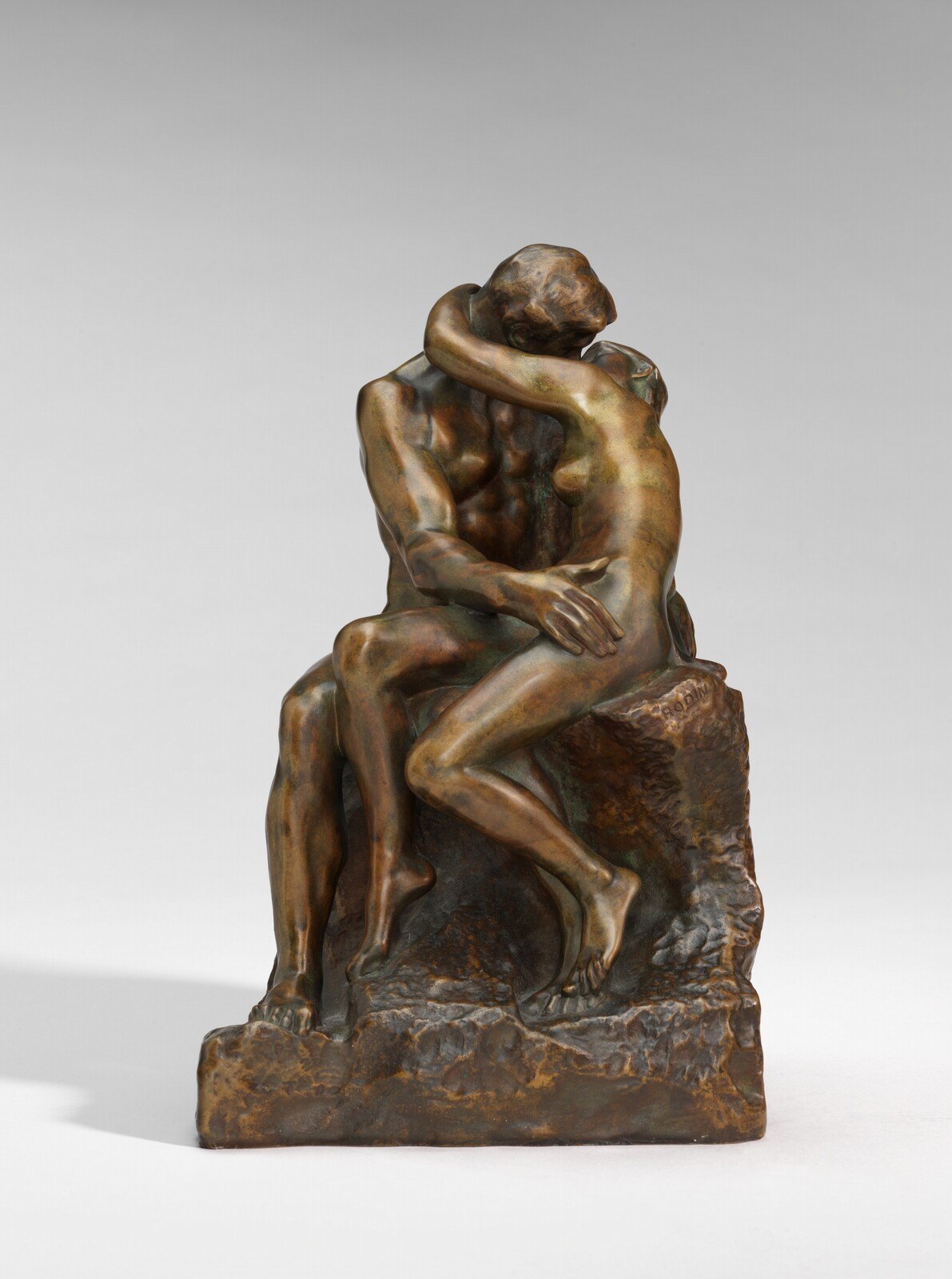
The Simpson reduction shows how Rodin developed the same episode as an embrace in The Kiss. National Gallery of Art, Washington, Gift of Mrs. John W. Simpson, 1942.5.15. Image source. CC0 / Public domain.
Rodin’s practice of taking groups out of the doorway gave such a composition another context. The Metropolitan Museum of Art reproduces a studio photograph of a marble Paolo and Francesca, taken by John Marshall and his wife during their visit around the turn of 1908. Marshall recommended the work among the pieces he considered for the museum, and his account placed an exhibition of that marble in London in January 1905. The early photographs show how much identifying a specific marble can depend on the date, the view and the history of the object, especially when similar titles recur in studio and collection records. [7]
The marbles and the Washington collection
The Musée Rodin identifies its 1904 Paolo et Francesca dans les nuages as S.1147 and gives a height of 65.5 centimetres. The National Gallery’s circa-1909 marble, 2014.136.249, is shorter at 53.34 centimetres high and extends more than a metre in depth. Agnes Ernst Meyer gave it to the Corcoran Gallery of Art in 1936. The National Gallery acquired it in 2014 and records Rodin’s signature on the back. A separate plaster in the Musée Rodin, S.03441, is catalogued in relation to the former Corcoran marble and also has a signature recorded at the back. Neither signature is visible from the viewpoint reproduced here. The Washington marble provides a documented example of the subject, while the photograph supports a close reading of the recumbent group without settling the precise version. [1] [2] [3]
A marble for the Glyptotek
Carl Jacobsen listed Francesca da Rimini among the works he requested from Rodin in August 1907. The placement of the name in the order matters because the story of Paolo and Francesca had already produced several distinct compositions in Rodin’s studio. Theodor Oppermann, writing from Copenhagen in January 1909, used both lovers’ names when he listed the works covered by an instalment. He separated that group of payments from the purchase of the bust of Dalou. The accounts help trace the Copenhagen commission while the late titles remain broad enough to need the comparison with sculpture records. [3] [8] [9]
In March 1910 Oppermann asked Rodin to confirm the order in which the Glyptotek’s marbles had been carved. He included Paolo and Francesca da Rimini among the objects he remembered as first examples. That was a recollection put to the sculptor for checking. It gives evidence of the museum’s interest in the identity of its own stone and the sequence of versions. The Washington marble’s catalogue documents a separate object. Reading that record alongside the correspondence keeps the commission history attached to the Copenhagen work. [1] [10]
Rodin artworks directory
Discussion
Look again at the images and ideas explored in Paolo and Francesca. These editorial prompts invite your observations.
Reader Insights
After reading “The figures across the stone”, what detail would you look for in the object or image?
What extra evidence would help you distinguish the artist’s choices from the effects of material, viewpoint or later display?
Join the Conversation
Share a detail, comparison or question about Paolo and Francesca below.
References
- National Gallery of Art. Paolo and Francesca, 2014.136.249. View source.
- Musée Rodin. Paolo et Francesca, S.03441. View source.
- Musée Rodin. L’Enfer selon Rodin, exhibition dossier, p. 18. View source.
- Musée Rodin. The Kiss, large model. View source.
- National Gallery of Art. Going through Hell? See Dante’s Divine Comedy in Art. View source.
- National Gallery of Art. The Kiss, 1942.5.15. View source.
- Metropolitan Museum of Art. Rodin at The Metropolitan Museum of Art: A History of the Collection, pp. 28, 34. View source.
- Carl Jacobsen’s Correspondence Archive. Jacobsen to Rodin, 28 August 1907. View source.
- Carl Jacobsen’s Correspondence Archive. Oppermann to Rodin, 15 January 1909. View source.
- Carl Jacobsen’s Correspondence Archive. Oppermann to Rodin, 21 March 1910. View source.

 Auguste Rodin.jpg)





