Auguste Rodin.jpg)
 by Tom Gurney
Tom Gurney BSc (Hons) is an art history expert with over 20 years experience
Published on June 19, 2020 / Updated on November 18, 2026
Email: tomgurney1@gmail.com / Phone: +44 7429 011000
The Kiss in Copenhagen
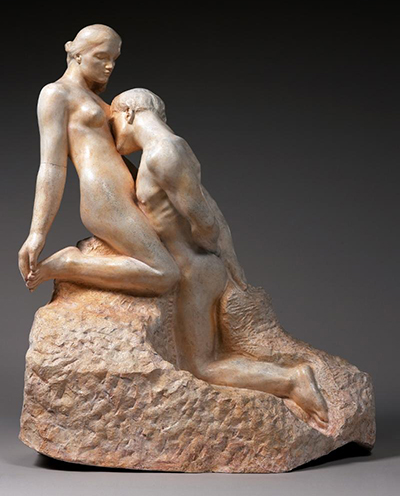
Two seated bodies turn towards one another, their arms closing the space around a kiss. Beneath them, the marble spreads into a broad, uneven mass. In Auguste Rodin’s The Kiss at the Ny Carlsberg Glyptotek in Copenhagen, the contrast between supple bodies and resistant stone is especially inviting: the embrace seems momentary, while the material supporting it feels enduring. The familiar subject has an unusually personal history here. This marble was commissioned by the museum’s founder, Carl Jacobsen, who had strong opinions about precisely how its bodies should emerge from the block. [1] [2]
The Copenhagen sculpture is the marble numbered M.IN. 609. The Ny Carlsberg Foundation records it as 197 centimetres high, 135 centimetres wide and 160 centimetres deep. Jacobsen commissioned it in October 1900; it was carved in 1901–03 and delivered in 1904. These dates describe the making and arrival of this particular object, decades after Rodin first developed the composition. [1]
At a Glance
Two marble commissions in Rodin’s career
Contents
- Following the embrace
- A story released from the Gates of Hell
- Jacobsen’s particular commission
- How a marble by Rodin was made
- A separate history from the Paris marble
- Progress reported beside the other Copenhagen works
- The marble stays in the studio
- Arrival in Copenhagen
- What Jacobsen could settle while the room was being arranged
- Artworks directory
- Discussion
Following the embrace
Start with the woman’s raised arm. It passes around the man’s neck, making a pale arch above his shoulder. Her torso turns towards him while her legs travel across the lower part of the group. His upper body bends into the encounter, but his seated posture gives the embrace a firm support. Their movements meet without becoming identical. One body reaches across; the other receives and answers that movement. [1]
The hand resting against the woman’s hip offers a quieter point of contact. It holds the eye below the entwined heads and helps spread attention across the whole group. The kiss is its centre, but the sculpture gives almost as much space to the relationship between shoulders, thighs, knees and feet. From the view reproduced by the foundation, the woman’s lowered foot makes a particularly delicate passage between the smooth body and the irregular stone beneath it. [1]
The base matters to this experience. Its broken-looking contours give the figures a setting without supplying a detailed landscape. Along the outside edge, the rough stone interrupts the rounded outlines of the limbs. Looking from one surface to the other makes the softness of the bodies more persuasive: everything is marble, yet it seems to have acquired different degrees of weight and sensitivity. This is a visual reading of the sculpture’s contrasts, rather than evidence that Rodin assigned a separate symbolic meaning to each unfinished passage. [1] [7]
A story released from the Gates of Hell
The lovers began as Paolo and Francesca, the adulterous couple from Dante’s Divine Comedy. Rodin developed their embrace for The Gates of Hell, his immense sculptural doorway. According to the Musée Rodin, the group occupied the lower left door before he removed it in 1886: its sensual happiness sat uneasily within the larger vision of damnation. It appeared independently in 1887 and became known as The Kiss. [3]
That change in title opens the sculpture to viewers who have never read Dante. The National Gallery of Art, discussing its small bronze version, nevertheless identifies a surviving literary clue: the book held by Paolo. In the story, reading brings the lovers towards their forbidden encounter. Knowledge of the narrative therefore adds an approaching catastrophe to an image that can otherwise seem absorbed in pleasure. [4]
The Copenhagen marble holds these two readings together. Its title allows an immediate recognition of affection and desire. Its origins bring a more troubled future into that recognition. Rodin concentrates the bodies so completely upon each other that the viewer must supply what lies outside their embrace. The surrounding world has temporarily disappeared for them; for a viewer who knows their story, it has become harder to forget.
Jacobsen’s particular commission
Jacobsen saw Rodin’s major Paris exhibition in 1900 and ordered several sculptures before the year ended. His letter of 21 October confirmed six numbered commissions for the Glyptotek, including The Kiss in first-quality Carrara marble. The agreement covered 70,000 francs for all six works, with the marble block charged separately. [5] [2]
He asked for execution at least as careful as the earlier marble’s, specifically mentioning the man’s left leg. He also recorded Rodin’s willingness to consider removing some rough marble obscuring the man’s left chest, while acknowledging that no promise had been made on this point. The museum required Rodin’s personal completion, reserving the right to refuse the group if unfinished at his death. [2]
These unusually concrete requests make Jacobsen more than a name in the ownership history. He was looking at the boundary between body and block, where an apparently incidental patch of stone could alter a figure’s visibility. His letter records a negotiation about finish; it does not prove that every requested alteration was carried out. [2]
How a marble by Rodin was made
The phrase “by Rodin” embraces a collaborative workshop practice. The V&A explains that Rodin employed specialist carvers alongside plaster casters, founders and other assistants. His models could pass through several hands and materials before becoming a finished marble. Supervision, including marks made to guide assistants, was part of the sculptor’s normal working method. [6]
The Musée Rodin describes how a plaster could be translated into stone by transferring measured points. A pointing machine supported work at the same scale; a system of three compasses could also accommodate enlargement or reduction. Such measurements established how far the carver needed to cut into the block. Different tools then removed large pieces, left striated surfaces or produced smoother passages. [7]
This helps explain how the Copenhagen group could repeat an established composition while remaining a distinct marble object. The transition from model to stone involved a sequence of material decisions. A limb’s outline had to be established; spaces had to be opened; surfaces had to be brought to different degrees of finish. Measurement supplied a framework within which skilled carving took place. [6] [7]
Albert E. Elsen, in his 1963 study Rodin, cautioned against the sweeping claim that the sculptor never worked in stone. He distinguished extensive reliance on assistants from evidence of Rodin’s training and occasional intervention in carving and finishing. That distinction is useful here. Jacobsen’s demand for Rodin’s personal completion tells us what the patron wanted; it does not identify the hand responsible for every part of M.IN. 609. [8]
Watch Rodin’s sculpture up close
Five films explore Rodin’s sculpture, from his use of classical models and the figures on his monumental doorway to the work of his studio.
Auguste Rodin – Challenging Beauty
Six sculptures show how Rodin adapted classical models.
Watch on YouTubeA separate history from the Paris marble
The Copenhagen sculpture is often encountered through the fame of the Paris Kiss. The Musée Rodin’s marble, S.1002, was commissioned by the French state in 1888 and carved between 1888 and 1898. Its recorded dimensions are 181.5 by 112.5 by 117 centimetres. It entered the Musée du Luxembourg in 1901 and transferred to the Musée Rodin in 1919. [3]
Jacobsen’s marble has its own commission, measurements and arrival story. Comparing the two is rewarding precisely because a shared pose does not make them the same historical object. Here the shared embrace acquired a fresh history in the hands of another patron. [1] [2]
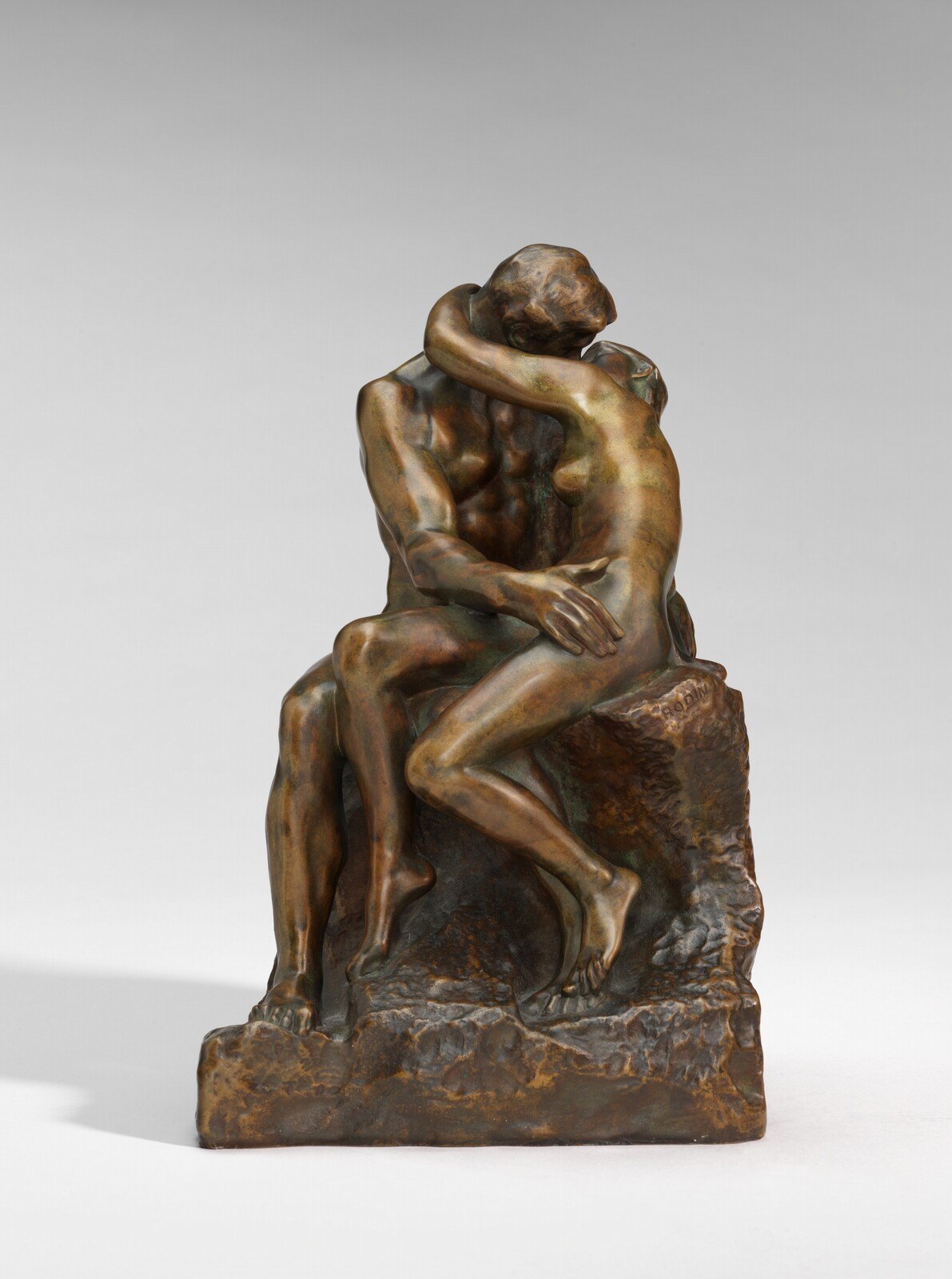
Kate Simpson’s smaller bronze gives a comparison in another material and scale for Jacobsen’s marble. National Gallery of Art, Washington, Gift of Mrs. John W. Simpson, 1942.5.15. Image source. CC0 / Public domain.
Progress reported beside the other Copenhagen works
On 1 September 1902 Rodin wrote to Jacobsen that work on the marble was continuing and that he could give no precise update in that letter. The commissioning agreement had specified first-quality Carrara marble at the scale of the original. Two years into the commission, the exchange was about the actual pace of work. Read beside the demand for personal completion in the original order, the later letter shows the difference between terms accepted for a future work and what Rodin was prepared to promise while it was being made. [2] [15]
The October order puts a number on what was being negotiated. Jacobsen set the price of six works at 70,000 francs and proposed reimbursing the marble block against the supplier’s bill. The payments were to be spread over four years, with the last instalment due in October 1904 if everything had been delivered. The Glyptotek was to pay for packing. These terms give the block a distinct place in the transaction. It was part of making the marble and, for the patron, an expense that could be settled from a separate document. The figure of 70,000 francs belongs to the group of works and cannot be assigned to the marble alone. [2]
The marble stays in the studio
By July 1903 Rodin could tell Jacobsen that the marble had been made. He still wanted to keep it for several months so he could judge the work and finish it. Jacobsen’s August reply treated the carving as well advanced and looked forward to discussing the final placement of Rodin’s works if the sculptor visited Copenhagen the following spring. He pictured an outdoor site for the Burghers of Calais and asked whether the weather might harm its patina. For the marble, the exchange documents a period in which the carving was far enough along to report to the patron and its departure from the studio still lay ahead. [13] [14]
Arrival in Copenhagen
The wait remained a practical concern. On 12 January 1903, Jacobsen wrote to Rodin after the safe arrival of Saint John the Baptist. He asked when the Glyptotek might expect The Burghers of Calais and The Kiss. In the same letter, he pursued plaster works, explaining that an original plaster could make a different impression from a bronze already in the collection. His interest extended beyond collecting famous subjects to experiencing them in different materials. [9]
On 23 February 1904 he could finally announce that The Kiss had arrived. His gratitude was exuberant: he wished he could celebrate Rodin and the group in poetry, but said he could not make two lines rhyme. The practical collector quickly returned. He still needed the cost of the marble block, and he was awaiting plaster sculptures of Victor Hugo and The Shade before the room containing Rodin’s works could be arranged. [10]
That letter places the arrival before the foundation database’s placement date of 1 March 1904. It also gives the embrace a wider setting. Jacobsen was building an encounter with Rodin across several subjects and materials, with the marble group becoming part of a room whose arrangement still depended on further deliveries. [1] [10]
The Glyptotek today frames its sculpture collection through Jacobsen’s enthusiasm for the expressive possibilities of the medium. Its account of Rodin stresses rough surfaces, fragments and the transformation of works through new combinations, sizes and titles. The Kiss offers an approachable entrance into those concerns. The subject is immediately legible, but a slower look keeps returning to the stone: where it yields to a body, where it remains a block, and how those two conditions make the embrace feel alive. [11]
What Jacobsen could settle while the room was being arranged
Jacobsen’s letter of 18 August 1903 restated the collective sum and kept the block expense separate. It also reported that the bronze Burghers of Calais had suffered a few scratches in transit. The letter records the sort of thing the Glyptotek had to account for when a large sculpture moved out of the workshop. The packing, the condition on arrival and the accounting did not all belong to the same person. The condition report concerns the bronze. The account also lets us trace an outstanding question about the marble while the other sculptures were already arriving. [16]
On 23 February 1904 Jacobsen asked again for the block’s price so he could bring the account closer to settlement. This was in the same letter in which he confirmed the marble’s arrival and sought news of the two remaining pieces needed to arrange the room. The acquisition could therefore advance on different schedules. The marble had reached the museum. An expense attached to its making still had to be confirmed. The room’s final arrangement depended on other works. The letters let us follow each stage separately, even though all three mattered to Jacobsen’s plan for the display. [16] [10]
 Auguste Rodin.jpg)
Frequently Asked Questions
Rodin artworks directory
Discussion
Look at how the bodies emerge from the stone, then consider the patron’s requests for this particular marble.
Reader Insights
Where does the stone seem most resistant to becoming a body?
How does the commissioned version’s history change your looking?
Which part of the embrace carries your attention beyond the kiss?
Join the Conversation
Share a detail, comparison or question about The Kiss in Copenhagen below.
References
- Ny Carlsbergfondet. “Kysset” [The Kiss]. Collection/foundation record for Auguste Rodin, M.IN. 609; no publication date stated. Danish. Object record, dimensions and execution history. Accessed 28 October 2026. View source.
- Carl Jacobsen. Letter to Auguste Rodin, Paris, 21 October 1900. Carl Jacobsens Brevarkiv, Ny Carlsbergfondet; Glyptotekets arkiv. French transcription with Danish translation. Commission, material, payment and completion conditions. Accessed 28 October 2026. View source.
- Musée Rodin. “The Kiss.” Collection record for S.1002 / Lux.132; no publication date stated. Paris marble and the composition’s history. Accessed 28 October 2026. View source.
- National Gallery of Art, Washington. “The Kiss (Le Baiser).” Collection record for 1942.5.15; no publication date stated. Dante, the book and the independent composition. Accessed 28 October 2026. View source.
- Ny Carlsbergfondet. “Bringing Rodin to Copenhagen.” No publication date stated. Jacobsen’s collecting and the correspondence archive. Accessed 28 October 2026. View source.
- Victoria and Albert Museum. “Auguste Rodin: production techniques.” Updated 12 May 2026. Workshop collaboration and carving. Accessed 28 October 2026. View source.
- Musée Rodin. “Marble carving.” No publication date stated. Measured transfer from plaster and carving tools. Accessed 28 October 2026. View source.
- Albert E. Elsen. Rodin. New York: The Museum of Modern Art; distributed by Doubleday, Garden City, New York, 1963, p. 133. Scholarly discussion of marble, assistants and Rodin’s participation. Accessed 28 October 2026. View source.
- Carl Jacobsen. Letter to Auguste Rodin, Copenhagen, 12 January 1903. Carl Jacobsens Brevarkiv, Ny Carlsbergfondet; Glyptotekets arkiv, Carl Jacobsens kopibøger, Kopibog 15, moderne kunst 1899–1913. French transcription with Danish translation. Outstanding deliveries and impressions made by different materials. Accessed 28 October 2026. View source.
- Carl Jacobsen. Letter to Auguste Rodin, Copenhagen, 23 February 1904. Carl Jacobsen’s Correspondence Archive, Ny Carlsbergfondet; Glyptotekets arkiv, Carl Jacobsens kopibøger, Kopibog 15, moderne kunst 1899–1913. French transcription with Danish translation. Arrival, gratitude, the marble bill and the Rodin room. Accessed 28 October 2026. View source.
- Ny Carlsberg Glyptotek. “French and Danish Sculpture 1800–1920.” Permanent collection presentation; no publication date stated. Jacobsen’s taste and the museum’s account of Rodin. Accessed 28 October 2026. View source.
- Tate, Tate Collection metadata, artwork_data.csv, October 2014 snapshot, released under CC0. Repository readme states that this dataset is no longer maintained. Downloaded and artist rows inspected 28 October 2026. View source.
- Auguste Rodin to Carl Jacobsen, 1 July 1903. Carl Jacobsen’s Correspondence Archive, Ny Carlsbergfondet. View source
- Carl Jacobsen to Auguste Rodin, 3 August 1903. Carl Jacobsen’s Correspondence Archive, Ny Carlsbergfondet. View source
- Auguste Rodin to Carl Jacobsen, 1 September 1902. Carl Jacobsen’s Correspondence Archive. View source.
- Carl Jacobsen to Auguste Rodin, 18 August 1903. Carl Jacobsen’s Correspondence Archive. View source.