


 by Tom Gurney
Tom Gurney BSc (Hons) is an art history expert with over 20 years experience
Published on June 19, 2020 / Updated on November 18, 2026
Email: tomgurney1@gmail.com / Phone: +44 7429 011000
Two Women Embracing
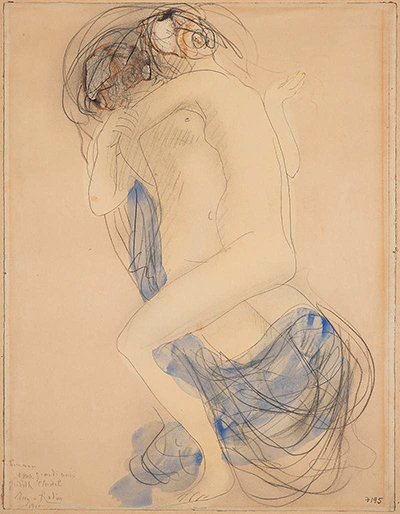
Two women draw close at the top of Auguste Rodin’s Two Women Embracing. Their heads meet amid dark loops of graphite, and a lifted leg crosses the middle of the sheet. Blue pigment gathers beside the upper bodies and again among the tangled lines near the bottom. The Musée Rodin catalogues the drawing as D.07195 and dates it to about 1908. A dedication to Judith Cladel at the lower left bears the date 1911. The drawing and its inscription thus preserve evidence of two moments, one in the making of the image and another in the history of the sheet. [1]
The embrace at the top of the sheet
The two heads take up a small area. They are close to the upper border, which gives their curves comparatively little room to spread. Loose strokes of graphite run over one another above the brows and through the hair. Some follow the turning heads closely, while others continue into the paper around them. The exact point where one face ends and the other begins can be hard to locate. The closeness is clear from farther away because the darkest marks bring the heads together into one area. Their position gives the softer outlines below a place from which to unfold. [1]
A curved outline drops from the cluster of heads and sweeps around a shoulder. From there it descends almost vertically before turning in towards the waist. Inside that longer contour, short marks indicate another shoulder and the direction of an arm. The pale paper carries much of the area between these lines. Beneath the heads, the embrace is built from a few points where lines cross and from stretches where they nearly meet. A narrow patch of blue beside the bodies makes the space between an arm and the torso easier to see. [1]
On the other side a small hand is faintly visible outside the strongest sweep of the contour. Its lightness makes it easy to pass over, especially beside the weight of the graphite near the heads. Once it comes into view it extends the upper gesture into the open space on the right. The distinction between its faint outline and the crowded drawing in the hair allows the embrace to feel close without closing off the entire upper part of the sheet. [1]
The leg and the drapery
The most legible movement in the middle is the long diagonal of a thigh. It goes across the body before turning at the knee to descend towards the bottom edge. The outline remains relatively clean along this stretch. Beside it, the gathered blue cloth is marked by a series of curves, some parallel and some crossing. Those lines form a large, rounded area towards the right. The knee projects to the left of it, giving the eye a clear bend to follow between the rounded mass of material and the pale outline of the leg. [1]
Near the bottom, one foot is indicated by a few lines that approach the border and then turn back into the drawing. A blue patch close to it spreads beyond some of the pencilled loops. The colour can read as part of the cloth higher up and as a loose mark on the paper farther down. This range matters to the movement of the lower half. The leg can be followed fairly continuously, while the cloth and wash let that movement spread further out in shorter, less predictable directions. [1]
The museum identifies graphite, stumping, watercolour and gouache on smooth paper. Stumping softens pencil marks and helps explain the diffused tone around parts of the figures. The hair and lower drapery contain darker, more distinct strokes. The wash belongs to the same drawing surface but works on a different scale, gathering several pencil lines into one patch. Looking from the blue towards the heads makes the different roles of tone apparent. Colour gives weight to the lower shapes, while the concentration of pencil at the top brings the faces near one another. [1]
Watch Rodin’s sculpture up close
Five films explore Rodin’s sculpture, from his use of classical models and the figures on his monumental doorway to the work of his studio.
Auguste Rodin – Challenging Beauty
Six sculptures show how Rodin adapted classical models.
Watch on YouTubeA dedication to Judith Cladel
The lower-left corner carries the dedication the Musée Rodin transcribes as hommage à ma grande amie Judith Cladel Aug. Rodin 1911. Rodin offers the drawing in tribute to a close friend. Cladel was a writer and journalist who became his biographer. The Musée Rodin’s index of the sculptor’s correspondents records an extensive exchange with her, spanning years before and after the approximate date of the drawing. The dedication places the sheet within that relationship and provides evidence that Rodin was still attending to it in 1911. The museum’s dating of the drawing itself remains about 1908. [1] [2] [3]
The inscription occupies a quiet part of the paper below the main bend in the leg. Its scale means a viewer can take in the embrace before seeing the words. The sheet is 32 by 24 centimetres, small enough to look at from a distance at which both the words and the lightly drawn foot can be examined. The writing is also a useful means of identifying this particular example. The legacy reproduction shows the note in the recorded position, and the number at the lower right corresponds to the digits of the museum inventory. [1]
Other drawings of embracing figures
A drawing from Rodin’s sketchbook known as Carnet 46 carries the same French title in the Musée Rodin catalogue. The museum dates it to about 1880 and records graphite on a smaller sheet, D.06966. The later drawing can be distinguished by its blue pigment, its dimensions and the Cladel dedication. The title describes a recurring subject, so the material features and inscriptions are especially important in identifying the work reproduced. [1] [4]
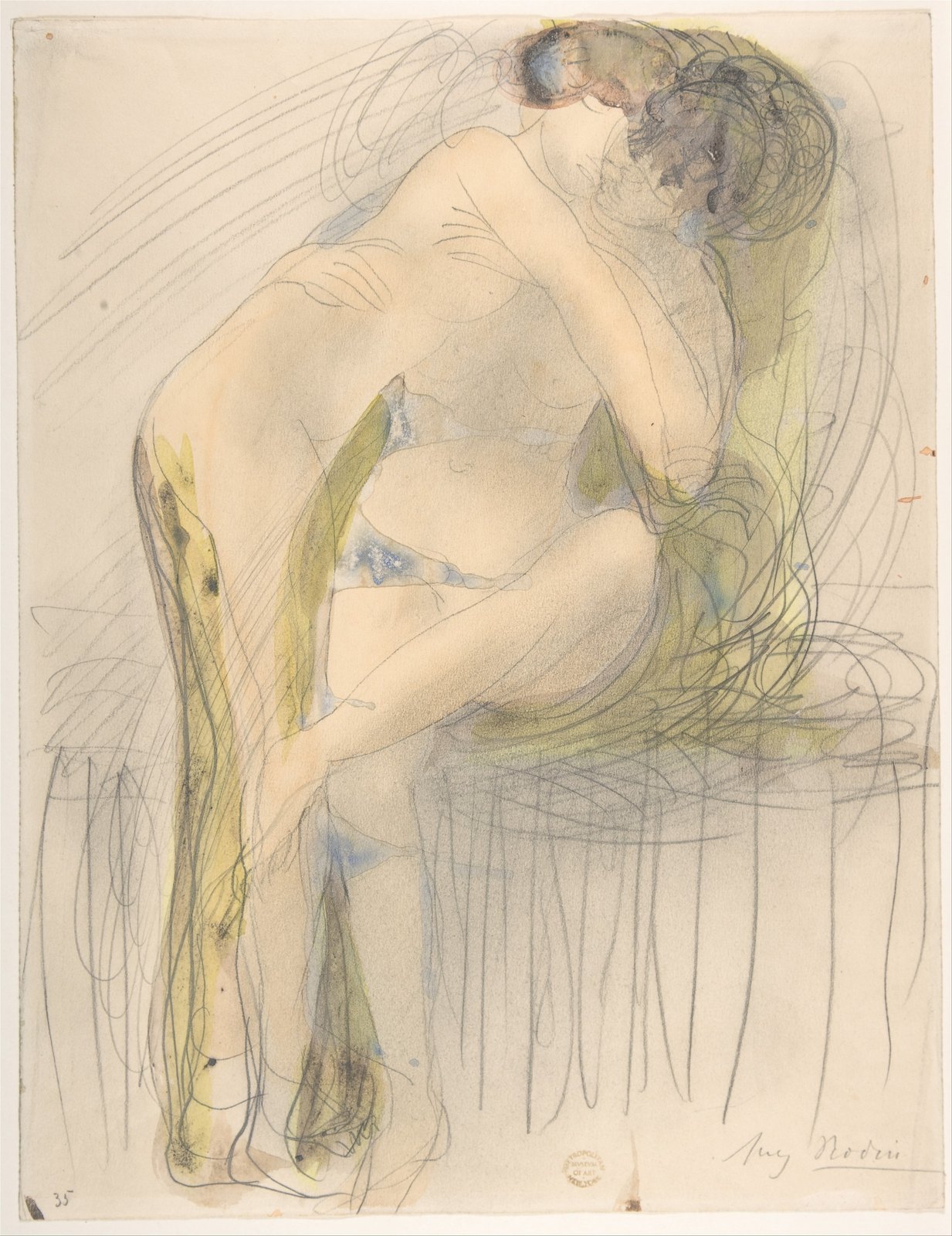
The Embrace at the Met offers a separate example of how Rodin used wash around two bodies. The Metropolitan Museum of Art, John Stewart Kennedy Fund, 1910, 10.66.6. Image source. CC0 / Public domain. Resized for the web.
The Musée Rodin has also shown embracing figures in its exhibition on drawing and cutting out. It describes how Rodin could trace an outline, add colour or rearrange bodies from earlier drawings. In this sheet, the long outline at the waist and the repeated marks around the heads show two ways of describing contact on a single surface. The contour across the leg is easy to follow, whereas the dark mesh above leaves some of the divisions open. The eye can move between those degrees of definition and read both the balance of the bodies and the closeness of the embrace. [1] [5]
A cut-paper embrace
Another sheet in the Musée Rodin, D.05197, carries the same French title. The catalogue records graphite and watercolour on cut paper and identifies a second drawing, D.06298, as a tracing of it. That link gives a concrete instance of an embrace being carried from one surface to another through its outline. A tracing could retain the arrangement of the figures while leaving room to reconsider the relation between the drawn line and the edge of the paper. In the Cladel drawing the blue wash and the handwritten dedication belong to the intact field around the bodies. The cut-paper sheet gives a different physical status to the surrounding space because part of the composition depends on the shape of the support itself. [1] [5] [6]
Rodin artworks directory
Discussion
Look again at the images and ideas explored in Two Women Embracing. These editorial prompts invite your observations.
Reader Insights
After reading “The embrace at the top of the sheet”, what detail would you look for in the object or image?
What extra evidence would help you distinguish the artist’s choices from the effects of material, viewpoint or later display?
Join the Conversation
Share a detail, comparison or question about Two Women Embracing below.
References
- Musée Rodin. Deux femmes enlacées, D.07195. View source.
- Musée Rodin. Mécènes, commanditaires et collectionneurs de Rodin. View source.
- Musée Rodin. Fichier des correspondants de Rodin, Judith Cladel entry. View source.
- Musée Rodin. Deux femmes enlacées, D.06966. View source.
- Musée Rodin. Dessiner, découper. View source.
- Musée Rodin. Deux femmes enlacées, D.05197, and its related tracing. View source.

 Auguste Rodin.jpg)





