


 by Tom Gurney
Tom Gurney BSc (Hons) is an art history expert with over 20 years experience
Published on June 19, 2020 / Updated on November 18, 2026
Email: tomgurney1@gmail.com / Phone: +44 7429 011000
Despair
A seated woman grips one foot in both hands in Auguste Rodin’s Despair. Her back bends, her head drops between her shoulders and the leg she holds stretches away from her body. The other foot rests on the base. Her effort is visible in the reach of her arms and the resistance of the raised leg. Rodin developed the figure while working on The Gates of Hell and returned to the motif as an independent sculpture. Changes in the angle of the leg, the size of the rock and the handling of the base distinguish some of the surviving versions. [1] [2] [3]
A figure pulling against herself
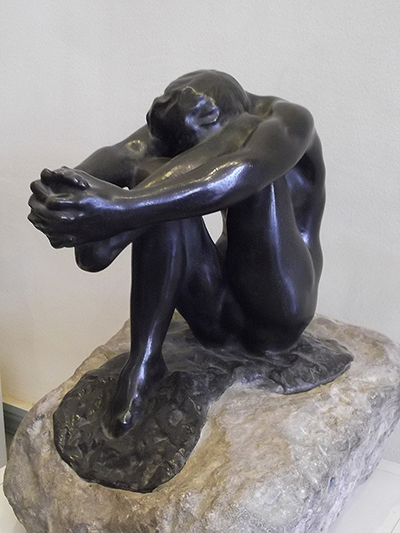
Start with the hands in the photograph. They project to the left, where the pale background gives their outline particular clarity. Both forearms lead to the same point. For a moment the grip can look like an isolated gesture, since the foot is mostly enclosed by the fingers. The underside of the raised foot comes into view just below them. It completes the connection between the two ends of the gesture and shows why the hands are so far from the torso. The arms pull towards the body while the leg presses outwards. The tension passes from the shoulders through the wrists and returns through the foot. [1] [2]
The foot that remains on the base helps explain how this uncomfortable arrangement can hold. Its shin rises near the middle of the figure. The line of the grounded leg is relatively upright in the photograph, while the arms cross in front of it from right to left. There is room for a small interval of light to enter between the limbs. Lower down, the toes come to rest against the dark surface where the bronze meets the stone. The downward path of that leg gives the viewer a stable reference from which to read the long reach of the arms. [1]
Highlights bring out the structure of the pose. Light runs along the nearest forearm and then turns at the elbow. The nearest shoulder catches a broader reflection, so the eye can follow the limb around the curve of the upper body. Beneath it the torso becomes much darker, with a more isolated reflection near the hip. The shadows around the face deepen the sense of a head enclosed by the arms and shoulders. A view from the other side would shift those highlights and make different parts of the face visible. From this position, the gathered limbs and the angle of the neck carry most of the expression. [1] [2]
From the doorway to the exhibition room
The French government commissioned The Gates of Hell in 1880 for a projected museum of decorative arts. The commission gave Rodin years to develop groups and single figures that could take different positions on the entrance or be exhibited separately. The Musée Rodin’s catalogue preserves a doorway study under the French title Le Désespoir de la Porte de l’Enfer. The Metropolitan Museum of Art traces the model for its bronze to the upper part of the left door. Those records help place the sculpture within a changing project in which related forms could appear more than once or take on different proportions. [2] [3] [4]
On the doorway the curve of the body has to register among neighbouring figures. Its tight outline is an effective way to make the posture legible at a distance. A freestanding bronze gives the spectator more time to work out what the hands are doing. Someone moving past it can follow the curve from the shoulders down to the seated figure’s hips, then see how the lifted leg partly interrupts the space between the face and hands. The base provides a visible limit to the action. The eye finishes that circuit where the other foot bears down, with the body still holding its pose. [1] [2] [3]
The small plaster appeared at the 1897 Venice Biennale under a title that describes a shade holding her foot. The title Despair appeared at Rodin’s exhibition in the Pavillon de l’Alma in Paris in 1900. A descriptive title calls attention to the identity of the figure as a shade and to the grip, the most unusual element in the composition. An emotional title shifts attention to the relationship between that grip, the bowed head and the inward bend of the body. The Musée Rodin reads a degree of serenity in the compact figure. A spectator can see how that reading grows out of the controlled outer curve, even while the limbs remain under strain. [1] [4] [5]
Watch Rodin’s sculpture up close
Five films explore Rodin’s sculpture, from his use of classical models and the figures on his monumental doorway to the work of his studio.
Auguste Rodin – Challenging Beauty
Six sculptures show how Rodin adapted classical models.
Watch on YouTubeScale, stone and bronze
The Musée Rodin’s bronze on stone, S.1129, is a documented example of the later treatment. The museum dates its conception to around 1903–04 and records that Alexis Rudier sand-cast it in 1929. It measures 35.5 centimetres high, 36.5 wide and 30 deep. The Met gives its bronze a modelling date around 1890 and a casting date around 1967, with Georges Rudier named as founder. These dates refer to separate events in the history of each object. In particular, the earlier modelling date in New York belongs to the design traced to the doorway, while the later date identifies production of the museum’s bronze. [1] [2]
The stone visible in the photograph supplies a rough plane below the bronze. Its pale surface continues outside the contour of the figure, especially at the front and right, where irregular changes in colour make the pedestal feel like a piece of rock. The upper edge of that stone follows a different rhythm from the smooth turn of the shoulder above. The bronze has irregular textures of its own around the grounded foot and the seat. They make the transition from flesh to support gradual at close range. From farther away, colour draws a much clearer boundary between the two materials. [1]
Tokyo’s National Museum of Western Art catalogues a smaller bronze under the same title, measuring 18 by 9 by 9 centimetres. Its record gives a date before 1890 and transcribes the Alexis Rudier foundry mark. The scale and relatively narrow base show why collectors and museums need measurements as well as a title when identifying a version. A photograph of a figure with a broad stone support provides a useful comparison with S.1129. The accession of the photographed bronze would require details such as its marks or an accompanying object record. The pose, the contact with its support and the different surfaces are visible in their own right. [1] [2] [6]
A narrow plaster from a piece mould
The Musée d’Orsay records a plaster from the Musée Rodin under inventory S.01804. The entry identifies 1882 as the model date and dates the plaster to 1917. It was made with a piece mould, which could be separated into sections to release a cast with projecting parts. The record gives the plaster a height of 32.5 centimetres and a width of only 13.8. Its depth, 28.5 centimetres, is more than twice its width. Those proportions help explain why the profile is informative. Along the narrow front the gesture gathers in on itself, while from the side there is more room to see how far the lifted foot projects from the body. Compare that slender footprint with the width of the later bronze on stone, where the support occupies much more of the frontal view. [1] [7]
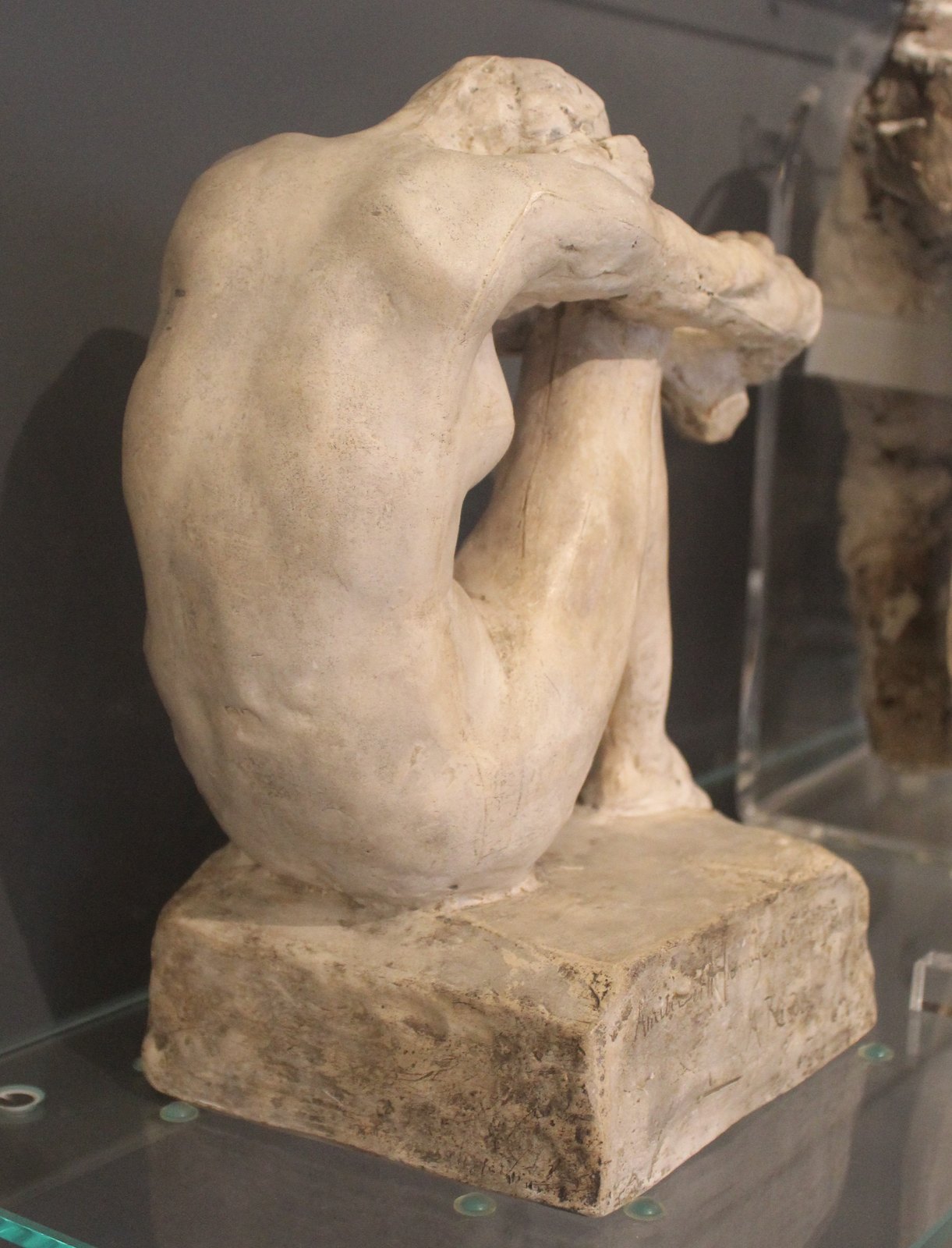
The V&A plaster brings out the narrow space between the raised foot and the torso. Photograph by 14GTR, Wikimedia Commons. Image source. CC0 / Public domain. Resized for the web.
Rodin artworks directory
Discussion
Look again at the images and ideas explored in Despair. These editorial prompts invite your observations.
Reader Insights
After reading “A figure pulling against herself”, what detail would you look for in the object or image?
What extra evidence would help you distinguish the artist’s choices from the effects of material, viewpoint or later display?
Join the Conversation
Share a detail, comparison or question about Despair below.
References
- Musée Rodin. Despair, S.1129. View source.
- Metropolitan Museum of Art. Despair, 1986.155.1. View source.
- Musée Rodin collections. Le Désespoir de la Porte de l’Enfer. View source.
- Musée Rodin. Le Désespoir, exhibition history and versions. View source.
- Musée Rodin. The depths of despair. View source.
- National Museum of Western Art, Tokyo. Despair, S.1959-0014. View source.
- Musée d’Orsay. Le Désespoir, plaster S.01804. View source.

 Auguste Rodin.jpg)





