



 by Tom Gurney
Tom Gurney BSc (Hons) is an art history expert with over 20 years experience
Published on June 19, 2020 / Updated on November 18, 2026
Email: tomgurney1@gmail.com / Phone: +44 7429 011000
The Burghers of Calais
A man carries a key that looks too heavy for an ordinary lock. Another raises his hands to his head. Their companions are close enough to touch, yet their gazes rarely meet. In The Burghers of Calais, Auguste Rodin gave six bronze figures a reason to be together and six different ways of facing what lay ahead. What you see depends on where you stand. From one side a shoulder interrupts a gesture. From another, a face appears between two heads and catches the light. For a monument commissioned by a town to commemorate a shared act, it is remarkably attentive to what each person experiences alone. [1] [2]
What Calais chose to commemorate
The monument takes its subject from the siege of Calais during the Hundred Years’ War. In the account associated with the chronicler Jean Froissart, six prominent townsmen put themselves at the mercy of Edward III in 1347 to save their community. Eustache de Saint-Pierre was the first to offer himself. The men go out with the city’s keys, their heads and feet bare and ropes at their necks. Froissart’s narrative supplies the conventional account behind the monument, including the intercession of Queen Philippa that spares their lives. Rodin depicts the men on their way to surrender, when the possibility of mercy is still beyond their view. [2] [3]
The city council voted in 1884 to honour Eustache. Rodin received the commission in 1885, and the bronze was unveiled in Calais ten years later. A proposal centred on one citizen became a sculpture in which five companions command considerable space of their own. Rodin used the attributes of the story, from the key to the men's clothing, to bring them together. He gave each body a set of pressures and decisions a viewer can recognise even before learning the name or the part played by the individual man. The monument asks us to consider the distance between a public act that can be commemorated and the fear that someone could feel while doing it. [1] [2] [3]
What the keys mean in Froissart’s account
In Froissart’s narrative, the keys are part of the terms of surrender. Edward sends Walter Manny back with the demand for six leading townsmen. Their bare heads and feet, the cords at their necks and the keys they must carry are all specified before anyone volunteers. For the chronicler this lets the reader grasp the position of the town before Eustache stands up. Other people stand up in turn, and the six eventually appear before the king. Taken as a narrative, the sequence moves between several kinds of power. Edward is able to impose the terms. Eustache and the others can offer themselves. Philippa can plead with the king after they have been brought in. The keys pass into the possession of the people who now control the town. [28] [29]
Rodin places the object before its delivery. Jean d’Aire already has the key in his hands, yet there is nobody in the group who can accept it from him. The size of the key makes it legible at some distance, while its position in front of his body directs attention to the wait before the act of surrender. Some figures in the bronze give their attention to spaces where neither the king nor the queen appears. Those absences are part of Rodin’s decision about how much of the story to put before a viewer. A public monument in Calais could easily have represented the meeting with the king, with the recipients and the petitioners in recognisable positions. Here one can stand where a figure appears to be going and still find nothing in the sculpture to confirm how the encounter will end. [3] [20] [28] [29]
The chronicler leaves the figures’ precise gestures open. A demand that the men leave bareheaded tells a sculptor something about their appearance, and little about how high one man will raise his hand or how far another will let his shoulder fall. Froissart can make the town react to each volunteer in sequence. The bronze has all six in place together. The differences among the faces and arms make it possible to encounter an individual response several times over without expecting there to be a single expression the whole town shares. This helps explain why beginning with the keys and the clothing gives a visitor a foothold in the story, while walking around the group gives a different kind of understanding. [2] [3] [28]
How the proposal for one citizen became a group
The municipal council’s 1884 appeal centred on Eustache de Saint-Pierre. Omer Dewavrin, the mayor, had to find a sculptor who could give that appeal a public form. The Met’s catalogue describes Rodin’s competing proposal alongside those of Émile Chatrousse and Laurent-Honoré Marqueste. What made Rodin’s proposal distinctive was the combination of six people in a single span of ground and the choice of when to show them. They were leaving Calais, with the encounter with Edward ahead of them. The choice allowed the sculpture to dwell on what it cost to leave the town rather than taking the eventual pardon as the climax. A gesture could be given a significance that would have been different had the men already been kneeling before the king. [3] [8]
The first maquette retained a prominent architectural support. The Musée Rodin records an example dated 1884 at 61 centimetres high. Its scale made the proposed relation between pedestal and group visible at once. In the Met’s account of the design, Eustache led, and a rope connected the men. That link would have helped the eye follow the group in a common direction. Rodin’s letter to Dewavrin also presented the base in terms of triumphal architecture. It would have framed the choice made by all six while letting Eustache retain a conspicuous role. In photographs of the later group, the eye can work its way between men whose bodies rarely seem committed to the same direction. The difference began in the design, before any argument about the height of the finished bronze. [3] [8] [9]
Six studies that could be moved around
In the development of the second maquette, Rodin worked with figures on individual bases. The procedure gave him freedom to change the distances and directions they took in relation to one another. It also leaves a problem for anyone trying to reconstruct the 1885 presentation. The Met catalogue describes a reconstruction by Cécile Goldscheider based on lines on the bases, a local newspaper description, and photographs found by Albert Elsen. These traces do not all give the same arrangement. A line on the base can show that two parts once met in a particular way. A photograph can establish an arrangement as seen from one direction. A review can tell us what struck a contemporary spectator. Each says something about the work, and the differences make it difficult to give all three the date and status of one definitive installation. [8]
The committee’s objection to the study concerned the disposition of the bodies as much as the face of any one man. As reported in the Met publications, the commissioners wanted more variety in height and a silhouette closer to the established pyramid of heroic monuments. They also disliked the appearance of dejection. Those objections help explain why keeping the six figures on one level mattered. A group that rises towards a single head makes it easy to locate the person in command of the scene. Rodin let the eye move among heads, hands and feet, with a different emphasis from each position. The history of the criticism shows that this was an intelligible choice even to people who disapproved of what they saw. [3] [8]
The individual figure of Eustache offers a smaller study of the same problem. The Musée Rodin preserves both a nude study for the second maquette and a clothed figure for it. The Met’s catalogue connects the nude to the painter Jean-Charles Cazin, who was from Calais and claimed descent from Eustache. The figure gave Rodin a body with a particular direction of the head and placement of the arms. The later drapery gives that structure more weight at the shoulders and along the falling sides of the body. A viewer who compares the studies can look for what survives the addition of cloth. One may see the head still tipped towards the ground, while the garment changes how slowly the eye reaches the hands. The casting or modelling date on one object should be read with its own collection record before assigning it to every version of Eustache. [8] [10] [11]
Six figures and several directions
Eustache has the stoop of an older man. His head projects forward, and the folds of his garment carry the downward pull of his shoulders. Jean d’Aire holds the key in front of him. The heavy shape becomes a point of concentration, and the relative steadiness of his body makes the differing poses around him more apparent. Pierre de Wissant brings a hand up where it can be read against open space, with his head and torso oriented away from the simple direction of a march. Across the group, the figures’ feet establish a common level while the turns of their heads break up any suggestion that all six are looking at the same thing. [2] [3]
The hands are large enough to carry information a face alone could never convey from a distance. A spread palm can register an involuntary response or a deliberate farewell. A figure covering his face gives you little access through his eyes, so the space enclosed by his arms and the bend of his spine take on unusual importance. Differences in the figures’ heights and silhouettes allow those gestures to appear, disappear and appear again as you move. The coarse drapery makes the exposed heads, hands and feet especially vivid, and it gives even the quieter figures a strong pattern of shadow. [2] [3]
An individual study can reveal something that the bronze group hides. A photograph preserved by the Musée Rodin shows Eustache modelled in clay in the studio, while a photograph attributed to Charles Bodmer shows the nude Pierre de Wissant with the group’s model behind him. The Musée Camille Claudel reproduces both photographs in its account of Rodin’s workshop. They show how the sculptor could work on a body at its own scale, then see how that body contributes to a gathering. The surviving individual sculptures let you make that comparison yourself. A hand seen past a companion’s shoulder in the final group is fully visible in an independent figure or study. [3] [4]
Pierre de Wissant, from pointing to shielding
In the first maquette Pierre raises his arm in a gesture the Met’s catalogue reads as pointing towards himself. The young face and full head of hair make the gesture seem more like a question than a declaration. The nude study for the second maquette gives the arm a different job. The head looks down over the right shoulder and the raised limb seems to shield him. Seen from the side, it opens a space in front of the face that looks different from the space a pointing gesture would have addressed. The change can be followed through an actual object. The Met’s nude study, 1984.364.11, was modelled in 1885 and the museum dates its Rudier bronze to before 1950. It stands 67.6 centimetres high. That date range and size belong to the small bronze, separately from the enlarged nude figure visible in a studio photograph. [8] [17]
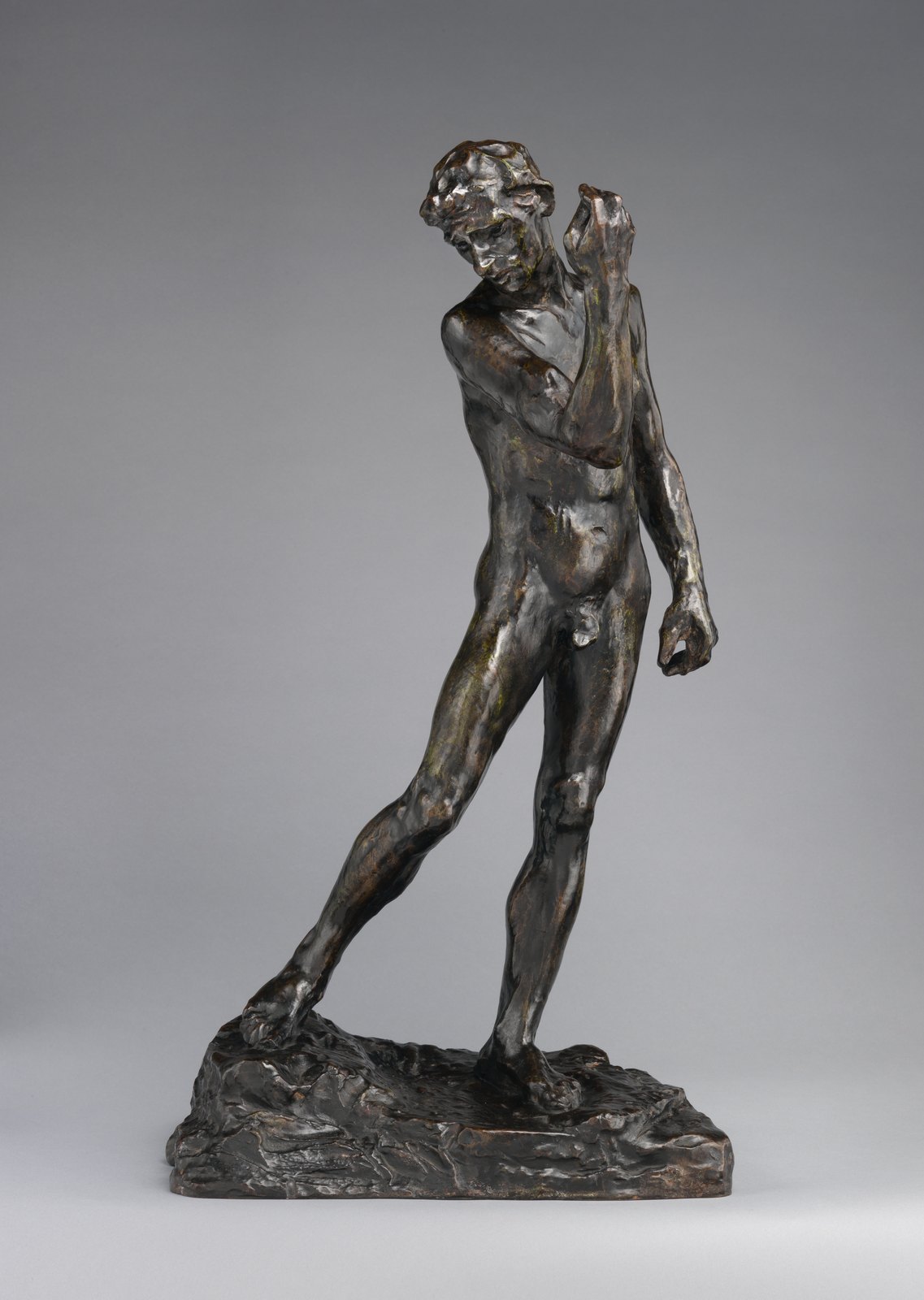
The Met’s nude study clarifies the pose beneath the drapery of the monument. The Metropolitan Museum of Art, Gift of Iris and B. Gerald Cantor Foundation, 1984, 1984.364.11. Image source. CC0 / Public domain.
At a later stage the head became more sharply marked. The Met catalogue describes a study with shorter hair, tightened brows and a partly open mouth, close to the appearance of the final figure. It also notes that the rope present in the second maquette leaves the neck unencumbered in the final version. Look at the tendons there and then at the angle of the raised hand. The space in front of Pierre is framed at one end by his fingers and at the other by the turn at the neck. When another burgher’s shoulder interrupts the view of the arm, the strained neck can still carry some of the expression. When a few steps reveal the palm again, a small turn of the head takes on the character of a larger bodily refusal or farewell. [2] [8]
Jean de Fiennes and the open arms
The Met’s half-clothed study of Jean de Fiennes puts the loose shirt to work between the arms and the body. A viewer can follow the lower edge of the hanging cloth back up towards the wrists. That path makes the outward reach register across the width of the figure, even if one hand is more strongly lit than the other. The catalogue treats the figure as an intermediate trial and records that the identification of this design with the one presented to the council in 1885 has been questioned. It dates the modelling to 1885 and the bronze, 1986.37.1, to 1969. The casting gives the trial design a physical presence for present-day viewers while leaving the evidence about the historical display open. [18] [19]
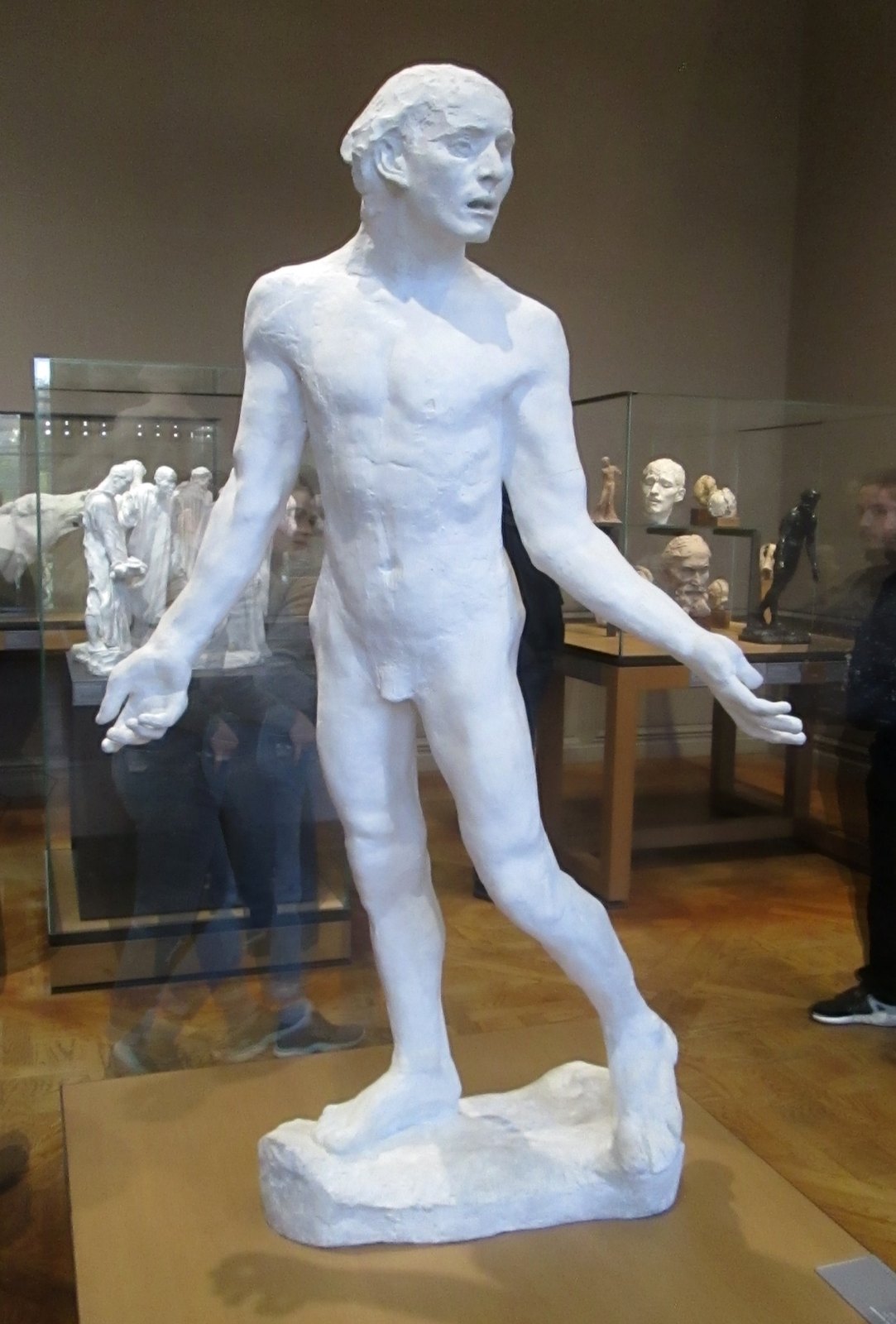
The plaster shows the gesture Rodin developed before clothing the figure. Photograph by Beyond My Ken, Wikimedia Commons. Image source. CC BY-SA 4.0. Resized for the web.
In the finished group the gesture can be read in another way. An arm seen in full on an isolated model competes there with figures passing in front of it. The broad spread has places where a viewer can enter it visually, and the broken views give the eye a reason to move. There is also a difference between the silhouette of cloth held away from a single torso and cloth that runs down near a neighbour. In the early trial the cloth gives the arm an extension even below the elbow. Set among several figures, that mass would affect the view of body and base around it. The Met’s acquisitions essay raises the weight of the drapery as one possible reason for modifying the trial. What the comparison demonstrates directly is how much a change in cloth can alter the space available for a gesture. [2] [18] [19]
A key and a face that has disappeared
Jean d’Aire provides a steady point from which to find the less conspicuous expressions. His key falls in front of the thighs. The long folds immediately beside it lead the eye down in nearly the same direction. In the National Gallery of Art’s separate reduction, whose bronze casting is dated probably to 1895, a raised turn of the head pulls away from the direction indicated by the key. This is a useful pairing of details to trace before returning to the monument. The hands hold a visible part of the story while the face retains some independence from it. A key could easily function only as the sign of surrendered authority. Positioned where the arms have to carry it, it becomes a weight that differentiates Jean’s pose from the uncovered hands farther around the group. [3] [20]
Andrieu d’Andres offers a case where the sculptor limits what can be learnt from a face. The arms rise and cover it. From the front the gesture closes the figure to anyone trying to catch his eyes. Seen from the side, the bend at the upper back and the outline of an elbow make it easier to follow the action as a physical effort. The Met’s Weeping Burgher, 40.12.6, is a bronze study only 43.2 centimetres high, modelled in 1885 and cast around 1908–09. At this smaller scale the enclosure made by the arms can be taken in almost at a glance. In the monument a viewer who first notices the hand of Pierre or the key of Jean may take much longer to find Andrieu. The group makes distinct responses available in succession, and the sense that one person is holding himself apart can grow stronger as the others come into view. [2] [3] [21]
Watch Rodin’s sculpture up close
Five films explore Rodin’s sculpture, from his use of classical models and the figures on his monumental doorway to the work of his studio.
Auguste Rodin – Challenging Beauty
Six sculptures show how Rodin adapted classical models.
Watch on YouTubeJacques de Wissant and a hand studied on its own
In the first maquette Jacques de Wissant faced Jean de Fiennes behind the foremost figures. The position made it possible to read one man in relation to another before paying much attention to their individual faces. The later studies offer a chance to reverse that order. The Musée Rodin catalogues an 1885 sketch of the head of Jacques for the second maquette. A separate study like this can turn a small inclination into the subject of the whole object. The viewer can attend to the projection of the chin or the weight of the head before thinking about whose shoulder might hide it. In the full group a head turning across a space can briefly seem to address the figure beyond it. As one goes on around the base, the apparent conversation can disappear. [3] [8] [23]
The evidence of the hands complicates the idea that each man had to be invented from entirely different forms. The Musée Rodin records that Rodin used the same hands for Pierre and Jacques. In the museum’s account of its studio materials, a photograph by Freuler shows a clay study of their left hand suspended by a thread. The arrangement let the hand hang without the rest of an arm fixing its appearance. A photograph records what the fingers do under their own apparent weight and allows the angle to be studied after the setup has been taken down. What matters in the finished monument is where such a form sits. A hand against a turn of cloth will seem more constrained than a similar hand silhouetted farther from a body. Rodin could give two figures distinct gestures through the direction of the arm and the position of the torso while drawing on a shared study. [24] [25]
The Musée Rodin contrasts the workshop photograph with Albert Rudomine’s later photographs of the Wissant hands, made around 1950. Rudomine arranged hands vertically so that they could be seen together in light and shadow. His photograph gives an isolated form a different scale of attention. In front of the complete bronze a visitor has to work to keep even one hand in sight. The later photographs let the fingers occupy the centre of a composition, showing why individual studies can be valuable for looking at the monument even when they give a different impression from seeing the gestures in place. [24] [25]
From the exhibition plaster to the Calais unveiling
Rodin could show the full group before the city had a bronze ready to unveil. The Met’s catalogue places its public presentation in plaster at the 1889 exhibition with Claude Monet at the Galerie Georges Petit. Octave Mirbeau praised the work in the press. For a visitor in 1889, the presence of the plaster meant that the men could already be seen and judged together. For Calais, there was still the question of financing and completing the commission. Dewavrin’s departure from the mayoralty interrupted support for the monument, and the Met’s account places the completion of the subscription after his return. The Musée Rodin’s teaching dossier identifies a lottery and state funding as part of the financing of the bronze. [8] [24]
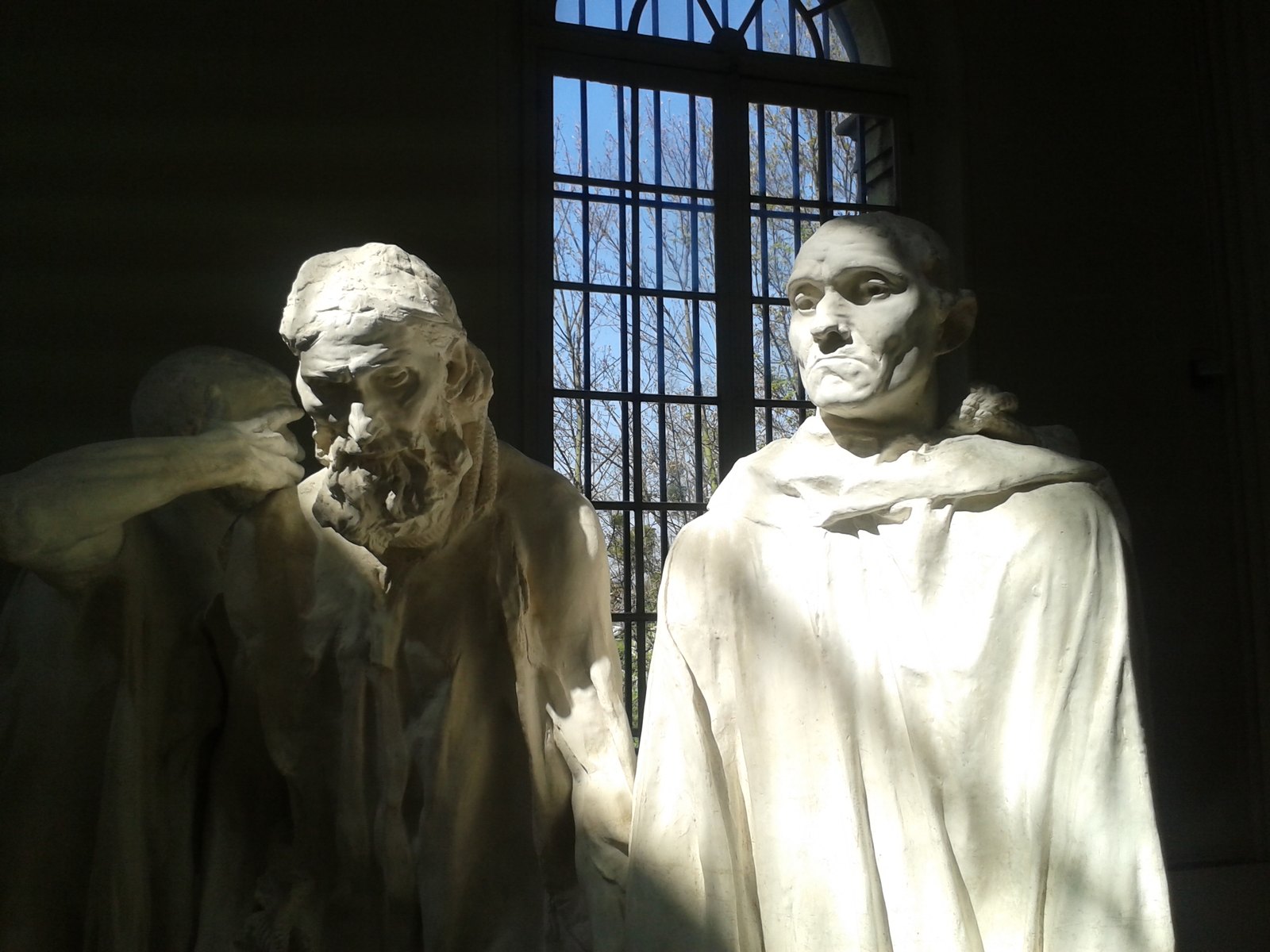
Two figures in the Meudon plaster show how their drapery and gestures read at close range. Photograph by Adoc, Wikimedia Commons. Image source. CC BY-SA 4.0. Resized for the web.
On 3 June 1895 the bronze was unveiled near the Richelieu Garden. The account in the Met catalogue describes a municipal celebration whose events included music, a procession and fireworks. Those activities brought residents together to see a work in which the figures have few easy signs of solidarity. The celebration made a place for communal pride. The sculpture gave prominence to lowered heads, heavy clothing and gestures that did not make the route ahead look easy. The bronze was raised on a high pedestal behind a fence. To approach the casting meant approaching the enclosure first, which was a very different encounter from coming alongside the men as they seemed to leave the town. [1] [8]
The Met catalogue dates the transfer to the front of Calais town hall to 1925 and describes a lower mounting there. The French heritage inventory identifies the town hall location and records the signature on the right side of the base. The move brought the monument into a setting closer to the one Rodin had discussed for a low placement. The building gives the figures a place from which they might be imagined to set out, even though the people who commissioned them belonged to a much later Calais than the people they depict. [8] [26]
The base carries evidence of the city’s casting as well as of its later display. The French heritage inventory transcribes Rodin’s name on the right side and the Leblanc-Barbedienne name on the left. Seeing them as two records prevents the label on one side from doing all the work of identification. One names the artist responsible for the design, and the other places this bronze with the foundry that made it. A photograph of a face taken near the top of the group cannot usually give that information. A view low along the base may reveal it while telling us very little about the gesture for which the photographer normally looks. For the original Calais work the heritage record anchors both names to the same casting. New York’s Coubertin attribution and Tokyo’s Rudier mark belong to their respective bronzes. [5] [6] [26]
The height of the encounter
The London history shows how long a decision about a pedestal can remain open to dispute. The Musée Rodin records Rodin returning to the idea of a high silhouette when a cast was acquired for Britain. Historic England dates the London erection to 1915. The setting and terms of display became matters of parliamentary concern. In 1912, while provision was being made for a base, a debate about the Houses of Parliament included questions about the suitability of Victoria Tower Gardens. The shape of the landscape and the proposed use of space were already in discussion before a visitor could stand in front of the bronze. [7] [12] [13]
The Musée Rodin describes two possibilities he entertained. A high mounting could put the figures in silhouette against the sky. A placement near the pavement could let the six stand almost among the people looking at them. These alternatives bring out different qualities of the same sculpture. Against the sky, the outlines of the separate men can become vivid at a distance. Close to the ground, the figures are near enough for an observer to catch the difference between a man’s lowered head and the hand he raises in front of him. [1]
The Calais installation of 1895 adopted another arrangement. The site could accommodate a traditional civic monument, but the raised base would give passers-by a different experience from the direct encounter Rodin had imagined for a low placement. At the Metropolitan Museum of Art, the bronze has been displayed near floor level. The enlarged hands, uneven turns and gaps between the figures then become visible to someone standing only a few steps away. Comparing photographs of installations can help, particularly when they include enough of the base and its surroundings to show how far the figures are above the viewer’s eyes. [1] [2]
The Musée Rodin’s exhibition on sculpture and space brought the issue back into the gallery by showing the group about four metres above the floor of the chapel. The exhibition account places the installation in relation to an earlier scaffold Rodin used in 1913 to gauge the proportions of the London mounting. The scaffold and its later museum counterpart allowed an elevated view to be tried out without treating a temporary support as the finished pedestal. It also makes clear why putting every version close to the viewer’s feet would miss part of the history. Height was something Rodin tested in relation to a setting, and a change of height can give priority to a different part of the same bronze. Looking up, the sky or ceiling can open around an elbow even as the head becomes hard to make out. Near the level of the figures, the way an arm is turned towards another body may become clearer while the outer silhouette loses some of its force. [7] [22]
London’s pedestal after Rodin
In 1927 a question in the House of Commons asked whether the pedestal in Victoria Tower Gardens could be lowered to let the public study the work to better advantage. In 1953 a member returned to the problem and explicitly said he preferred the treatment in Calais. The minister defended the London mounting by pointing to Rodin’s approval. These exchanges are evidence that people disagreed not only about what Rodin had wanted but about the experience they should have in front of the figures. A pedestrian can read a silhouette clearly at a distance and still have difficulty seeing the features of a hand low in the group. A decision made in consultation with the sculptor could therefore be defended on historical grounds while continuing to disappoint somebody who came to look closely. [7] [14] [15]
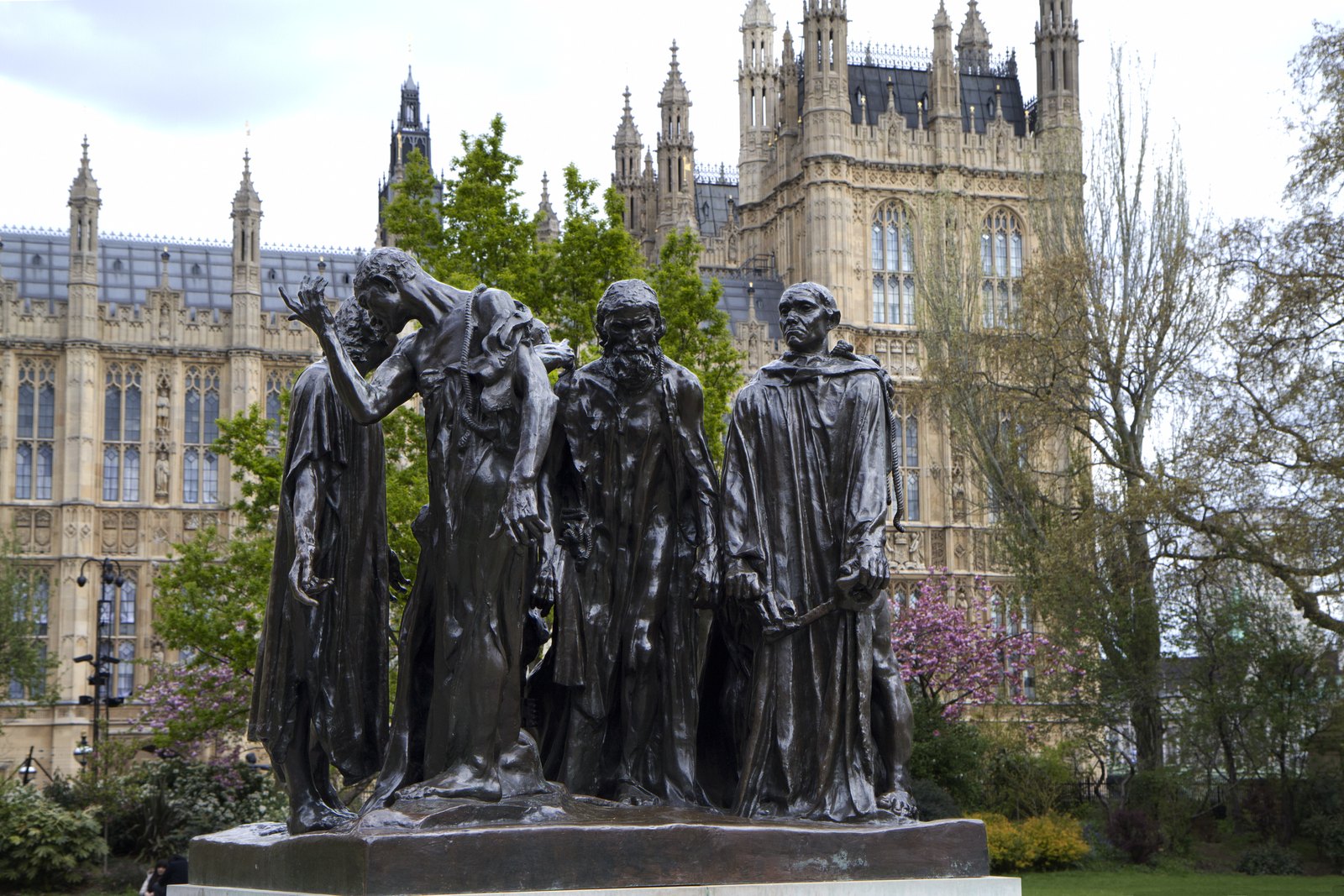
The London photograph shows the monument and its pedestal together. Photograph by JD, Wikimedia Commons. Image source. CC BY 2.0. Resized for the web.
Historic England records the group’s resiting in 1955–56 in the course of changes to the northern end of the gardens. That move gives London’s installation a further date of its own, distinct from acquisition and from the 1915 erection of the bronze. It also makes the background of a photograph worth checking. A view taken across a public path can tell us where a visitor might have seen the group in the garden, and the difference in background across two photographs may come from a change of position rather than a different casting. London’s history is therefore part of the history of how the composition has been seen. The figures could keep the same relations on their base while the approach to them changed. [12] [16]
Bronzes in different places
The 1895 Calais bronze belongs to the history of the city’s commission. Later bronzes carry the composition to other institutions and bear their own casting dates. Tokyo’s National Museum of Western Art records its bronze as S.1959-0008, cast in 1953. The Metropolitan Museum of Art’s 1989.407, a gift of Iris and B. Gerald Cantor, was cast in 1985 at the Coubertin Foundry. A date on either label tells you about the bronze in front of you. The years spent designing the figures and arranging them belong to the original commission, while the dates of later casts belong to the continuing history of the work’s display. [2] [5] [6]
A visit to one of those groups can begin with any of the six men. Pick a gesture, then keep it in view for as long as you can while moving around the base. You may find that a figure who seemed distant comes into alignment with another, or that two people standing close together are looking in opposite directions. The achievement of the monument becomes clearer in those moments. Rodin lets the men share a strip of ground and an uncertain future while preserving how differently each of them inhabits it.
A forecourt in Tokyo and a roof in New York
Tokyo’s National Museum of Western Art places its 1953 bronze in the forecourt, where it can be encountered on the way into the museum. The catalogue records a width of 230 centimetres and a depth of 220, dimensions that give a useful sense of how nearly square the group’s ground is. A frontal view may make it look like six figures spread across a line. The depth means that people following the route around it will see one figure move behind another and open up again as they change direction. The museum records the Japanese government’s purchase in 1959 and an exhibition in 1960. The inscription at the back identifies the Rudier foundry. Together those details give a physical and institutional history to a cast whose outdoor setting might otherwise seem to be its only distinguishing feature. [5]
New York’s bronze is a separate cast, made at Coubertin in 1985 and given by Iris and B. Gerald Cantor in 1989. The Met records its installation on the roof garden in a photograph dated 9 September 1998. The outdoor view supplies a way of studying how the figures read against open space, while the museum’s indoor display has been used to give visitors a close view at a low mounting. An image of the group published with the earlier roof as a background can therefore show the same bronze that another visitor knows from the sculpture court. The collection number, 1989.407, identifies the cast. The setting and the date on an installation photograph identify a particular opportunity to see it. [2] [6] [27]
There is value in following the same figure through these views. Jean d’Aire’s key gives a recognisable starting point, but from the side it may occupy scarcely more space than a fold of his garment. If a photograph has been made from low down, the outline of his head may remain clear while the key grows difficult to read. A near-level view gives more weight to its relation to the hands. Seen outside, the dark space between one figure’s forearm and the next body may stand out against a bright distance. Seen in a room, it might appear as an opening through which to fix the position of a leg. These changes are part of the reason a monument like this continues to be studied by walking around it. [2] [5] [20] [27]
When a figure leaves the monument
The monument’s history also runs through objects smaller than any full cast. The Musée Rodin describes Pierre de Wissant and Eustache de Saint-Pierre circulating in bronze as individual figures. Jean d’Aire could be made in stoneware as well. These are different ways to take a figure beyond the bronze ensemble. A complete figure on its own keeps the relation between hand, head and stance that helped determine how it stood in the group. Without the nearby figures, the same gesture may no longer seem to address anyone at all. With a bust, another move is possible. The viewer can see the direction of a head independently of the hands and of the clothing that once carried the eye down towards a key. [20] [24] [30]
The National Gallery of Art’s plaster bust of Jean d’Aire is catalogued separately from its small bronze of the complete figure. The gallery traces the bust to the Belgian sculptor Victor Rousseau, who reportedly kept it on his studio mantel. The figure thus acquired a place in another sculptor’s working life before becoming a museum object in Washington. That contrast gives a practical route back into the monument. Look first at the exposed head and set of the mouth, then look at how the bronze’s key and vertical folds move the centre of attention downwards. In the group, those two parts of the figure have to compete with the figures around them. An isolated cast gives the eye a chance to return to one element and remember it for the next encounter. The separation, like Rodin’s studies of heads and hands in the studio, can make the larger work easier to see while leaving the moment of departure to the six together. [20] [24] [30]
Rodin artworks directory
Discussion
Look again at the images and ideas explored in The Burghers of Calais. These editorial prompts invite your observations.
Reader Insights
After reading “What Calais chose to commemorate”, what detail would you look for in the object or image?
What extra evidence would help you distinguish the artist’s choices from the effects of material, viewpoint or later display?
Join the Conversation
Share a detail, comparison or question about The Burghers of Calais below.
References
- Musée Rodin. Monument to the Burghers of Calais. View source.
- The Metropolitan Museum of Art. The Burghers of Calais. View source.
- Nelly Silagy Benedek. Auguste Rodin: The Burghers of Calais. The Metropolitan Museum of Art, 2000. View source.
- Musée Camille Claudel. L’atelier de Rodin. View source.
- National Museum of Western Art. Burghers of Calais, S.1959-0008. View source.
- The Metropolitan Museum of Art. The Burghers of Calais, 1989.407. View source.
- Musée Rodin. Sculpture and architecture. View source.
- The Metropolitan Museum of Art. Rodin, The B. Gerald Cantor Collection. View source.
- Musée Rodin. Première maquette du monument des Bourgeois de Calais. View source.
- Musée Rodin. Eustache de Saint-Pierre, nude study for the second maquette. View source.
- Musée Rodin. Eustache de Saint-Pierre, figure for the second maquette. View source.
- Historic England. Statuary Group of the Burghers of Calais. View source.
- UK Parliament. Houses of Parliament Buildings debate, 4 June 1912. View source.
- UK Parliament. Burghers of Calais, 20 July 1927. View source.
- UK Parliament. The Burghers of Calais Sculpture, 19 May 1953. View source.
- Historic England. Victoria Tower Gardens. View source.
- The Metropolitan Museum of Art. Pierre de Wiessant, Nude Study, 1984.364.11. View source.
- The Metropolitan Museum of Art. Jean de Fiennes, a Burgher of Calais, 1986.37.1. View source.
- The Metropolitan Museum of Art. Recent Acquisitions, A Selection 1985–1986. View source.
- National Gallery of Art. A Burgher of Calais, Jean d’Aire. View source.
- The Metropolitan Museum of Art. The Weeping Burgher, Andrieu d’Andres, 40.12.6. View source.
- Musée Rodin. La Sculpture dans l’espace. View source.
- Musée Rodin. Jacques de Wissant, head study for the second maquette. View source.
- Musée Rodin. Le Monument des Bourgeois de Calais, gallery dossier. View source.
- Musée Rodin. Rodin, le laboratoire de la création. View source.
- Ministère de la Culture. Monument des Bourgeois de Calais, PM62001902. View source.
- The Metropolitan Museum of Art. Rodin at The Met, related digital content. View source.
- Jean Froissart. Chroniques, book I, chapter 320. Buchon edition, 1835. View source.
- Jean Froissart. Chroniques, book I, chapter 321, excerpt. Réseau Canopé dossier. View source.
- National Gallery of Art. Jean d’Aire, plaster bust. View source.

 Auguste Rodin.jpg)




