



 by Tom Gurney
Tom Gurney BSc (Hons) is an art history expert with over 20 years experience
Published on June 19, 2020 / Updated on November 18, 2026
Email: tomgurney1@gmail.com / Phone: +44 7429 011000
Quotes
Auguste Rodin’s conversations with Paul Gsell often begin with something the two men can look at. A lamp is lifted near a marble torso. A body is examined at the point where a shoulder turns or where a raised foot changes the meaning of a stride. The resulting book, L’Art, appeared in 1911 with Gsell named as the compiler of the conversations. It gives readers a way to follow how Rodin talks about making and seeing sculpture. The exchanges are a published work shaped by Gsell. A sentence in dialogue should be read with an eye to who is speaking, which object is under discussion and what question prompted it. Short passages below are given in French with English translations. [1]
« L’art, c’est la contemplation. » “Art is contemplation.”
« Ne considère jamais une surface que comme l’extrémité d’un volume. » “Treat a surface only as the outer limit of a volume.”
« Dans la réalité le temps ne s’arrête pas. » “In reality, time does not stop.”
« La Beauté, c’est le caractère et l’expression. » “Beauty is character and expression.”
Contemplation
The sentence comes from the preface. The surrounding argument gives contemplation an active sense. Rodin describes an artist looking closely enough to discover something about the world, and making it possible for another person to see it. In that account, the useful things a society produces can still be shaped in ways that deserve attention. A chair, vessel or piece of furniture has an appearance that matters to the person who lives with it. The examples suit a sculptor whose early career included work for ornamental workshops, where a form could be repeated and adjusted to fit an architectural or domestic setting. [2] [3]
Consider The Thinker in that light. The figure’s attention is concentrated, but the muscles and the pressure of the hand make the concentration visible from the outside. There is no way to tell precisely what he is thinking when you encounter an isolated cast. On The Gates of Hell, the figure has something to look down at, and the Musée Rodin traces his conception to Dante. The sentence about contemplation offers a way to think about the visible work of attending to something. The sculpture has its own history, including the years in which it became an independent figure and acquired new meanings away from the portal. [2] [4]
The depth behind a surface
In the chapter on modelling, Rodin remembers an instruction given to him by a sculptor named Constant. The words belong to Constant as quoted by Rodin in Gsell’s book. The lesson begins in the decorative workshop. Rodin is making leaves for a capital, and Constant tells him to change their position so that some project towards the viewer. The distinction is easy to see in a plant. Two leaves that reach the same height can give different impressions of depth if one extends towards you. The point at which it comes forward becomes part of how you understand the whole leaf. [5]
Rodin says he took the lesson into figure modelling. A ridge on a torso could suggest a muscle or a bone continuing beneath the visible surface. Looking at a prominent point can then lead the viewer back into an idea of what supports it. Later in the same conversation, he lifts a lamp to change how an antique marble is illuminated. The movement of the light helps him describe the transitions from bright areas to shadows and halftones. It gives visible evidence for the way parts of the body project. Take a few steps around a Rodin plaster and a change in position can make the lesson clear. A plane that appeared almost flush with its neighbour can turn out to be tilted quite sharply away from it. [5]
The time inside a gesture
The remark appears in the chapter on movement, where Gsell asks about the difference between an artwork and a photograph that arrests a gesture. Rodin argues that a sculptor can compose a figure so that a viewer apprehends more than one phase of an action. A photograph made at one moment can show a particular position accurately. The work of art can give the eye time to travel from the position a body is leaving to the one it is about to occupy. Rodin gives that experience of movement considerable weight in deciding what counts as a true account of an action. [6]
The Walking Man makes the argument concrete. The feet both have purchase on the ground, yet there is no lack of forward pressure. By looking along the separate legs, then up to the join with the torso, a viewer can see how the step has been built. The movement takes time to perceive. The Met’s history of its collection reads the firmly placed feet as combining different phases of a step. Rodin’s practice with photographs was also more varied than the remark on its own would suggest. He used studio photographs to inspect and revise his sculpture. His argument with Gsell concerns how one kind of photographic image handles time. The photographs Rodin worked on allowed him to think further about a still view. [6] [7] [8]
Character and expression
In the conversation on realism, these words follow a discussion about where beauty can be found. Character here is something that makes a form particular. A hand can have character through the way it holds itself, and a face through the shape of the raised cheek or the prominence of a brow. An artist still has to decide what to show and how to make it legible. The thought is useful beside The Man with the Broken Nose. Its irregular features give a viewer more to follow in the modelling of the face. Rodin’s handling of those features gives the portrait its force. [9] [10]
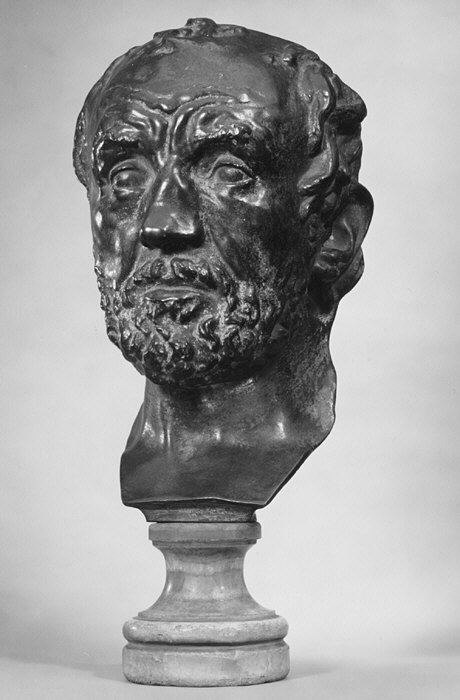
An example of the face discussed in Rodin’s conversation on expression. The mask draws attention to the brow, cheeks and nose. The Metropolitan Museum of Art, Bequest of Susan Vanderpoel Clark, 1967, 67.155.13. Image source. CC0 / Public domain.
Watch Rodin’s sculpture up close
Five films explore Rodin’s sculpture, from his use of classical models and the figures on his monumental doorway to the work of his studio.
Auguste Rodin – Challenging Beauty
Six sculptures show how Rodin adapted classical models.
Watch on YouTubeReading the conversations alongside the work
Gsell’s conversations become especially useful when they direct attention to a physical detail. If you are looking at the capital in the lesson on modelling, ask what the farthest projecting leaf shows you about the depth of the others. With The Walking Man, follow the feet and the forward lean separately before trying to hold them in view together. Those experiments also make it easier to tell an explanation Rodin offered late in his life from information about when an individual work was made. A quotation can illuminate a decision without furnishing a date or proving that he was thinking in the same terms as he made his first model. The 1911 book lets you follow the discussion far enough to see what kind of evidence each passage can give. [1] [5] [6] [7]
What Rodin says about the missing limbs of Meditation
In the chapter on thought in art, Gsell describes coming across a cast of a woman twisting and lowering her head. He regrets the absence of the arms and legs. Rodin, who calls the sculpture Meditation, takes up that objection by considering what the absent limbs would ordinarily allow a person to do. Arms act and legs carry the figure forward. In his explanation, prolonged reflection brings opposing possibilities into view and can hold someone still. The compressed pose and absence of limbs give that state a visible form. [11]
The exchange preserves two readings of the same cast. Gsell sees a figure that seems to have lost part of its body. Rodin sees a form whose apparent incompleteness is bound up with its subject. Pay attention to how Gsell stages the encounter. His objection gives Rodin an occasion to discuss this particular decision, and Rodin’s explanation invites the reader to look again at the bowed head and closed eyes. For the history of the object, Gsell’s preface and the chapter record the circumstances of a conversation published in 1911. A museum record is needed to identify the particular version under discussion. [1] [2] [11]
Why Rembrandt’s line belongs to Rembrandt’s colour
In the chapter on drawing and colour, Gsell asks whether an affecting painting might still have a weakness in drawing or colour. Raphael and Rembrandt supply his examples. Rodin answers by asking how the technique serves the subject before deciding whether it succeeds. He points to Raphael’s Saint George in the Louvre, Parnassus in the Vatican and the tapestry cartoons he knew at South Kensington. For him, the brightness and freshness of Raphael’s palette support what the pictures are trying to express. That quality would be lost if colour were transplanted from an artist with a different way of organising the same surface. [12]
Rodin makes the complementary case for Rembrandt. He attends to the rough lines around old faces, hands and clothing, and relates them to the dignity he sees in the people depicted. The quality he admires resides in how the line makes a viewer experience a particular subject. A softer outline might make the figure more graceful and at the same time take away something essential to the way Rembrandt presents that person. Rodin makes a related argument about Delacroix, whose excited line belongs with the emotional force of his colour. [12]
When technique is felt through its effect
In the same chapter Rodin argues that accomplished technique can escape notice because the viewer attends to what a work expresses. He applies the idea to writing as well as drawing and painting. The point comes in response to a question about skill, so it is useful to read it alongside his insistence that the artist needs considerable command of the craft. His examples ask the reader to notice two things at different moments. First attend to the figure or scene. Then see what edges, changes of tone and decisions about colour made that experience possible. [12]
This is a way to read several of Rodin’s observations together. The conversation on modelling asks how a form projects from the surface. The discussion of colour asks whether the handling of the medium fits the artist’s conception. Each moves from a technical feature to its effect on an observer. Gsell’s questions preserve the practical situation in which the point arises. Extracting a sentence may keep the conclusion, while the sequence of examples supplies a method for looking. [12] [5]
Two clay figures made for a conversation
Gsell’s chapter on Phidias and Michelangelo begins with Rodin inviting him to Meudon to watch him model two statuettes. In the first, Rodin asks Gsell to direct his attention to the foot that supports the body. The other foot lightly touches the ground. The shoulder and hip approach one another on the supporting side, and their changing levels help carry a gentle turn through the entire figure. In the account, the point about ancient sculpture grows out of a series of movements the reader can imagine in the clay. Follow the line of weight first and the upper body has a reason to tilt. [13]
In the second demonstration the legs are both bent and both carry weight. Rodin has the upper body turn against the direction of the lower one, with the limbs drawn close to the trunk. Gsell reports his impression of muscular tension before Rodin explains how he organised it. The scene gives a different basis for quoting the artist than a short maxim about influence would. We can follow the comparison between the two invented figures, see where Gsell first notices a difference, and distinguish that observation from Rodin’s more general claims about Greek and Renaissance sculpture. [13]
Rodin artworks directory
Discussion
Look again at the images and ideas explored in Quotes. These editorial prompts invite your observations.
Reader Insights
After reading “Contemplation”, what detail would you look for in the object or image?
What extra evidence would help you distinguish the artist’s choices from the effects of material, viewpoint or later display?
Join the Conversation
Share a detail, comparison or question about Quotes below.
References
- Auguste Rodin and Paul Gsell. L’Art, 1911 edition, facsimile index. Paris, Grasset, 1911. View source.
- Auguste Rodin and Paul Gsell. Préface. L’Art, 1911. View source.
- Musée Rodin. Sculpture and architecture. View source.
- Musée Rodin. The Thinker. View source.
- Auguste Rodin and Paul Gsell. Le Modelé. L’Art, 1911. View source.
- Auguste Rodin and Paul Gsell. Le Mouvement. L’Art, 1911. View source.
- The Metropolitan Museum of Art. Rodin at The Metropolitan Museum of Art: A History of the Collection. 1981. View source.
- Musée Rodin. Rodin et la photographie. View source.
- Auguste Rodin and Paul Gsell. Le réalisme dans l’art. L’Art, 1911. View source.
- Musée Rodin. 1840–2015. View source.
- Auguste Rodin and Paul Gsell. La Pensée dans l’Art. L’Art, 1911. View source.
- Auguste Rodin and Paul Gsell. Le Dessin et la Couleur. L’Art, 1911. View source.
- Auguste Rodin and Paul Gsell. Phidias et Michel-Ange. L’Art, 1911. View source.

 Auguste Rodin.jpg)




