


 by Tom Gurney
Tom Gurney BSc (Hons) is an art history expert with over 20 years experience
Published on June 19, 2020 / Updated on November 18, 2026
Email: tomgurney1@gmail.com / Phone: +44 7429 011000
George Wyndham
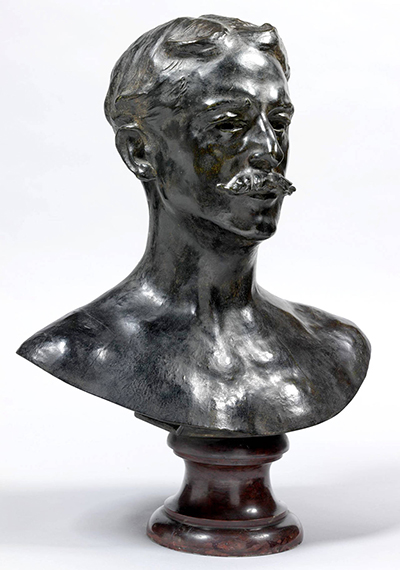
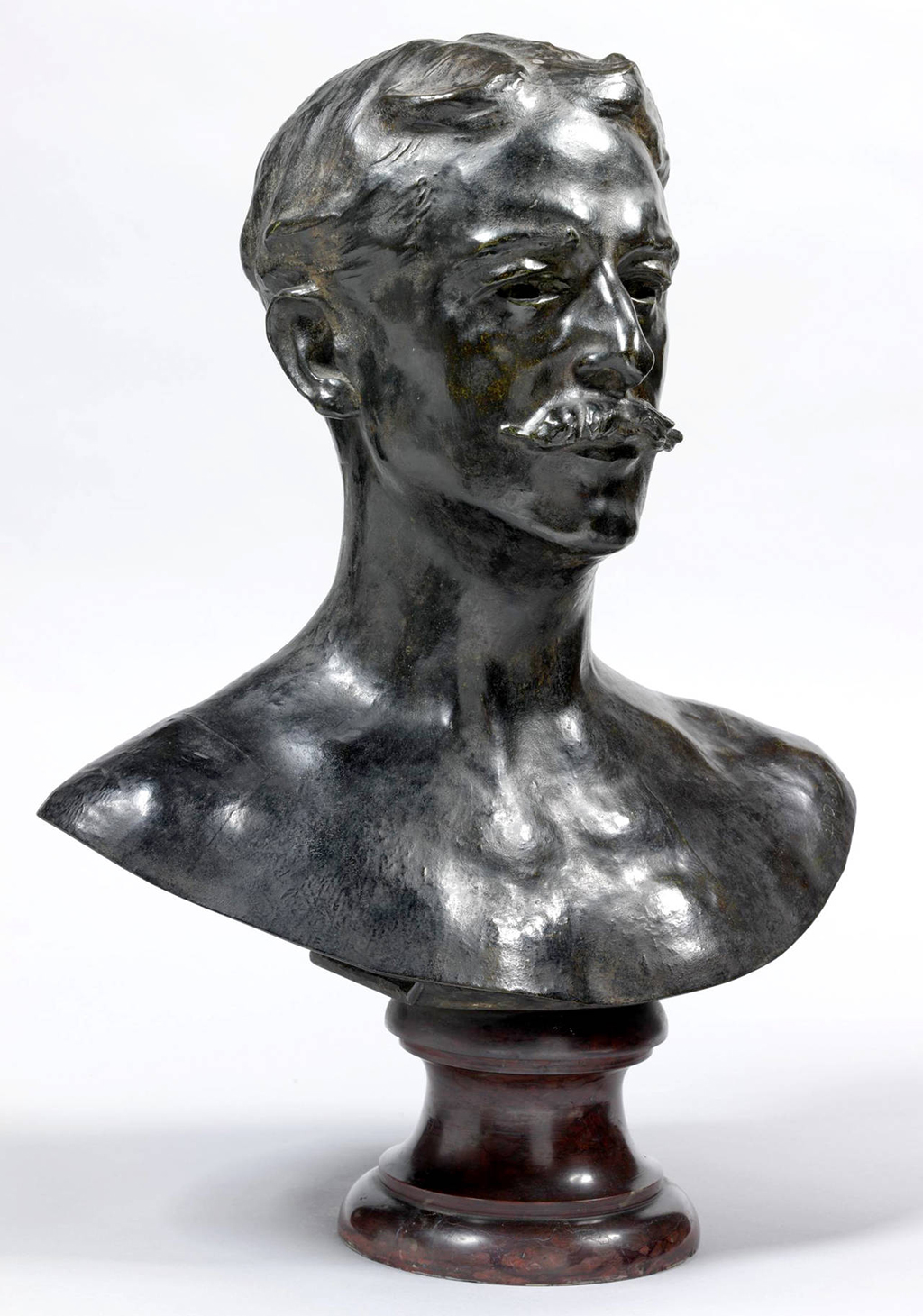
Auguste Rodin’s bronze portrait of George Wyndham shows the British chief secretary for Ireland with his head turned slightly away from the line of his shoulders. Rodin modelled the bust in 1904, while Wyndham was in office. The narrow neck and bare shoulders give the head a pronounced rise. Across the face, light picks out the ridge of the nose and the tips of the moustache, while the eyes remain partly in shadow. The photographed bust corresponds to the Victoria and Albert Museum’s example. Casts in other collections and Rodin’s letters about a bust for Dublin document how the portrait circulated after the sittings. [1] [2] [3] [4]
The turn of the head
The angle in the photograph leaves one ear plainly visible and brings the cheek beside it into view. The line from that ear to the chin is more gradual than the relatively sharp contour at the far side of the face. The face looks ahead of the body in one direction while the broad shoulders extend across the image. It is a small turn, but because the shoulders remain so clearly defined, the amount of movement can be judged quite precisely. Moving to a position nearer the line of the gaze would change the relative width of the cheeks and the amount of neck visible beneath each side of the jaw. [1]
The moustache passes over the narrow opening of the mouth and projects beyond it. In the photograph, small reflections make individual ridges visible along the upper edge. A darker interval separates it from the lower lip. The nose and the forehead catch light across broader areas. Lower down, a reflected highlight follows part of the jaw then breaks just where the neck begins to turn into shadow. The changes of scale in the surface modelling help the face register at a distance, even when the shadow under the brow makes it hard to see the eyes. [1] [2]
Across the chest and shoulders, shallow marks interrupt the more even surface along the base of the neck. The shoulders end in a wide curved edge. Its downward sweep leads to the small projecting support below. The pictured support has a rounded foot and a narrow waist, and its reddish tone sets it apart from the bronze. Seen together, these shapes give the portrait a broad lower edge from which the neck rises. In a front view that width would read quite differently, since both shoulders would carry a more nearly equal share of the outline. [1] [2]
The two reproductions make different details legible. In the smaller one, the hair is a single mass swept away from the forehead. In the larger view, short strokes run into the longer sweep above the temple and terminate in a ridge near the ear. These marks change direction where the hair meets the skin. That boundary gives the temple a clear edge even though much of it lies beyond the brightest area of the face. [1] [9]
Sittings at Meudon
The V&A traces the introduction between artist and sitter to the poet and critic William Ernest Henley. It records that Rodin showed Wyndham around his studio in 1901. The following year Wyndham presided at a London banquet marking the presentation of a cast of Saint John the Baptist Preaching to the museum. The connection therefore extended beyond a portrait commission. The sculptor was building a public reputation in Britain, and Wyndham took part in an occasion at which a major figure sculpture entered a British collection. [1] [5]
The V&A reports that Rodin was expected to travel to Ireland for the portrait, but Wyndham went to Meudon for the sittings. Its catalogue quotes letters in which Wyndham describes their wide-ranging conversations and his reaction to the finished plaster. He singled out the throat for its lifelike appearance and found in the expression something of the experience of a man at mid-career. That reaction is particularly interesting in the oblique view. There is a clear separation between the lower jaw and the long neck. Just below it, a shallow vertical form catches enough light to bring out the front of the throat. [1] [5]
Wyndham held office as chief secretary from 1900 to 1905. The Irish Land Act of 1903 was a major event of his tenure. The 1904 parliamentary record shows him answering questions on the progress of land sales under it, including sales to tenants through the Estates Commissioners. This was the public work occupying him at the time of the portrait. The shape of the bronze gives little account of official position through costume. The sitter’s identity depends on the likeness and on the records that connect the bust with his name and the period in which Rodin modelled it. [1] [2] [6]
Watch Rodin’s sculpture up close
Five films explore Rodin’s sculpture, from his use of classical models and the figures on his monumental doorway to the work of his studio.
Auguste Rodin – Challenging Beauty
Six sculptures show how Rodin adapted classical models.
Watch on YouTubeVersions for different collections
In a letter dated 10 January 1907, preserved in the Hugh Lane papers at the National Library of Ireland, Rodin said that the bust intended for the Municipal Gallery of Modern Art in Dublin was complete and asked for the exact delivery address. Another letter in the archive discusses shipping and the need for a pedestal. The archive dates that record to February 1902, a date that sits uneasily with the 1904 modelling and the January 1907 letter. Lady Gregory later remembered the Dublin portrait as a bronze given by Rodin. These accounts show the portrait’s connection to the Municipal Gallery and the importance Rodin placed on the way it would be exhibited. [1] [3] [4] [7]
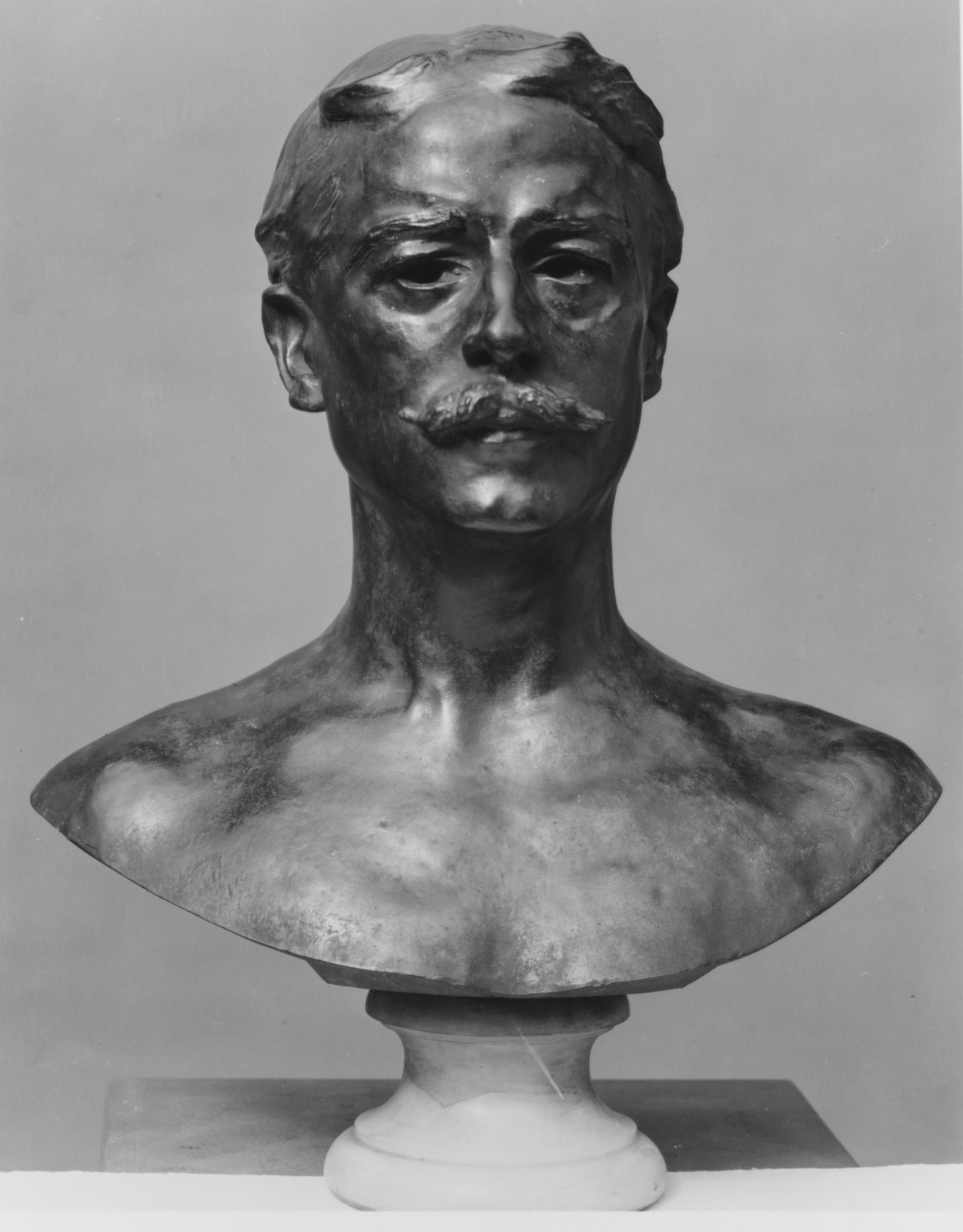
The New York bronze gives a comparison for the turn of the sitter’s head. The Metropolitan Museum of Art, Gift of Thomas F. Ryan, 1913, 13.164.7. Image source. CC0 / Public domain.
The Musée d’Orsay records a bronze on a light marble support, acquired by the French state in 1906 and later deposited at the Musée Rodin. Its foundry mark is behind the right shoulder. The Metropolitan Museum of Art records its own example as a bronze cast by Alexis Rudier and given by Thomas F. Ryan in 1913. The museum dates the modelling to 1904. Casting, acquisition and the dates attached to a sitting refer to different parts of the history of the portrait. The published photograph of the V&A bust matches the turned head, bright spots on the shoulders and reddish pedestal in the illustrated view. The light marble recorded in Paris is one particularly clear example of how the presentation can vary while the likeness remains recognisable. [1] [2] [8] [9]
Another sitter at Meudon
George Bernard Shaw sat for Rodin at Meudon in 1906, two years after Wyndham’s sittings began. Shaw later wrote about Rodin measuring the sitter and the clay with dividers. When parts of the portrait needed adjusting, Rodin could shorten a nose by removing clay or reposition an ear by cutting and reattaching it. This is Shaw’s account of his own sittings. It gives a concrete example of the kind of revision possible in the material Rodin used while working from a living sitter. The Wyndham portrait offers a place to look for the resulting precision, particularly where the narrow edge of the moustache meets the cheek and the head turns away from the bust’s centre. [2] [5] [10]
The National Trust’s account records a bronze and a marble commissioned by Charlotte Shaw, and a request from Rodin to include the bronze in the International Society’s 1907 exhibition alongside other works commissioned by British collectors. In Wyndham’s case, the letters to Hugh Lane document decisions about transportation and the pedestal. The two commissions give different views of the work that continued after the sitter left Meudon, from the choice of material and exhibition to delivery and presentation. [3] [4] [10]
Rodin artworks directory
Discussion
Look again at the images and ideas explored in George Wyndham. These editorial prompts invite your observations.
Reader Insights
After reading “The turn of the head”, what detail would you look for in the object or image?
What extra evidence would help you distinguish the artist’s choices from the effects of material, viewpoint or later display?
Join the Conversation
Share a detail, comparison or question about George Wyndham below.
References
- Victoria and Albert Museum. George Wyndham, A.47-1914, collection record. View source.
- Metropolitan Museum of Art. George Wyndham, 13.164.7. View source.
- National Library of Ireland. Rodin to Hugh Lane, 10 January 1907. View source.
- National Library of Ireland. Rodin to Hugh Lane, shipping and pedestal letter. View source.
- Metropolitan Museum of Art. Rodin at The Metropolitan Museum of Art, spring 1981. View source.
- UK Parliament. House of Commons, land purchase questions answered by Wyndham, 4 August 1904. View source.
- Augusta Gregory. Hugh Lane’s Life and Achievement. View source.
- Musée d’Orsay. George Wyndham, LUX 159. View source.
- Victoria and Albert Museum. George Wyndham, collection image 2006AX9879. View source.
- National Trust. George Bernard Shaw, bronze NT 1274943 and Shaw’s account of the sittings. View source.

 Auguste Rodin.jpg)





