


 by Tom Gurney
Tom Gurney BSc (Hons) is an art history expert with over 20 years experience
Published on June 19, 2020 / Updated on November 18, 2026
Email: tomgurney1@gmail.com / Phone: +44 7429 011000
The Martyr
A woman lies across a low support in Auguste Rodin’s The Martyr. Her head falls back and one arm hangs over the edge. Her knees turn in different directions, so that the legs show traces of movement even though the body lies still. Rodin developed the figure for The Gates of Hell, where versions of it appear in several positions. The independent sculpture places the body horizontally, with enough of it projecting beyond the support to make the edge part of the composition. The title suggests the subject of a martyr’s death, while the sculpture leaves the woman’s identity and the circumstances of her death open. [1] [2] [3]
A figure extending over the edge
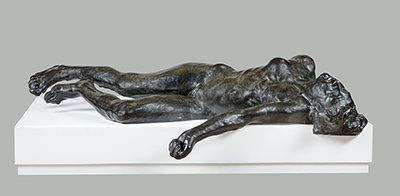
The photograph can be read from the long straight line at the front of the pedestal. The torso lies above that line. At the right, the head reaches down to it, and nearer the centre the arm crosses it and ends against the pale side. These intersections give the pedestal a more active role than a simple background. Its front edge marks the points where parts of the body stop being supported from below. The arm would be hard to see as a falling weight if the viewer could only look down on it. The side view gives the drop of the wrist a clear outline. Near the fingers, the arm turns slightly towards the pedestal, leaving a narrow shadow between the hand and the pale front. [1] [2]
The two legs give the left side of the work a different movement. One foot extends almost as far as the corner of the pedestal, and the other lies closer to the viewer. A narrow band of background appears between them. It widens towards the knees before the legs come together at the hips. The changes in angle give the eye more than one way to follow the figure along its length. One path stays close to the top of the support. The other rises and dips slightly as the nearer leg turns, then continues into the twist of the torso. [1] [2]
The face points up and away from the head’s point of contact with the support. Light catches a few ridges near the hair, while the darker surface makes the eyes difficult to distinguish in the small photograph. The arm closest to the camera has a long, clear contour, and the other is partly hidden by the rise of the chest. Walking around an independent bronze changes how much of that second arm and shoulder is visible. From the pictured angle, the fallen head and the arm hanging towards the viewer carry most of the sense of abandon. [1] [2]
From the doorway to a horizontal sculpture
The Musée Rodin records versions and fragments on the upper field of The Gates of Hell, also known as the tympanum. It also describes a partially draped, veiled version on the lower left door in the role of Fortune. The Met describes the figure from which its enlargement developed as standing on the lintel. Taken together, the accounts describe a model that Rodin could rotate and adapt to architectural positions. In one setting the body had to register against the doorway and among other figures. In the independent version the relationship with the support remained important, though the direction of the body changed. [1] [2] [3]
The Musée Rodin notes hollowing along the spine and behind the head, traces of the way the figure had been attached to the doorway. These are especially relevant to a work designed to be seen from several sides. What was behind the body when it was attached to the door can become visible in an independent sculpture. The Met also points out that its bronze has no integral base to support the whole figure. Placing it on a pedestal makes the viewer aware of the height at which its unsupported parts hang. This effect depends on the sculpture’s installation as well as on the shapes Rodin modelled. [1] [2]
Watch Rodin’s sculpture up close
Five films explore Rodin’s sculpture, from his use of classical models and the figures on his monumental doorway to the work of his studio.
Auguste Rodin – Challenging Beauty
Six sculptures show how Rodin adapted classical models.
Watch on YouTubeEarlier images of the reclining body
The Musée Rodin proposes Stefano Maderno’s Saint Cecilia as a likely precedent. It also compares the figure with Gian Lorenzo Bernini’s Ludovica Albertoni and Ecstasy of Saint Teresa. These comparisons help explain the ambiguous bearing of the head and arms. A body with closed eyes may suggest death, suffering or an experience that has overcome its ability to maintain a controlled posture. The title The Martyr directs attention towards death, while the extended limbs give the pose an uncertainty that a named saint’s attributes would help resolve. Rodin leaves the exposed body and its relationship with the pedestal to convey the scene. [1] [2]
The absence of visible injury also changes where the viewer looks. In the photograph the shadows fall chiefly at points where the parts of the body turn or overlap. The shoulder dips beneath the chest, the neck turns under the head, and the loosely closed hand hangs below the arm. All are observable signs of the body’s position. The position and the force of gravity suggest an event without supplying details of how it happened. [1] [2]
Plaster and bronze examples
The Musée Rodin dates the conception to 1885 and records a plaster, S.01484, at 61 centimetres in length. The Metropolitan Museum of Art dates its bronze model to the same year. Its example measures 156.2 centimetres long and entered the collection in 1913 as a gift from Watson B. Dickerman. Newfields documents another bronze, The Martyr #5, cast in 1960. The differences in scale and casting history matter when comparing photographs. A short length of support can exaggerate the projection of an arm in a close view, while a longer overall sculpture gives the viewer more room to see the lower and upper body separately. [1] [2] [4]
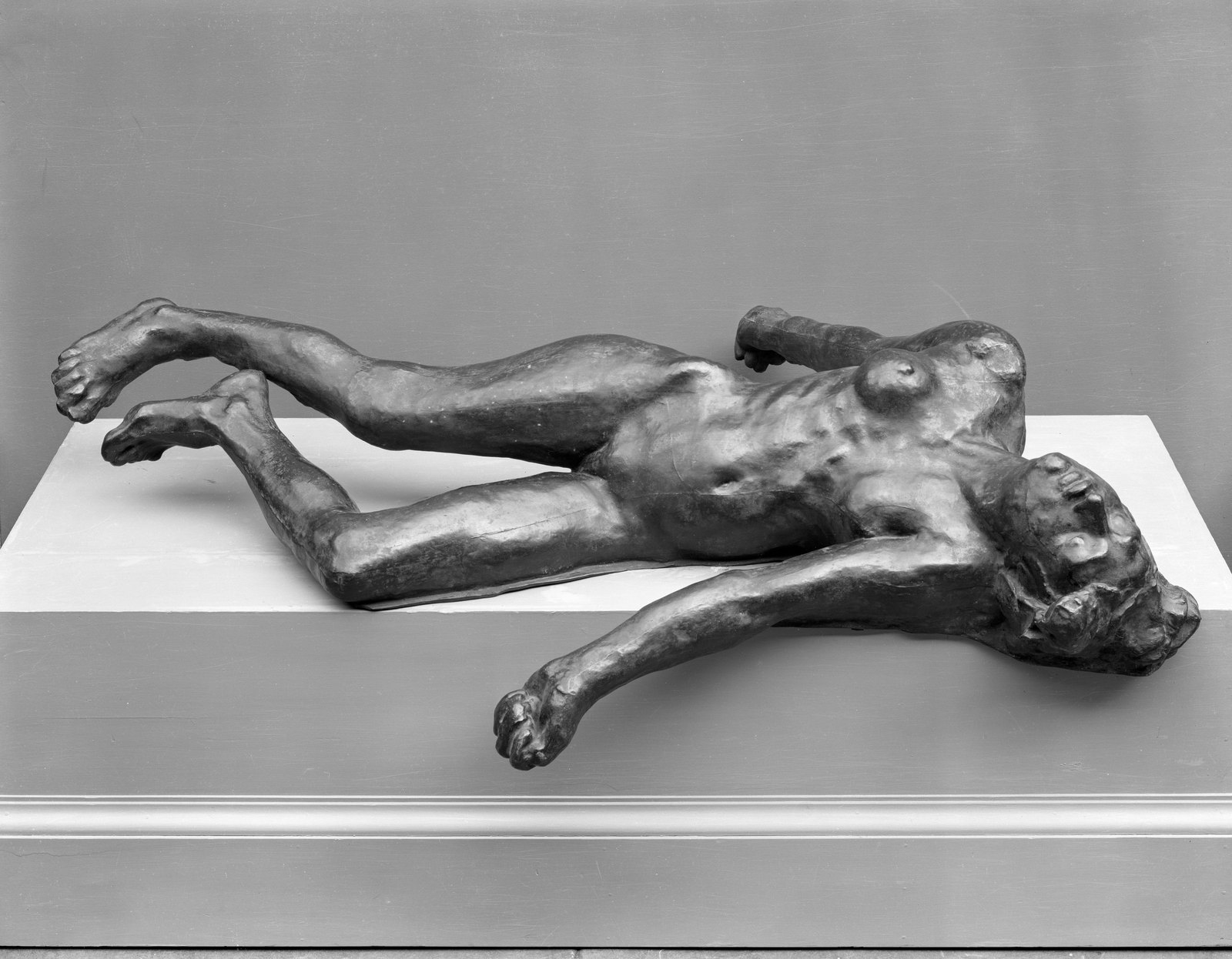
The Met bronze makes the relation of the body to its supporting ledge visible. The Metropolitan Museum of Art, Gift of Watson B. Dickerman, 1913, 13.221. Image source. CC0 / Public domain.
The legacy photograph is consistent with the enlarged horizontal composition. The Met’s bronze is a useful comparison because its lowered arm and head occupy similar positions above a pale pedestal. The catalogued view is taken from higher up and leaves the precise identification of the pictured bronze open. The photograph shows how the straight edge of the support helps a viewer follow each deviation from the horizontal. The body’s weight is concentrated over the pedestal while the visible hand and head take the gesture beyond it. [1] [2]
From the whole figure to a bust
The Musée Rodin preserves the head as an independent plaster, S.00456. It stands 16.5 centimetres high and was used as a foundry model. A number on its underside identifies a part of the work that would ordinarily be out of sight. The museum also holds a bronze bust, S.00081, sand-cast by Alexis Rudier before 1927. It is just half a centimetre taller than the plaster, before adding its separate marble pedestal. The record places Rodin’s signature on one shoulder and the foundry mark behind the other. Those details distinguish two closely related objects whose faces can be read at nearly the same scale. [5] [6]
In the reclining figure the tilt of the head carries the body’s descent beyond the edge of the support. On a pedestal the viewer can look at the head first, following the fall of the hair and the angle of the chin without having to trace the larger outline of the torso. The catalogue also preserves evidence of other choices in reproducing the whole figure. For its 1995 bronze S.06661, the museum identifies the intermediate cast and mould used by the Godard foundry and traces them back to the original S.864. The bust and the smaller bronze both depend on a process of reproduction, but each preserves a different amount of the gesture that makes the whole figure recognisable. [1] [5] [6] [7]
Rodin artworks directory
Discussion
Look again at the images and ideas explored in The Martyr. These editorial prompts invite your observations.
Reader Insights
After reading “A figure extending over the edge”, what detail would you look for in the object or image?
What extra evidence would help you distinguish the artist’s choices from the effects of material, viewpoint or later display?
Join the Conversation
Share a detail, comparison or question about The Martyr below.
References
- Musée Rodin. The Martyr, S.01484. View source.
- Metropolitan Museum of Art. The Martyr, 13.221. View source.
- Musée Rodin. Martyre, La Porte de l’Enfer. View source.
- Indianapolis Museum of Art at Newfields. The Martyr #5, collection data. View source.
- Musée Rodin. Tête de la Martyre, plaster S.00456. View source.
- Musée Rodin. La Martyre, bust S.00081. View source.
- Musée Rodin. La Martyre, small model with base, S.06661. View source.

 Auguste Rodin.jpg)





