


 by Tom Gurney
Tom Gurney BSc (Hons) is an art history expert with over 20 years experience
Published on June 19, 2020 / Updated on November 18, 2026
Email: tomgurney1@gmail.com / Phone: +44 7429 011000
Ugolino Surrounded by his Three Children
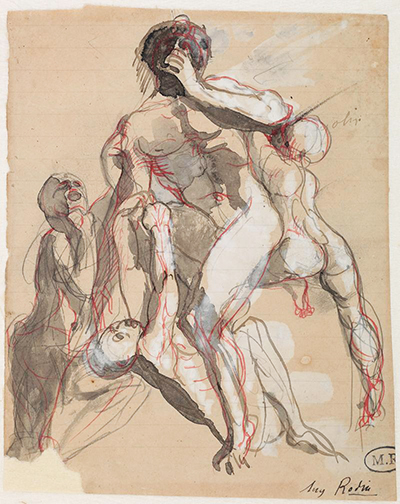
Ugolino raises one hand to his face as three children crowd around him in this drawing by Auguste Rodin. The adult forms the highest point of the group. Below him the children extend in several directions, their limbs picked out in red and dark brown lines against light areas of gouache. The Musée Rodin dates the sheet to about 1880 and identifies it as D.07627. The scene on the front takes its subject from Dante’s Inferno. The reverse bears a different composition, a horseman surrounded by four figures. [1] [2]
The figure with a hand to his mouth
The darkest marks at the top of the sheet enclose Ugolino’s head. A pale hand approaches it from the right. The contrast makes the gesture readable before the viewer can distinguish the eyes or the line of the mouth. The forearm extends across a wide interval, with a dark shadow beneath it and several red marks running near its edge. The arm forms a horizontal break beneath the bowed head. From there the shoulder and upper body descend into the dense marks around the children. The pale outline of the fingers keeps the gesture distinct where the face is almost entirely in shadow. [1] [2] [3]
The seated pose is easier to follow through the left contour of the body, which bends at the hip and narrows where the legs are surrounded. Lines near the waist cross one another without each belonging to an easily identifiable limb. Wash distinguishes some of those shapes before the ink does. A darker area on the chest sits above paler passages at the sides. The direction of the raised arm is unusually clear by comparison. It carries the eye back to the head independently of the marks that bind the group together below. [1] [2]
Three children around the seated figure
The child at the left lifts an open mouth towards Ugolino. The contour at the back of the head is distinct against the bare paper, while the shoulders merge into a patch of darker wash. The body descends beside the adult’s leg, giving the eye a nearly vertical line at the outside of the group. Near the lower edge, another child extends across the drawing and looks upwards. The face catches a pale highlight and the arm follows a diagonal towards Ugolino. The angle of the face relates the child to the figure above even where the outlines cross. [1] [2] [3]
The third child is gathered at the right. A lightly described head appears close to the adult’s arm, while the body bends outward and the extremities descend towards the margin. In this area the red contours are especially visible against light ground. The placing of the three children makes the group wider below Ugolino’s head without dispersing it evenly across the sheet. A projecting leg or arm may take attention almost to the edge. Each time, a tilted face or a line through an arm sends it back towards the seated figure. At the lower left, a wide dark patch reaches almost to the edge of the sheet. The other side stays comparatively open around the extremities of the third child. [1] [2]
Graphite, ink and gouache on ruled paper
The Musée Rodin records graphite, brown and red ink and touches of gouache on ruled paper. Some of the ruling remains visible in the quieter areas above and beside the bodies. Across the figures the grey and brown washes make regions of light and shadow that are larger than the individual pen strokes. Gouache adds small opaque areas, particularly where a body or limb passes in front of another. Near the raised hand it helps separate the gesture from the face. Farther down, pale passages keep the lower bodies legible in a mass of overlapping lines. [1] [2] [3]
The red ink serves a different purpose from the wash. In places it follows the edge of a limb, but elsewhere several parallel strokes can be seen at once. They show how a contour shifts as it passes through the group. The catalogue Auguste Rodin: 101 Drawings connects that tangle of pencil and ink with the agitation of the scene. The darker wash draws attention to a few points, including Ugolino’s face and the body stretched below him. The red can then carry the eye from one of those points to another. [1] [3]
Drawing Ugolino before The Gates of Hell
In Dante’s Inferno, Ugolino tells the poet how he and his children were imprisoned in a tower and left to starve. Rodin considered the subject repeatedly in his drawings and in developing The Gates of Hell. The Musée Rodin connects his early seated designs with a plan to place Ugolino opposite the lovers who became The Kiss. The sculpture he ultimately developed for the doorway places the father on his hands and knees. On this sheet the seated figure still rises above the children, so that their gestures can be read in relation to his hand and face. The change in pose gives the same story a different arrangement of attention. [2] [4] [5]
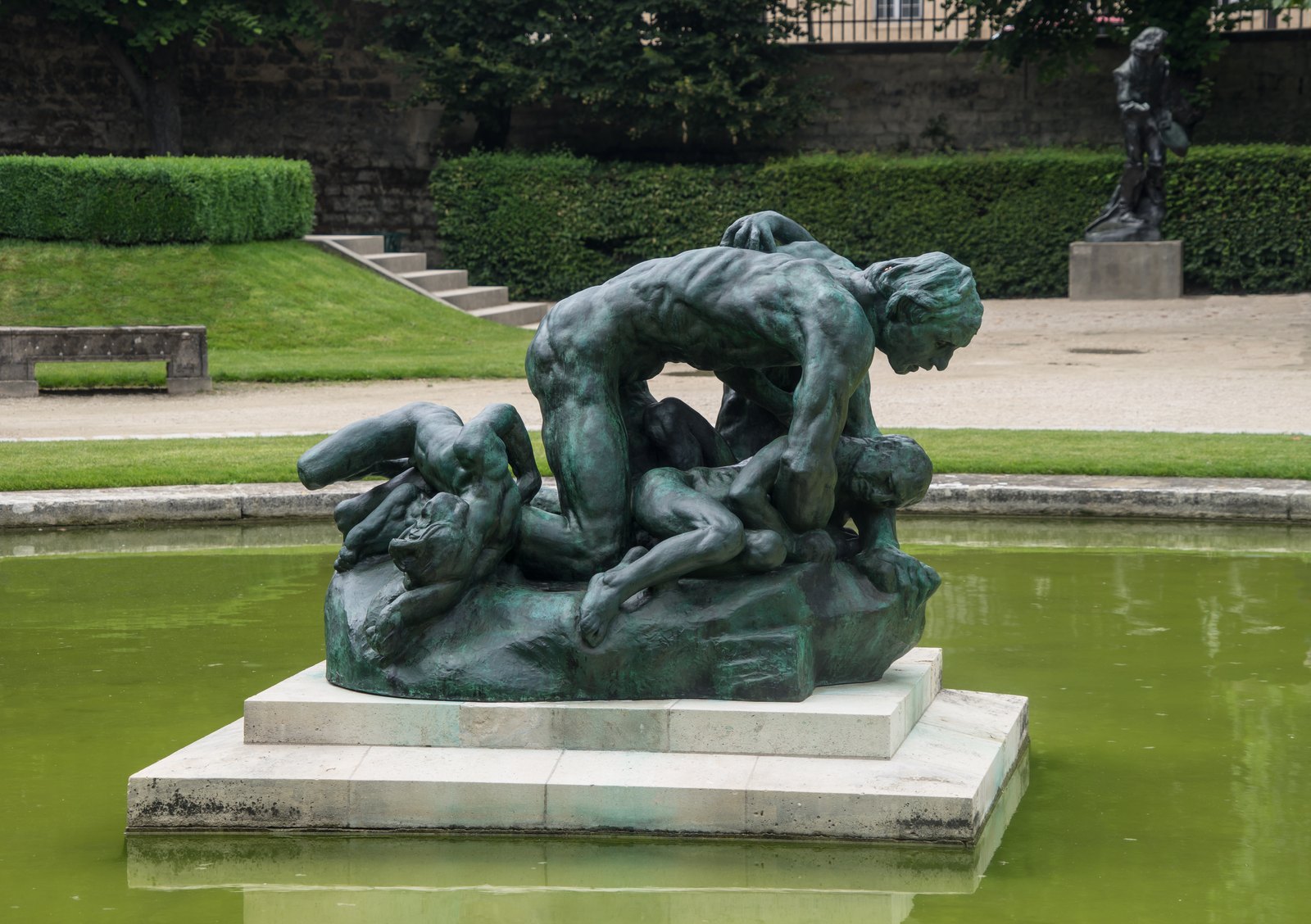
In this later sculptural composition the father bends forward on all fours. The drawing keeps him seated above the children. Photograph by Jebulon, Wikimedia Commons. Image source. CC0 / Public domain. Resized for the web.
The seated figure takes up more than half the height, but his hand occupies a relatively small area of the paper. Its importance comes partly from the difference between the pale forearm and the wash immediately around it. Below, the children have no comparably isolated gesture. Their bent limbs make sense through contact with one another and with the adult. The arrangement makes it possible to read Ugolino’s response and the children’s movements at different speeds, even though those movements belong to the same scene. [1] [2] [3]
The Musée Rodin entry notes the name Ugolin in brown ink at the upper right and the signature Aug. Rodin at the lower right. The signature and stamp in the legacy image agree with the museum record, and the Museo Soumaya catalogue lists the same drawing as figure 126. The present collection record measures the sheet at 17.5 by 13.7 centimetres. Both sides carry drawings, and the title of the reverse records a rider with four figures. The legacy image shows the front, where the open upper corners leave the dark head and the pale hand almost alone at the top. The children widen the scene below, and the eye follows the folds of the bodies back to that single interruption at Ugolino’s mouth. [1] [2]
Watch Rodin’s sculpture up close
Five films explore Rodin’s sculpture, from his use of classical models and the figures on his monumental doorway to the work of his studio.
Auguste Rodin – Challenging Beauty
Six sculptures show how Rodin adapted classical models.
Watch on YouTubeA possible study in Carnet 35
Among the drawings the Musée Rodin catalogues under Carnet 35 is D.06743, an entry whose title asks whether the sketch is a study for Ugolino. The question mark is significant. The sketchbook comparison helps locate the drawing within a broader body of work connected by the museum with the theme, with varying degrees of certainty. On the independent two-sided sheet reproduced here, the brown-ink name provides a direct identification. The catalogue title and the visible inscription can therefore carry a claim about this drawing that the tentative title alone cannot carry for the sketchbook. The two records leave the sequence of development open while showing how different kinds of evidence affect the reading of a figure. [1] [6] [7]
What the hand at the mouth may recall
Canto XXXIII gives more than one reason for an image to bring Ugolino’s hand near his face. In the tower he sees his own suffering reflected in the four faces around him and bites his hands in grief. His children read the gesture differently and offer him their bodies. Rodin’s sheet fixes a hand near the father’s mouth, but the pencil and ink do not establish whether his teeth close on it. The gesture gives a viewer who knows the episode a point of recognition and leaves room for the hesitation conveyed by the body immediately below it. [8] [1]
Dante counts four young people in the tower. The museum describes three on this side of Rodin’s drawing. That difference makes it useful to begin by locating bodies rather than tallying every hand or line at the bottom of the page. Trace the recognition of a head or a shoulder through to the space each child occupies. The sheet can evoke the episode with fewer figures than the poet names. A drawing that fixes the gesture need only give enough of the family’s arrangement for the bodies to register around the father. [8] [1]
A second small sheet with a more tentative title
The Musée Rodin also catalogues a small work as Couple et trois enfants, with a tentative suggestion that the group may involve Minos or Ugolino. Its principal support measures only 9.3 by 11.5 centimetres, and the museum gives separate dimensions for its larger secondary support. The small area of the original helps explain why a family group may be described with relatively few marks. The entry’s question mark leaves the subject open even though the museum gives the number of children. [9]
The comparison underlines what the ink inscription contributes on the sheet reproduced here. A number of figures can be described quite precisely and still leave their story in doubt. The name Ugolin beside the group of father and children supplies a reason for bringing this particular image together with the other tower scenes. It also gives a way to distinguish the sheet from another drawing of several people gathered close. On this page, the title of the drawing is evidence that can be tested against the sheet, just as the disposition of bodies can be tested against what one actually sees. [1] [9]
From the ruled sheet to the doorway maquette
The Musée Rodin’s third maquette for The Gates of Hell, S.06295.(E), is a plaster relief dated 1880–81 and measuring 111.5 centimetres high. The museum’s guide to the door reads this model alongside the drawings as evidence that Rodin considered a seated Ugolino opposite Paolo and Francesca. By preserving the door as a whole, the maquette makes the relation between the proposed groups easier to judge. The small ink drawing can give its full width to what happens around the father. In the maquette the group also needs to hold a position in relation to the pair on the other door. [10] [4]
The two works provide different evidence about the idea. The ruled paper carries a seated figure and the handwritten name. The relief shows how a seated group might enter the larger project. Neither catalogue identifies the drawn sheet as the immediate source for the relief. Setting them side by side lets us follow the pose at two scales and in two media, while leaving the exact order in which those decisions were made open. [1] [10] [4]
Rodin artworks directory
Discussion
Look again at the images and ideas explored in Ugolino Surrounded by his Three Children. These editorial prompts invite your observations.
Reader Insights
After reading “The figure with a hand to his mouth”, what detail would you look for in the object or image?
What extra evidence would help you distinguish the artist’s choices from the effects of material, viewpoint or later display?
Join the Conversation
Share a detail, comparison or question about Ugolino Surrounded by his Three Children below.
References
- Musée Rodin. Ugolin entouré de trois enfants (recto), D.07627. View source.
- Museo Soumaya. La puerta del Infierno, figure 126. View source.
- Auguste Rodin: 101 Drawings, entry for Ugolino surrounded by his Three Children. View source.
- Musée Rodin. Ugolin et ses enfants, La Porte de l’Enfer. View source.
- Musée Rodin. Ugolino and his children, S.01427. View source.
- Musée Rodin. Carnet 35. View source.
- Musée Rodin. Etude pour Ugolin ?, D.06743. View source.
- Dante Alighieri. Inferno, canto XXXIII, Dartmouth Dante Lab. View source.
- Musée Rodin. Couple et trois enfants (Minos, Ugolin et ses trois enfants ?). View source.
- Musée Rodin. Porte de l’Enfer, troisième maquette, S.06295.(E). View source.

 Auguste Rodin.jpg)





