


 by Tom Gurney
Tom Gurney BSc (Hons) is an art history expert with over 20 years experience
Published on June 19, 2020 / Updated on November 18, 2026
Email: tomgurney1@gmail.com / Phone: +44 7429 011000
Cybele
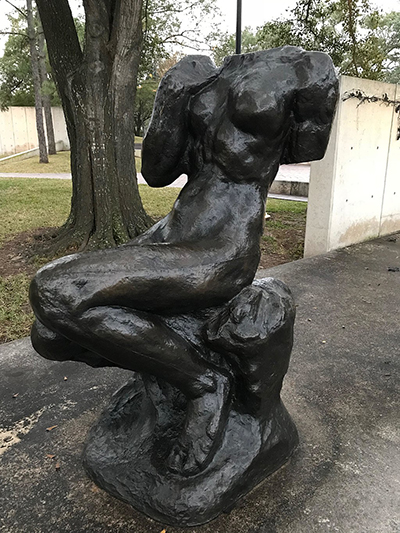
Auguste Rodin’s Cybele is a seated figure whose knees project well beyond the upright torso. The head and much of the arms are absent. One arm bends beside the chest and stops near the shoulder, while the other is visible mainly through the shape it gives the upper edge. The thighs lead towards the knees, then the lower legs turn back towards the rock and base. This arrangement was developed from a smaller figure associated with The Gates of Hell. The Musée des Beaux-Arts de Bordeaux holds an enlarged plaster dated 1904, and later bronzes allow the large model to be seen in very different settings. [1] [2] [3]
How the figure sits
Look first at where the hips meet the rock. The contour of the back narrows into the waist, then the line changes direction as it reaches the upper thigh. A wide passage of modelling follows the leg towards the knees. The feet come back under it, where the surface of the rock breaks up the outline again. These turns make it possible to follow the position of the seated body even from an angle that gives no clear view of the place where it bears on the support. The knees project into open space while the compact arrangement around the feet makes the figure feel firmly seated. [1] [2] [3]
The front of the torso has several changes of direction within a relatively short rise. The abdomen begins above the hips and gathers towards the chest. The breast and the broken ends at the shoulders make different kinds of edges against the background. A highlight can carry the eye across the torso until it meets a rougher passage at the top, where the movement stops. From another angle the bent arm near the chest becomes easier to distinguish. Seen from the side, it gives the upper figure a thickness that can be lost in a frontal silhouette. This is one of the details that keeps the torso from reading like a flat shape above the legs. [1] [2]
There is also a difference between the way the rock and the body receive light. The rock beside the hip has abrupt edges and shorter ridges. The exposed upper thigh gives light a wider surface to travel across. Where the legs return towards the base, the two treatments run close together, and shadows can briefly obscure the limits of the feet. In a dark bronze, those shadows may connect parts that are clearly separate in the plaster. The light on the large surfaces is therefore a useful starting place, but the smaller spaces near the support explain how the lower body fits together. [1] [2] [3]
From a small study to the Salon
The Bordeaux museum traces the sculpture to a small seated figure devised in the late 1880s for the portal. The Musée Rodin catalogues a small version as Cybèle, ou Étude de femme assise. Its associated title places attention on the posture. At that scale, the angles at the waist and knees can be compared at a glance. Enlarging the figure changes how a viewer experiences those same distances. The broad surface of the thigh can hold the eye before it reaches the foot, and the steep turn from the hip to the chest has more room to unfold as the spectator walks past. [1] [2] [4]
Bordeaux dates its plaster to 1904 and records that it was displayed at the Salon of the Société Nationale des Beaux-Arts in Paris in 1905. The Musée Rodin preserves a photograph by Jacques-Ernest Bulloz of the plaster at that Salon. The following year the work appeared in Bordeaux, where the city purchased it from Rodin. These records place the enlarged figure in a public exhibition during Rodin’s lifetime. They also give the plaster a history of its own. Its pale material and the light around it affected how visitors saw the seated figure before the large design became familiar through later examples in bronze. [1] [3] [5]
The top of the torso and the surviving portions of the arms helped make this a conspicuous work in exhibition. The pose remains specific even though a gaze and complete gestures are absent. The direction usually supplied by a head is partly given by the turn of the shoulders. The legs and their support tell a viewer where to begin moving around it. From the side, the projecting knee and the nearest shoulder set the outer limits of the curve through the waist. In a smaller object, the omission can read quickly as a feature of a study. Encountered in the much larger plaster, the same abrupt boundaries occupy enough space to demand close attention. The large figure can hold its place in a room through its modelling and bearing alone. [1] [2] [5]
Watch Rodin’s sculpture up close
Five films explore Rodin’s sculpture, from his use of classical models and the figures on his monumental doorway to the work of his studio.
Auguste Rodin – Challenging Beauty
Six sculptures show how Rodin adapted classical models.
Watch on YouTubeThe title and the bronzes
The Shizuoka Prefectural Museum of Art links the name Cybele to the London exhibition of 1914. The name recalls the ancient mother goddess, while the earlier descriptive title directs attention to a seated figure. The sculpture offers few narrative details around the body. What makes the name plausible to a viewer is the figure’s weight and the way it claims the roughly formed seat. Consider how far the knees extend while the torso rises above them. Much of the impression of stability comes from those opposed directions, which can be seen whether the work is approached as a study of the body or through its mythological title. [1] [4] [6]
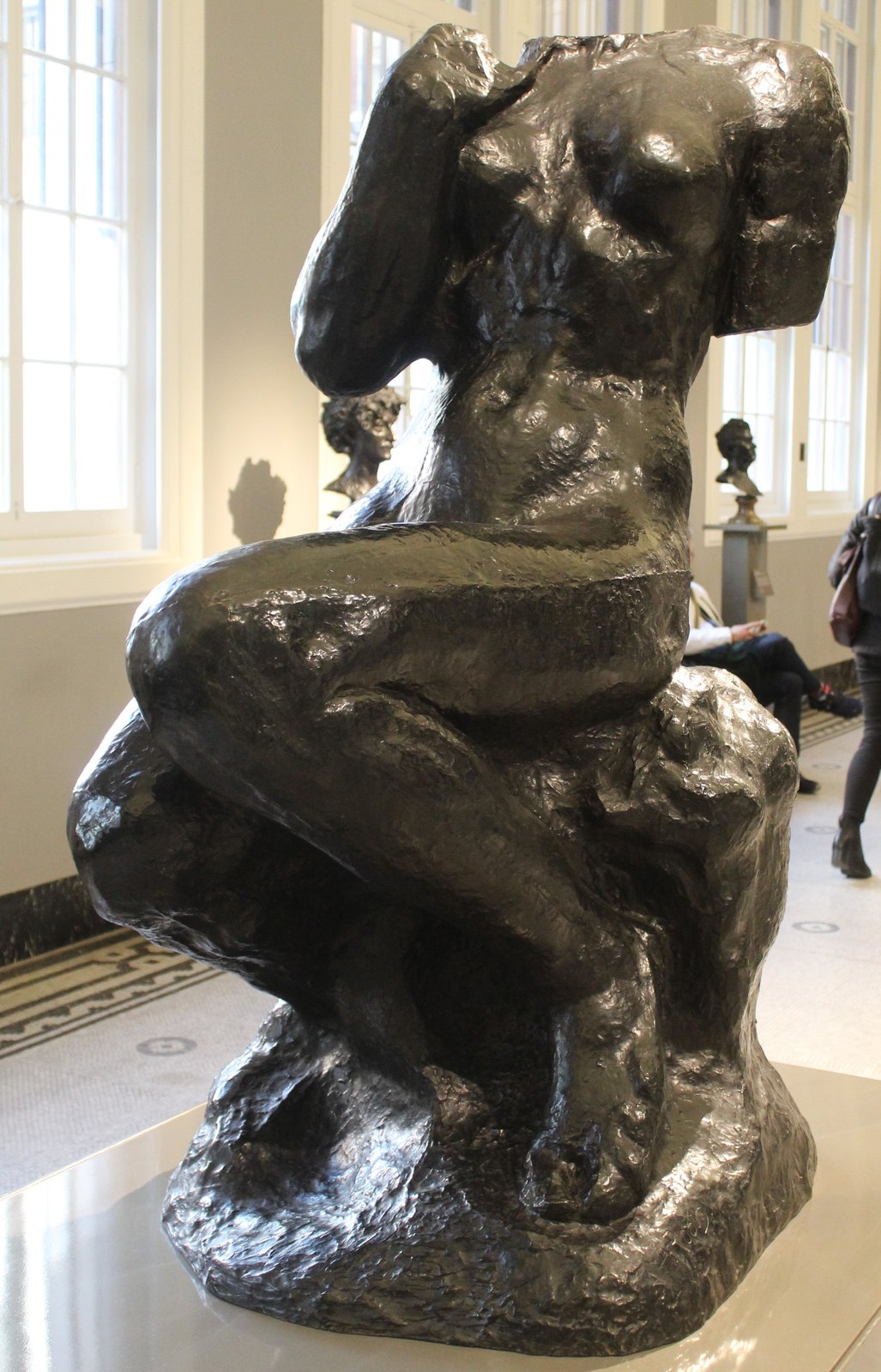
The V&A bronze gives a view of the truncated seated figure. Photograph by 14GTR, Wikimedia Commons. Image source. CC0 / Public domain. Resized for the web.
The North Carolina Museum of Art dates the model to about 1889–90, its enlargement to 1904–05 and its own bronze cast to 1987. The Shizuoka record gives about 1890 for the model and 1904 for the enlargement, and documents a 1988 mark on its example. The Bordeaux plaster, the casts and the early model are distinct objects or stages of work. A photograph taken outdoors can tell us something about how the bronze relates to the trees and ground around it. Its overall size, the marks on the base and collection documentation are better evidence for identifying a specific cast. Look back at where the knees extend past the rock. That relationship remains visible across the documented changes of scale, material and setting. [1] [2] [3] [6]
Enlargement and the mould seams
The Bordeaux museum names Henri Lebossé as the practitioner who enlarged the seated figure for Rodin, using a pantograph to transfer its proportions at a larger scale. Its plaster is 166 centimetres high and 94 deep. Those measurements help explain the effect of standing beside a seated figure whose knees project so far from the torso. Much of the encounter takes place horizontally, across the distance from the upright back to the front of the knees. An enlargement preserves the relation between those points while making their separation register against the space occupied by a standing spectator. [1] [3]
The museum records a piece mould and draws attention to the seams visible on the plaster. These are traces of the sections used to make the cast. Some run over surfaces whose larger curves come from the figure’s posture. At close range the seam can be read separately from the slope of a thigh or flank. Seen at the distance of the Salon photograph, the outline and mass dominate. The surviving plaster thus records both the enlarged design and details of how it was reproduced. [1] [5]
Rodin artworks directory
Discussion
Look again at the images and ideas explored in Cybele. These editorial prompts invite your observations.
Reader Insights
After reading “How the figure sits”, what detail would you look for in the object or image?
What extra evidence would help you distinguish the artist’s choices from the effects of material, viewpoint or later display?
Join the Conversation
Share a detail, comparison or question about Cybele below.
References
- Musée des Beaux-Arts de Bordeaux. Cybèle. View source.
- North Carolina Museum of Art. Cybele. View source.
- Musée des Beaux-Arts de Bordeaux. Cybel, English collection entry. View source.
- Musée Rodin. Cybèle, ou Étude de femme assise, S.00481. View source.
- Musée Rodin. Jacques-Ernest Bulloz, Cybèle (plâtre) au Salon de la Société Nationale des Beaux-Arts. View source.
- Shizuoka Prefectural Museum of Art. Cybele, large model. View source.

 Auguste Rodin.jpg)





