


 by Tom Gurney
Tom Gurney BSc (Hons) is an art history expert with over 20 years experience
Published on June 19, 2020 / Updated on November 18, 2026
Email: tomgurney1@gmail.com / Phone: +44 7429 011000
Eve
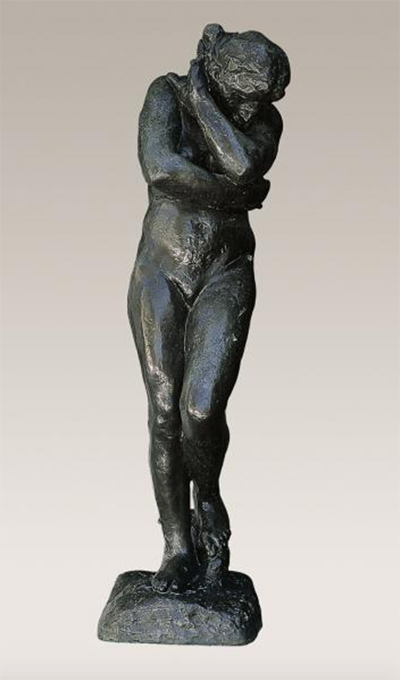
Auguste Rodin’s Eve stands with one arm wrapped across her chest and the other raised beside her head. The head drops into the space made by her arms. One knee bends towards the other and the weight of the body appears to settle into a narrow area above the feet. The gesture belongs to a figure Rodin developed in 1881 as a companion to Adam for The Gates of Hell. It also had a long life as an independent sculpture. Different casts and carvings preserve the folded posture at several scales and with distinct treatments of the hair, feet and base. [1] [2] [3] [4]
The gesture from the head to the feet
In the photograph the higher forearm runs diagonally down across the body. The elbow is close to the bend of the other arm, which makes a more horizontal passage above the waist. These two directions bring the eye towards the face and then down before it has had time to make out the features. Only a small part of the face catches the light. The broad shape of the lowered head carries more of the expression than the details of the eyes or mouth. A viewer approaching the sculpture from one side would see different parts of the head emerge from behind the arm. [1] [5]
The legs continue the movement in a quieter way. The nearest knee turns in and interrupts the line from the hip to the ankle. Behind it the straight leg descends to a foot set forward on the base. A narrow strip of background appears between the lower legs. That interval defines the edge of the shin and gives the viewer a point from which to judge the angle of the bent knee. The hips have room to shift above the feet, even within a silhouette that looks almost closed near the shoulders. [1] [5]
The light in the photograph makes small ridges visible along the forearm and the front of the hip. It falls more evenly on the projecting thigh. Lower down the surface of the base is rougher, with a sloping edge that keeps the feet distinct from the ground around them. The light also picks out the hair near the crown. From this angle it is possible to follow the retreat of the head into the shoulders even when the lower part of the face is lost in shadow. The figure seems to make itself smaller while remaining fully upright. [1] [5]
A companion to Adam at the doorway
In 1881 the French fine arts administration commissioned two large figures of Adam and Eve. Rodin proposed that they stand on either side of The Gates of Hell, the bronze entrance he was developing for a planned museum of decorative arts. The figures would have framed the doorway and connected the torments inside it with the Biblical story of the Fall. The Musée Rodin suggests that Rodin may have taken an architectural cue from the arrangement of Michelangelo’s Slaves around the Stanga doorway in the Louvre. The idea can be understood by imagining viewers passing between the upright figures before confronting the bodies on the doors. [1] [2] [6]
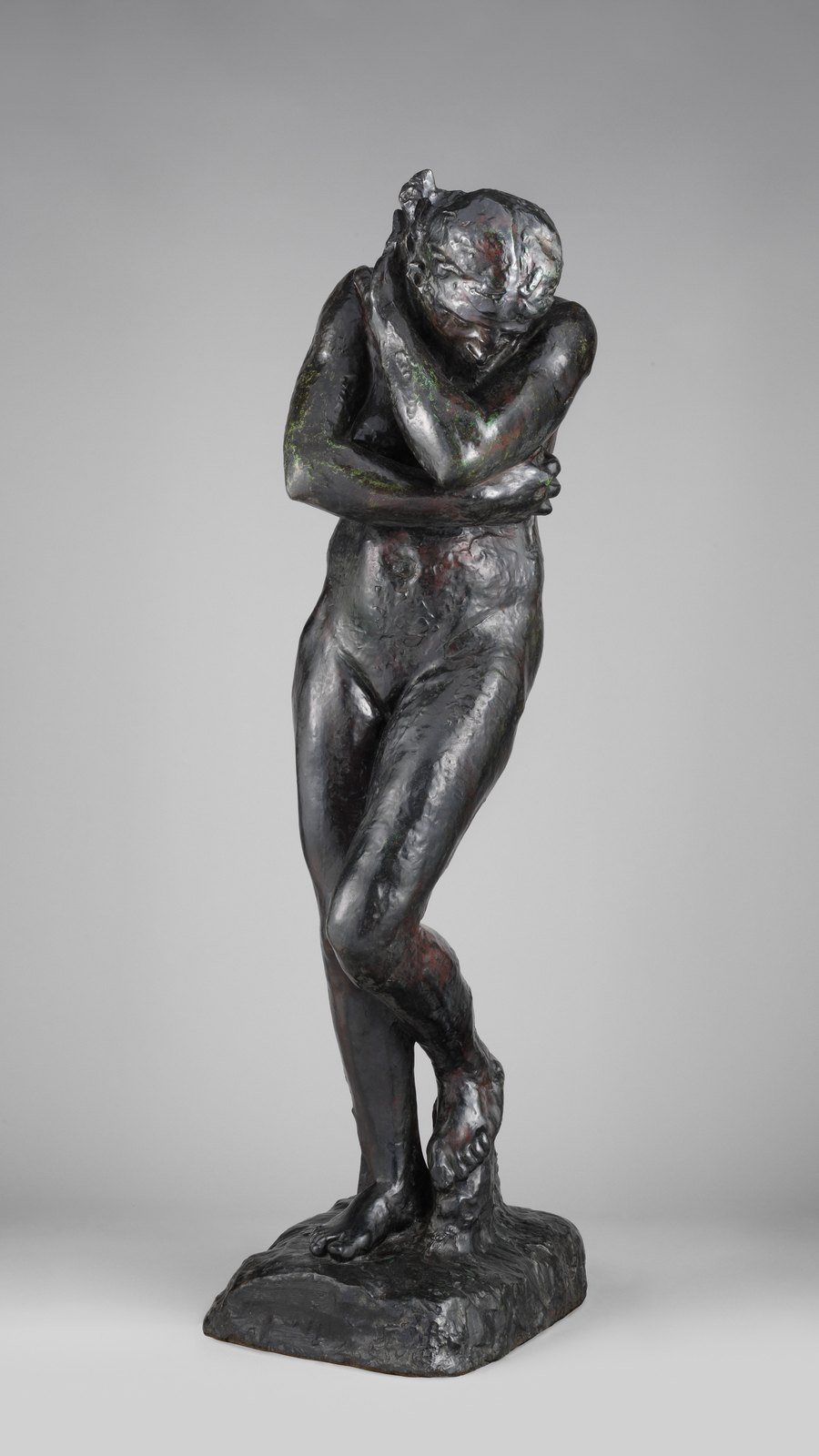
The Met’s Eve gives a view of the closed pose conceived as a counterpart to Adam. The Metropolitan Museum of Art, Gift of Thomas F. Ryan, 1910, 11.173.2. Image source. CC0 / Public domain.
There is also a more specific resemblance between the sculpture and Michelangelo’s Eve in the Expulsion from Paradise on the Sistine Chapel ceiling. The Musée Rodin points to the way the woman in that scene recoils and protects her face. Rodin concentrates the action in a single standing body. The raised forearm, bowed head and narrow stance make her response intelligible without an angel beside her. Seen with Adam, the two figures register bodily distress in different directions. His long arm reaches down and away across the front of his body, while hers leads up towards her head. The contrast would have mattered across the large gap formed by the doors. [1] [2] [7]
The large figure and its unfinished surface
The Musée Rodin explains that work on the large figure stopped when the pregnant model could no longer pose. Rodin presented the unfinished figure publicly in 1899. The museum points to uneven modelling and a trace of the armature at the right foot as evidence of an interrupted working process. An armature supported the soft material while he was modelling it. Such a trace helps explain why the large bronze can retain evidence of the making of the figure even after the original model was translated into a durable material. [3]
The scale of the large figure makes the folded arms especially striking in person. At about the height of an adult, the shoulders and face invite the viewer to imagine standing opposite Eve. Much of the face remains covered from the front. A step sideways offers a clearer view of some features and emphasises the turn of the waist. The Metropolitan Museum of Art commissioned casts of Adam and Eve in 1910 from plasters in Rodin’s studio. It records its Eve as 174 centimetres high. A cast at the Los Angeles County Museum of Art, with a similar height, was made in 1968. [1] [5]
Watch Rodin’s sculpture up close
Five films explore Rodin’s sculpture, from his use of classical models and the figures on his monumental doorway to the work of his studio.
Auguste Rodin – Challenging Beauty
Six sculptures show how Rodin adapted classical models.
Watch on YouTubeReductions and versions in marble
The Musée Rodin separates small versions on square and round bases and a version associated with a rock. The round-base catalogue entry also notes reworking of the hair. In a smaller sculpture the degree of finish around the head and the meeting of the feet with the base can make a considerable difference to how clearly the pose reads. The National Gallery of Art in Washington holds a marble just over 76 centimetres high, commissioned by Henri Vever in 1890 and delivered in 1891. In the museum’s views, the stone gives the body a more even surface and the contrast with the rough support is visible without the sharp reflections of a dark bronze. [4] [8] [9] [10]
The dark figure in the photograph stands on a low, irregular platform. The platform and the turn of the ankles are useful points of comparison with published versions. Measurements and views of the base or its marks would help establish which cast it shows. The photograph is especially clear about the relationship between the upward gesture of the arm and the downward movement of the head. Those opposing directions continue through the enclosed upper body and the slightly unsteady step below, giving the figure its sense of recoil. [1] [4] [5]
A bronze ordered for the Musée du Luxembourg
The French state ordered its large bronze in 1911 for 6,000 francs. The Musée Rodin records that it entered the Musée du Luxembourg in 1912 and was deposited by that museum in 1918. At 174 centimetres high it is the same recorded height as the Met’s bronze, which came out of a separate order. The Paris inventory identifies its example as sand cast and locates Rodin’s signature in front of the left foot and the Alexis Rudier mark at the right rear. Those details are useful if a photograph includes the base. The size and the folded posture can establish a relationship to the large model, while the marks and the collection history help establish which object a photograph shows. [1] [11]
The near-contemporary commissions also show how the work entered public collections on both sides of the Atlantic. The Met’s collection history describes commissioning casts from the plasters in Rodin’s studio. In Paris the state order gave the Musée du Luxembourg its own example. The two bronzes belong to the same stage in the public recognition of Rodin’s work, even though each owes its place in a museum to a different transaction. They also offer a reason to look closely at the feet. Rodin’s signature on the Paris base belongs to the record of the bronze, whereas the trace described near the right foot in the museum’s guide refers back to the support used during modelling. The two kinds of mark belong to different stages of making a sculpture. [1] [3] [11] [12]
What the rock can do in marble
The Musée Rodin also records a medium-sized marble Eve on the Rock worked by the practitioner François Curillon. The identification keeps that carving distinct from the marble commissioned by Henri Vever, even while both offer a way to compare the body with a rough stone support. In bronze the contrast can depend strongly on the way the surface catches the light. In marble it can also come from the visibility of tool marks and the transition from a broadly cut base to a more smoothly described leg. Looking at one such passage helps establish where the body seems to come free of the support and where the stone still connects the two. The folded upper body can feel precarious, while the rock gives its narrow stance a broad area of contact with the surface beneath it. [10] [13]
Rodin artworks directory
Discussion
Look again at the images and ideas explored in Eve. These editorial prompts invite your observations.
Reader Insights
After reading “The gesture from the head to the feet”, what detail would you look for in the object or image?
What extra evidence would help you distinguish the artist’s choices from the effects of material, viewpoint or later display?
Join the Conversation
Share a detail, comparison or question about Eve below.
References
- Metropolitan Museum of Art. Eve, 11.173.2. View source.
- Musée Rodin. Adam. View source.
- Musée Rodin. Teacher’s guide, Eve. View source.
- French Ministry of Culture. Ève, grand modèle and related objects, Joconde. View source.
- Los Angeles County Museum of Art. Eve. View source.
- Musée Rodin, Meudon. The Gates of Hell. View source.
- Musée Rodin. The human body in Rodin’s sculpture. View source.
- Musée Rodin. Petite Ève, base carrée. View source.
- Musée Rodin. Petite Ève, base ronde. View source.
- National Gallery of Art. Eve, 2014.136.247. View source.
- Musée Rodin. Ève, grand modèle, S.01029 (LUX). View source.
- Metropolitan Museum of Art. Rodin at The Metropolitan Museum of Art, a history of the collection. View source.
- Musée Rodin. Ève, marble worked by François Curillon. View source.

 Auguste Rodin.jpg)





