


 by Tom Gurney
Tom Gurney BSc (Hons) is an art history expert with over 20 years experience
Published on June 19, 2020 / Updated on November 18, 2026
Email: tomgurney1@gmail.com / Phone: +44 7429 011000
Standing Embracing Couple, Profile View
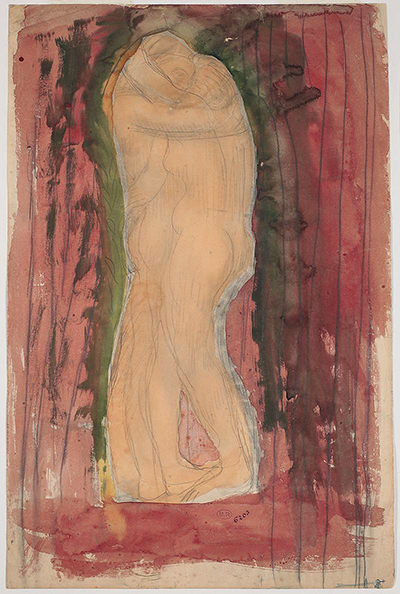
Two standing figures press together inside a pale contour in Auguste Rodin’s Standing Embracing Couple, Profile View. Their bowed heads and crossed arms are lightly drawn, while red pigment and darker strokes surround them on the rest of the sheet. The Musée Rodin dates the work to about 1900 and identifies it as D.06203. The museum proposes that Rodin traced the couple from an earlier drawing now in Weimar. Transferring the figures gave him room to change the world around them, and the change in colour gives the familiar outline a different force. [1] [2]
Finding the figures in the wash
The heads are enclosed by a rounded outline at the top of the pale area. Inside it, lines turn across the back of one head and pass close to the profile of the other. The features are difficult to pick out because the heads are lowered into the embrace. Immediately below, a long curve runs across the group at the level of the shoulders. It establishes the reach of an arm before the eye has identified every part of the two torsos. The pale wash extends across both bodies, allowing the narrow pencil lines to carry most of the differences between them. [1]
Below the shoulders the single outline widens and narrows as it moves down the sheet. At the right a hip projects and the contour draws in below it. Lower down it follows the bend of a leg before turning back towards the ground. Inside the pale area, several finer lines have a similar direction. Some run from the waist towards the feet, while others mark where one body passes close in front of the other. The two legs are easiest to distinguish near the base, where a small opening in the lower part of the silhouette admits a patch of red. [1]
The view from the side is responsible for much of this compression. It brings the two bodies into overlap and lets the edge of the pair do some of the descriptive work that separate silhouettes would do in a wider pose. The enclosing shape is much easier to take in at first glance than the faces or the position of each hand. Looking closer makes the small shifts in pencil more apparent. The embrace becomes legible in stages, starting with the common contour and gradually yielding the bowed heads, the bending knees and the closeness of the bodies. [1]
What the red background changes
A greenish band runs along the left of the figures and darkens where it curves over their heads. On the right, deep brown and green marks stand against a wider stretch of red. The boundaries between pigments are ragged or blurred in places, while the line around the bodies stays comparatively clear. Close to the legs the dark band thins and gives way to warmer colour. That movement brings the eye down to the red spread below the feet. The bottom margin then opens into an area where light paper shows through the strokes. [1]
Fine vertical lines run through much of the right side of the background. Some continue below the main red area where they are easier to see against the paper. Their spacing varies less than the areas of paint around them. They suggest a regular backdrop behind the curve of the bodies without clearly describing an object. The Musée Rodin compares the effect to that of a red stage curtain. The analogy draws attention to the streaks in the colour and the concentration of light on the figures. The sheet leaves the place and circumstances of the embrace open. [1]
The narrow, cool edge visible on parts of the silhouette gives the bodies additional definition. It sits between the flesh-coloured wash and the longer stretches of dark pigment. Elsewhere a border of uncovered paper has a similar effect. These details can give the appearance of a cut-out laid onto a coloured sheet. The museum instead explains the effect through Rodin’s probable use of a tracing on a fresh support. What the eye perceives as a sharp change of surface can come from drawing an outline and working around it with different densities of colour. [1] [3]
Watch Rodin’s sculpture up close
Five films explore Rodin’s sculpture, from his use of classical models and the figures on his monumental doorway to the work of his studio.
Auguste Rodin – Challenging Beauty
Six sculptures show how Rodin adapted classical models.
Watch on YouTubeA probable source in Weimar
The Musée Rodin proposes A Reef at the Bottom of the Sea–Two Embracing Figures as the source of the couple. It dates that earlier drawing between 1896 and 1900 and records its display at the Pavillon de l’Alma in 1900. A tracing would allow Rodin to carry the contours to a new sheet, preserving the configuration of the bodies while giving him freedom to alter the background. The earlier drawing’s watery setting and the red field here suggest different surroundings for a similar pose. The museum describes the connection as probable, and the dating of the two sheets leaves room for the stages of development. [1] [2]
Rodin’s experiments with transferring and rearranging figures were part of a wider practice on paper. The Musée Rodin’s exhibition Dessiner, découper documents how he could retain a figure from one sheet and use it to develop another arrangement. A pair of bodies could therefore have a history before the last application of colour. In this case the fine interior drawing keeps the earlier movement available to the eye, while the new background gives the outer silhouette more emphasis. The changes can be seen in the way the vertical field encloses the bent heads and then extends through the lower margin. [1] [3]
Materials and scale
The Musée Rodin lists pencil, stumping, soft-lead pencil highlights, gouache and watercolour on a sheet measuring 49.8 by 33 centimetres. Stumping softens and spreads pencil marks, an effect visible where the contours give way to gentle shading within the bodies. In contrast, several of the lines outside the couple remain distinct as they cross broad areas of red. The difference in handling helps the background read as a surface in its own right, while the faint lines within the figures preserve the movements of bodies seen close together. At the scale of the sheet, the bold field can be taken in from a short distance and the details of the embrace invite a closer view. [1]
Another embrace on wove paper
The Musée Rodin records a different Couple enlacé, D.04600, on wove paper. That sheet measures 32.5 by 24.8 centimetres and carries Rodin’s signature in the upper left. The museum lists graphite, stumping, gouache and watercolour. The overlap in materials makes it a comparison for how Rodin could build tone inside a contour, and the measurements give a sense of how much more space the larger red drawing gives its figures and surrounding colour. The catalogue does not identify D.04600 as a source for the red sheet. [1] [4]
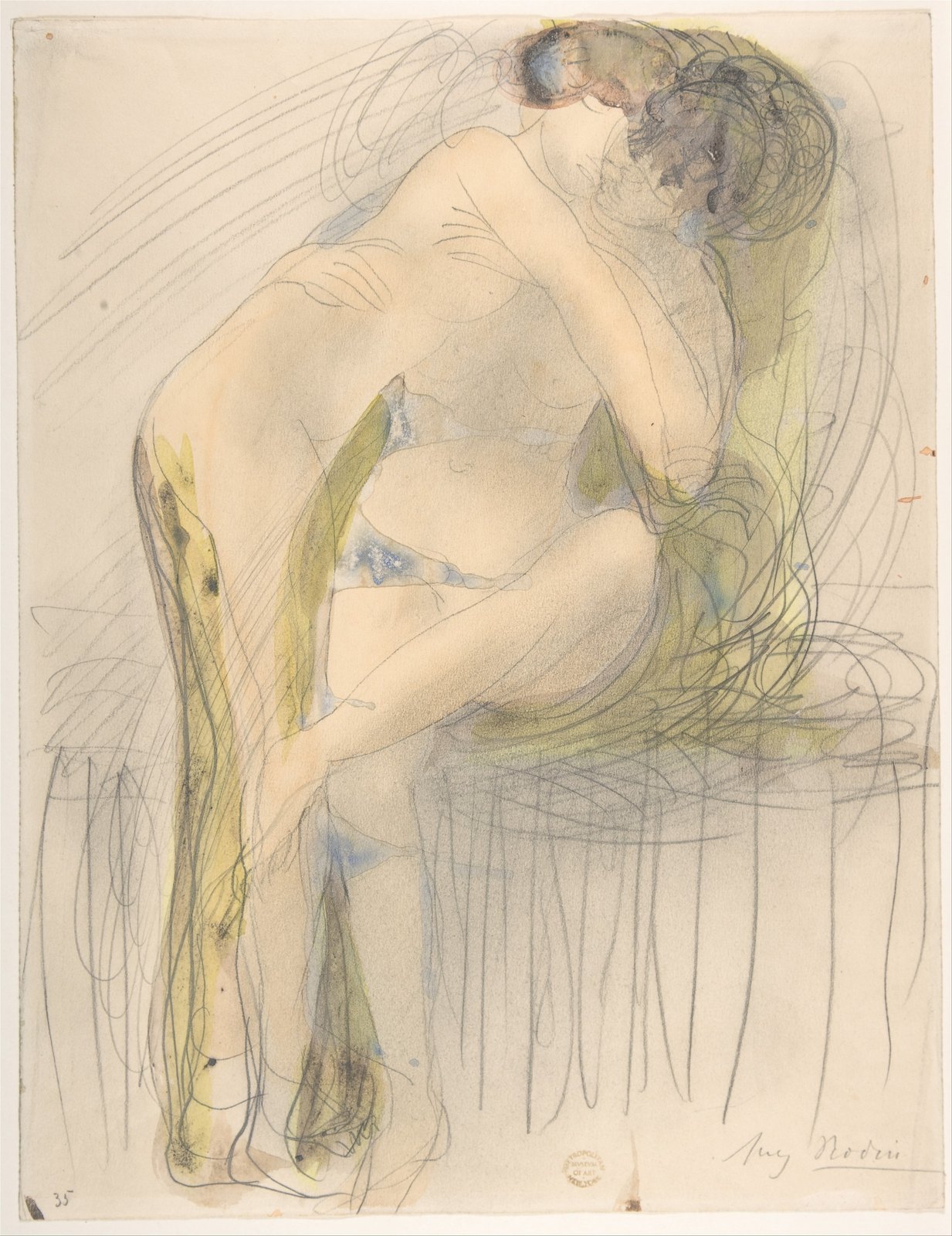
A separate sheet in the Met collection gives a comparison for the treatment of an embrace with graphite and wash. The Metropolitan Museum of Art, John Stewart Kennedy Fund, 1910, 10.66.6. Image source. CC0 / Public domain. Resized for the web.
The label Couple enlacé can describe several different points in Rodin’s drawing practice. In the relationship the museum proposes between Weimar and the red sheet, the contour of a specific pair appears to have been transferred. The smaller signed drawing provides evidence of a recurring subject and a shared range of materials. The distinction depends on the shapes, dimensions and individual records, since a title can identify the act of embracing without identifying the precise arrangement Rodin was working with. [1] [2] [4]
Rodin artworks directory
Discussion
Look again at the images and ideas explored in Standing Embracing Couple, Profile View. These editorial prompts invite your observations.
Reader Insights
After reading “Finding the figures in the wash”, what detail would you look for in the object or image?
What extra evidence would help you distinguish the artist’s choices from the effects of material, viewpoint or later display?
Join the Conversation
Share a detail, comparison or question about Standing Embracing Couple, Profile View below.
References
- Musée Rodin. Standing Embracing Couple, Profile View, D.06203. View source.
- Klassik Stiftung Weimar. Rodin’s figure studies in the Weimar collection. View source.
- Musée Rodin. Dessiner, découper. View source.
- Musée Rodin. Couple enlacé, D.04600. View source.

 Auguste Rodin.jpg)





