


 by Tom Gurney
Tom Gurney BSc (Hons) is an art history expert with over 20 years experience
Published on June 19, 2020 / Updated on November 18, 2026
Email: tomgurney1@gmail.com / Phone: +44 7429 011000
Crouching Woman
Auguste Rodin’s Crouching Woman pulls the body down towards its base. The knees rise high and the head tips out from the compact arrangement of the limbs. From behind, the back and thigh make broad curves that almost join. Turn towards the front and spaces between the arms and legs open up, bringing the hands and face into view. Rodin developed the figure in the early 1880s in connection with The Gates of Hell. It also became an independent sculpture, surviving in smaller and enlarged versions. The differences between the doorway and the freestanding figure are particularly clear at the meeting point of one hand and the opposite leg. [1] [2] [3]
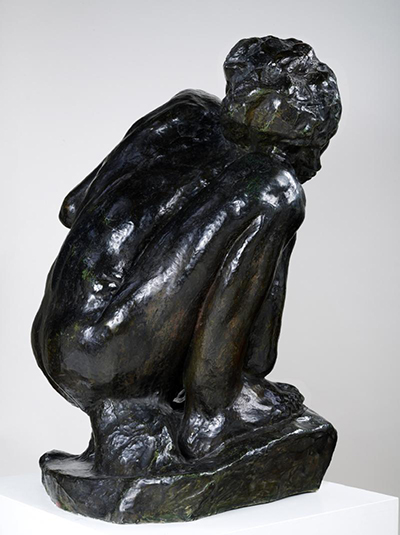
The view from behind
In the rear view, the body forms a steep diagonal up towards the head. The back opens into a large, uneven surface, while the raised leg near the viewer has a narrower band of reflected light. That band shows how closely the limb lies against the torso. The two surfaces are easier to tell apart where a shadow runs between them. Look for the point at which the line of the leg turns down again towards the base. The curve carries much of the pose, even though the hand and face that give a frontal view its character are largely out of sight. [1] [2]
The head sits high on one side. Its irregular hair interrupts the smooth sweep that leads up from the body. Seen from this position, the neck is partly obscured by the slope of the shoulders. A small projection at the other side of the outline also hints at an arm passing beyond the back. That difference between the two sides gives the group more direction than its compact outline first suggests. The shape is tightly held together around the middle, with the head and the low edges of the base pointing outward in different directions. [1] [2]
At the bottom, the edges of the bent limbs are close to the rougher modelling of the support. This makes the areas in shadow particularly helpful in working out how far the body is raised above it. A small opening near the foot appears against a much larger closed surface. From a slightly different angle that opening may disappear, with the foot and the support reading as one continuous mass. The pale display plinth visible in the photograph marks the edge of the object underneath. The darker, irregular base above it belongs to the sculptural arrangement and is involved in the balance of the pose. [1] [2]
The figure near The Thinker
The National Museum of Western Art in Tokyo compares its independent bronze with a figure in the tympanum of The Gates of Hell near The Thinker. On the doorway, the left leg extends farther down, and the right hand comes between the calf and the thigh. In the independent work the hand holds the opposite ankle. That small change is easier to follow if the rest of the pose is kept in view. On the doorway, lowering the leg changes the shape the figure makes among its neighbours. On the base, holding the ankle brings the gesture back towards the body and makes the crouch seem to tighten. [1] [3]
The French state commissioned the doorway in 1880 for a projected museum of decorative arts. The projected building never opened, and Rodin continued to develop figures for the relief and as separate sculptures. The Kröller-Müller Museum uses the title Squatting Woman for its bronze and connects the unusual pose with the expression of distress. Tokyo’s account instead finds something like sleep in the independent figure. Both responses can begin with the lowered body and the disappearance of several limbs into its mass. Turning the sculpture in the imagination, or comparing museum photographs, helps show where the tense bends and possible moments of rest are found. [1] [2] [3]
Watch Rodin’s sculpture up close
Five films explore Rodin’s sculpture, from his use of classical models and the figures on his monumental doorway to the work of his studio.
Auguste Rodin – Challenging Beauty
Six sculptures show how Rodin adapted classical models.
Watch on YouTubeThe pose turned over
The Musée Rodin also identifies the figure within the two-person group I Am Beautiful. There a man derived from The Falling Man lifts the woman, and Rodin turns and gathers her pose. The bodily action changes because the arrangement no longer rests on the crouching woman’s own base. Her limbs belong to a shape being carried by another body. The Musée Rodin links the independent group’s title to Baudelaire’s poem Beauty. The comparison is a way to see what Rodin could change by altering the direction of a body and the source of its support. The broad folded outline remains recognisable within a very different action. [4] [5]
In the freestanding Crouching Woman, the raised knee gives something for the arms to work around. In the group the woman’s back and limbs are read in relation to the man’s hands and upright effort. A hand that closes a gap in one composition can help explain where weight is carried in another. This is one of the advantages of comparing the sculptures from angles that make their points of contact clear. The change of orientation becomes apparent through the contact before the titles supply any interpretation. [1] [4] [5]
The scale of a cast
The Hirshhorn records both a small bronze and an enlarged bronze. The dates in its larger object record distinguish the early model, the enlargement and a cast made in 1962. The Tokyo museum describes its bronze as an enlargement standing 96 centimetres high and records the Alexis Rudier foundry mark at the back of the base. A photograph at the same display size can make a small and a large cast appear closely comparable. On the objects, the distance from the foot to the head has a different effect. The enlarged body allows the viewer to spend more time following the long passage from the thigh into the compressed upper figure. The small cast puts those changes in reach of a single glance. Dimensions and object marks help establish which scale and cast a photograph records. The Tokyo record places the signature on the left side of the sculpted base and the foundry mark at the back. A second view that shows the lower edge at eye level would therefore answer a different question from an image arranged to show the whole crouch. [1] [6] [7]
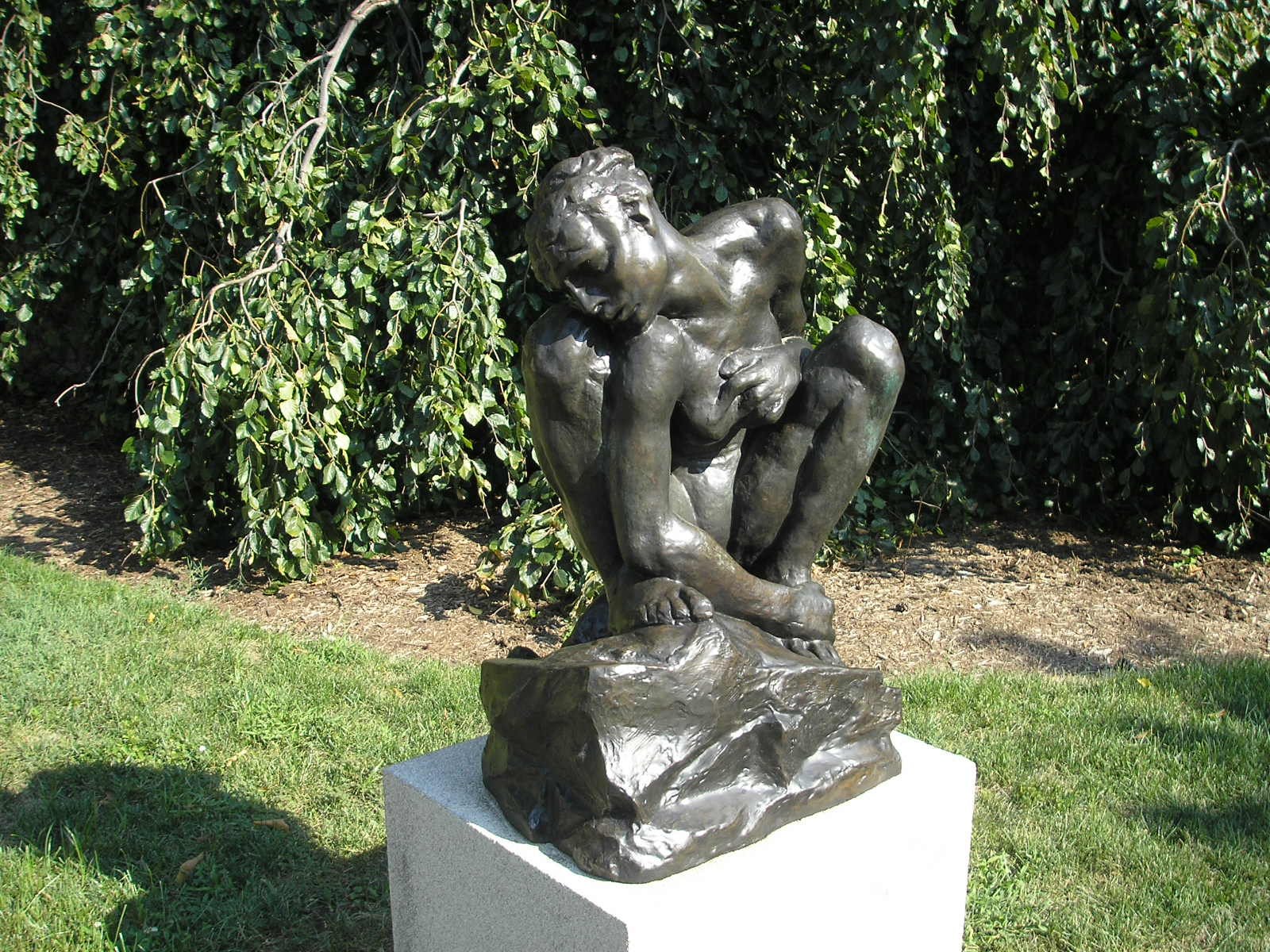
A photographed bronze enlargement gives a comparison for the compact figure developed for The Gates of Hell. Photograph by Gryffindor, Wikimedia Commons. Image source. Public domain. Resized for the web.
What the joins preserve
The Musée Rodin’s plaster of I Am Beautiful shows what it took to turn the crouching woman into a figure held above the ground. The museum records joins made with fresh plaster where the chests meet and where the woman’s right arm touches the man’s left side. It also identifies cuts and adjustments in the man’s arms. Their new positions allow them to meet and support a form that had been modelled separately. Tool marks show where the woman was removed from her base and her body was reworked in plaster. Look first at the parts that would have borne weight in the crouching pose, then at the points where the two bodies touch in the group. The joins record how the studio made the earlier pose answer to a new direction of support. [4] [8]
The Paris records also separate several objects that can look alike in photographs. A small plaster, S.01850, is dated about 1881–82 and measures 31.7 centimetres high. The large bronze S.01156 was sand cast by Alexis Rudier in 1909 and is 85.8 centimetres high. Its catalogue distinguishes the foundry mark at the right rear from Rodin’s mark inside the bronze. A third object, S.03146, is a 97-centimetre foundry plaster on a mound, executed around 1921 from a design developed earlier. That working plaster and the 1909 bronze both belong to the large model. Their production dates and the treatment of the support distinguish them even if a photograph leaves out the base. [9] [10] [11]
Rodin artworks directory
Discussion
Look again at the images and ideas explored in Crouching Woman. These editorial prompts invite your observations.
Reader Insights
After reading “The view from behind”, what detail would you look for in the object or image?
What extra evidence would help you distinguish the artist’s choices from the effects of material, viewpoint or later display?
Join the Conversation
Share a detail, comparison or question about Crouching Woman below.
References
- National Museum of Western Art, Tokyo. The Crouching Woman, S.1959-0020. View source.
- Kröller-Müller Museum. Squatting Woman, KM 124.044. View source.
- Musée Rodin, Meudon. The Gates of Hell. View source.
- Musée Rodin. I Am Beautiful. View source.
- Metropolitan Museum of Art. Rodin: The B. Gerald Cantor Collection. View source.
- Hirshhorn Museum and Sculpture Garden. Crouching Woman, 66.4342. View source.
- Hirshhorn Museum and Sculpture Garden. Crouching Woman (Small Version), 66.4331. View source.
- Musée Rodin. Je suis belle, assembled plaster. View source.
- Musée Rodin. La Femme accroupie, small plaster S.01850. View source.
- Musée Rodin. La Femme accroupie, large bronze S.01156. View source.
- Musée Rodin. Femme accroupie, foundry plaster S.03146. View source.

 Auguste Rodin.jpg)





