


 taken by Alphonse Eugene Druet.jpg)
 by Tom Gurney
Tom Gurney BSc (Hons) is an art history expert with over 20 years experience
Published on June 19, 2020 / Updated on November 18, 2026
Email: tomgurney1@gmail.com / Phone: +44 7429 011000
Photograph of Les Bourgeois de Calais (The Burghers of Calais) taken by Alphonse Eugene Druet
In this photograph attributed to Eugène Druet, Auguste Rodin’s The Burghers of Calais stands on a platform in front of tall windows. The figures rise from a pale rectangular base. The lower panes are partly covered, and there is light enough above the cloth to see foliage outside. The photographer has pulled back far enough for the room to frame the monument. The group’s height and the spacing of its figures can be judged against the window frames, while the folds of their robes remain visible. The Musée Rodin holds several Druet photographs of the plaster monument. They record different views, settings and sometimes different stages of the work’s display. [1] [2] [3]
The monument and the windows
The bright area at the left makes the rest of the room look particularly dark. A raised hand and the top of a head lie close to the edge of this brighter area. Near the middle, a figure brings a bent arm up beside his lowered head. At the right, a more upright man faces out, broadly framed by his cloak. These three gestures make a sequence across the image. The left hand reaches out into the space between the sculpture and the window. The middle arm turns back towards a body. On the right the hands hang low, with the broad surface of the robe above them. The window uprights make the smaller deviations of the heads and hands easier to see. [1] [2] [4]
The window cloth ends at a height where it overlaps the middle of the figures in the photograph. Its folds make a second set of draped surfaces behind the sculpted robes. In the room the cloth gathers and sags between points that hold it in place. On the figures, folds hang from the shoulders and bunch at the feet, taking their direction from the limbs underneath. The difference is particularly clear at the right, where the upright figure’s robe falls almost to the edge of the base. Looking between the two surfaces is a way to see how much information Rodin could give about a body while showing relatively little of its anatomy. [1] [2] [4]
The entire front edge of the pale base is visible. Its straight line helps the eye follow the light across the floor of the sculpture, and the darker support below widens the gap between it and the room’s floor. In an outdoor view of the bronze the foundation can be as important as the sky. Here the windows, the lower wall and the platform make the monument seem part of a particular interior. There is also enough space at each end for the eye to read a figure’s outer edge before coming back into the more crowded middle. The columns of the window frame help mark where the gaps actually are. At the lower right, a small foreground shape enters the frame and makes that stretch of floor recede further by comparison. [1] [2] [4]
Druet’s work with Rodin
The Musée Rodin dates the start of their work together to 1896. Druet ran a café Rodin frequented and was already making photographs when the sculptor turned to him. The museum describes Rodin’s use of photographs to study sculptures at a distance from the original and to consider alterations. A photograph taken squarely enough to show a whole arrangement would allow comparison with a view from the side or with an image taken under different light. For a group of six figures, those differences could determine whether a hand, face or bent knee was visible at all. [3] [5]
A second part of that history was exhibition. The Musée Rodin notes that Rodin displayed photographs alongside sculpture and drawings in Geneva in 1896 and again at his Pavillon de l’Alma exhibition in 1900. The photographs had a size, a surface and a viewpoint that visitors could attend to in their own right. An image of the plaster near windows would also offer a kind of evidence that a freestanding cast could not carry into another room. It preserves one arrangement of the group, its support and the light around it. Even an exhibition visitor who had just seen the work could use the photograph to notice what that particular angle brought forward. [3] [5] [6]
Watch Rodin’s sculpture up close
Five films explore Rodin’s sculpture, from his use of classical models and the figures on his monumental doorway to the work of his studio.
Auguste Rodin – Challenging Beauty
Six sculptures show how Rodin adapted classical models.
Watch on YouTubeOne composition in several photographs
The Musée Rodin records a gelatin silver print by Druet, Ph.01365, of the plaster at the Folie Payen, dated about 1896. Its sheet is vertical. Another photograph in the museum, Ph.03373, has the same place and approximate date in the catalogue, but the primary image support is considerably wider than it is high. The catalogue also records an annotation giving 1886, distinct from the date assigned to the photograph. The different formats make it worth checking the actual image before transferring details from either record to a reproduction. A date attached to a photograph may belong to the sitting, the print, the sculpture or a later inscription. [1] [2]
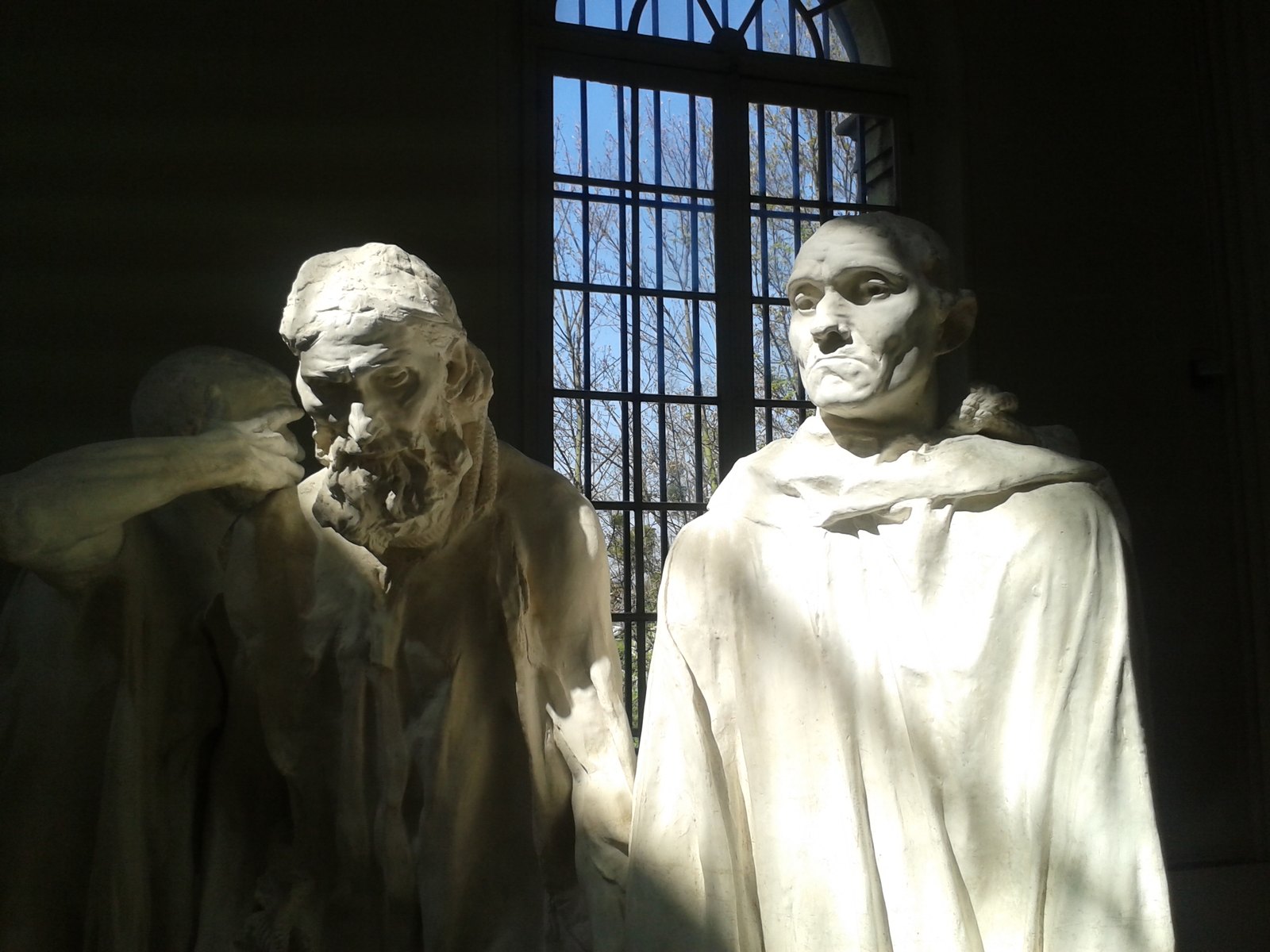
A close view of two figures at Meudon offers a comparison with Druet’s wider studio composition. Photograph by Adoc, Wikimedia Commons. Image source. CC BY-SA 4.0. Resized for the web.
The Musée Camille Claudel documents Druet views of the group at the Folie Payen and at the Pavillon de l’Alma. Other photographs in the Musée Rodin show the plaster on scaffolding in the garden at Meudon. The record for Ph.01362 dates that view to September 1913. Compared with the view before the windows, a scaffold changes both the height of the group and what appears below its feet. Such settings can change the apparent relationship between the projected movements and the ground. They also furnish clues for identifying an image before a catalogue date or location can be attached to it. [6] [7]
In the view before the windows, the group has enough space around it for the viewer to return to the broad arrangement after inspecting a face. Look at the range of heights from the base to the raised elbow, and then at how the head at the right stays clear against a dark pane. The angle leaves some figures behind others, as any single picture of the monument will. It also gives the gestures a distinct sequence across the frame. That sequence and the measured space around it belong to the photograph, preserving a way of seeing the sculpture alongside the details of the room. [1] [2] [4]
A vertical print and a panoramic print
The Musée Rodin dates two Druet prints of the plaster to around 1896 at the Folie Payen. Ph.01365 measures 40 by 29.8 centimetres and has a vertical format. Ph.03373 measures 14.7 by 36.1 centimetres on its primary support and is attached to a substantially larger mount. The wide format of the second gives more space to read across the figures. The first leaves more room above and below them, so the building and the distance to the floor can contribute to the impression of scale. The photographs share a subject and location while putting quite different bounds around what a viewer can see. [1] [2]
Jean Limet’s Ph.03229 records the plaster at the Pavillon de l’Alma in Meudon. The museum catalogues it as a 24 by 17.9 centimetre aristotype print. Its vertical format provides another comparison with Druet’s larger vertical print, while the medium and site identify a separate photographic object. The collection records thus give several ways to follow the plaster from one setting to another and to tell which part of that history a particular image records. [1] [2] [8]
Rodin artworks directory
Discussion
Look again at the images and ideas explored in Photograph of Les Bourgeois de Calais (The Burghers of Calais) taken by Alphonse Eugene Druet. These editorial prompts invite your observations.
Reader Insights
After reading “The monument and the windows”, what detail would you look for in the object or image?
What extra evidence would help you distinguish the artist’s choices from the effects of material, viewpoint or later display?
Join the Conversation
Share a detail, comparison or question about Photograph of Les Bourgeois de Calais (The Burghers of Calais) taken by Alphonse Eugene Druet below.
References
- Musée Rodin. Eugène Druet, Monument des Bourgeois de Calais (plâtre), Ph.01365. View source.
- Musée Rodin. Eugène Druet, Monument des Bourgeois de Calais (plâtre), Ph.03373. View source.
- Musée Rodin. Rodin and photography. View source.
- Musée Rodin. Monument to The Burghers of Calais. View source.
- Musée Rodin. Rodin et le marbre, section on photography. View source.
- Musée Camille Claudel. L’atelier de Rodin. View source.
- Musée Rodin. Eugène Druet, Monument des Bourgeois de Calais (plâtre) sur un échafaudage, Ph.01362. View source.
- Musée Rodin. Jean Limet, Monument des Bourgeois de Calais (plaster), Ph.03229. View source.

 Auguste Rodin.jpg)





