


 by Tom Gurney
Tom Gurney BSc (Hons) is an art history expert with over 20 years experience
Published on June 19, 2020 / Updated on November 18, 2026
Email: tomgurney1@gmail.com / Phone: +44 7429 011000
The Succubus
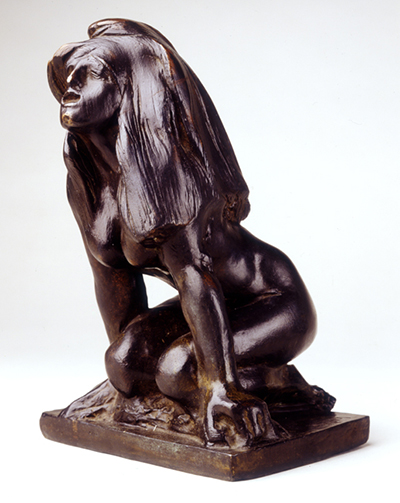
A woman kneels with both hands planted beside her and raises her face in Auguste Rodin’s The Succubus. Long hair hangs heavily around her cheeks and shoulders. Her mouth is open, and the muscles of her arms stand out where they bear down towards the base. The Petit Palais records a bronze under the title Succube and dates the work to around 1889. A Musée Rodin bronze in the French national collections database carries the alternative title Hécube aboyant, or Hecuba Barking. Both names make the open mouth important, though they lead the viewer towards different stories. [1] [2]
A pose built from points of support
The near hand rests where the rough surface beneath the figure meets the flat edge of the plinth. The fingers bend around the coarse shapes on top, making the pressure visible in a small area. From that hand the arm rises with only a slight bend, and a long highlight follows the forearm towards the shoulder. The opposite arm is set farther back in the photograph. It provides another point of support on the other side of the body. Together they make it possible for the head and chest to project in front of the hips while the figure stays close to the ground. [1] [2]
The bent legs carry much of the weight. The nearer knee makes a rounded form beside the arm, and its surface catches a small patch of light quite separate from the highlights on the upper body. Farther back, the curve of the hip occupies a large share of the silhouette before narrowing sharply into the base. The angle of the photograph makes the hip seem to draw away from the rising face. In the Petit Palais views from behind, the relation of the hips to the folded legs is clearer. The figure seems compact from that position, with much of its extension concentrated in the arms and the head. [1]
The break between the rough surface and the straight sides of the plinth matters at this scale. The flat edge gives the eye a level from which to measure the rise of the arms. Above it, the irregular ground interrupts the outlines of the fingers and feet. The smooth curves of the knee and forearm are comparatively easy to trace. A view from slightly higher up makes the knees appear more deeply enclosed by the arms, while a view from nearer the level of the hands emphasizes the height of the face above them. [1]
Hair, face and the sound implied by the pose
Rodin drew the hair into long strands that descend close to either side of the face. The hair on the nearer side forms a broad sheet of bronze, marked by grooves that catch the light almost to the shoulder. Its weight makes the head seem more firmly joined to the rest of the composition. Against those downward lines, the chin rises and the mouth opens. The small shadow between the lips can be seen even in a reduced photograph. The eye has to move closer to make out the features above it, where the brow and the hair leave more of the face in shadow. [1] [2]
The French title Succube evokes a female demon. The alternate title recorded for the Musée Rodin bronze gives that face a different context. Hecuba, the wife of Priam of Troy, loses her human form in book thirteen of Ovid’s Metamorphoses. Her speech gives way to barking. Read in that light, the open mouth and supported crouch can suggest a person undergoing a change, while the face and hands are still recognizably human. The title directs attention to a sound that bronze can evoke through the configuration of the mouth and the strain in the neck. [2] [3]
The two titles also affect the way the viewer follows the upper body. Looking for Hecuba’s cry draws attention to the head, which appears to lift out of the downward sweep of the hair. Looking at the figure as a succubus puts more emphasis on the face emerging between the heavy locks and the directness of the upward gaze. Both interpretations depend on the close relation between the head and the supported pose. The bronze gives very little space to an imagined setting, and that leaves the hands, bent legs and face to supply the circumstances of the action. [1] [2]
Watch Rodin’s sculpture up close
Five films explore Rodin’s sculpture, from his use of classical models and the figures on his monumental doorway to the work of his studio.
Auguste Rodin – Challenging Beauty
Six sculptures show how Rodin adapted classical models.
Watch on YouTubeBronzes in Paris and Mexico City
The Petit Palais bronze, accession PPS1712, is 24 centimetres high, 16 wide and 17 deep. The Musée Rodin and the French national database document other examples around this size. The national record names Alexis Rudier as the founder of one example and notes marks at the rear of the base and inside the bronze. The Musée Rodin also records an example with a dedication to Monsieur Roux. These are ways of distinguishing individual bronzes when the general configuration of the hair, face and plinth is shared. The inscriptions that identify them can sit on surfaces outside the view normally reproduced. [1] [2] [4]
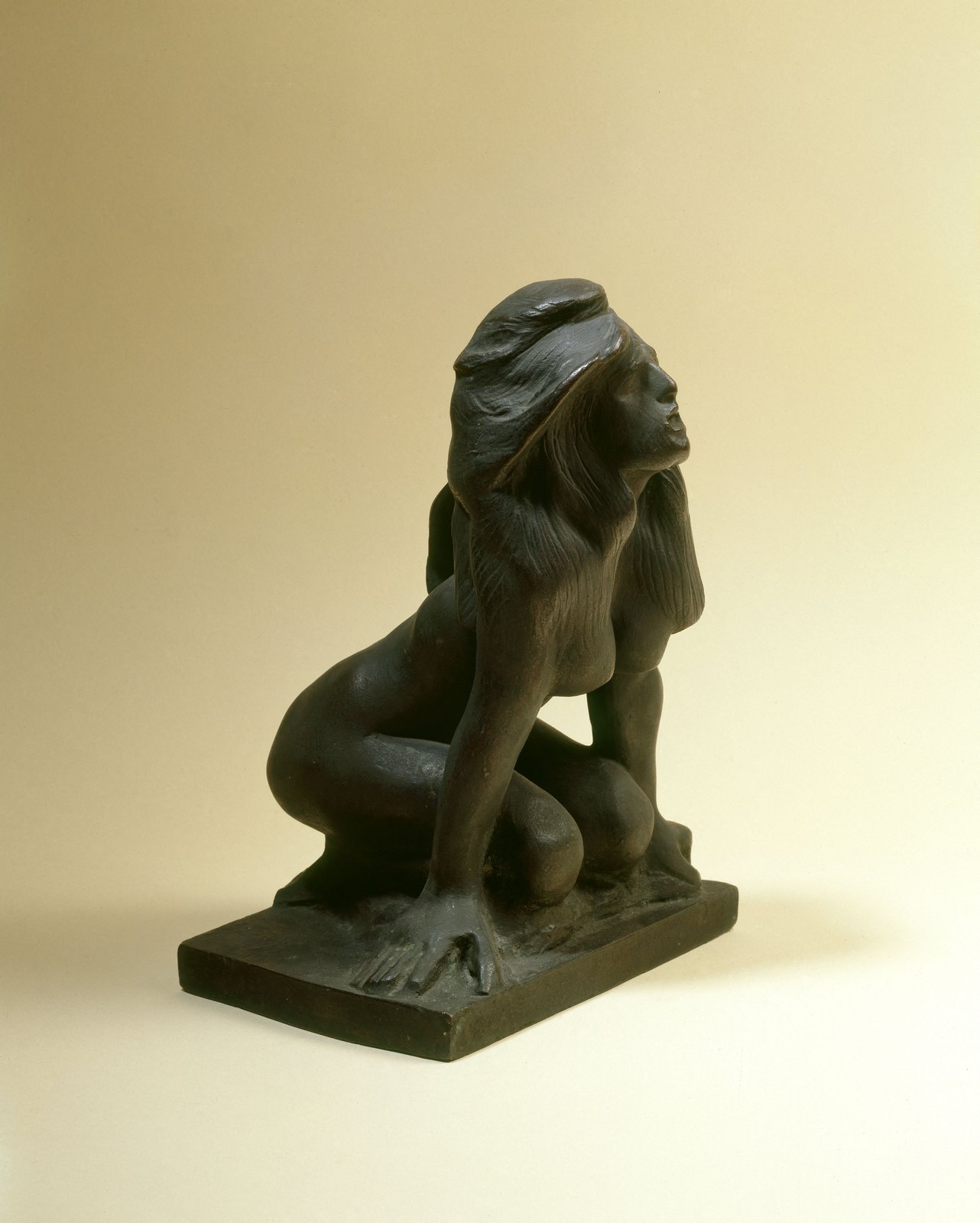
This view documents the Petit Palais bronze, PPS1712. Petit Palais, Paris Musées, via Wikimedia Commons. Image source. CC0 / Public domain. Resized for the web.
Museo Soumaya associates its bronze with the 1889 Rodin–Monet exhibition at the Galerie Georges Petit and attributes that casting to Griffoul & Lorge. Its account calls attention to the fact that a bronze cast during Rodin’s lifetime can lack a foundry mark. The appearance of the cast and its documented history can therefore be important alongside signatures and marks. In the legacy photograph the straight edges of the plinth and the hanging locks agree with the composition in the Petit Palais photographs. The colour of the metal and the direction of the light vary between views, and the image leaves the identity of the exact cast open. [1] [5]
The work’s relatively small dimensions bring the whole figure within reach of a single view. The force of the raised face is still more apparent when the spectator looks first at the hands and then follows the loaded arms upward. The rough surface underneath them and the straight edge of the base provide a measure of how far the head rises from the crouch. From the side, that ascent can be read as a continuous action from the planted fingers to the slightly open mouth. The lips sit well forward of the shoulders when seen from this angle. [1] [2]
A foundry plaster finished to look like bronze
The Musée Rodin records S.03351 as a plaster foundry model with a patina that imitates bronze. At 24 centimetres high and 17 deep, it retains much of the depth that makes the figure’s backward bend legible. The museum records Rodin’s signature on the rear right of the base. From the front, that signature disappears from view, and the finish can make it difficult to tell plaster from metal in a photograph. The catalogue establishes the material and the model’s workshop function separately from its appearance. [6]
The museum also indexes this object as a seated female nude holding her left foot, without a head. That description is useful when comparing it with the Paris and Mexico City bronzes. The head and face carry much of the expression associated with the title Hecuba Barking. The plaster allows a different reading in which the bent limbs and the point where the hand meets the foot carry the strain of the pose. The resemblance in the bodies and the difference at the neck can both be checked against the records for the individual works. [1] [2] [5] [6]
Rodin artworks directory
Discussion
Look again at the images and ideas explored in The Succubus. These editorial prompts invite your observations.
Reader Insights
After reading “A pose built from points of support”, what detail would you look for in the object or image?
What extra evidence would help you distinguish the artist’s choices from the effects of material, viewpoint or later display?
Join the Conversation
Share a detail, comparison or question about The Succubus below.
References
- Petit Palais, Paris Musées. Succube, PPS1712. View source.
- French Ministry of Culture, Joconde. Le Succube, also known as Hécube aboyant. View source.
- Ovid. Metamorphoses, book XIII, Hecuba transformed. View source.
- Musée Rodin. Le Succube. View source.
- Museo Soumaya. November 2017 collection publication. View source.
- Musée Rodin. Le Succube, foundry plaster S.03351. View source.

 Auguste Rodin.jpg)





