


 by Tom Gurney
Tom Gurney BSc (Hons) is an art history expert with over 20 years experience
Published on June 19, 2020 / Updated on November 18, 2026
Email: tomgurney1@gmail.com / Phone: +44 7429 011000
Six Studies of Cambodian Dancers
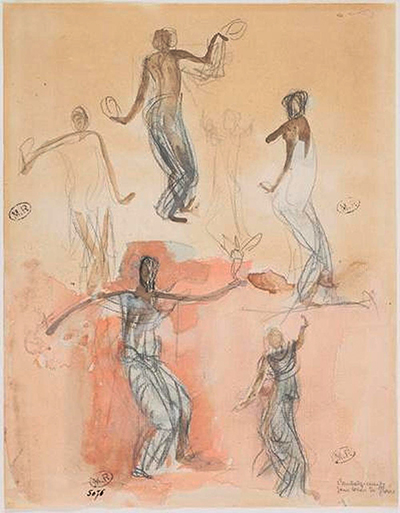
Auguste Rodin spread six studies of dancers across this small sheet in July 1906. The figure near the top lifts a bent arm while the one at lower left extends both arms. Between and around them are quieter forms, including a lightly drawn figure that is easy to miss at first. Rodin made these studies in the month he encountered the Royal Ballet of Cambodia during King Sisowath’s official visit to France. The Musée Rodin catalogues the sheet as D.05076. It records graphite, watercolour, crayon gras and gouache on watermarked paper. [1] [2]
How the figures occupy the sheet
The dancer near the top bends through the knees and lifts a forearm towards the upper right. The other arm falls towards the left before turning out at the hand. Dark marks follow the back and the line of the legs, where they bunch together close to the feet. Around the raised hand, the lines are thinner and less firmly attached to the silhouette. Rodin leaves room above and beside the arm for its movement to continue in the viewer’s eye. The dark lower body gives the pose a centre of weight from which the two arms move in different directions. [1]
At the upper left, a figure in thin lines opens one arm towards the edge of the paper. Her shoulder and neck can be seen in a few marks, while the lower body is lightly drawn over a warm area of the sheet. Still fainter strokes lie between the dark upper figure and the woman on the right. They are best seen when the eye leaves the strong outline of the body next to them. The different pressures of the drawing make the sheet possible to read in stages. It can look like a group of four clearly pronounced poses until attention moves to the less emphatic studies in the spaces around them. [1]
The figure towards the upper right rests on a slant through the legs. The dark area at the head and shoulders makes the turn of the upper body visible, while the thin lines at the shin keep part of the pose open. At lower right, another figure reaches up with a smaller gesture. Her drapery is indicated with looping lines close to the torso and longer marks nearer the legs. The two poses at the right use similar space on the page, but their arms lead the eye differently. One holds attention close to the shoulder, while the other sends it into the unmarked area above. [1]
The open arms at lower left
The figure at lower left crosses the widest field of colour. One arm stretches towards the left margin and the other extends across the middle of the paper. The knees bend below a cluster of blue-grey lines, and one foot extends beyond the other. The direction of the arms is visible from a distance, but the shift in weight becomes clearer when the eye follows the dark lines at the legs. The horizontal reach of the gesture is held above a shape that grows narrower as it approaches the feet. This difference is one reason the figure feels poised even though the lines around it keep changing direction. [1]
A red-orange wash lies behind and across parts of the same study. Its edges broaden at the waist and thin towards the margin of the sheet. The darker strokes of the legs can still be read through the shift in colour, and the wash reaches into areas the silhouette leaves empty. Above the figure, colour joins shapes that remain separate in pencil. This makes the nearest studies interact on the paper even when their bodies and gestures can be followed individually. Much of the top of the sheet remains warmer and lighter, allowing its softer marks to stand at a distance from the stronger colour near the bottom. [1]
Watch Rodin’s sculpture up close
Five films explore Rodin’s sculpture, from his use of classical models and the figures on his monumental doorway to the work of his studio.
Auguste Rodin – Challenging Beauty
Six sculptures show how Rodin adapted classical models.
Watch on YouTubeThe Royal Ballet in France
The Musée Rodin places the encounter in the context of King Sisowath’s official visit in 1906, during the period of French colonial rule in Cambodia. Rodin saw the dancers perform at the Pré Catelan in Paris and followed the troupe to Marseille, from where they were to embark for home. His studies followed an encounter with a specific royal company and its repertoire. The museum records that, in speaking about the performance, he drew on his longstanding admiration for ancient art. That comparison helps explain his response to the dancers’ movements and belongs to the language he brought to the visit. [2] [3]
The Royal Ballet’s hand gestures form part of a Khmer classical dance tradition associated with the court. UNESCO describes meaningful gestures and postures as part of the vocabulary of the dance. Cambodia’s Ministry of Culture and Fine Arts also describes sequences of gestures with distinct meanings. On Rodin’s sheet, the hands receive varying degrees of definition, from small turns at the wrist to lines that expand beyond a single contour. The drawings show how much a hand can change the direction of a pose. Their abbreviated marks provide too little evidence to assign a specific choreographic meaning to each gesture. [1] [4] [5]
One sheet among many
The Musée Rodin records other studies from the same month that gather different numbers of dancers on a page. It also holds a separate study of a dancer’s hand. Those works show how Rodin could shift his attention from the disposition of several bodies to a single part of one performer. Here, the six figures share a sheet measuring 27.1 by 21.2 centimetres. Their relative scale and the ways they are spaced make it possible to compare a lifted arm with a lowered hand or a slight knee bend with a deep one. [1] [6] [7]
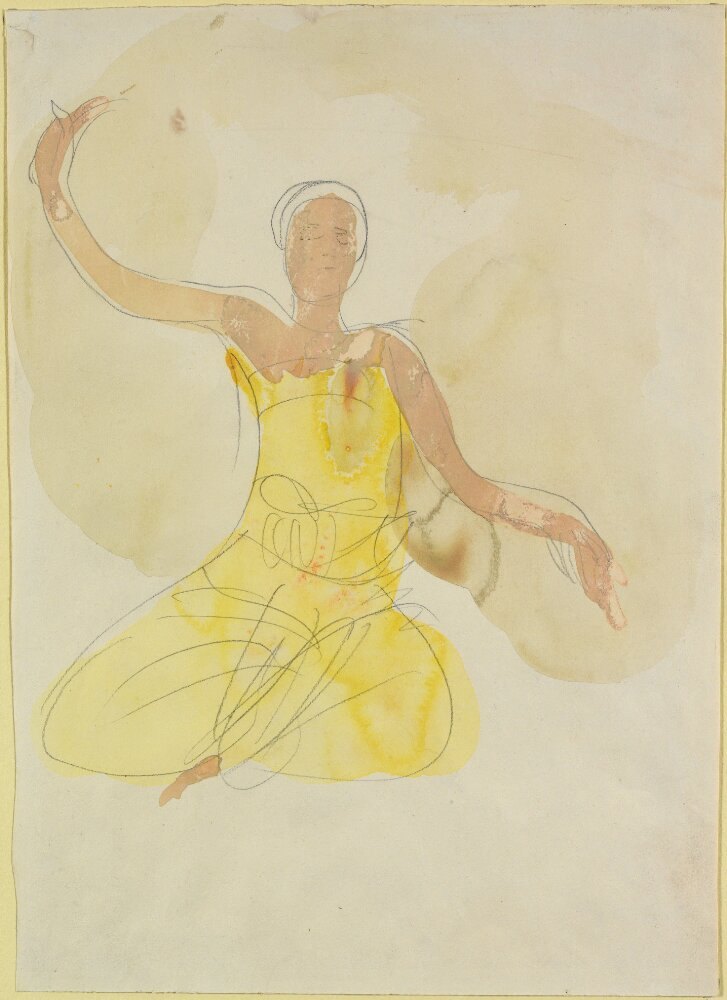
The Stockholm sheet gives one performer the space that the six-figure study divides among several poses. Nationalmuseum, Stockholm, via Wikimedia Commons. Image source. Public domain. Resized for the web.
The lower-right corner carries an annotation that the museum transcribes as Cambodgienne / pour servir de gloire. The inscription sits apart from the stronger strokes of the closest dancer. Elsewhere, the recorded number 5076 appears below the lower-left study. The quietest mark in the centre of the sheet remains nearly absorbed into the paper, while the strongest lines at the lower left gather against the red-orange wash. The differences in finish give the page a range of movements without requiring a fixed order in which to read them. [1]
Five studies on another sheet
The Musée Rodin catalogues a second sheet from July 1906, D.04457, under the title Five Studies of Cambodian Dancers. At 25 by 29.5 centimetres it is wider than it is tall. Its materials include graphite, watercolour and gouache as well as brown ink applied with a pen. The catalogue records a violet signature at the lower right and an upside-down note about a pasted arm near the centre-right. The note relates to this particular sheet. It gives evidence of how Rodin worked on an individual limb while retaining several studies on one support. [8]
Compare that note with the outspread arms on D.05076. In the six-study sheet, the arm positions help a viewer tell one movement from the next. In the five-study sheet, the note makes an arm part of the physical history of the drawing as well as part of the dancer’s gesture. Both sheets ask the viewer to consider how a small change in the direction of a limb affects the figure around it. [1] [8]
Rodin artworks directory
Discussion
Look again at the images and ideas explored in Six Studies of Cambodian Dancers. These editorial prompts invite your observations.
Reader Insights
After reading “How the figures occupy the sheet”, what detail would you look for in the object or image?
What extra evidence would help you distinguish the artist’s choices from the effects of material, viewpoint or later display?
Join the Conversation
Share a detail, comparison or question about Six Studies of Cambodian Dancers below.
References
- Musée Rodin. Six études de danseuses cambodgiennes, D.05076. View source.
- Musée Rodin. Rodin and the Cambodian Dancers. View source.
- Musée Rodin. Rodin et les danseuses cambodgiennes. View source.
- UNESCO. Royal Ballet of Cambodia. View source.
- Ministry of Culture and Fine Arts, Cambodia. Royal Ballet of Cambodia. View source.
- Musée Rodin. Quatre études de danseuses cambodgiennes. View source.
- Musée Rodin. Étude de main de danseuse cambodgienne. View source.
- Musée Rodin. Cinq études de danseuses cambodgiennes, D.04457. View source.

 Auguste Rodin.jpg)





