


 by Tom Gurney
Tom Gurney BSc (Hons) is an art history expert with over 20 years experience
Published on June 19, 2020 / Updated on November 18, 2026
Email: tomgurney1@gmail.com / Phone: +44 7429 011000
Jean d'Aire
Jean d’Aire stands upright in a long garment, holding the keys to Calais just below his waist. Auguste Rodin made him one of the six figures in The Burghers of Calais. The keys make him easy to recognise even when he is seen among the others. In the independent figure, the compact arrangement of his hands and the vertical folds below them are easier to examine. Rodin also made studies of the nude body, the head and smaller versions of the clothed figure. Those works give different views of the strength and strain he put into the finished pose. [1] [2] [3]
The keys and the folds
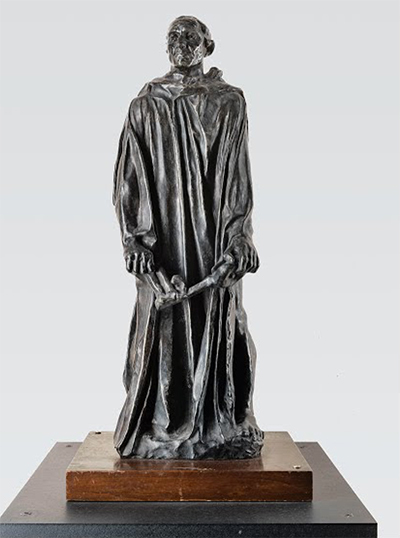
In the photograph, the keys extend across the front of the body. One hand is a little higher than the other. The keys consequently make an oblique line across folds that run almost straight down from the torso. The fingers stand out in front of the garment. Small highlights catch on the knuckles, and the gaps between them let the viewer see how closely the hands are closed. Their size gives them particular prominence below the hanging sleeves. Near the centre, a loop in the keys catches light against the dark folds, making their shape easier to distinguish from the hands. The face is much higher up, so the hands and head can be read as separate centres of expression. [1] [2]
The garment gathers near the neck and opens into broad channels. The brightest surfaces are on ridges facing the light. Behind them are long, dark spaces that narrow near the hands and widen as they approach the feet. Much of the body is described by those changes of direction. One shoulder rises slightly and leads towards the turn of the head. The other carries a sleeve that bends across the arm before dropping again. The shape of the standing figure remains clear from a distance, and at closer range the sleeves and heavy folds reveal how the posture is held. [1] [2]
At the bottom, the garment nearly meets the base across the full width of the figure. A narrow passage of light picks out the lower edge of the model where it rests on the rectangular wooden mount. The mount is wider than the figure, and its regular planes make the irregular bronze edge above it quite distinct. Neither the mount nor its height can stand in for a measurement of the sculpture itself. They do help explain why the figure can seem so tall in a frontal view. The vertical lines begin near the shoulders and continue almost uninterrupted to the bottom of the garment. [1] [4]
Jean d’Aire among the six burghers
The commission took its subject from the siege of Calais. In Froissart’s account, Edward III called for six citizens to offer themselves and bring the keys of the city. The Met’s study of the monument points out that the chronicle gives details of their clothing and the objects they carried while leaving their faces and individual gestures to the sculptor. Rodin could therefore work out how each person would bear the ordeal. Jean’s hands, level shoulders and relatively upright posture give him a different bearing from Eustache de Saint-Pierre, whose head and shoulders incline as he advances. [1] [2] [3]
The finished group, inaugurated at Calais in 1895, brings these different responses into the same space. Jean’s keys provide a reference among figures who face and move in several directions. The isolated figure allows the spectator to come closer to the place where the keys pass between the hands. In the monument a viewer moving round the group might first see the figure from the side. From that position the keys would be less immediately apparent, and the distance between his elbows and torso would have more to do with how the pose reads. [1] [2] [3]
Watch Rodin’s sculpture up close
Five films explore Rodin’s sculpture, from his use of classical models and the figures on his monumental doorway to the work of his studio.
Auguste Rodin – Challenging Beauty
Six sculptures show how Rodin adapted classical models.
Watch on YouTubeWhat the preparatory studies reveal
The Musée d’Orsay records a nude study of about 1886 on deposit from the Musée Rodin. Made in shellacked plaster, it stands 210 centimetres high. It gives a viewer access to the underlying distribution of weight, which the final garment conceals in places. Where the plaster shows the leg or the muscles of the torso directly, the clothed figure describes the supporting body by the way the fabric pulls and hangs. The method let Rodin work on the attitude of the entire figure before using drapery to sharpen its outline. [2] [5]
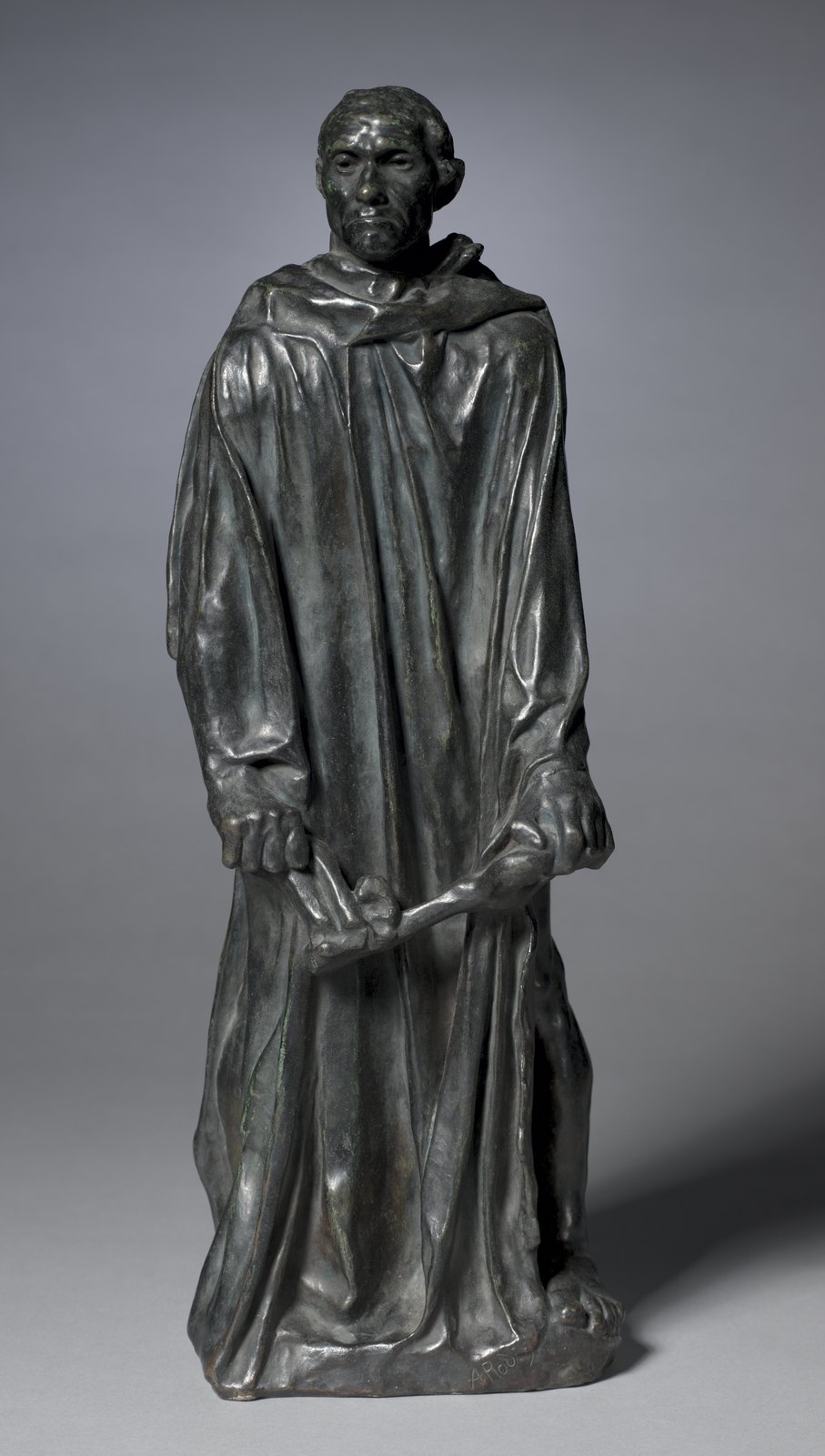
The Cleveland museum catalogues this independent Jean d’Aire as a work of 1884. The Cleveland Museum of Art, Gift of Loïe Fuller, 1917.723. Image source. CC0 / Public domain.
The Met’s Cantor catalogue compares several stages of Jean’s development. In the second maquette he stands firmly with the keys on a cushion. In a separate bust, the head is held higher than in that maquette and the jaw looks particularly resolute. These variations help explain how the final figure could express both the physical cost of the siege and the effort involved in standing upright. At the scale of the monument the head would have to remain legible across the distance between the onlooker and the figure. The position of the chin and the strength of the jaw are visible even when shadows obscure the eyes. [1] [6]
Reductions and other materials
The National Gallery of Art in Washington catalogues its separate bronze at 47 centimetres high. Mr and Mrs John W. Simpson acquired it from Rodin before 1905, and it entered the gallery in 1942. The French national collections database also records a large glazed ceramic figure dated 1900 and signed by Rodin and the ceramicist Paul Jeanneney. These two objects show how far the figure could travel from the scale and material of the original monument while retaining the keys and the long garment. In ceramic the glaze changes the way light falls across the folds. The smaller bronze brings the entire figure into view with little movement on the part of the spectator. [1] [4]
The legacy photograph shows the clothed figure with keys, on a rectangular wooden mount. Its shape offers a basis for comparison with collection photographs, although the cast is still open. A signature, dimensions or another view of the base would give stronger evidence. The frontal view gives the best account of the narrow range of motion Rodin allows the figure. The arms hang close, the hands close around the keys, and the folds below trace the upright stance to the ground. [1] [4]
Two heads in Buenos Aires
The Museo Nacional de Bellas Artes holds heads of Jean d’Aire and Pierre de Wissant. Its research department draws attention to Jean’s closed lips and fixed gaze and to Pierre’s lowered eyes and partly open mouth. The comparison lets the faces carry the distinction that in the monument is also expressed through the arms. Jean has the keys in both hands. Pierre raises one hand toward his head. In the studies, the two expressions can be read at close range without those gestures competing for attention. The tension around Jean’s mouth looks particularly compressed beside the broken line of Pierre’s lips. [2] [7]
An isolated head also changes how much of the figure a viewer has to hold in mind at once. From the front of the full sculpture the face sits well above the hands and the eye can travel back and forth between them. Put the heads of Jean and Pierre side by side and the direction of the gaze becomes one of the first differences to register. The closed mouth and outward look help explain why Jean’s upright stance can convey resolve even without the keys that identify him. [1] [2] [7]
Rodin artworks directory
Discussion
Look again at the images and ideas explored in Jean d'Aire. These editorial prompts invite your observations.
Reader Insights
After reading “The keys and the folds”, what detail would you look for in the object or image?
What extra evidence would help you distinguish the artist’s choices from the effects of material, viewpoint or later display?
Join the Conversation
Share a detail, comparison or question about Jean d'Aire below.
References
- National Gallery of Art. A Burgher of Calais (Jean d’Aire), 1942.5.13. View source.
- Metropolitan Museum of Art. The Burghers of Calais, an educator’s resource. View source.
- Musée Rodin, Meudon. Monument aux Bourgeois de Calais. View source.
- French Ministry of Culture. Jean d’Aire, figure du monument, S 152, Joconde. View source.
- Musée d’Orsay. Jean d’Aire, nude study, DO 2013 5. View source.
- Metropolitan Museum of Art. Rodin: The B. Gerald Cantor Collection, Jean d’Aire entries. View source.
- Museo Nacional de Bellas Artes. Collection research on the heads of Pierre de Wissant and Jean d’Aire. View source.

 Auguste Rodin.jpg)





