



 by Tom Gurney
Tom Gurney BSc (Hons) is an art history expert with over 20 years experience
Published on June 19, 2020 / Updated on November 18, 2026
Email: tomgurney1@gmail.com / Phone: +44 7429 011000
The Cathedral
Two hands rise from a rough piece of stone. Their wrists stand apart, their fingers bend towards one another, and a narrow opening runs up between them. It can look at first like a single person bringing their palms together. Follow the thumbs and a stranger arrangement becomes clear. Both are right hands. Auguste Rodin took forms that had belonged to separate figures and made them meet in a sculpture with enough room for an eye to pass between them. The stone gives the hands their weight, while the space they nearly enclose gives the work much of its shape. [1] [2]
Reading the two hands
The point of contact is high up. Lower down, each wrist has room to turn before the fingers come close to their companions. One palm appears to face more directly into the opening, while the other presents more of its edge from the same viewpoint. Try to reconstruct the position of the bodies to which the hands could belong. One would have to stand in a different relation to the other from the way two hands are held in prayer. That small discovery changes the gesture. It can suggest a meeting between two people or the arrangement of forms Rodin deliberately brought into relation after separating them from their bodies. [1] [2]
Turn the work in your mind, or move around it if you can. From a broad view the opening seems large enough to have a clear outer edge. Viewed more obliquely, one hand moves across the other and the gap narrows. The effect depends on the projection of fingers into space. A photograph can show a single alignment in which the hands appear almost joined. With a sculpture in front of you there is time to see where that alignment occurs and where it breaks. What looks momentarily like a closed contour separates into two forms again. [1] [3]
The rough surface is particularly important in the stone example at the Musée Rodin. Tool marks remain visible. At the base a wrist seems to push out of a mass that still carries the evidence of cutting. The fingers allow the eye to travel beyond that surface into the open space between them. From a distance the wrists carry the outline of the work. Up close there are quite different things to follow, including notches and ridges that affect where light settles. The same stone produces a sense of physical concentration at the base and a sense of delicacy at the point where the hands approach. [1] [2]
From the Ark to the Cathedral
The Musée Rodin dates the work to 1908 and records an earlier title, The Ark of the Covenant. The museum connects the later title, probably, with the publication in 1914 of Rodin’s Les Cathédrales de France. That explanation allows for the sculpture to predate the name by which it is now best known. The older title gives the enclosed space a possible association with a sacred object. The later one encourages the eye to follow the sides of the opening upward, as it would follow the supports and rising curves of a building. [1] [2] [4]
A cathedral can make visitors especially aware of the space between supports. Columns describe the width of a passage. An arch gathers their vertical lines into something that spans the air above the floor. In Rodin’s stone the rounded wrists give way to bent fingers, and the tips seem to carry the eye across from one side to the other. The space has a pointed outline from some positions and almost disappears from others. It is a temporary likeness to architecture produced by two hands, and the title invites you to discover how long you can see it as you change position. [1] [4]
Compare The Secret and The Hand of God
Other hand sculptures help make the specific arrangement clearer. Philadelphia’s Rodin Museum has shown The Cathedral beside The Secret. In The Secret, an object separates the palms. Part of the sculpture’s interest lies in what can be seen between them, and the hands direct attention towards what they enclose. In The Cathedral, the opening itself holds the eye. There is no object of comparable size between the hands to interrupt the line that runs up towards the fingers. A slight difference in distance and alignment gives the two works quite different subjects. [1] [5]
Compare the marble Hand of God at the Metropolitan Museum of Art. There the oversized hand cradles two smaller bodies, and the stone around them can be read as matter taking form. Scale establishes the relation between the hand and the people resting in it. The Cathedral gives both hands a similar importance and allows the interval between them to become one of its main features. A viewer can follow these differences without having to assume that each fragment in Rodin’s studio was made to represent an individual person. Once joined, fragments could take on relations and meanings that their original contexts had never suggested. [1] [6] [7]
A fragment could also bear a particular person's identity. The Philadelphia exhibition included Two Hands, whose Paris plaster bears an inscription associating the hands with Rodin and Rose Beuret. The association gives that work an intimate scale of meaning even when the sculpture is seen beside the other hand groups. In The Cathedral, the titles point instead towards sacred objects and architecture. The same choice of subject, hands detached from their bodies, can lead a viewer towards a pair of people, an object they hold or the space they enclose. [5]
Stone and bronze
The stone at the Musée Rodin and the bronzes in Philadelphia and Raleigh should be read as distinct objects. Philadelphia records a bronze cast in 1925. The North Carolina Museum of Art dates its Musée Rodin cast to 1955 and records 1908 as the modelling date. A window or a spotlight can make the bronze pick out different ridges from those most apparent on the pale stone. At an oblique angle a bright edge in one material may draw the eye where a dark hollow does in the other. Brighter highlights also make it easier to pick out the tips of the fingers from a dark background. [1] [3] [5]
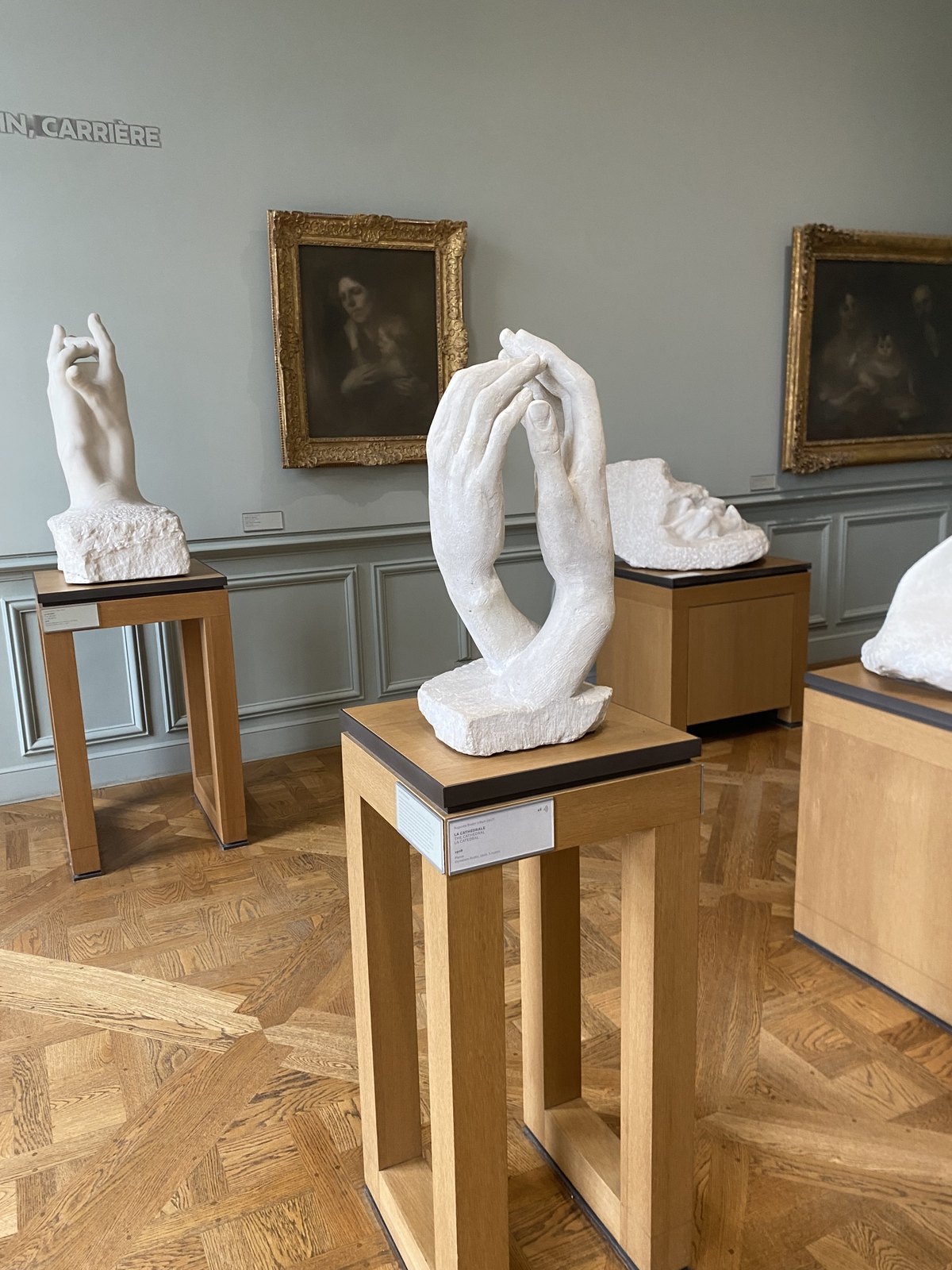
The stone in the Musée Rodin shows the opening between the paired right hands. Photograph by Phaloute01, Wikimedia Commons. Image source. CC BY 4.0. Resized for the web.
The accession, material and cast date tell you which example a museum is describing. The composition can be recognised across them because the hands continue to make the same basic demand on the viewer. Start at the base, where each form is rooted. Follow both wrists upward and see how the opening changes shape as the two sets of fingers draw together. The title may bring a building to mind. The sculpture also gives you time to notice how much the position of one hand can change what you see in the other. [1] [3]
Watch Rodin’s sculpture up close
Five films explore Rodin’s sculpture, from his use of classical models and the figures on his monumental doorway to the work of his studio.
Auguste Rodin – Challenging Beauty
Six sculptures show how Rodin adapted classical models.
Watch on YouTubeA plaster between stone and bronze
The Musée Rodin catalogues a plaster, S.03188, as a cast from a carving and as a foundry model. At 64.5 centimetres high it is close to the 64-centimetre stone. The surface is recorded as coated with a release agent. This is evidence of a further use for a form already made in stone. The plaster could carry the arrangement of the fingers and the hollow between the wrists into foundry work. The stone itself preserves a different record through the tool marks left on its surface. A plaster’s catalogue can therefore explain how a carved composition was made available for casting without establishing that a particular surviving bronze was cast from that plaster. [2] [8]
One bronze made for the Musée Rodin is catalogued as cast by Georges Rudier in 1966. Its base bears the foundry name, the date in the museum’s copyright inscription and the cast number zero below the signature. At 64 centimetres it has the same recorded height as the stone. Seen from where the hands come together, its outline may give very little indication of the date or material of the object. The side of the base holds the foundry mark and the front has information about the cast. Those details distinguish the bronze both from the stone and from the 1955 bronze in Raleigh. [2] [3] [9]
The hands in Rudomine’s portfolio
Albert Rudomine’s photograph Ph.18320.1 shows the stone at the Hôtel Biron. The Musée Rodin dates the exposure to around 1940–50 and the gelatin silver print to about 1950. It records that the portfolio also includes a view of the marble Secret. The two works could thus be compared in print before the Philadelphia installation placed them in the same display. A photograph holds one shape of the opening steady. The viewer can look back and forth between two such prints without moving, whereas a step to one side of the sculpture changes the opening’s silhouette. Rudomine’s photograph documents a view of the carved object, and its place in the portfolio documents a way of seeing the hand sculptures together. [5] [10]
The Met’s Study for The Secret offers a third scale for comparison. Its bronze is only 12.1 centimetres high without the black marble base. Georges Rudier cast it in 1956, a decade before the museum cast of The Cathedral described above. The difference in height affects how directly a spectator can see down into the space held by the hands. A close photograph can make the small bronze appear to have the presence of a larger pair. Its recorded dimensions and separate base restore the conditions in which the upright forms would be seen on a shelf or support. [9] [11]
What the touring bronze could show
The North Carolina Museum of Art records a bronze cast made in 1955 from the model of 1908. Its exhibition history follows the bronze through venues in Australia and Singapore, then through galleries across the United States and Canada. The catalogue is unusually useful here because its dates follow one accessioned object, 2009.1.27. A listing of exhibitions under the title The Cathedral alone could easily conflate that bronze with a different cast or with the stone in Paris. The itinerary belongs to the bronze. The modelling date gives the earlier point at which the composition took shape. [3]
The museum's teaching guide describes the fingertips as touching, while the Philadelphia Museum's exhibition text describes the tips as about to touch. A visitor can test what each description draws attention to by moving around the work. Where one tip overlaps the other in the line of sight, the boundary looks closed. A view into the gap makes the separation easier to see. A catalogue photograph can supply evidence of a particular angle. To establish contact on a particular cast, look for a view across the fingertips that keeps both edges in sight. [12] [5]
A space shaped by several kinds of contact
The Philadelphia exhibition set The Cathedral beside The Secret and a bronze called Two Hands. The latter has a plaster model in Paris inscribed with Rodin's and Rose Beuret's names. The Philadelphia museum treats the inscription as an indication of whose hands they may be. In that work a clasp makes contact the subject. In The Secret, the intervening object helps explain the disposition of the palms. In The Cathedral the opening can be followed from the broader space between the palms to the meeting point suggested by the fingertips. The comparison shows three distinct ways Rodin made the space between hands part of the action. [5]
The same exhibition includes a cast of Rodin's right hand made from life by Paul Cruet shortly before Rodin died. Cruet put one of the small female torsos from the studio into it. The pairing is useful alongside The Cathedral because it brings together two different processes viewers sometimes describe simply as casting. One records the surface of a living hand and is then combined with a modelled fragment. In the other, Rodin arranged the right hands of two figures into a composition of their own. The life cast also gives a limit to an otherwise tempting inference. The fact that Cruet's piece is identified with Rodin's hand supplies no sitter identification for either hand in The Cathedral. [5] [1]
Arches and buttresses in the architectural drawings
Rodin studied buildings by isolating parts of them. The Musée Rodin points to drawings of porches and a belfry at Reims, the abbey entrance at Saint-Pierre d’Auxerre, and the buttress of the Château d’Ussé. A doorway or buttress offered a manageable passage of stone in which light could be seen along more than one plane. The museum dates the Reims drawing D.7717 to 1905, decades after the visit it records in 1875. Those dates distinguish his encounter with the building from the date of that particular drawing. They also help set the hand sculpture in the context of a long practice of looking at carved architecture. [4]
His 1909 article in Le Matin protested the neglect of French cathedrals and referred to the lines and shadows of their buttresses. The book Les Cathédrales de France, published in March 1914 with a preface by Charles Morice, gathered notes and drawings he had made during his visits. The hand sculpture and the book can be compared through what they ask a viewer to attend to. Light changes where each finger reveals or hides the one behind it. The outline of the enclosed space depends on where one stands, just as a drawing of part of a doorway can register a particular view into a recess. The architecture supplies a way to look more closely at the stone and its opening, without requiring the shape to be traced to one particular building. [1] [4]
Rodin artworks directory
Discussion
Look again at the images and ideas explored in The Cathedral. These editorial prompts invite your observations.
Reader Insights
After reading “Reading the two hands”, what detail would you look for in the object or image?
What extra evidence would help you distinguish the artist’s choices from the effects of material, viewpoint or later display?
Join the Conversation
Share a detail, comparison or question about The Cathedral below.
References
- Musée Rodin. The Cathedral. View source.
- Musée Rodin. La Cathédrale. View source.
- North Carolina Museum of Art. The Cathedral, bronze cast in 1955. View source.
- Musée Rodin. Sculpture and architecture. View source.
- Philadelphia Museum of Art. Rodin’s Expressive Hand Sculptures on View in Philadelphia. View source.
- The Metropolitan Museum of Art. The Hand of God. View source.
- Musée Rodin. Multiples, fragments, assemblages. View source.
- Musée Rodin. La Cathédrale, foundry plaster S.03188. View source.
- Musée Rodin. La Cathédrale, bronze S.00478. View source.
- Musée Rodin. Albert Rudomine, La Cathédrale (pierre), Ph.18320.1. View source.
- The Metropolitan Museum of Art. Study for The Secret, 1984.364.6. View source.
- North Carolina Museum of Art. The Cathedral, teaching guide. View source.

 Auguste Rodin.jpg)




