


 by Tom Gurney
Tom Gurney BSc (Hons) is an art history expert with over 20 years experience
Published on June 19, 2020 / Updated on November 18, 2026
Email: tomgurney1@gmail.com / Phone: +44 7429 011000
Jules Dalou
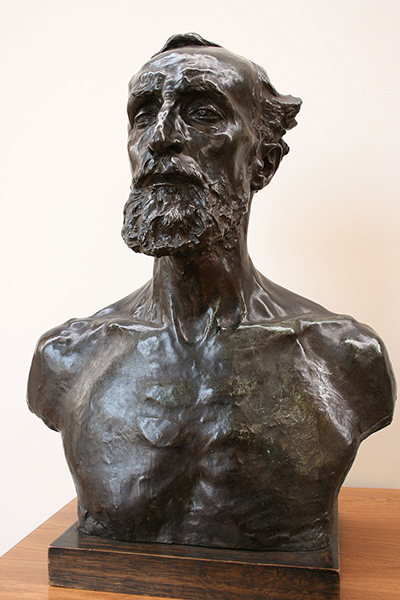
Auguste Rodin’s portrait of the sculptor Jules Dalou shows a lifted head above a narrow neck and bare shoulders. The beard casts a shadow across the throat, while the chest below catches light in broad patches. Rodin modelled the likeness in 1883, when Dalou had become an important sculptor of public monuments in France. The two men had known each other for years. The bust survives in several bronzes, including examples acquired in New York, Boston and Paris. The dates of those casts and acquisitions belong to a different part of the portrait’s history from the modelling of the face. [1] [2] [3] [4]
The face and the bearing of the bust
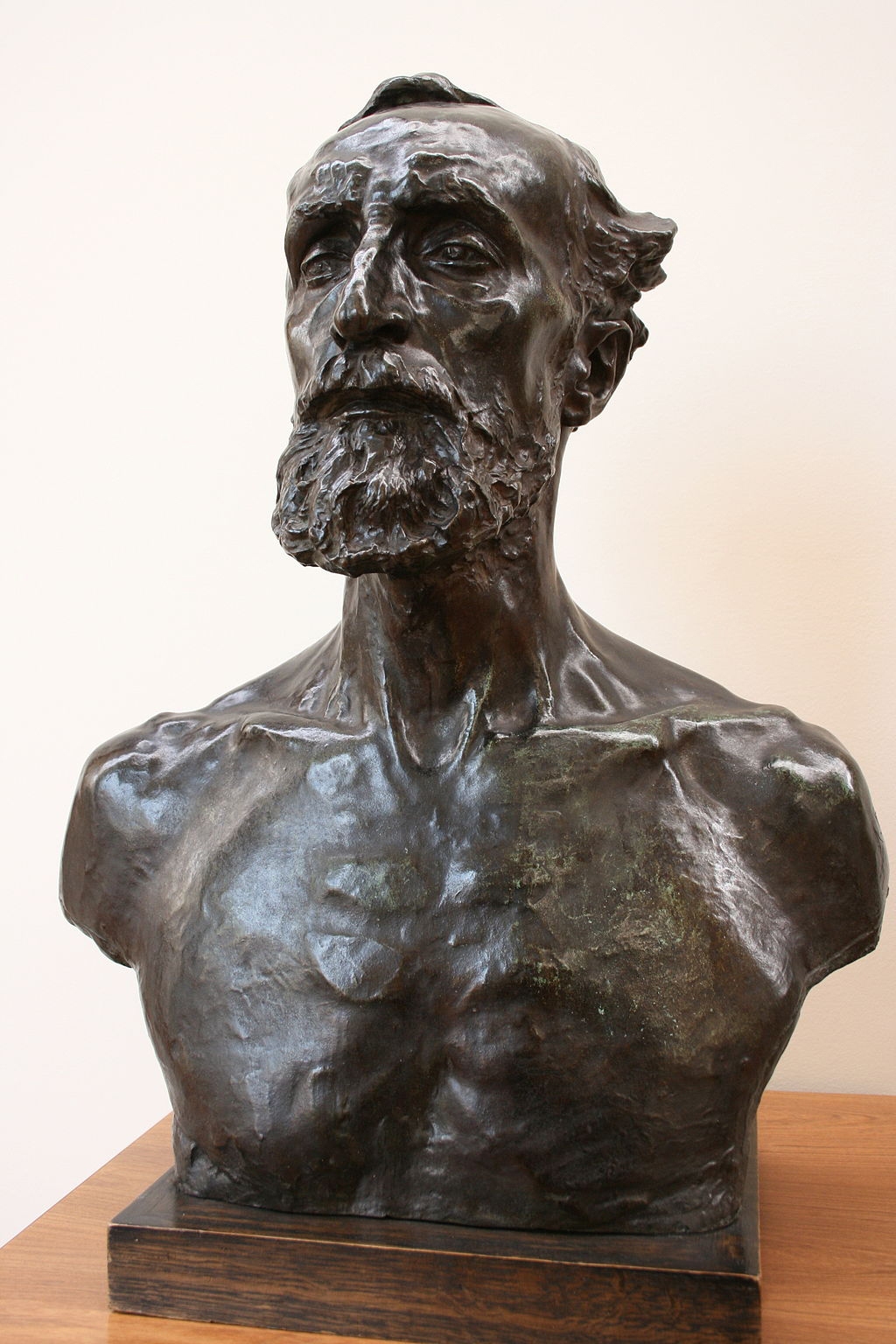
In the photograph, the centre of the face is turned slightly away from the viewer. One cheek shows a long, irregular plane from the eye to the top of the beard. The other side looks narrower, and the nose projects where it crosses that contour. Light gathers over the near brow and outlines a deep recess beneath it. Both eyes remain visible, although a slight change in angle would make their relation to the nose quite different. The head also rises above the shoulders with a backward inclination, leaving much of the neck open to view. [1] [2]
The hair at the side breaks the outline in small projections. Those uneven edges make a sharp change from the broad curve above the forehead. Follow the face downwards and the modelling becomes dense again in the beard. Short ridges catch points of light, while darker gaps make it possible to see where several locks run together. The moustache projects far enough to cast a shadow across part of the mouth. These details bring the eyes and the closed mouth into focus even though neither occupies a large area. They also make the cheeks appear more spare, because the surface around them has been worked in much broader planes. [1] [2]
The chest is particularly exposed in this view. The line of the collarbones leads from the base of the throat towards the rounded shoulders. The chest swells below it, where patches of reflected light divide it into broad, uneven surfaces. Near the lower edge the modelling darkens and gives way to the straight boundary of the bust. The wooden support in the photograph provides a second horizontal line beneath it. The torso establishes the posture from which the head rises, and the cut at the bottom keeps the viewer’s attention within that limited distance from chest to crown. [1] [2]
The larger reproduction allows a closer look at the juncture of the neck and chest. A narrow highlight runs down one side of the throat and disappears into the shadow between the collarbones. The other side of the neck is lit more broadly. This unevenness makes the turn visible even below the beard. It carries the direction of the head into the chest, where the reflections spread sideways. [1] [4]
A sculptor portrayed by another sculptor
Aimé-Jules Dalou was born in 1838. The Petit Palais places his public career in the context of the French Republic and the demand for sculpture that could serve public spaces. His work also included portraits and smaller figures. The Met’s collection history traces his training at the École des Beaux-Arts and describes him as one of the busiest sculptors of public monuments in late nineteenth-century Paris. Rodin’s portrait belongs to the period after Dalou returned from exile in England. The two men had followed different professional paths by the time the bust was modelled. [2] [5]
Rodin and Dalou had been friends before the sittings. The Met links the later rupture between them to the commissioning of a monument to Victor Hugo for the Panthéon. Rodin was still several years away from that commission when he made Dalou’s portrait. The earlier date allows the bust to be understood in the context of friendship and professional regard at the time of modelling. The head has a distinct lift and turn, and the bare shoulders leave the sitter’s profession to be supplied by the title and by the history of his work. The resemblance depends on the construction of the head and its bearing. [1] [2] [5]
The portrait also shows the value of an oblique view. Seen from directly in front, the head would occupy a more symmetrical position above the shoulders. In the photograph the nearer shoulder begins a long sweep across the bottom of the bust, while the face looks past it. The move from chest to neck to jaw gives the pose a progressive turn. The outward edge of the beard helps carry that movement beyond the shadow of the throat. [1] [2]
Watch Rodin’s sculpture up close
Five films explore Rodin’s sculpture, from his use of classical models and the figures on his monumental doorway to the work of his studio.
Auguste Rodin – Challenging Beauty
Six sculptures show how Rodin adapted classical models.
Watch on YouTubeBronzes in several collections
The Metropolitan Museum of Art commissioned its bronze in 1910. Its catalogue records the modelling date of 1883 and gives the height as just over 52 centimetres. Boston’s Museum of Fine Arts bought its bronze directly from Rodin in 1912 after showing it at the museum that year. The institutional centenary account dates that example’s casting to around 1889. These dates establish that busts based on the same early portrait could enter collections at similar times even when their production histories differed substantially. [1] [2] [3]
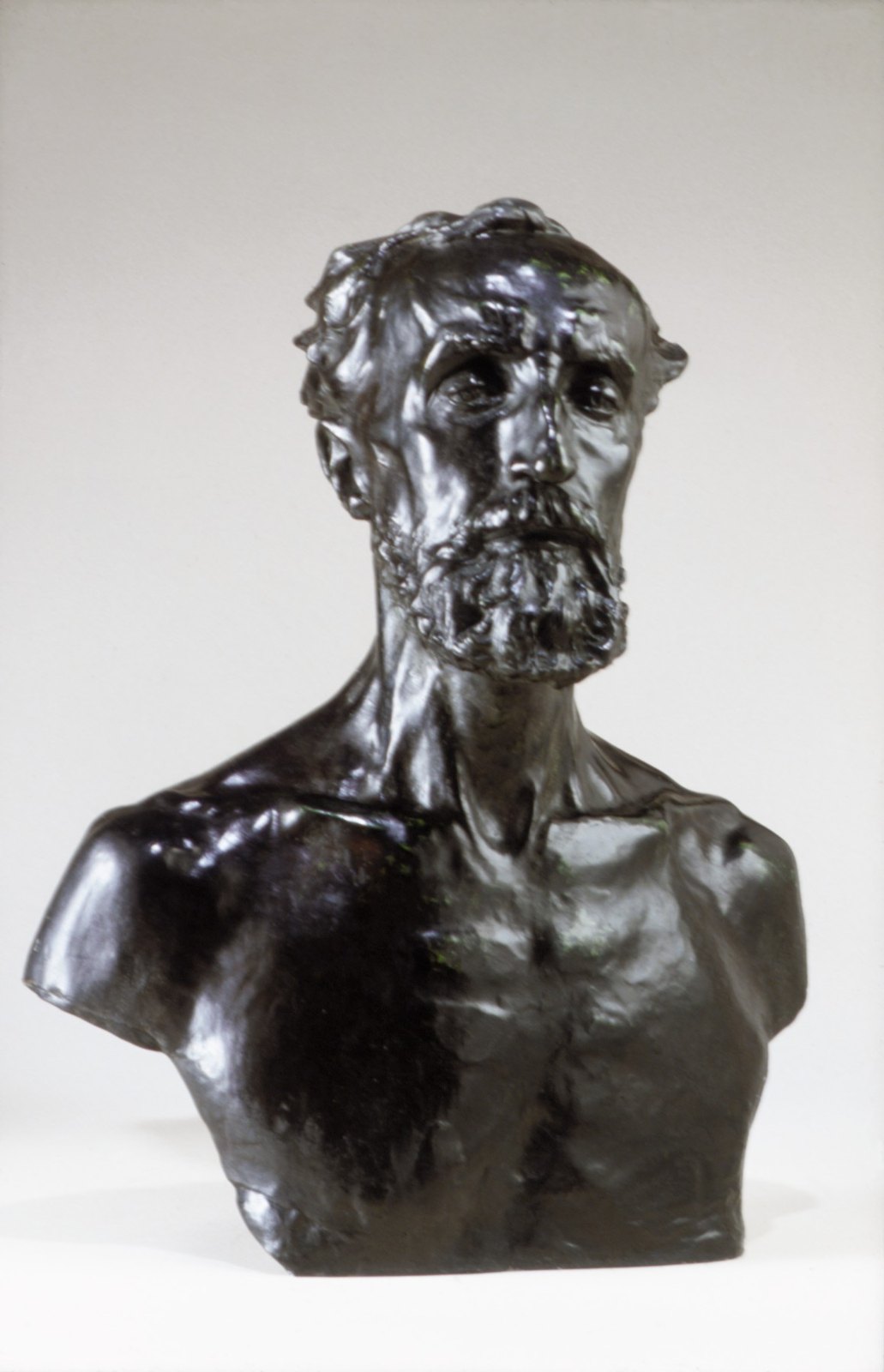
The Met’s bronze provides another example of Rodin’s portrait of his fellow sculptor. The Metropolitan Museum of Art, Gift of Thomas F. Ryan, 1910, 11.173.4. Image source. CC0 / Public domain.
The Musée Rodin records a sand-cast bronze associated with the Alexis Rudier foundry. Its entry gives dimensions for the sculpture and for the support separately. In another case, the Institut national d’histoire de l’art records a bronze made for the collector Jacques Doucet in 1907. The documented commissions and purchases help trace the portrait beyond its original purpose. Each bust carries the same likeness into a new setting, where the finish of the bronze, the type of base and the level at which it is exhibited affect how the pose is seen. [4] [6]
The legacy photograph shows a bronze bust resting on a rectangular wooden support. The exact cast remains unverified. The mount and the lower edge of the bronze are visible enough to be useful for comparing it with documented examples, alongside any foundry mark or inscription available in another view. In this view the strongest features are the lifted chin and the sweep of the shoulders. Both are legible at once, even before the closer details of the face have come into focus. [1] [4]
The state’s purchase of the portrait
The Musée d’Orsay records a patinated bronze of Dalou, RF 2244, with the Rudier foundry credited. The French state bought the portrait in 1906 as part of a purchase of eight works. The bust was entered at the Musée du Luxembourg in January 1908 under the inventory number LUX 148, before passing into the Louvre’s records in 1933. It was also listed at the Musée de l’Impressionnisme in the Jeu de Paume in 1947. These entries follow one object through several institutions and explain why a reference to the Luxembourg number and a reference to RF 2244 can refer to the same bronze. [7]
The state purchase was four years after Dalou’s death. In the museum the portrait could be seen as both a work by Rodin and a likeness of another sculptor whose monuments were familiar in Paris. Its institutional history differs from that of the Met’s bronze, although the line of the collar and the weight of the beard still let viewers compare how Rodin modelled the same sitter. [1] [5] [7]
Rodin artworks directory
Discussion
Look again at the images and ideas explored in Jules Dalou. These editorial prompts invite your observations.
Reader Insights
After reading “The face and the bearing of the bust”, what detail would you look for in the object or image?
What extra evidence would help you distinguish the artist’s choices from the effects of material, viewpoint or later display?
Join the Conversation
Share a detail, comparison or question about Jules Dalou below.
References
- Metropolitan Museum of Art. Jules Dalou (1838–1902). View source.
- Metropolitan Museum of Art. Rodin at The Metropolitan Museum of Art. View source.
- Philadelphia Museum of Art. French Sculptor Auguste Rodin Centenary Celebrated in North America, Museum of Fine Arts, Boston entry. View source.
- Musée Rodin. Buste de Jules Dalou. View source.
- Petit Palais. Dalou (1838–1902), le sculpteur de la République. View source.
- Institut national d’histoire de l’art. Dalou et Carpeaux, deux sculpteurs en buste. View source.
- Musée d’Orsay. Jules Dalou, RF 2244 and LUX 148. View source.

 Auguste Rodin.jpg)





