


 by Tom Gurney
Tom Gurney BSc (Hons) is an art history expert with over 20 years experience
Published on June 19, 2020 / Updated on November 18, 2026
Email: tomgurney1@gmail.com / Phone: +44 7429 011000
Saint John the Baptist
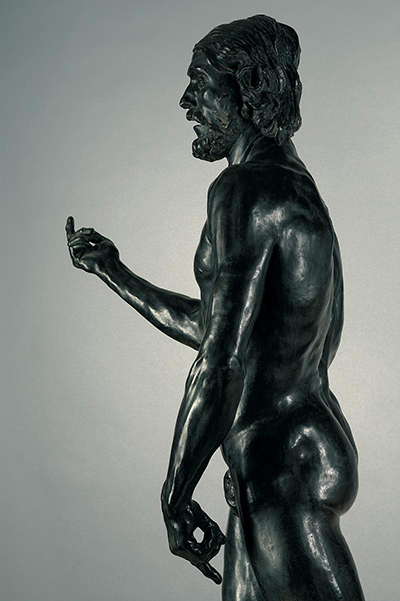
One hand speaks before the rest of the body comes fully into view. Auguste Rodin’s Saint John the Baptist reaches forward with his right arm and lifts his fingers. His other arm hangs low. Between those different gestures, the chest and head rise above widely spaced feet. You can see how far the figure has come out from its upright axis without losing its grip on the ground. From the side, where the feet separate most clearly, the gesture is already ahead of the body. Rodin makes the act of preaching visible as something a man does while moving across a space. [1] [2]
Pignatelli in the studio
In Rodin’s recollection, the model was an Italian man named Pignatelli, who came to the studio looking for work. Rodin saw something of John in his bearing. The story survives as the sculptor’s account of the encounter, and a photograph from the Musée Rodin collection has an annotation identifying its sitter as the model. This is firmer evidence of Pignatelli’s association with the work than any attempt to recover exactly how he stood when they first met. In the finished figure the stride extends over a broad base, with room for one arm to reach and the other to descend at its side. [3] [4] [5]
Rodin had encountered criticism for the lifelike appearance of The Age of Bronze, a plaster that some viewers suspected he had moulded directly on the model. The Met’s chronology connects that experience to his decision to work at a larger-than-life scale for Saint John. The increase in size also suits the subject. An outstretched hand on a figure more than two metres high can address someone across a room. A carefully observed model gave Rodin a starting point, while the size and breadth of the figure allow the gesture to be seen from farther away than one would normally stand to watch a man speak. [1] [5] [6]
A preacher without his usual attributes
There is no cross or scroll to identify the Baptist. The Musée Rodin points instead to the way the body and right hand carry the action of preaching. The saint’s face looks towards the space beyond the fingers. Seen from near the front, the arm can be foreshortened, drawing the hand and head together in your field of view. Farther round the side, its length becomes apparent. A viewer can then see that the open space between the two arms is almost as active as the limbs the sculptor has given them. The pose suggests someone making a point to people beyond the edge of the sculpture. [1] [2] [3]
There is also a difference between the story suggested by the title and the one suggested by the feet. The title gives the figure a place in Christian history. The wide stride gives it an action anyone can recognise before reading a label. Both feet make contact with the base, although the figure feels as if it is about to move. The front foot establishes where the weight could go. The trailing foot and the backward arm still carry something of where the figure has been. A view from behind brings that trailing half of the body into greater prominence, for a moment making the spread of the legs as important as the hand lifted in speech. [1] [2]
From the Salon to the museum
The early exhibition history is clearest when attached to a particular object. The Musée d’Orsay dates its bronze, RF 670, to 1878 in the catalogue and records its acquisition at the Salon in 1881. The bronze subsequently entered the Musée du Luxembourg. A studio photograph at the Musée Rodin, catalogued to around 1886, shows the work in plaster at the Dépôt des marbres. Another view places it between the Bust of Bellone and the head of The Man with the Broken Nose. Those photographs show a sculpture still living among other works in the studio after an example had already entered a public collection. [1] [3] [7]
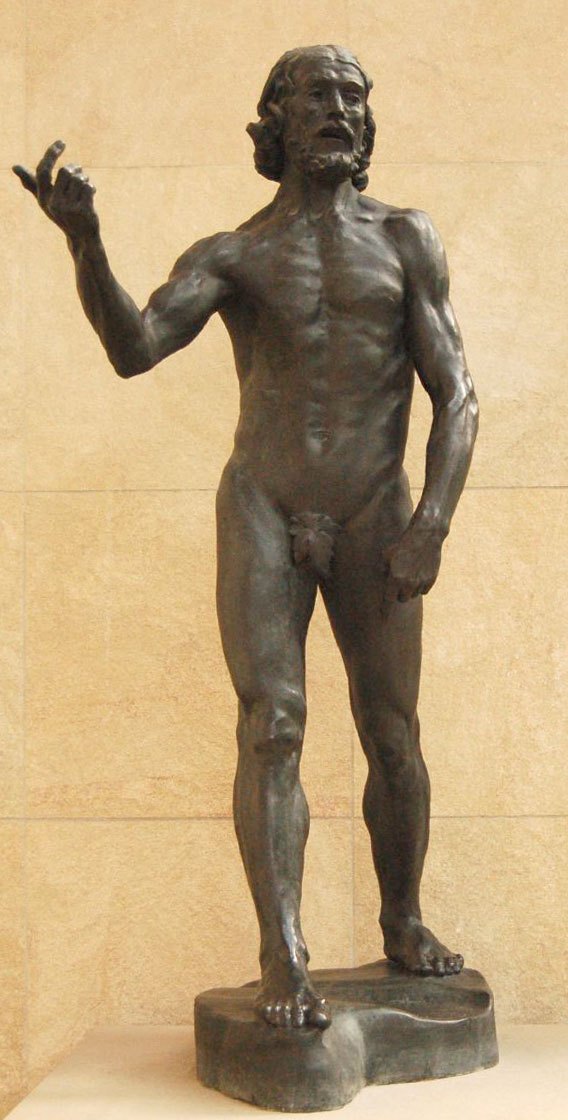
The photographed bronze shows the figure’s full stride and the raised arm. Photograph by Maarten, Wikimedia Commons. Image source. CC BY 2.0. Resized for the web.
The bronzes in the Musée Rodin and the National Museum of Western Art have casting histories of their own. The Paris bronze, S.00999, stands 203 centimetres high and was sand-cast by Alexis Rudier in 1915. The museum records it in Rodin’s 1916 donation. Tokyo’s S.1959-0052 is a 201-centimetre bronze cast in 1944 and part of the Matsukata Collection. The catalogue also records a signature on the front of its base and the Rudier foundry mark at the back. Those particulars can help identify a bronze in a collection or exhibition photograph. A date for the earlier design tells a different part of the story from the date of either cast. [2] [6]
The Philadelphia bronze adds another date to the record. The Philadelphia Museum of Art places the modelling in 1878–80 and dates its cast to 1925. Its Rodin Museum has also exhibited several sculptures of hands, including independent studies and finished groups. That context allows the raised hand of Saint John to be seen alongside forms that had to express character or suggest an action by themselves. In the complete figure, the hand gets much of its force from the long line connecting it to the shoulder and the counterweight of the other arm. [9]
What remained when the figure came apart
The body Rodin arrived at for Saint John remained available to him in separate studies. Years later he joined a torso from that period to legs from another study associated with the figure. The resulting sculpture became The Walking Man. An early plaster appeared in his 1900 retrospective, still identified in connection with Saint John. Without the head and the outstretched hand the figure has lost much of the action of speaking. The lean of the torso and the spread of the feet become the places where a viewer can look for the action instead. [8]
That change is worth following in both directions. Begin with The Walking Man and pay attention to what the head and arms contribute in the earlier work. A face gives a direction to the gaze. The raised hand projects that attention beyond the body and gives the stride something like a destination. Begin with Saint John and you can see what the later assembly brought forward from the same family of studies. The movement was already there in the distance between the feet. With the figure reduced to a torso and legs, there was room to imagine how far a single stride could carry a sculpture. [1] [8]
Watch Rodin’s sculpture up close
Five films explore Rodin’s sculpture, from his use of classical models and the figures on his monumental doorway to the work of his studio.
Auguste Rodin – Challenging Beauty
Six sculptures show how Rodin adapted classical models.
Watch on YouTubeA plaster bought in preference to bronze
The Musée d’art moderne André Malraux in Le Havre preserves a full-length plaster with gum lacquer varnish. Its catalogue dates the work to 1880 and gives a height of 203 centimetres. The acquisition took place decades later. In 1928 the curator, Alphonse Saladin, approached the Musée Rodin about buying plasters. Georges Grappe proposed a bronze of the saint, but Saladin chose three plasters, including The Age of Bronze and the Bust of Dalou, for 1,800 francs altogether. They arrived on 18 May 1929. The museum also records a comparable plaster acquired by Cambrai on the same date. [10]
The purchase shows that a plaster could be chosen for a public collection even when a bronze was available. The varnish belongs to the Le Havre object’s surface and gives the museum another way to describe it alongside cast metal. A comparison can begin at the raised fingers, where both materials preserve the outline against the air. Up close the differences in how they reflect light become part of the viewing experience. The 1929 delivery also identifies a specific plaster without requiring it to be the one that earned Rodin an honourable mention at the 1880 Salon. [1] [10]
The head exhibited apart from the stride
The Met traces the independent bust to a painted plaster shown in 1879. Its own bronze, accession 93.11, was cast in 1883 and given by Samuel P. Avery in 1893, becoming the first Rodin sculpture to enter the collection. The bust stands just over 54 centimetres high. Where the complete figure gives the head a direction established by the stride and lifted arm, the bust concentrates attention on the cheeks, the eye sockets and the turn of the neck. An audience could therefore encounter the head as an independent work before the full-length plaster was shown in 1880. Later the same subject could introduce a museum audience to Rodin on a much smaller scale than the complete figure. [5] [10] [11]
The full figure enters the Museum of Modern Art
The Museum of Modern Art dates the model to 1878–80 and its bronze to 1921. Its object number, 27.1955, records a much later stage in the sculpture’s history. The announcement issued in 1955 describes the acquisition as MoMA’s first Rodin and connects the purchase with an effort to acquire major works from the second half of the nineteenth century. A sculpture modelled before the museum existed could thus help it explain where modern sculpture had come from. The date of the acquisition belongs to that institutional history. The casting date belongs to the particular bronze and falls after Rodin’s death. [12] [13]
The bronze is just over two metres tall, and the base measures 94 by 57.2 centimetres. Those measurements are useful together. The height makes the lifted hand a gesture a spectator has to look up to follow. The base gives the feet enough room for the forward step to remain legible. From the side, the long distance between them is relatively easy to see. From closer to the front, the foot that comes toward the viewer changes the relation of the body to the ground. The same scale therefore helps to explain both the action of the legs and the authority of the upper body. [12]
The New York acquisition also makes a useful comparison with the Met’s bust. The Met received its much smaller bronze in 1893 as a gift from Samuel P. Avery. MoMA purchased a complete figure in 1955 with the Mrs. Simon Guggenheim Fund. Each institution identifies its acquisition as the first Rodin to enter its collection. For one audience that introduction was a head and upper chest. For the other it was a figure tall enough to confront visitors at the scale of their own bodies. The different objects brought different aspects of Rodin’s modelling into institutional view. [12] [13] [11]
What a sculpted step asks the viewer to supply
In its acquisition announcement MoMA quoted a discussion of how Rodin could suggest steps while the sculpture remained fixed. The two feet are separated, and the lifted arm gives the movement an additional direction. Examine the trailing leg and then the one in front. The pose can make the spectator infer the shift of weight that links them. The sculpture gives enough of that shift to be read from either leg, but the viewer has to connect those cues to see a stride. This explains why the figure can look at once firmly grounded and about to move. [13]
The raised hand adds another kind of action to the step. MoMA’s collection text points out the absence of objects traditionally used to identify the saint. The arm can therefore register first as the gesture of a man addressing someone beyond the base. The title allows that direction to become a preacher’s address. A spectator can begin with the body in motion and then see what the same pose does when understood as speech. [12] [13]
A purchase date and a casting date in the Matsukata record
The National Museum of Western Art records a purchase by Kōjirō Matsukata from the Musée Rodin around July 1921. Its provenance entry names Léonce Bénédite as the intermediary and records 35,000 francs, citing correspondence with Suzuki & Co. The museum dates the bronze in Tokyo to 1944. Read together, those entries establish an early transaction in the collection history and a later casting date attached to its surviving bronze. The purchase date alone cannot be used to date the metal. The distinction also prevents a coincidence from becoming an identification: MoMA’s bronze is dated 1921, the year of the Matsukata purchase, but is catalogued separately. [12] [2]
The Tokyo record also traces the work through French sequestration in 1944 and a transfer to the Japanese government in January 1959 before it entered the National Museum of Western Art in April. For a visitor, the front of the base bears the artist’s signature and the back carries the foundry mark. The marks help identify the object in front of the viewer. They belong with the dated provenance, which explains how a work acquired through Rodin’s museum reached a collection on the other side of the world decades later. [2]
Rodin artworks directory
Discussion
Look again at the images and ideas explored in Saint John the Baptist. These editorial prompts invite your observations.
Reader Insights
After reading “Pignatelli in the studio”, what detail would you look for in the object or image?
What extra evidence would help you distinguish the artist’s choices from the effects of material, viewpoint or later display?
Join the Conversation
Share a detail, comparison or question about Saint John the Baptist below.
References
- Musée d’Orsay. Saint Jean-Baptiste, RF 670. View source.
- National Museum of Western Art. Saint John the Baptist Preaching, S.1959-0052. View source.
- Musée Rodin. St John the Baptist, Man with a Broken Nose and the Bust of Bellone. View source.
- Musée Rodin. Pignatelli, modèle du Saint Jean-Baptiste. View source.
- The Metropolitan Museum of Art. Rodin: The B. Gerald Cantor Collection. View source.
- Musée Rodin. Saint-Jean-Baptiste, S.00999. View source.
- Musée Rodin. Saint Jean-Baptiste prêchant, studio photograph Ph.05700. View source.
- Musée Rodin. Multiples, fragments, assemblages. View source.
- Philadelphia Museum of Art. Rodin’s Expressive Hand Sculptures on View in Philadelphia. View source.
- Musée d’art moderne André Malraux. Saint John the Baptist, Le Havre plaster. View source.
- The Metropolitan Museum of Art. St. John the Baptist, bronze bust 93.11. View source.
- Museum of Modern Art. St. John the Baptist Preaching, 27.1955. View source.
- Museum of Modern Art. Acquisition announcement for St. John the Baptist Preaching, 1955. View source.

 Auguste Rodin.jpg)





