


 by Tom Gurney
Tom Gurney BSc (Hons) is an art history expert with over 20 years experience
Published on June 19, 2020 / Updated on November 18, 2026
Email: tomgurney1@gmail.com / Phone: +44 7429 011000
Alsatian Orphan
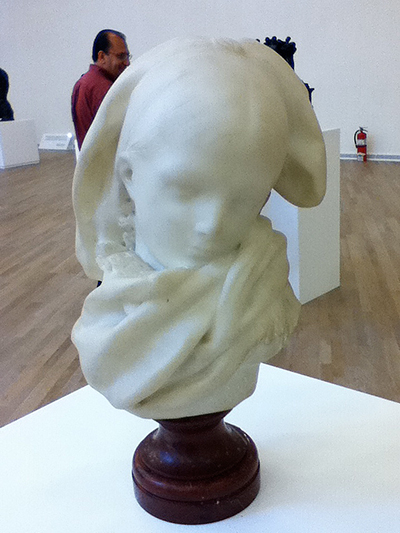
The girl in Auguste Rodin’s Alsatian Orphan seems to retreat into her costume. Her head dips within a broad headdress and her collar folds up towards her chin. Almost everything that might tell us what has happened to her lies outside the sculpture. There is no scene around her and no second figure to explain her expression. Rodin concentrates attention on the small area of the face and on the fabric that surrounds it. In the example at the Musée des Beaux-Arts de Reims, that combination gives the white marble an unusual intimacy. The work was one of Rodin’s early successes and survives in several versions. [1] [2]
A head framed by cloth
The Reims museum calls its marble Jeune Alsacienne and records Orpheline alsacienne as another title. Look first at the overall shape. The fabric spreads to either side of the upper head, while the lower part of the sculpture narrows into the gathered collar. The face occupies a much smaller space between these two areas. The inclination brings the chin near the edge of the collar and leaves very little bare neck visible. A view from the side makes it easier to see how far the head projects within the folds. From the front the headdress can seem to close around it. [1]
The delicacy of the marble depends on differences of scale. A broad part of the fabric takes the light in one sweep, while the more intricate carving along the edge breaks it up. The cheeks have much gentler transitions. Look back and forth between the edge of the costume and the contours of the face to see how the light changes where the surfaces meet. A photograph with strong overhead lighting can make the face seem more withdrawn because the upper folds cast a shadow across it. The museum’s photographs from several angles allow some of those effects to be traced back to the carving. [1]
The Reims catalogue describes the characteristic Alsatian headdress as normally having a rigid bow shape and draws attention to the way Rodin softens it. It gives the work its regional specificity and helps shape the expression. An upright head and a sharply extended bow might convey the impression of someone dressed for a public occasion. In the Reims figure the fabric slopes with the lowered head. Its edges gather the eye around the face and the upper part of the drapery. The collar contributes a second enclosing curve below the chin, where the gesture would otherwise be much less legible. [1]
An early work with a public life
The museum places the work in the period when Rodin was making a career in Belgium after the Franco-Prussian War. He had trained in Paris and worked for the sculptor Albert-Ernest Carrier-Belleuse, whom he joined in Brussels in 1871. His work in Belgium included sculpture for the Brussels stock exchange. The change of scale between those architectural commissions and a head small enough to examine at close quarters is considerable. In a building, a figure has to communicate through silhouette and position across a distance. Here even the angle at which the face meets the collar can affect how we read it. [1] [3] [4]
The two titles place different demands on the viewer. Young Alsatian directs attention to age and regional dress. Alsatian Orphan supplies a circumstance that is hard to deduce from the carving alone. In the aftermath of the Franco-Prussian War, that second title could give the child’s lowered head a public resonance. The Reims catalogue notes the patriotic undercurrent and records an exhibition connected to a benefit for flood victims in Alsace-Lorraine in 1883. At that event an already familiar design could take on an immediate association with people in need. The name of the region linked the sculpture to the occasion before anyone had looked at its details. [1] [2]
Who supplied the face is harder to establish. The Reims catalogue favours Rose Beuret, who was Rodin’s companion from 1864. It also records an unconfirmed story about a child seen by the sculptor in a procession in Strasbourg in 1863. A model and a subject can be different people, and a head worked from one person can carry details suggested by another encounter. The folds of the regional costume, the inclination of the head and the title carry much of the meaning here. The sources give those features firmer ground than either story about the sitter. [1] [3]
Watch Rodin’s sculpture up close
Five films explore Rodin’s sculpture, from his use of classical models and the figures on his monumental doorway to the work of his studio.
Auguste Rodin – Challenging Beauty
Six sculptures show how Rodin adapted classical models.
Watch on YouTubeWhy the dates on the labels differ
The Musée Rodin dates the creation of its marble’s design to before 1871 and the execution of the piece, inventory S.01399, to 1883. The national Joconde entry gives a different account, discussed below. The museum’s catalogue names Henri Trehard as the practitioner and gives the sculpture and its pedestal separate measurements. The Reims museum gives approximate dates of 1871 and 1878 for its own marble, which it associates with the same carver. These entries record the history of particular objects as well as that of Rodin’s composition. The date at which a model was available, the date a practitioner cut a particular block, and the date that stone entered a collection can be years apart. [1] [5]
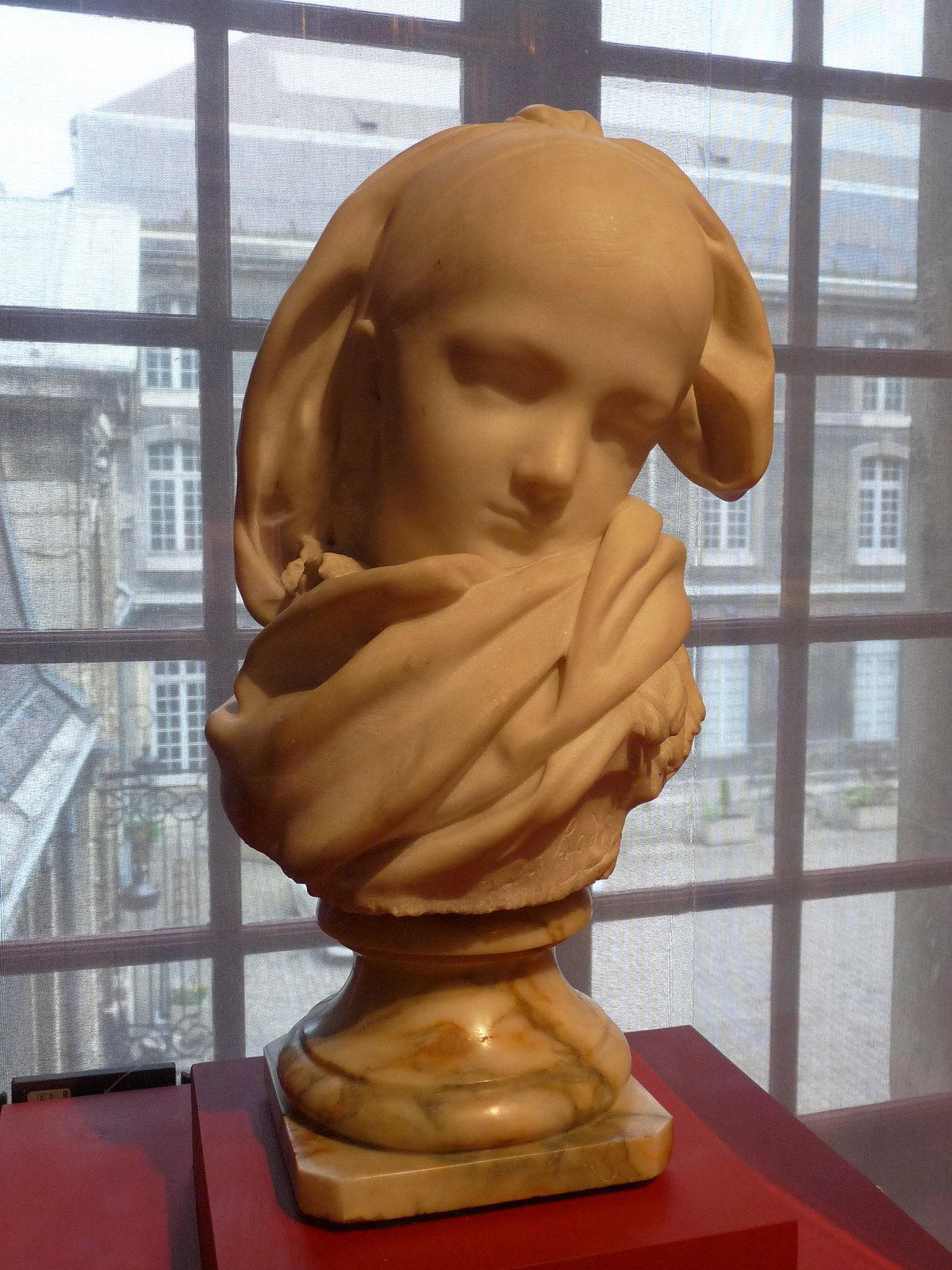
The Reims marble supplies a separate institutional example of the bust. Photograph by Ji-Elle, Wikimedia Commons. Image source. CC BY-SA 3.0. Resized for the web.
Another marble belongs to the Fondation des Artistes in Paris through the 1922 bequest of Adèle de Rothschild. The Institut national d’histoire de l’art dates it to about 1871 and discusses the possibility that it was purchased around the time of the 1883 benefit exhibition. That qualification matters because the history of the event and the provenance of the surviving object answer different questions. The Reims version entered its public collection through the bequest of Henry Vasnier in 1907. A version can thus have a documented path into a museum even when details of its early ownership remain to be established. [1] [2]
The INHA records examples of the design in terracotta and plaster as well as marble. The Musée Rodin describes the clay busts and figures that Rodin made in Belgium in the 1870s for production in multiples. The practice gives some context for the later life of this head. As it moved between materials and collections, the design remained recognisable by the bearing of the face and the silhouette of the regional costume. To compare two versions, look at the dip of the chin, the extent of the headdress, the folds below the face and the shape of the support. Those details make it possible to describe the object in front of you with more precision than the shared title allows. [1] [2] [5] [6]
Reading the signature
The national Joconde database records a marble under the same inventory number as the Musée Rodin’s S.01399, given there as S 1399. It describes the marble as carved by pointing from Rodin’s plaster and classifies the signature inscribed on the back as apocryphal. The entry gives a date after 1883 and records the object’s physical entry in 1928. These details differ from the execution date in the museum’s own public catalogue. The two records give a reader reason to distinguish Rodin’s authorship of the model, responsibility for carving a particular marble and the status of the name cut into the stone. The finding concerns this inventory number. The Reims and Rothschild marbles have their own records. [1] [2] [5] [7]
Rodin artworks directory
Discussion
Look again at the images and ideas explored in Alsatian Orphan. These editorial prompts invite your observations.
Reader Insights
After reading “A head framed by cloth”, what detail would you look for in the object or image?
What extra evidence would help you distinguish the artist’s choices from the effects of material, viewpoint or later display?
Join the Conversation
Share a detail, comparison or question about Alsatian Orphan below.
References
- Musée des Beaux-Arts de Reims. Jeune Alsacienne, 907.19.399. View source.
- Institut national d’histoire de l’art. L’Orpheline alsacienne, par Auguste Rodin. View source.
- Musée Rodin. 1840–2015 chronology. View source.
- Musée Rodin. Sculpture and architecture. View source.
- Musée Rodin. Orpheline alsacienne, S.01399. View source.
- Musée Rodin. Multiples, fragments, assemblages. View source.
- French Ministry of Culture. Orpheline alsacienne, S 1399, Joconde 000SC005952. View source.

 Auguste Rodin.jpg)





